
SEGGER Microcontroller GmbH
SEGGER J-Link BASE Classic USB JTAG/SWD Debug Probe
SEGGER J-Link BASE Classic USB JTAG/SWD Debug Probe
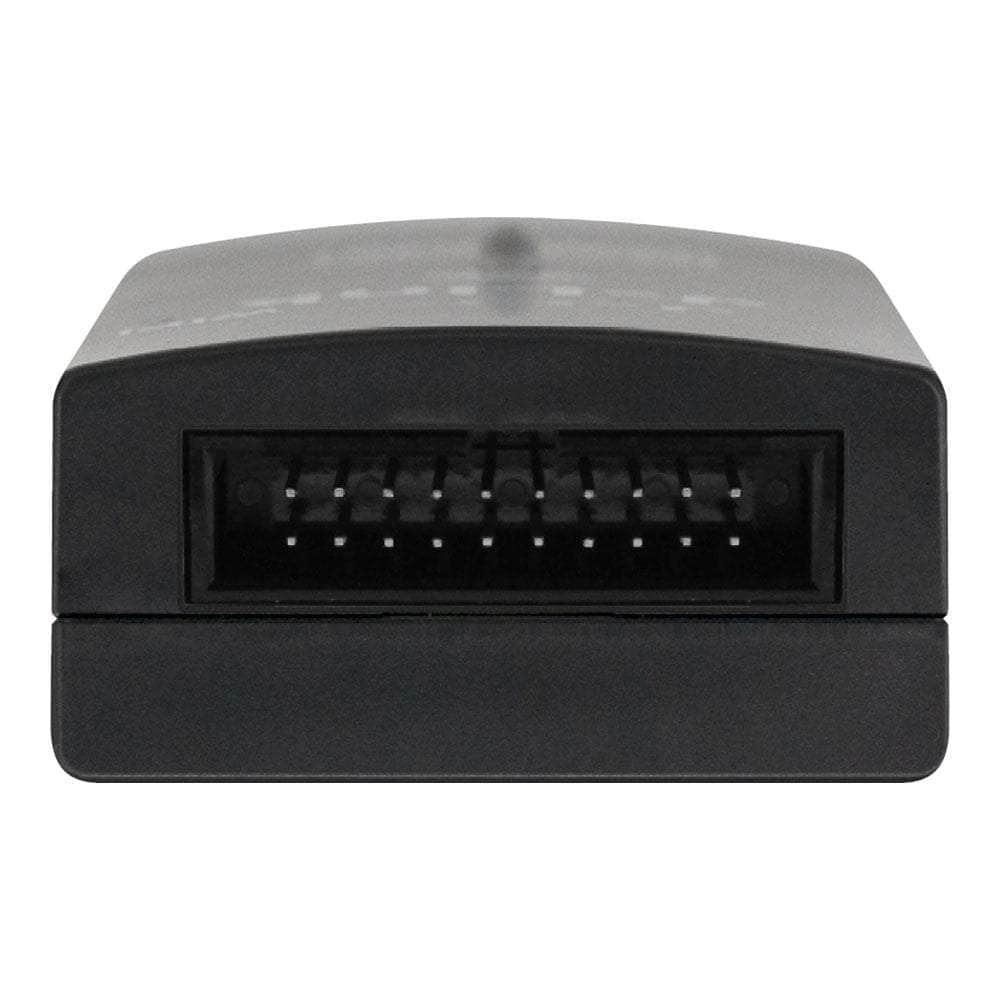
SKU: 8.08.00
Payment methods
- Bank transfer
Couldn't load pickup availability
Key Features
Overview
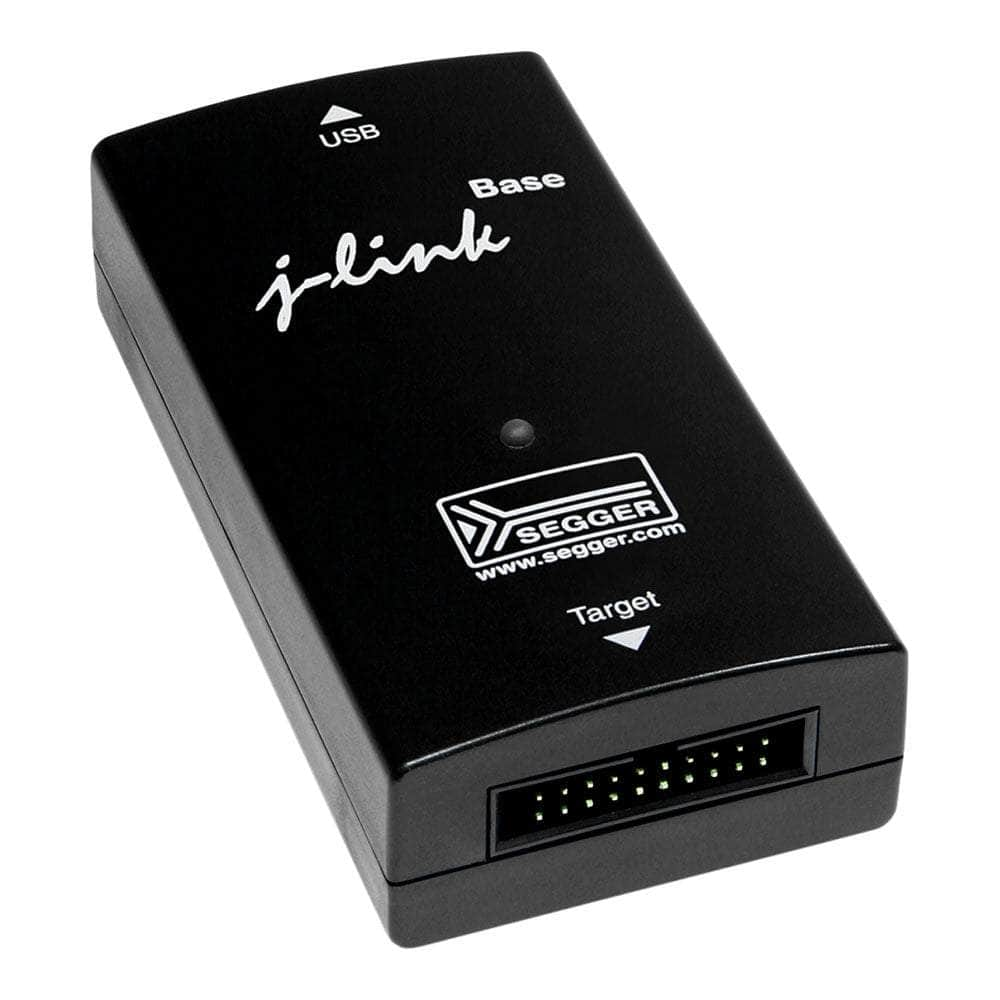
The SEGGER J-Link BASE Classic (8.08.00) is a USB debug probe for JTAG and SWD, with up to 15 MHz target interface speed and download speeds up to 1 MB/s. It connects through the standard 20-pin 0.1" J-Link connector and supports SEGGER's Real Time Transfer (RTT), plus a VCOM function that works only when debugging over SWD.
Downloads
User Manuals
- Details
 SEGGER J-Link and J-Trace
Why Engineers Choose the SEGGER J-Link BASE Classic USB JTAG/SWD Debug Probe
Standardise Across Projects
Efficient Debug I/O
Future-Proof Path
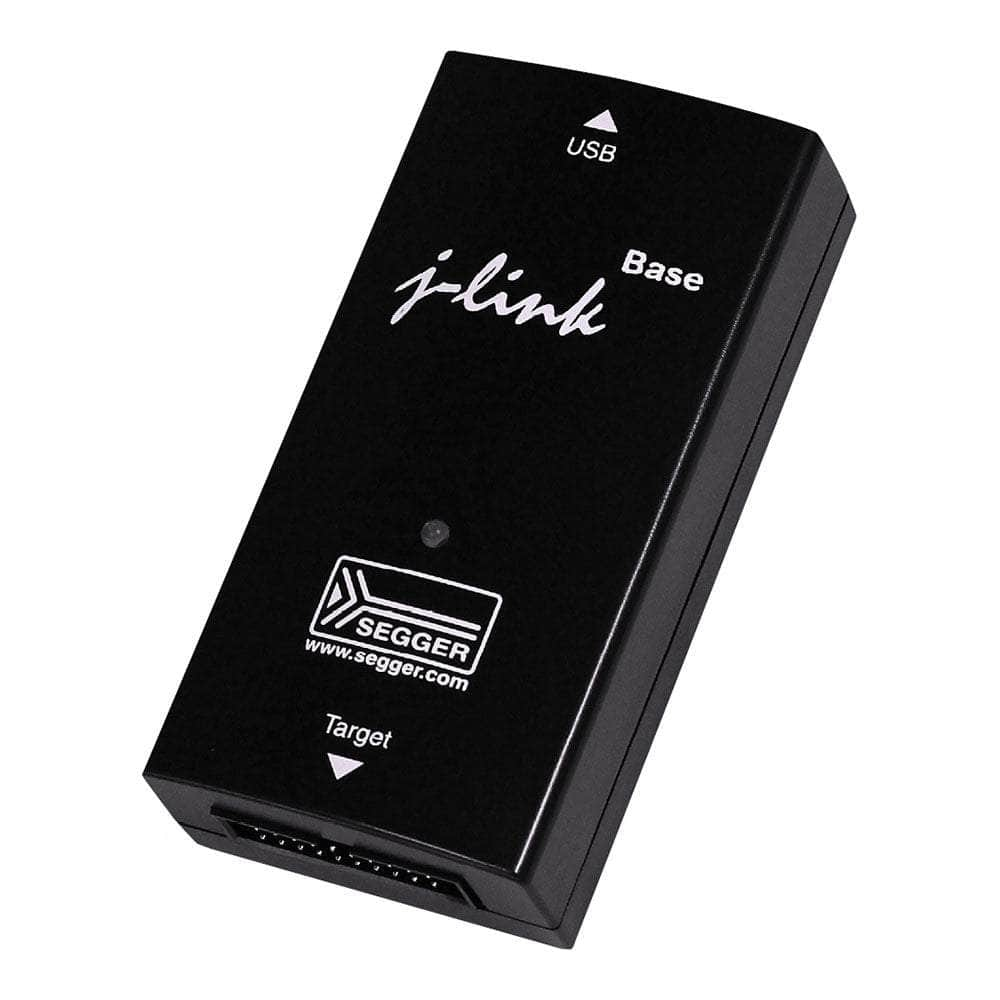
The SEGGER J-Link BASE Classic (part number 8.08.00) is a USB-powered JTAG/SWD debug probe in a 100mm x 53mm x 27mm desktop housing, with a 1.2V to 5V target interface, up to 15 MHz target interface speed and download speeds up to 1 MB/s. It has the same J-Link BASE feature set as the Compact model, with a USB Type B host port. It suits firmware bring-up and day-to-day debug at the bench on ARM Cortex, RISC-V, Renesas RX and Microchip PIC32 targets.
Desktop JTAG/SWD Debug Probe for the Bench
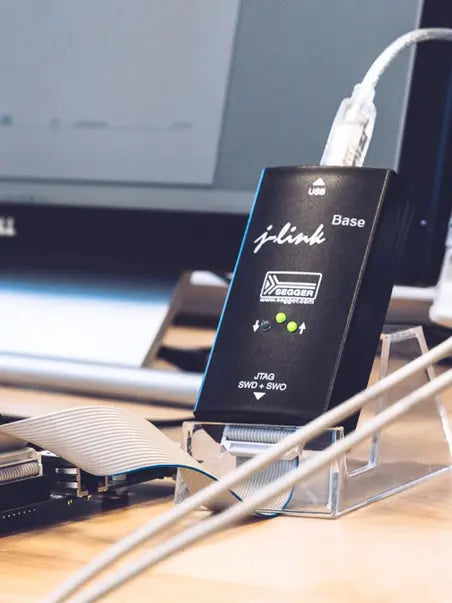
The Classic is the full-size J-Link housing, 70g without cables, built to sit beside the board on a bench. The host link is USB 2.0 Hi-Speed over a USB Type B connector, and the probe is USB powered. On the target side it uses the standard J-Link 20-pin 0.1" connector found on most J-Link models. Pin assignments and adapter options are in our SEGGER J-Link 20-pin connector pinout guide.
Target Interfaces and Supported Cores
Current J-Link BASE hardware supports JTAG, cJTAG, SWD, SWD multi-drop, SWO, SPI, Microchip ICSP, Renesas FINE and Silicon Labs C2. SEGGER's supported cores list covers ARM Cortex-M0 to Cortex-M85, Cortex-A and Cortex-R, legacy ARM7 to ARM1176, RISC-V cores from SiFive, Andes, Codasip and Nuclei, Renesas RX, Microchip PIC32 and Silicon Labs EFM8. The probe can also supply the target with 5V at up to 300mA from the USB rail.
RTT, VCOM and Trace Buffer Support
SEGGER Real Time Transfer (RTT) moves data between the running target and the host through the debug connection, so you can log or interact with an application without a spare UART. Where a UART is available, the VCOM function bridges it to a virtual COM port on the PC using pins 5 (J-Link Tx) and 17 (J-Link Rx) of the 20-pin connector; VCOM works only when debugging over SWD. Embedded Trace Buffer (ETB) and Micro Trace Buffer (MTB) are supported where the target implements them.
Software, IDEs and the Upgrade Path
The J-Link software and firmware updates are free. Setup and control software runs on Windows (x86-64 and ARM64), Linux (x86-64 and ARM64) and macOS (x86-64 and Apple Silicon). SEGGER lists full support in SEGGER Embedded Studio, Eclipse, IAR EWARM, Keil MDK-ARM, STM32CubeIDE, MCUXpresso and Visual Studio Code, among others. Several J-Links can run from one PC, each identified by its serial number.
What's Included
J-Link BASE Classic probe, 20-pin 0.1" ribbon cable (18cm) and a USB cable. No adapter for 10-pin 0.05" Cortex Debug headers is included.
Specifications
| Host interface | USB 2.0 Hi-Speed, USB Type B |
|---|---|
| Target interface | JTAG/SWD 20-pin, 0.1" (2.54mm) |
| Supported debug interfaces | JTAG, cJTAG, SWD, SWD multi-drop, SWO, SPI, Microchip ICSP, Renesas FINE, Silicon Labs C2 |
| Target interface voltage (VIF) | 1.2V to 5V |
| Current drawn from VTref | Less than 25µA |
| Target supply | 5V (derived from USB), max. 300mA |
| Target interface speed | Max. 15 MHz |
| SWO sampling frequency | Max. 30 MHz |
| Download speed | Up to 1 MB/s |
| Power supply | USB powered, max. 50mA plus target supply current |
| Dimensions (without cables) | 100mm x 53mm x 27mm |
| Weight (without cables) | 70g |
| Operating temperature | +5°C to +60°C |
| Storage temperature | -20°C to +65°C |
| Relative humidity | Max. 90% rH, non-condensing |
| EMC | EN 55022, EN 55024 |
| Host OS | Windows and Linux (x86-64, ARM64); macOS (x86-64, Apple Silicon) |
Limitations
- J-Flash and J-Flash SPI, Unlimited Flash Breakpoints, the Ozone debugger and the RDI licence pack are not included, and SEGGER lists monitor-mode debugging under the PLUS upgrade. They come with the J-Link PLUS, or with the BASE to PLUS upgrade licence for an existing BASE.
- Download speed is up to 1 MB/s; SEGGER quotes up to 4 MB/s for higher-tier J-Link models.
- No ETM trace (use SEGGER J-Trace) and no QSPI target interface.
- VCOM is available only when debugging over SWD, and it is disabled as shipped: enable it in J-Link Configurator or J-Link Commander, then power-cycle the probe.
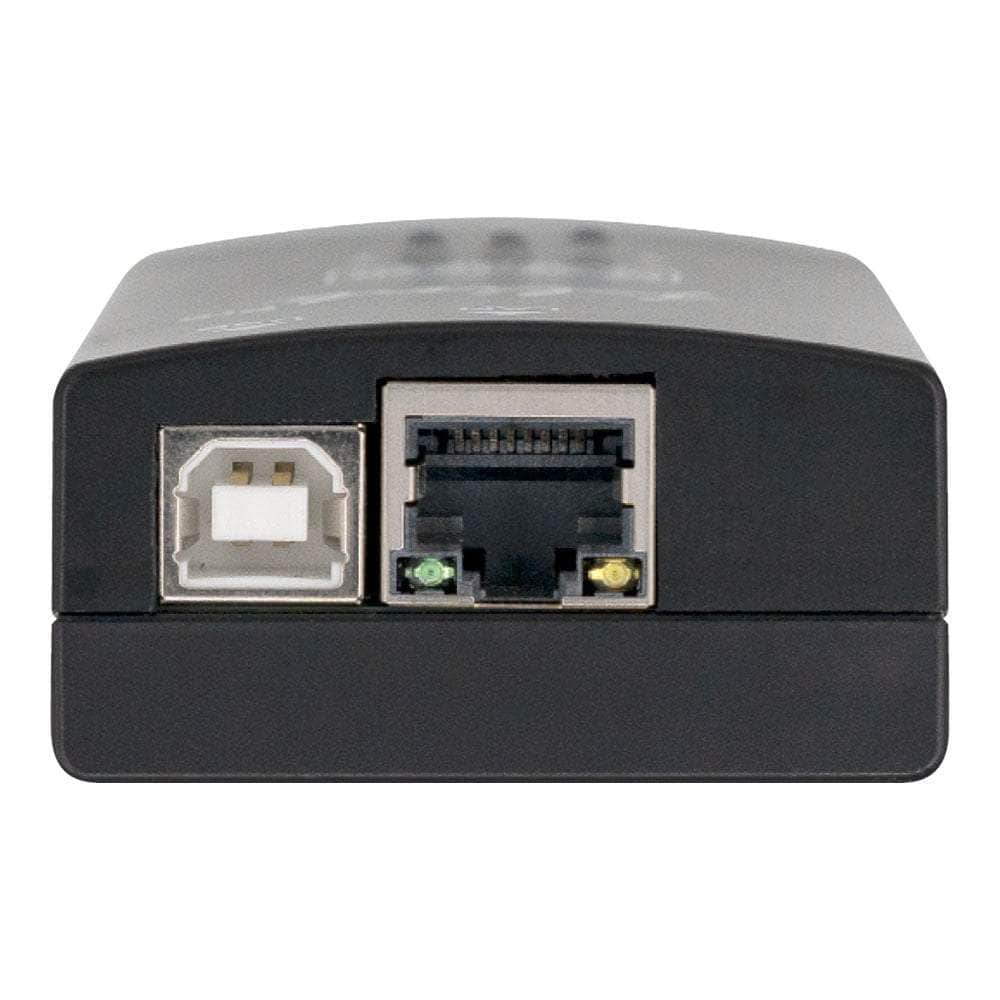
- USB only, with no Ethernet. For mounting inside a fixture, the BASE Compact has two mounting holes in a 46mm square housing.
J-Link BASE Classic Compared with Related Models
| Model | Form factor | Host connector | J-Flash, Ozone, Unlimited Flash Breakpoints | Price ex VAT |
|---|---|---|---|---|
| J-Link BASE Classic (this product) | 100 x 53 x 27mm, 70g | USB Type B | Not included | £470 |
| J-Link BASE Compact | 46 x 46 x 17mm, 20g, two mounting holes | USB-C | Not included | £470 |
| J-Link PLUS Classic | 100 x 53 x 27mm, 70g | USB Type B | Included | £660 |
| J-Link Upgrade BASE to PLUS | Licence for an existing BASE | n/a | Adds them | £320 |
Typical Applications
Flash download and source-level debug of STM32, NXP LPC and Kinetis Cortex-M parts from STM32CubeIDE or MCUXpresso. RTT logging from a target with no free UART during firmware bring-up.
Choose the Classic for the bench; for a fixture or enclosure, the Compact carries the same feature set in a 46mm square housing.
Order the J-Link BASE Classic for £470 ex VAT. Check your part number against SEGGER's supported devices list, or ask us for a formal quotation. See the full range in our SEGGER debug probes collection.
Last reviewed 16/11/2026.
| Host and Target Interface | |
|---|---|
| Host interface | USB 2.0 Hi-Speed, USB Type B |
| Target interface | JTAG/SWD 20-pin, 0.1" (2.54mm) |
| Target interface voltage (VIF) | 1.2V to 5V |
| Performance | |
| Target interface speed | Max. 15 MHz |
| SWO sampling frequency | Max. 30 MHz |
| Download speed | Up to 1 MB/s |
| Power | |
| Current drawn from VTref | Less than 25µA |
| Target supply | 5V (derived from USB), max. 300mA |
| Power supply | USB powered, max. 50mA plus target supply current |
| Software and Compatibility | |
| Supported debug interfaces | JTAG, cJTAG, SWD, SWD multi-drop, SWO, SPI, Microchip ICSP, Renesas FINE, Silicon Labs C2 |
| Host OS | Windows and Linux (x86-64, ARM64); macOS (x86-64, Apple Silicon) |
| Physical | |
| Dimensions (without cables) | 100mm x 53mm x 27mm |
| Weight (without cables) | 70g |
| Environmental | |
| Operating temperature | +5°C to +60°C |
| Storage temperature | -20°C to +65°C |
| Relative humidity | Max. 90% rH, non-condensing |
| EMC | EN 55022, EN 55024 |
| Ordering information | |
| Part number (SKU) | 8.08.00 |
| Manufacturer | SEGGER Microcontroller GmbH |
| EAN | 5055383614783 |
| Warranty | 12 months |
| Shipping weight | 0.5 kg |
- 1 ×J-Link BASE Classic debug probe
- 1 ×20-pin ribbon cable, 0.1 in (2.54 mm) pitch
- 1 ×USB cable
-
SEGGER J-Link BASE Compact Debug Probe
Fits inside test fixtures and enclosures: the same J-Link BASE in a 46 x 46 x 17 mm housing with two mounting holes and a USB-C port. SEGGER lists no difference in electrical or performance specification.
£470View product
-
SEGGER J-Link Upgrade BASE to PLUS
Get the PLUS features without buying a new probe: adds J-Flash, unlimited flash breakpoints and Ozone to the J-Link BASE you already have (Classic or Compact). SEGGER needs the J-Link serial number.
£320View product
-
SEGGER 9-Pin Cortex-M Adapter (SKU 8.06.02)
Connects straight to boards with the small 9-pin 0.05" Cortex-M header and keeps JTAG, SWD and SWO. Adapts the J-Link 20-pin 0.1" connector.
£35View product
-
Tag-Connect ARM20-CTX 20-Pin ARM to TC2030-IDC SWD Adapter
No debug header to fit on each board: debug through a 6-pin Tag-Connect footprint instead. Adapts the J-Link 20-pin 0.1" connector to a TC2030-IDC or TC2030-IDC-NL cable, for SWD.
£40View product
-
Tag-Connect TC2030-IDC 6-Pin Plug-of-Nails Cable
No header to buy or solder on your boards: this plug-of-nails cable presses onto the Tag-Connect footprint. It plugs into the ARM20-CTX adapter.
£42View product
-
SEGGER STDC 14 Adapter - 20-pin to 14-pin Debug Connector
Debug STM32 boards fitted with the 14-pin STDC14 connector (the one ST-LINK V3 uses) directly, with no flying leads.
£60View product
-
SEGGER J-Link JTAG Isolator
Isolates the J-Link and your PC from a target that does not share their ground, and shields them from electrical spikes such as those in motor control. Basic isolation to 1 kV DC only. JTAG only, up to 4 MHz: for SWD targets, SEGGER offers separate SWD isolators.
£226View product


SEGGER J-Link BASE Classic USB JTAG/SWD Debug Probe compared with SEGGER J-Link BASE Compact Debug Probe , SEGGER J-Link PLUS Classic – USB JTAG/SWD Debug Probe , SEGGER J-Link PLUS Compact (8.19.28) , SEGGER J-Link ULTRA+ Ultra-Fast JTAG/SWD Debug Probe , SEGGER J-Link PRO – Ultra-Fast Ethernet/USB Debug Probe , SEGGER J-Link Pro PoE Debug Probe and SEGGER J-Link WiFi Wireless Debug Probe (8.14.28) on 16 specifications.
| Specification | This product SEGGER J-Link BASE Classic USB JTAG/SWD Debug Probe8.08.00In stock |
 SEGGER J-Link BASE Compact Debug Probe8.19.00In stock |
 SEGGER J-Link PLUS Classic – USB JTAG/SWD Debug Probe8.08.28Available to order |
 SEGGER J-Link PLUS Compact (8.19.28)8.19.28Available to order |
 SEGGER J-Link ULTRA+ Ultra-Fast JTAG/SWD Debug Probe8.16.28Available to order |
 SEGGER J-Link PRO – Ultra-Fast Ethernet/USB Debug Probe8.12.00Available to order |
 SEGGER J-Link Pro PoE Debug Probe8.12.28Available to order |
 SEGGER J-Link WiFi Wireless Debug Probe (8.14.28)8.14.28Available to order |
|---|---|---|---|---|---|---|---|---|
| USB host interface | USB 2.0 Hi-Speed, USB Type B | USB 2.0 Hi-Speed, USB-C | USB 2.0 Hi-Speed, USB Type B | USB 2.0 Hi-Speed, USB-C | USB 2.0 Hi-Speed, USB-C | USB 2.0 Hi-Speed, USB-C | USB 2.0 Hi-Speed, USB-C | USB 2.0 Hi-Speed, USB Type B |
| Network interface | None (USB only) | None (USB only) | None (USB only) | None (USB only) | None (USB only) | 100 Mbit/s Ethernet | 100 Mbit/s Ethernet | WiFi IEEE 802.11 b/g/n, 2.4 GHz |
| Power over Ethernet | Not supported | Not supported | Not supported | Not supported | Not supported | Not supported | IEEE 802.3af, Type 1, Class 3 | Not supported |
| Ethernet isolation | No Ethernet interface | No Ethernet interface | No Ethernet interface | No Ethernet interface | No Ethernet interface | Data lines isolated to IEEE 802.3, 1500 Vrms for 1 minute (shield not isolated) | Data lines isolated to IEEE 802.3, 1500 Vrms for 1 minute (shield not isolated) | No Ethernet interface |
| Size and weight | 100 x 53 x 27 mm, 70 g | 46 x 46 x 17 mm, 20 g | 100 x 53 x 27 mm, 70 g | 46 x 46 x 17 mm, 20 g | 72 x 45 x 18 mm, 40 g | 100 x 53 x 27 mm, 73 g | 123 x 68 x 30 mm, 125 g | 103 x 53 x 28 mm, 70 g |
| Target interface speed | Max. 15 MHz | Max. 15 MHz | Max. 15 MHz | Max. 15 MHz | Max. 50 MHz | Max. 50 MHz | Max. 50 MHz | Max. 15 MHz |
| Download speed | Up to 1 MB/s | Up to 1 MB/s | Up to 1 MB/s | Up to 1 MB/s | Up to 4 MB/s | Up to 4 MB/s | Up to 4 MB/s | Up to 1 MB/s |
| SWO sampling frequency | Max. 30 MHz | Max. 30 MHz | Max. 30 MHz | Max. 30 MHz | Max. 100 MHz | Max. 100 MHz | Max. 100 MHz | Max. 30 MHz |
| Max. VCOM baud rate | 115200 Bd | 115200 Bd | 115200 Bd | 115200 Bd | 10 MBd | 10 MBd | 10 MBd | 115200 Bd |
| Target interface voltage (VIF) | 1.2 V to 5 V | 1.2 V to 5 V | 1.2 V to 5 V | 1.2 V to 5 V | 1.2 V to 5 V | 1.2 V to 5 V | 1.2 V to 5 V | 1.2 V to 5 V |
| Target supply | 5 V from USB, max. 300 mA | 5 V from USB, max. 300 mA | 5 V from USB, max. 300 mA | 5 V from USB, max. 300 mA | 5 V from USB, max. 300 mA | 5 V from USB, max. 300 mA | 5 V, max. 400 mA via USB; 5.25 V, max. 1000 mA via PoE | 5 V from USB, max. 300 mA |
| Power measurement | Not supported | Not supported | Not supported | Not supported | 200 kHz sampling, 50 µA resolution | 200 kHz sampling, 50 µA resolution | 200 kHz sampling, 50 µA resolution | Not supported |
| J-Flash / J-Flash SPI licence | Not included (BASE to PLUS upgrade) | Not included (BASE to PLUS upgrade) | Included | Included | Included | Included | Included | Included |
| Unlimited Flash Breakpoints | Not included (BASE to PLUS upgrade) | Not included (BASE to PLUS upgrade) | Included | Included | Included | Included | Included | Included |
| Ozone licence | Not included (BASE to PLUS upgrade) | Not included (BASE to PLUS upgrade) | Included | Included | Included | Included | Included | Included |
| RDI licence | Not included (BASE to PLUS upgrade) | Not included (BASE to PLUS upgrade) | Included | Included | Included | Included | Included | Included |
| Price | £470 | £470 | £660 | £660 | £870 | £1,100 | £1,320 | £1,100 |
- Details
 SEGGER SystemViewComplete user guide for SEGGER SystemView v3.52 - real-time recording and analysis toolkit for embedded systems runtime behavior. Covers installation,...
- Details
 SEGGER Ozone Debugger
- Details
 SEGGER SystemView
- Details
 SEGGER J-Link GDB Server Protocol Extension User Manual
- Details
 SEGGER Ozone SoftwareComprehensive user manual for SEGGER Ozone v3.30b debugger and performance analyzer. Features C/C++/Rust debugging, instruction tracing, code profiling, and system...
 SEGGER AN00016 Analyzing HardFaults on Cortex-M CPUsSEGGER application note on finding the cause of HardFaults on Cortex-M devices using a HardFault handler and a debugger to...
 SEGGER AN08005 Using RTT on Cortex-A/R Based DevicesSEGGER application note on using Real Time Transfer (RTT) with J-Link on Cortex-A and Cortex-R devices.
 SEGGER AN00021 Connecting J-Link to STM32 Discovery BoardsSEGGER application note on connecting a J-Link to STM32 Discovery evaluation boards in place of the on-board ST-LINK.
Questions and Answers
-
What Is the Difference Between the BASE Classic and the BASE Compact?
The housing and the host connector. The Classic measures 100mm x 53mm x 27mm, weighs 70g and uses USB Type B; the Compact measures 46mm x 46mm x 17mm, weighs 20g, has two mounting holes and a USB-C port. SEGGER lists no difference in electrical or performance specification.
-
Can I Use J-Flash or Ozone with the J-Link BASE?
Not by default. They need the BASE to PLUS upgrade licence or a J-Link PLUS or higher model. SEGGER also offers a free 30-day trial licence on request, quoting the J-Link serial number.
-
Can the J-Link BASE Classic Power My Target Board?
Yes, within limits. It supplies 5V derived from USB at up to 300mA on the 20-pin connector. Boards that need more current, or a different supply voltage, need their own supply.
-
Can the BASE Classic Power the Target?
Yes. It can provide a 5 V target supply (derived from USB) at up to 300 mA. Check your board's power requirements.
-
Does It Work on macOS and Linux as Well as Windows?
Yes. J-Link software is multi-platform with installers for Windows, macOS and Linux.
-
Is Ethernet or a Web Interface Available on BASE?
No Ethernet. BASE is USB-only. A web interface over USB is available on V11 and later hardware via the J-Link USB Web Server tool. Ethernet and network access are features of higher-end models such as the PRO and PRO PoE.
-
What If I Later Need Production Flash Programming?
Add the BASE to PLUS licence to get J-Flash and other tools, or choose a higher model.
-
Can I Replace My Old Macraigor Wiggler or Demon with J-Link BASE Classic for Debugging?
Yes. The SEGGER J-Link BASE Classic is a modern, USB-powered JTAG/SWD probe that replaces legacy parallel-port devices like the Macraigor Wiggler or Demon. It is compatible with current IDEs on Windows, macOS and Linux.
-
What MCUs Does the SEGGER J-Link BASE Classic Support?
It supports a very wide range of ARM cores (Cortex-M/R/A and legacy ARM7/9/11) and RISC-V devices listed in SEGGER’s supported-devices database.
-
How Fast Is Programming and What Are the Signal Limits?
Up to 1 MB/s download to RAM with a maximum 15 MHz target interface and SWO sampling up to 30 MHz, subject to target/IDE limits.
-
Does J-Link BASE Include Unlimited Flash Breakpoints, J-Flash or Ozone?
No. These are included with higher models, or you can enable them by buying the J-Link BASE to PLUS upgrade licence.
-
Is RTT Available on J-Link BASE?
Yes. RTT is available on all J-Links and provides high-speed, low-intrusion logging via the debug connection.
-
Can I Use J-Link BASE with Open-Source Tools (GDB/OpenOCD)?
Yes. J-Link integrates with GDB-based IDEs and can be used with OpenOCD, but SEGGER does not support that set-up and it loses speed, RTT and unlimited flash breakpoints. Use the J-Link GDB Server instead.
-
How Does BASE Compare with Other Debug Probes?
BASE focuses on core debug functions: Flash Download, GDB Server, RTT and VCOM. Licences for J-Flash, Ozone and Unlimited Flash Breakpoints come with the PLUS or higher models.


No questions match your search.
