


SEGGER Microcontroller GmbH
SEGGER J-Link JTAG Isolator
SEGGER J-Link JTAG Isolator
SKU: 8.07.00
Payment methods
- Bank transfer
Couldn't load pickup availability


Key Features
Overview
The J-Link JTAG Isolator sits between a J-Link or Flasher and the target, giving 1kV DC basic isolation on JTAG at up to 4 MHz for target interface voltages from 1.2V to 5V. Both sides use 20-pin 0.1" male JTAG connectors, and it is powered from the probe side. Use it where the debug or production tools do not share a ground with the application.
Downloads
User Manuals
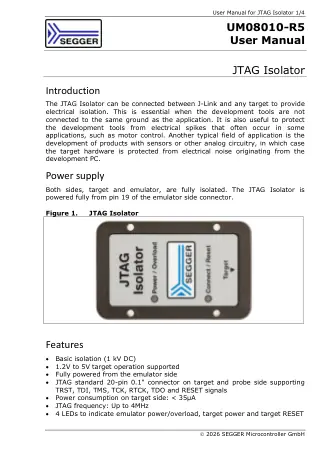
The SEGGER J-Link JTAG Isolator (part number 8.07.00) is an isolator box that sits between a J-Link or Flasher and the target, giving 1kV DC basic isolation on JTAG at up to 4 MHz for target interface voltages from 1.2V to 5V. Both sides use 20-pin 0.1" male JTAG connectors; the isolator is powered from the probe side and draws less than 25µA on the target side. Use it where the debug or production tools do not share a ground with the application.
JTAG Isolation for Motor Control, Sensor and Analogue Designs
SEGGER describes isolation as essential when the development or production tools are not connected to the same ground as the application. Motor control applications tend to introduce electrical spikes, and the isolator keeps them away from the probe. In sensor and analogue designs, it keeps the debug system from disturbing the measurement. The isolator uses high-speed digital isolators and passes TRST, TDI, TMS, TCK, RTCK, TDO and RESET.
Protection includes overvoltage and overcurrent protection on the probe side, overvoltage protection on the target VTref pin and ESD protection. Four LEDs show probe or programmer power, probe or programmer overload, target power and target RESET. On the target side, SEGGER's Knowledge Base lists pins 1 and 2 as VCC, through which the target side draws its power, with pins 17 and 19 not connected. See our SEGGER J-Link 20-pin connector pinout guide for the probe side.
What's Included
- JTAG Isolator Box
- 0.1" 20-pin ribbon cable
Specifications
| Isolation | 1kV DC, basic isolation |
|---|---|
| Target interface | JTAG |
| Target signals | TRST, TDI, TMS, TCK, RTCK, TDO, RESET |
| Max. target interface speed | 4 MHz |
| Target interface voltage | 1.2V to 5V |
| Probe-side connector | 20-pin 0.1" male JTAG |
| Target-side connector | 20-pin 0.1" male JTAG |
| Power supply | Powered from the probe side |
| Target-side power consumption | <25µA |
| Dimensions (L x W x H) | 73mm x 46mm x 19mm |
| Weight | 38g |
| Operating temperature | +5°C to +60°C |
| Storage temperature | -20°C to +65°C |
| Relative humidity | <90% rH, non-condensing |
| Compatible J-Link models | PRO PoE, PRO, Ultra, WiFi, PLUS, BASE |
| Compatible Flasher models | PRO, PRO XL, Compact, Portable PLUS |
Limitations
- No SWD and no cJTAG: the isolator does not support bidirectional transmission on SWDIO or TMSC. Use the SWD Isolator for SWD.
- Target interface speed is limited to 4 MHz.
- Basic isolation only. Do not use it with hazardous voltages without a further protection measure such as double or reinforced isolation.
- Third-party probes with the same pinout must supply 5V on pin 19; SEGGER states their use is at your own risk.
JTAG Isolator Compared with Other SEGGER Isolators
| Isolator | Isolated link | Isolation | Max. speed | Price ex VAT |
|---|---|---|---|---|
| JTAG Isolator (this product) | Probe to target, JTAG, 20-pin 0.1" | 1kV DC, basic | 4 MHz | £226 |
| SWD Isolator | Probe to target, SWD and SWO, 20-pin 0.1" | 1kV DC, basic | 4 MHz | £240 |
| USB Isolator | Host PC to probe, USB | 3kV DC for 1s, basic | USB Full-Speed, 12 Mbit/s | £185 |
| J-Trace Isolator | J-Trace to target, JTAG, SWD, SWO and ETM trace, 19-pin 0.05" | 1kV DC, basic | 4 MHz debug, 75 MHz trace clock | £320 |
Order the JTAG Isolator for £226 ex VAT. Confirm that your target debugs over JTAG at 4 MHz or below, or ask us for a formal quotation. See the full range in our SEGGER debug probes collection.
Frequently Asked Questions
Can I Use the JTAG Isolator for SWD?
No. It does not support bidirectional transmission on the SWDIO pin, so SWD will not work through it. SEGGER offers the SWD Isolator for SWD targets.
Answered by John Legg, Director, Debug Store
Is It Rated for Hazardous Voltages?
Not on its own. It provides 1kV DC basic isolation only, and SEGGER states that hazardous voltages need a further protection measure, such as double or reinforced isolation.
Answered by John Legg, Director, Debug Store
Should I Isolate on the Target Side or the USB Side?
Target-side isolation with the JTAG Isolator allows the host USB link to run at Hi-Speed on J-Link models that support it, but limits the debug speed to 4 MHz. The USB Isolator isolates the host side instead and forces USB Full-Speed, which SEGGER says does not, or not significantly, reduce debug and flash programming speed.
Answered by John Legg, Director, Debug Store
Last reviewed 16/11/2026.
| General | |
|---|---|
| Isolation | 1kV DC, basic isolation |
| Host and Target Interface | |
| Target interface | JTAG |
| Target signals | TRST, TDI, TMS, TCK, RTCK, TDO, RESET |
| Target interface voltage | 1.2V to 5V |
| Probe-side connector | 20-pin 0.1" male JTAG |
| Target-side connector | 20-pin 0.1" male JTAG |
| Performance | |
| Max. target interface speed | 4 MHz |
| Power | |
| Power supply | Powered from the probe side |
| Target-side power consumption | <25µA |
| Software and Compatibility | |
| Compatible J-Link models | PRO PoE, PRO, Ultra, WiFi, PLUS, BASE |
| Compatible Flasher models | PRO, PRO XL, Compact, Portable PLUS |
| Physical | |
| Dimensions (L x W x H) | 73mm x 46mm x 19mm |
| Weight | 38g |
| Environmental | |
| Operating temperature | +5°C to +60°C |
| Storage temperature | -20°C to +65°C |
| Relative humidity | <90% rH, non-condensing |
| Ordering information | |
| Part number (SKU) | 8.07.00 |
| Manufacturer | SEGGER Microcontroller GmbH |
| EAN | 5055383620111 |
| Warranty | 12 months |
| Shipping weight | 0.05 kg |
- 1 ×JTAG Isolator Box
- 1 ×0.1" 20-pin ribbon cable
Questions and Answers
No questions have been asked about this product yet. Ask our engineers below and we'll reply by email.
