

OMICRON-Lab
OMICRON Lab B-LFT 100 Low-Frequency Injection Transformer
OMICRON Lab B-LFT 100 Low-Frequency Injection Transformer
SKU: P0005773
Couldn't load pickup availability

Key Features
Overview
The OMICRON Lab B-LFT 100 injects a low-frequency test signal into slow control loops, such as PFC regulators, so a Bode 100 or other frequency response analyser can measure loop gain and phase margin. Usable range 10 mHz to 100 kHz, 1:1 turns ratio, insertion loss under 1 dB at 100 Hz, 1 kΩ injection resistor, isolation rated 600 V CAT II. It injects a 1 Hz signal at the Bode 100's full 2 Vrms output without saturating. For faster loops, OMICRON Lab offers the B-WIT 100 (1 Hz to 10 MHz).
Downloads
Application Notes

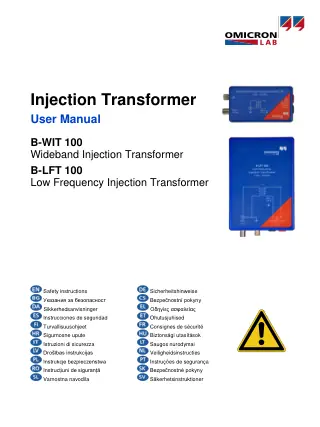
The OMICRON Lab B-LFT 100 is a low-frequency injection transformer for loop gain measurement on slow control loops, with a usable range of 10 mHz to 100 kHz, a 1:1 turns ratio, insertion loss under 1 dB at 100 Hz and isolation rated to 600 V CAT II. It injects a 1 Hz signal at the full 2 Vrms output of a Bode 100 without saturating. Power electronics engineers use it to measure gain and phase margin on PFC regulators and other slow loops.
Loop Gain Measurement Down to 10 mHz
OMICRON Lab specifies a usable frequency range of 10 mHz to 100 kHz. The typical lower -3 dB point is below 100 mHz and the upper -3 dB point is above 15 kHz (20 kHz typical), with attenuation of approximately 20 dB at 100 kHz. Insertion loss is under 1 dB at 100 Hz, measured as input-to-output voltage gain with a 1 kΩ secondary resistance and a 0 dBm source. Typical volt-second capacity is 0.456 Vs, against 3.5 mVs for the wideband B-WIT 100.
Injection Transformer Setup with a 1 kΩ Injection Resistor
The BNC input plug connects to the source output of the analyser, such as the Bode 100. The isolated output on 4 mm safety banana jacks goes across the injection resistor in the feedback path. The B-LFT 100 is designed for a 1 kΩ injection resistor. The B-WIT 100 uses 1 Ω to 10 Ω, so check the resistor before swapping. Two voltage probes either side of the resistor give the analyser the loop gain ratio. Because the disturbance is injected differentially, the DC operating point of the loop is not disturbed.
600 V CAT II Isolation for Off-Line Supplies
Primary-to-secondary isolation is rated to 600 V CAT II, so the injection point can sit at a high potential while the analyser stays referenced to earth. Connect the earth terminal on the housing to safety ground whenever voltages above 30 VAC or 60 VDC are present. Typical primary-to-secondary capacitance is 600 pF at 1 kHz. Output current is limited to 0.1 A by a fuse in the output winding, which is not user-replaceable.
Specifications
| Usable frequency range | 10 mHz to 100 kHz (approx. 20 dB attenuation at 100 kHz) |
|---|---|
| Lower -3 dB frequency | < 100 mHz (typ.) |
| Upper -3 dB frequency | > 15 kHz (20 kHz typ.) |
| Turns ratio | 1:1 |
| Insertion loss | < 1 dB at 100 Hz (1 kΩ secondary resistance, 0 dBm source) |
| Primary-secondary capacitance | 600 pF at 1 kHz (typ.) |
| Max. volt-second | 0.456 Vs (typ.) |
| DC saturation current | 0.8 mA (typ.) |
| Max. input voltage | 10 Vrms (absolute maximum, user manual) |
| Absolute max. current | 0.1 A (fuse in output winding, not user-replaceable) |
| Isolation | 600 V CAT II |
| Input connector | BNC plug |
| Output connectors | 4 mm safety banana jacks (isolated), plus earth terminal |
| Injection resistor | 1 kΩ |
| Dimensions | 183 x 122 x 61 mm (including connectors) |
| Weight | 1.33 kg |
| Operating temperature | -20 °C to +60 °C |
| Relative humidity | 5% to 80% |
| Max. altitude | 2,000 m |
Limitations
- The analyser and voltage probes are not included. The B-LFT 100 is the injection element only.
- DC saturation current is 0.8 mA (typ.). OMICRON Lab states that no DC signal may be applied to the output.
- Response rolls off above the 15 kHz (min.) upper -3 dB point. For loops that cross over in the kHz to MHz range, choose the B-WIT 100 (1 Hz to 10 MHz usable) or the Picotest J2101A, specified for 10 Hz to 45 MHz into a 5 Ω termination.
- Do not open or modify the unit. It has no user-serviceable parts.
Injection Transformer Comparison
| Feature | B-LFT 100 | B-WIT 100 | Picotest J2101A |
|---|---|---|---|
| Frequency range | 10 mHz to 100 kHz usable; < 100 mHz to > 15 kHz (-3 dB) | 1 Hz to 10 MHz usable; 7 Hz to 5 MHz (-3 dB) | 10 Hz to 45 MHz (5 Ω termination) |
| Turns ratio | 1:1 | 1:1 | 1:1 |
| Insertion loss | < 1 dB at 100 Hz | < 0.5 dB at 10 kHz | Not stated by Picotest |
| Injection resistor | 1 kΩ | 1 Ω to 10 Ω | 5 Ω termination |
| Isolation | 600 V CAT II | 600 V CAT II | Tested to 600 V CAT II |
| Price | £760 | £545 | £550 |
Typical Applications
Gain and phase margin measurement on the control loop of a PFC regulator with a Bode 100, sweeping from below 1 Hz with a 1 kΩ injection resistor. Stability checks on other slow regulation loops whose crossover sits below the 1 Hz floor of the B-WIT 100.
The B-LFT 100 suits power electronics engineers who already own a frequency response analyser and need to reach the sub-hertz region that a wideband injection transformer cannot cover.
What's Included
- B-LFT 100 injection transformer
- BNC to 4 mm banana adapter
The OMICRON Lab B-LFT 100 is £760 ex VAT. If your loop crosses over above 15 kHz, check the B-WIT 100 first, or contact us for a formal quotation covering the analyser and probes. See all injection transformers in our range.
Frequently Asked Questions
Should I Choose the B-LFT 100 or the B-WIT 100?
Choose by crossover frequency. The B-LFT 100 covers 10 mHz to 100 kHz (usable) and suits slow loops such as PFC regulators; the B-WIT 100 covers 1 Hz to 10 MHz for faster DC/DC converter loops. They also need different injection resistors: 1 kΩ for the B-LFT 100, 1 Ω to 10 Ω for the B-WIT 100.
Answered by John Legg, Director, Debug Store
Can I Measure on a Mains-Connected PFC Stage?
Yes, within the 600 V CAT II isolation rating. Connect the earth terminal to safety ground whenever voltages above 30 VAC or 60 VDC are present, and use safety-rated voltage probes.
Answered by John Legg, Director, Debug Store
What Injection Resistor Does the B-LFT 100 Need?
1 kΩ. OMICRON Lab designs the B-LFT 100 for a 1 kΩ injection resistor; the B-WIT 100 uses 1 Ω to 10 Ω. Connect the transformer output across the resistor in the feedback path.
Answered by John Legg, Director, Debug Store
Last reviewed: 30 October 2026
Sources (3 manufacturer pages)
| Ordering information | |
|---|---|
| Part number (SKU) | P0005773 |
| Manufacturer | OMICRON-Lab |
| EAN | 5055383623266 |
| Warranty | 12 months |
| Shipping weight | 1.33 kg |
- 1 ×B-LFT 100 injection transformer
- 1 ×BNC to 4 mm banana adapter
Questions and Answers
No questions have been asked about this product yet. Ask our engineers below and we'll reply by email.