
Total Phase, Inc
Total Phase TP360210 CAN/I2C Activity Board Pro
Total Phase TP360210 CAN/I2C Activity Board Pro
SKU: TP360210
Couldn't load pickup availability
Key Features
Overview
Introducing the CAN/I2C Activity Board Pro: Your Ultimate Embedded Systems Companion
Are you an embedded systems enthusiast seeking to conquer CAN and I2C protocols effortlessly? Look no further than the cutting-edge CAN/I2C Activity Board Pro – your indispensable tool for seamless development.
Unlock Seamless Development: The CAN/I2C Activity Board Pro is meticulously crafted to empower developers like you. With pre-installed, proven target devices, you can kickstart your projects confidently and accelerate your progress.
Key Features:
- CAN Mastery: Harness the power of CAN nodes, leveraging our activity board's exceptional compatibility with the Komodo CAN Solo interface and Komodo CAN Duo Interface.
- I2C Excellence: Dive into the world of I2C slaves easily, thanks to seamless integration with the Aardvark I2C/SPI Host Adapter.
Your Path to Success: Elevate your development journey with the CAN/I2C Activity Board Pro. Whether you're a seasoned developer or just starting, our board provides the resources you need to thrive.
Take advantage of the future of embedded systems development. Supercharge your skills and projects with the CAN/I2C Activity Board Pro today!
Downloads
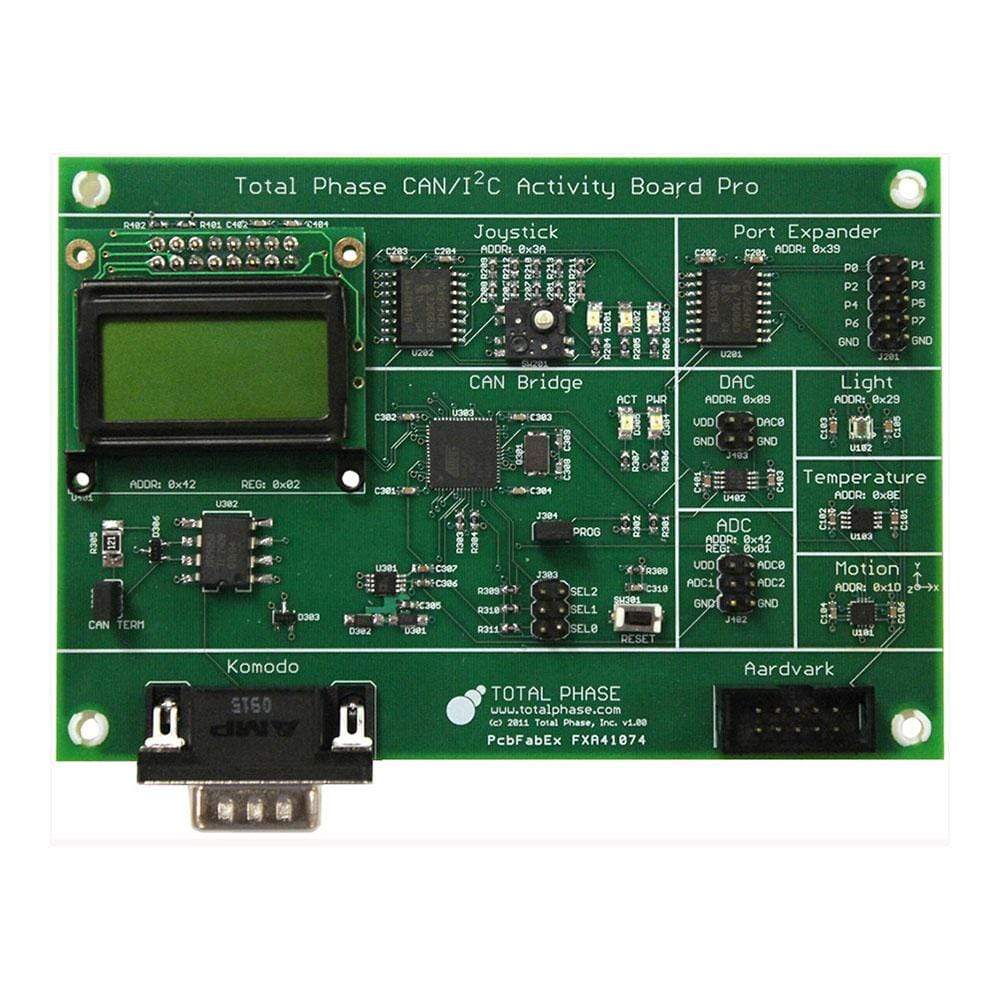
The Total Phase CAN/I2C Activity Board Pro is the ideal tool for the embedded systems developer working with CAN and I2C protocols. This board provides known-good target devices to help developers get up and running quickly.
Target devices featured on this activity board can operate as CAN nodes or I2C slaves. The CAN/I2C Activity Board Pro is compatible with the Komodo™ CAN Solo interface, the Komodo™ CAN Duo interface, and the Aardvark™ I2C/SPI Host Adapter.
Features
- Test and debug with known working CAN and I2C slave devices.
- Interface directly with the Komodo™ CAN Solo Interface, the Komodo™ CAN Duo Interface or the Aardvark™ I2C/SPI Host Adapter.
Targets
- Digital-to-Analog Converter (DAC)
DAC081C085 Single Channel 8-bit Digital-to-Analog Converter (NXP Semiconductors) - Motion Sensor
LIS33DE 3-axis Linear Accelerometer (ST Microelectronics) - Light Sensor
APDS-9300 Ambient Light Photo Sensor (Avago Technologies) - Port Expander #1
PCA9554AD 8-pin Port Expander with pins configured as inputs or outputs (NXP Semiconductors) - Joystick, LEDs, and Port Expander #2
TPA511GLFS 2-axis Joystick with five output pins (C&K Components)
PCA9554AD Port Expander communicates the status over CAN and I2C (NXP Semiconductors) - Analog-to-Digital Converter (ADC)
AT90CAN32 8-bit ADC on the AT90CAN32 MCU (Atmel) - LCD Display
NHD-0208AZ-RN-YBW 2x8 character LCD Display Module (Newhaven Display International) - Temperature Sensor
DS75 Digital Thermometer and Thermostat (-55°C to °C) (Maxim Integrated Products)
Example Code
Example code for the CAN/I2C Activity Board Pro is available in C, C#, Python, .NET, VB.NET, and VB6 as part of the Komodo™ Software API and Shared Library package in the Downloads section of this website. README.txt files are included in the package to explain each of the examples.
Questions and Answers
-
How Does the Activity Board Pro Support Both CAN and I2C Protocols Simultaneously?
A CAN-to-I2C bridge on the board gives access to the same target devices from either bus. Over CAN, each 11-bit ID is split into a 7-bit node address (the device's I2C address) and a 4-bit opcode that sets the function.
The board runs CAN at 125 kbps by default, and auto-baud can be selected at reset. The CAN bus is not electrically isolated from the rest of the board.
-
What Are the Power Requirements and Electrical Specifications for the Board?
The Activity Board Pro needs a VDD supply of 3.1-3.5V and a CAN supply input of 4.3-5.5V. It supports dominant and recessive CAN signalling states with correct differential voltage levels, and has integrated power management.
CAN differential inputs handle up to ±7V and single-ended inputs up to ±12V. I2C works with standard 3.3V and 5V logic levels. GPIO port expanders accept 2.0-5.5V inputs and have standard TTL outputs.
-
What Software and Development Support Is Available for the Activity Board Pro?
Total Phase provides example code in C, C#, Python, .NET, VB.NET and VB6 through the Komodo Software API and shared library packages. Also included:
- Control Center software for GUI-based testing with automated scripting
- Data Center software for real-time protocol analysis with LiveDisplay, LiveFilter and LiveSearch
- LabVIEW drivers for test automation systems
- User manuals, with README files explaining each example application
The software is free, with regular updates and no extra licence fees.
-
How Does the Board's CAN Implementation Handle Arbitration and Error Detection?
Each 11-bit CAN ID is split into a 7-bit node address (the target device's I2C address) and a 4-bit opcode. Packets that do not match a defined opcode are ignored by the CAN bridge.
The bridge has multiple receive buffers and a small number of transmit buffers. If the receive buffer overflows, packets are acknowledged but not processed, so Total Phase recommends no more than about 10 packets per 100 ms. CAN bit, stuffing, CRC and acknowledgement errors are handled by the CAN controller in hardware, as on any CAN node.
The CAN bus is not electrically isolated. Auto-baud can be selected at reset.
-
What Training and Educational Applications Does the Activity Board Pro Support?
The Activity Board Pro is used to teach embedded systems, protocol analysis and hardware-software integration.
Universities and training institutions use its target devices to demonstrate real CAN and I2C implementations. The example code and documentation support a progression from basic protocol understanding to system integration, and students work with industry-standard devices.
It is available from Total Phase and its distributors, including Debug Store.
-
What Is the Total Phase CAN/I2C Activity Board Pro and Who Should Use It?
The Total Phase CAN/I2C Activity Board Pro (TP360210) is a development board with known-good CAN and I2C target devices.
It includes digital-to-analogue converters, accelerometers, temperature sensors, LCD displays and port expanders to speed up embedded debugging and development. Electronic design engineers, automotive developers, embedded systems engineers and production test teams use it for rapid prototyping, device validation and training.
It is available from Total Phase and its distributors, including Debug Store.
-
Which Total Phase Interfaces Are Compatible with the CAN/I2C Activity Board Pro?
The CAN/I2C Activity Board Pro works with:
- Total Phase Komodo CAN interfaces, through its DE-9 CAN connector: the single-channel Komodo CAN Solo or the two-channel Komodo CAN Duo
- The Aardvark I2C/SPI Host Adapter, through its I2C header
The board does not power itself from these headers: supply 4.5 V to 5.0 V target power from the Komodo or the Aardvark.
-
What Target Devices Are Included on the CAN/I2C Activity Board Pro?
The board has eight target devices:
- DAC081C085 single-channel 8-bit digital-to-analogue converter
- LIS33DE 3-axis linear accelerometer
- APDS-9300 ambient light sensor
- dual PCA9554AD 8-pin port expanders with configurable I/O
- TPA511GLFS 2-axis joystick with output pins
- AT90CAN32 8-bit ADC microcontroller
- NHD-0208AZ-RN-YBW 2x8 character LCD display
- DS75 digital temperature sensor with thermostat function
The parts come from manufacturers including NXP, STMicroelectronics and Maxim. Each device works as a CAN node or an I2C slave.


No questions match your search.