


Total Phase, Inc
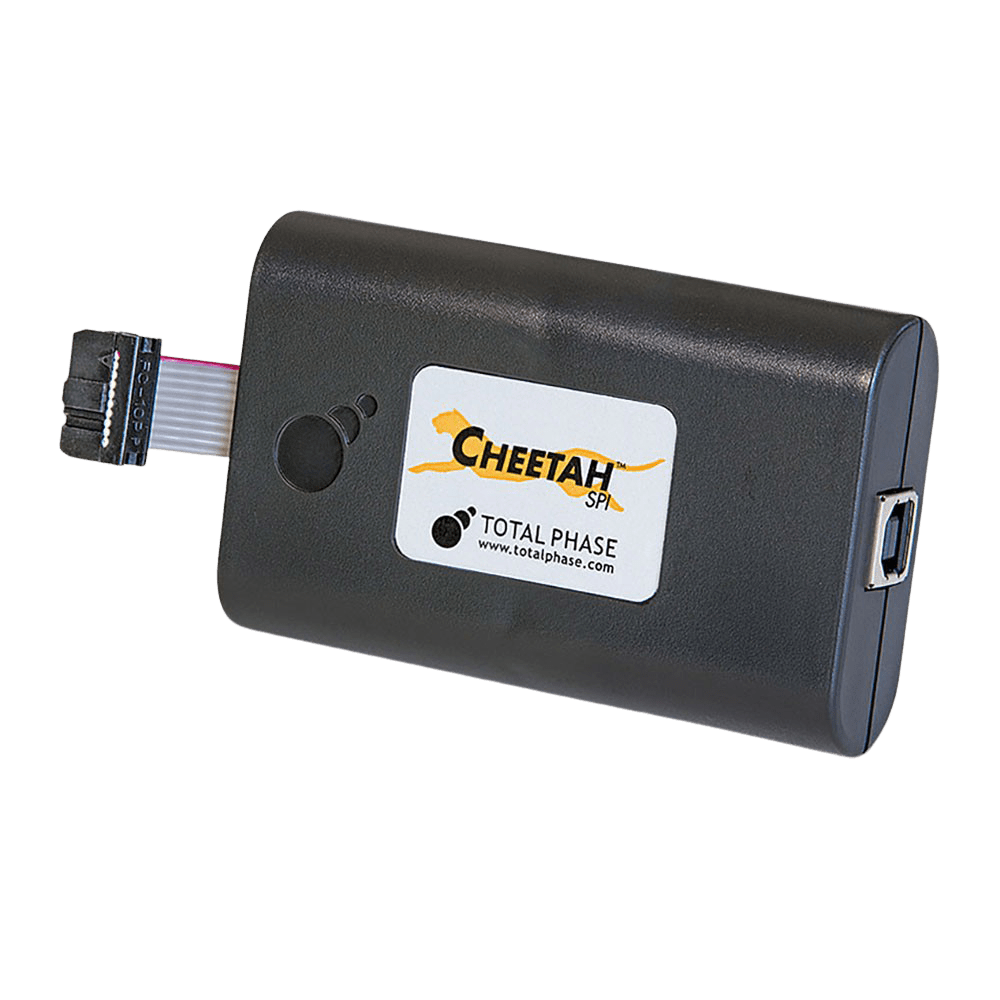
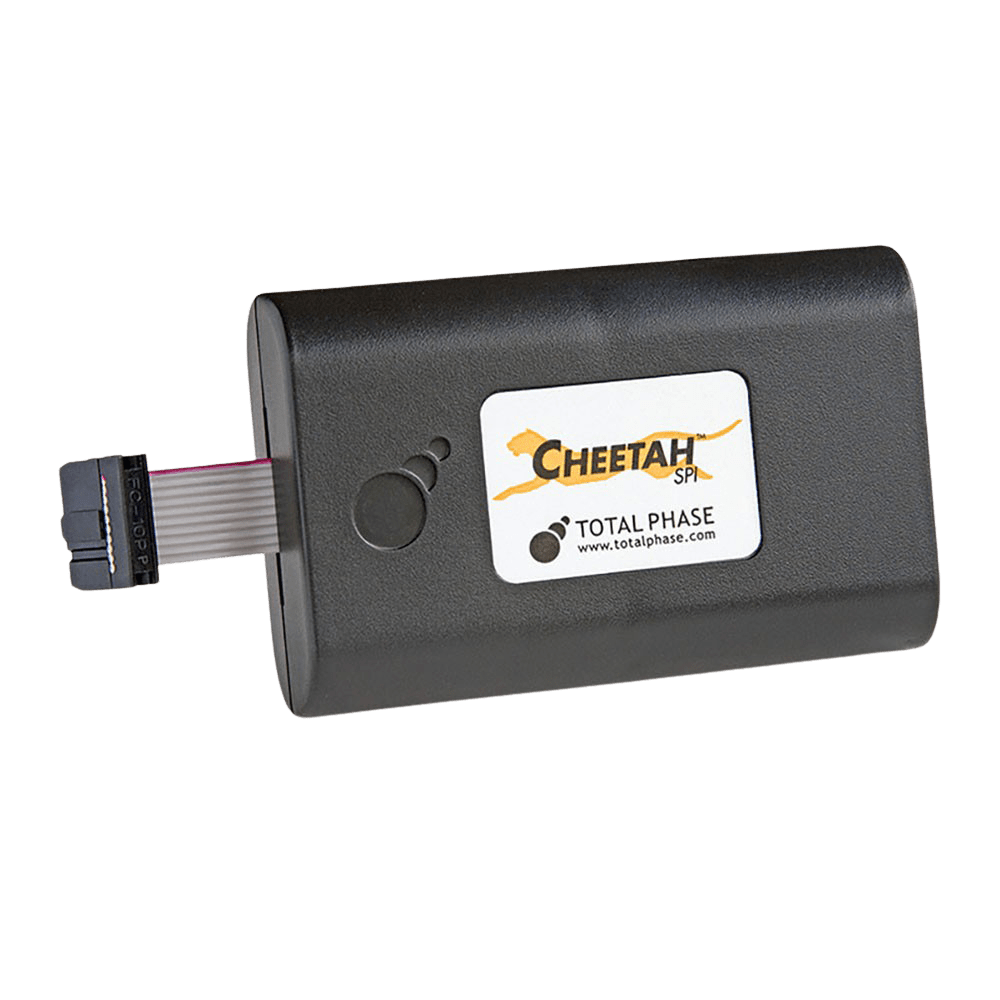
Total Phase Cheetah SPI Host Adapter
Total Phase Cheetah SPI Host Adapter
SKU: TP280121
Couldn't load pickup availability
Key Features
Overview
Downloads
Professional SPI Host Adapter for High-Performance Applications
The Total Phase Cheetah SPI Host Adapter represents the pinnacle of SPI interface technology, specifically engineered for applications demanding maximum performance and reliability. Operating at speeds up to 40+ MHz, this professional-grade adapter delivers the performance required for modern embedded system development and production programming environments.
Advanced Architecture and Performance
The Cheetah adapter's pipelined architecture enables continuous, gapless data shifting that maximises throughput whilst maintaining precise timing control. This advanced design eliminates the performance bottlenecks common in traditional SPI interfaces, delivering sustained data rates that approach the theoretical maximum of the SPI clock frequency.
| Parameter | Specification |
|---|---|
| SPI Clock Range | 0.1 MHz to 40+ MHz |
| Maximum Overclocking | Up to 50 MHz (experimental) |
| Slave Select Lines | 3 independent (SS1, SS2, SS3) |
| USB Interface | High-Speed USB 2.0 (480 Mbps) |
| Target Power Supply | +5V, 25mA maximum |
Comprehensive Software Ecosystem
The Cheetah adapter includes a complete software suite designed to maximise productivity across the entire development lifecycle. Flash Center Software provides professional-grade memory programming capabilities with support for hundreds of SPI flash and EEPROM devices through an extensible XML-based parts library.
Gang Programming Capability
Connect multiple Cheetah adapters to a single computer for parallel programming operations, dramatically reducing production line cycle times whilst maintaining programming reliability.
Wiring Quick-Start
The Cheetah adapter connects to target systems via a standard 10-pin ribbon cable with 2.54mm (0.1") pitch IDC connector. The pin assignment follows industry standards for maximum compatibility:
| Pin | Signal | Function |
|---|---|---|
| 1 | SS2 | Slave Select 2 |
| 2 | GND | Ground Reference |
| 3 | SS3 | Slave Select 3 |
| 4 | NC/+5V | Target Power (Optional) |
| 5 | MISO | Master In, Slave Out |
| 6 | NC/+5V | Target Power (Optional) |
| 7 | SCLK | Serial Clock |
| 8 | MOSI | Master Out, Slave In |
| 9 | SS1 | Primary Slave Select |
| 10 | GND | Ground Reference |
Essential Wiring Considerations
Proper grounding is critical for reliable operation. Connect both ground pins (2 and 10) to establish a solid ground reference between the Cheetah adapter and target system. The adapter provides optional +5V target power on pins 4 and 6, capable of supplying up to 25mA for low-power target devices.
Programming Example Code
The following Python example demonstrates basic SPI communication using the Cheetah API:
import cheetah_py as ch # Open Cheetah adapter handle = ch.ch_open(0) if handle <= 0: print("Unable to open Cheetah adapter") exit() # Configure SPI mode and bitrate ch.ch_spi_configure(handle, ch.CH_SPI_POL_RISING_FALLING, ch.CH_SPI_PHASE_SAMPLE_SETUP, ch.CH_SPI_BITORDER_MSB, 0x0) ch.ch_spi_bitrate(handle, 10000) # 10 MHz # Clear command queue and setup transaction ch.ch_spi_queue_clear(handle) ch.ch_spi_queue_oe(handle, 1) # Enable outputs ch.ch_spi_queue_ss(handle, 0x1) # Assert SS1 ch.ch_spi_queue_byte(handle, 1, 0x9f) # Send READ ID command ch.ch_spi_queue_byte(handle, 3, 0x00) # Read 3 bytes response ch.ch_spi_queue_ss(handle, 0x0) # Deassert SS1 # Execute transaction (ret, data_in) = ch.ch_spi_batch_shift(handle, 0) print(f"Device ID: {data_in:02x} {data_in:02x} {data_in:02x}")[1][2][3] ch.ch_close(handle)Flash Memory Programming Workflow
Programming SPI flash memory with the Cheetah adapter and Flash Center Software follows a streamlined workflow optimised for both development and production environments:
- Connect target flash device via ribbon cable
- Launch Flash Center Software and detect adapter
- Select memory device from extensive parts library
- Load programming data (binary, hex, or S-record formats)
- Execute erase, program, and verify sequence
Performance Benchmark
The Cheetah adapter can erase, program, and verify a typical 1MB SPI flash memory in approximately 23 seconds, with the main limitation being the flash memory's page commit time rather than the adapter's transfer speed.
Development Environment Integration
Cross-platform API support enables seamless integration into existing development workflows. The Cheetah API provides comprehensive control over all adapter functions, with example code available for C/C++, Python, C#, and LabVIEW development environments.
For automated testing and production environments, XML batch scripting capabilities in Control Center Serial Software enable complex test sequences to be executed without manual intervention, improving both efficiency and repeatability.
Quality and Compliance
Manufactured to professional standards with CE, REACH, and RoHS compliance, the Cheetah adapter meets international regulatory requirements for professional and industrial applications. Each unit includes a comprehensive one-year warranty backed by Total Phase's professional support team.
| General Information | |
|---|---|
Part Number (SKU) |
TP280121
|
Manufacturer Manufacturer of the product
|
|
| Physical and Mechanical | |
Weight |
0.5 kg
|
| Other | |
EAN |
5055383603466
|
Questions and Answers
-
What Is a Cheetah SPI Host Adapter?
The Total Phase Cheetah SPI Host Adapter is a high-speed USB to SPI adapter that allows communication between a host computer and an SPI device. It supports clock rates up to 40 MHz and operates in full-duplex mode.
-
What Is the Main Purpose of the Cheetah SPI Host Adapter?
The Cheetah SPI Host Adapter is a bridge between a host computer and an SPI device, so the computer can send data to and receive data from the device.
-
What Is the Maximum Clock Rate That the Cheetah SPI Host Adapter Supports?
The Total Phase Cheetah SPI Host Adapter supports clock rates up to 40 MHz.
-
Does the Cheetah SPI Host Adapter Come with Software?
Yes. The Cheetah works with Total Phase's free Control Center Serial Software (which includes the former Cheetah GUI functions) and Flash Center, plus the free API, for sending and receiving data to and from the SPI device. The software is free, with free updates.
-
Is the Cheetah SPI Host Adapter RoHS Compliant?
Yes, the Total Phase Cheetah SPI Host Adapter is RoHS compliant.
-
What Types of Memory Devices and Applications Does the Cheetah SPI Adapter Support?
The Cheetah is designed for high-speed programming of SPI flash memory and EEPROM.
Flash Center's extensible XML parts library supports virtually any SPI memory device, including parts from Atmel, Macronix, STMicroelectronics and Micron.
Common applications:
- BIOS programming for embedded systems
- firmware updates for IoT devices
- high-speed sensor interfacing
- prototyping, where it emulates an MCU to poll SPI sensors, write to on-board flash and control the bus with precise timing
-
What Quality Standards and Certifications Does the Total Phase Cheetah Meet?
The Cheetah carries CE and RoHS marks. Total Phase manufactures it in the USA in a facility certified to ISO 9001, ISO 13485 (medical devices) and AS9100C (aerospace), and lists it as ITAR compliant.
Total Phase gives a one-year warranty.
-
How Does the Cheetah's USB Interface and Power Requirements Compare to Other Solutions?
The Cheetah uses high-speed USB 2.0 at 480 Mbps, much faster than USB 1.1 adapters such as the Aardvark.
It is fully bus-powered, so it needs no external power adapter and works straight away from a laptop or desktop. It draws approximately 125mA from the USB host and can supply up to 25mA at 5V to target devices.
-
What Programming Languages and Development Environments Are Supported by the Cheetah API?
The Cheetah API supports:
- Windows (32-bit and 64-bit), Linux (multiple distributions) and Mac OS X
- C/C++, C#, Python, Visual Basic .NET and Visual Basic 6, with example programs included
- LabVIEW instrument drivers, included at no extra cost
The documentation includes timing diagrams and function references.
-
How Does the Cheetah Handle Advanced Timing Control and Signal Integrity for Critical Applications?
The Cheetah shifts bytes with no gap between them, where the Aardvark needs about 7 to 9 microseconds between SPI bytes. The Cheetah's MISO setup time is 4.8 nanoseconds.
User-insertable delays are set in 8 clock cycle increments, so you can tune timing to each slave device. The pipelined architecture shifts bytes without gaps, keeping throughput steady even on transactions spanning megabytes.
Built-in ESD protection adds approximately 15pF of parasitic capacitance. The 3.3V outputs work with both CMOS and TTL devices.
-
What Is the Total Phase Cheetah SPI Host Adapter and What Makes It Unique?
The Total Phase Cheetah SPI Host Adapter is a high-speed USB-to-SPI interface that runs at up to 40+ MHz, with unsupported overclocking to 50 MHz.
The general-purpose Aardvark I2C/SPI Host Adapter tops out at 8 MHz. The Cheetah adds gapless shifting and precise timing control, and its pipelined architecture gives nearly 100% throughput efficiency. It suits high-speed SPI flash programming and embedded development.
-
How Does the Cheetah SPI Adapter Compare with Competitor Solutions?
The Cheetah runs SPI at 40+ MHz over high-speed USB 2.0 (480 Mbps). It includes Flash Center, Control Center Serial Software and a royalty-free API with no extra licence fees.
-
What Software Applications Are Included with the Cheetah SPI Host Adapter?
The Cheetah comes with three software packages at no extra cost:
- Flash Center Software: XML-based parts library with built-in support for many SPI flash memories and EEPROMs from major manufacturers. Supports gang programming with multiple Cheetah adapters.
- Control Center Serial Software: simple SPI message sending, with XML-based batch scripting to automate repetitive tasks.
- Cheetah API: royalty-free, for Windows, Linux and Mac OS X, with C/C++, C#, Python and Visual Basic .NET bindings and example files.
-
What Are the Specific Technical Capabilities and Signal Specifications of the Cheetah SPI Adapter?
The Cheetah is a full-duplex SPI master running from 100 kHz to 40+ MHz.
- All four SPI modes, with configurable clock polarity and phase
- Three independent slave select lines (SS1, SS2, SS3) for multiple devices
- 3.3V logic levels, compatible with TTL and CMOS devices
- Built-in ESD protection
- User-insertable delays quantised in 8 clock cycle blocks
- USB 2.0 high-speed (480 Mbps)
- Bus-powered, drawing approximately 125mA
-
How Does the Cheetah's Gang Programming Capability Work for Production Environments?
Flash Center Software's gang programming feature lets several Cheetah adapters program devices at the same time, one target per adapter.
The Cheetah runs SPI at up to 40+ MHz, much faster than the Aardvark's 8 MHz, which shortens programming time for large SPI flash devices.

No questions match your search.