
SEGGER Microcontroller GmbH
SEGGER Flasher ARM Programmer (5.07.01) - Stand-Alone Production Flash Programmer
SEGGER Flasher ARM Programmer (5.07.01) - Stand-Alone Production Flash Programmer
SKU: 5.07.01
Couldn't load pickup availability
Key Features
Overview
The SEGGER Flasher ARM (5.07.01) delivers professional-grade flash programming for ARM-based microcontrollers in both development and production environments. This versatile programmer supports all major ARM cores from legacy ARM7/9/11 to modern Cortex-M and Cortex-A series, making it suitable for diverse embedded applications.
Unlike basic debug probes, the Flasher ARM functions as a complete standalone programming solution with 128 MB internal memory for storing multiple target programs. Its three operational modes—J-Link mode, standalone mode, and mass storage device mode—provide flexibility for different workflow requirements.
For production integration, the Flasher ARM includes authorised flashing capabilities that limit programming cycles and prevent unauthorised access—essential for contract manufacturing environments. Remote control via Ethernet, RS-232, or TTL signals enables seamless integration with automated test equipment.
Related products include the SEGGER Flasher Compact for space-constrained applications and the SEGGER Flasher PRO for multi-architecture support.
How it connects
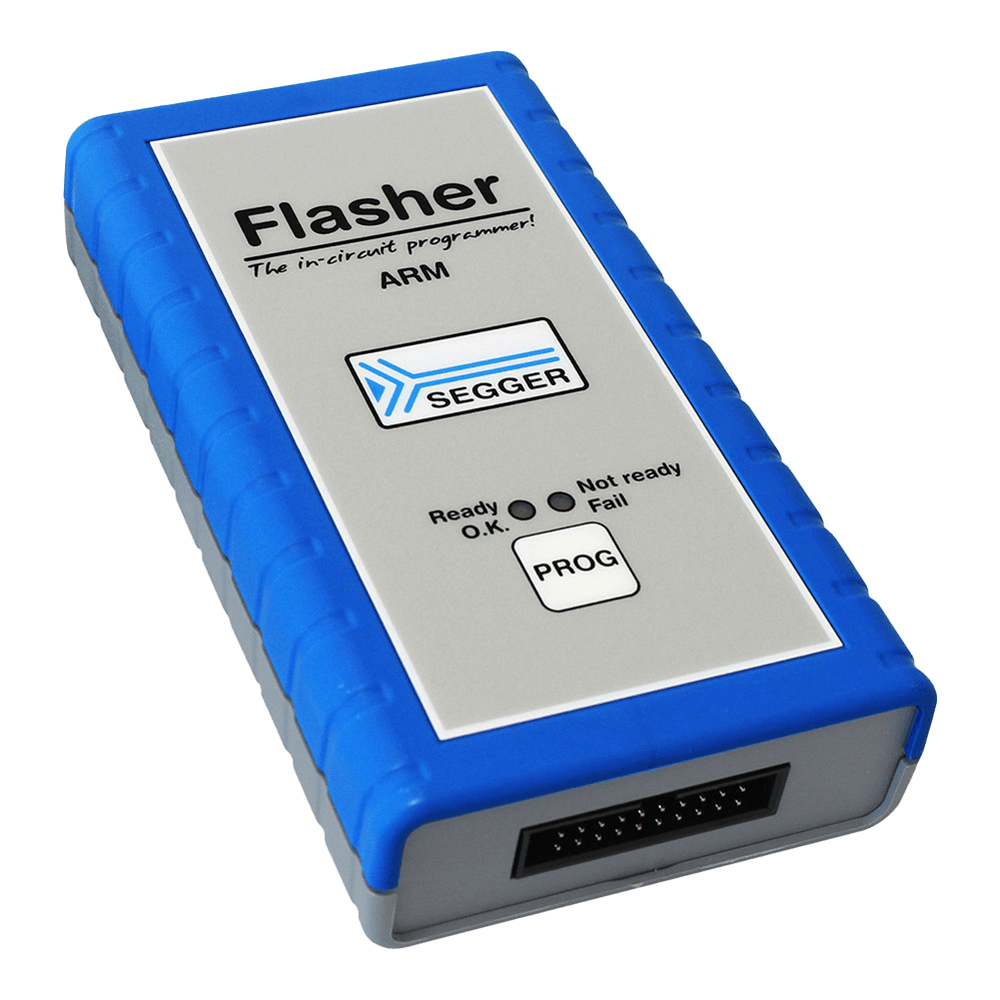
This Flasher uses SEGGER's standard 20-pin 0.1" (2.54 mm) connector. For JTAG and SWD targets the pin assignment is the same as J-Link: VTref (pin 1), SWDIO/TMS (pin 7), SWCLK/TCK (pin 9), nRESET (pin 15) and GND (pin 4). Other target interfaces use interface-specific assignments, so check the SEGGER Flasher manual for your interface. Full JTAG, SWD and SPI pin tables: SEGGER J-Link 20-pin connector pinout.
Downloads
Why Engineers Choose the SEGGER Flasher ARM Programmer (5.07.01) - Stand-Alone Production Flash Programmer
Production Line Integration
Standalone Operation
Comprehensive Device Support
Professional ARM Flash Programming Solution
The SEGGER Flasher ARM is a production-grade programming tool designed specifically for ARM core-based microcontrollers with on-chip or external flash memory. Once configured, it operates as a standalone JTAG/SWD programmer without requiring a PC connection, making it ideal for production environments and field programming applications.
Key Programming Capabilities
| Feature | Specification |
|---|---|
| Supported Cores | ARM7, ARM9, ARM11, Cortex-M0/M0+/M1/M3/M4/M7, Cortex-A5/A7/A8/A9/A12/A15/A17 |
| Target Interface | JTAG, SWD via 20-pin connector |
| Programming Speed | 30 KB/sec to 1 MB/sec (target dependent) |
| Internal Memory | 128 MB for target program storage |
Connection Interfaces
The Flasher ARM provides multiple connectivity options for flexible integration:
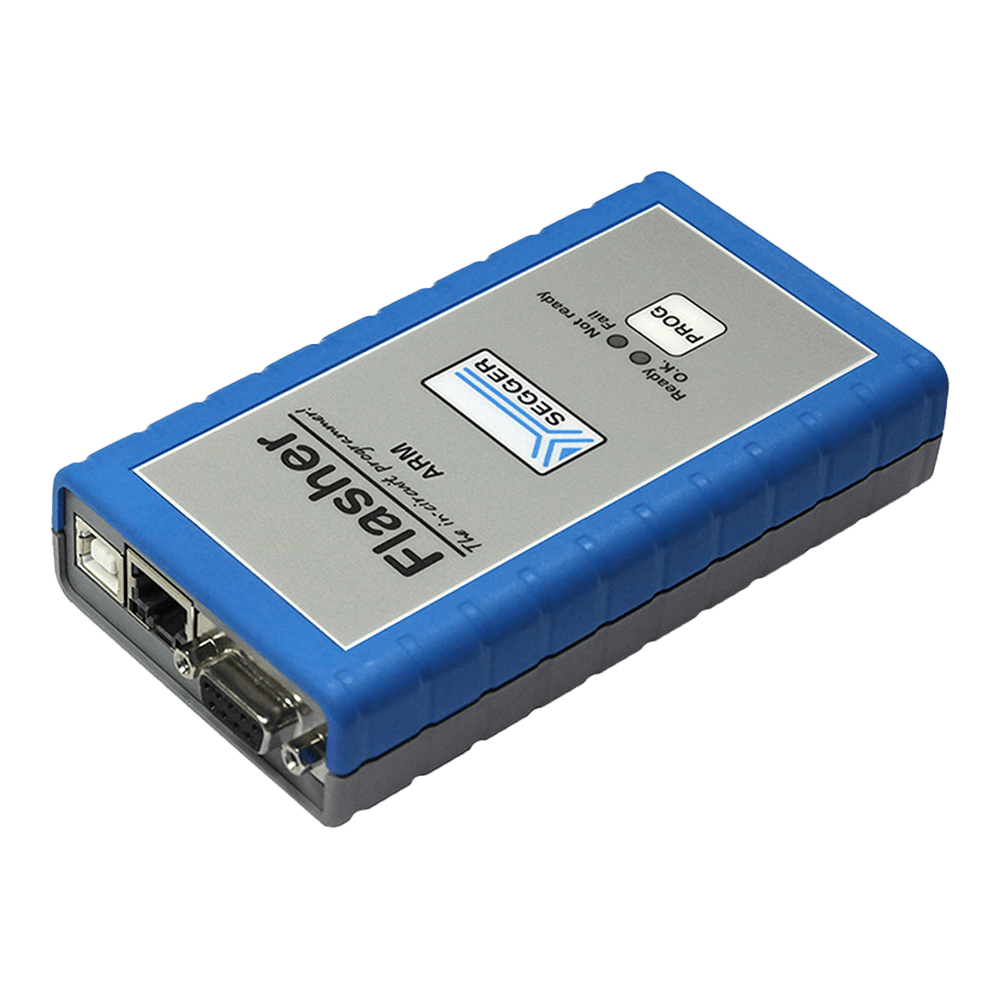
- USB 2.0: High-speed connection for PC control and power
- Ethernet (10/100 RJ45): Network-based programming and remote control
- RS-232 (DB9): Serial interface for automated test equipment integration
- 20-pin JTAG/SWD: Standard ARM debug connector
Wiring Quick-Start
Target Connection (20-pin JTAG/SWD): Pin 1: VTref Pin 2: NC Pin 3: nTRST Pin 4: GND Pin 7: TMS Pin 8: GND Pin 9: TCK Pin 10: GND Pin 13: TDO Pin 14: GND Pin 15: nRESET Pin 16: GND Pin 17: DBGRQ Pin 18: GND Pin 19: 5V-Out Pin 20: GND
SWD Mode (minimal connection):
Pin 1: VTref
Pin 7: SWDIO
Pin 9: SWCLK
Pin 15: nRESET
GND: Any even pin (2,4,6,8,etc.)
| General Information | |
|---|---|
Part Number (SKU) |
5.07.01
|
Manufacturer |
|
| Physical and Mechanical | |
Weight |
0.5 kg
|
| Other | |
EAN |
5055383605736
|
Questions and Answers
-
How Do I Integrate the Flasher ARM Into Production Equipment?
The Flasher ARM is a deprecated product; SEGGER recommends the Flasher PRO as its replacement. Firmware for current hardware versions is still maintained.
The Flasher ARM offers several integration interfaces:
- Ethernet for network-based control
- RS-232 for serial communication with test equipment
- TTL signals for hardware triggers
The ASCII command interface lets you automate it without specialised software.
-
What Is Authorised Flashing and Why Is It Important?
Authorised flashing limits the number of programming cycles and protects against unauthorised access. This protects your intellectual property when programming is done by a contract manufacturer or other external production facility.
-
Can the Flasher ARM Be Used for PC-Controlled Programming?
The Flasher ARM is used for PC-controlled programming through SEGGER's J-Flash software as well as for stand-alone programming.
-
What Software Is Required to Use the Flasher ARM?
The Flasher ARM works with SEGGER's J-Flash software for configuration and PC-controlled programming. All software, firmware updates and flash loaders are free of charge. Windows, Linux and macOS are supported.
-
What Accessories Are Included with the Flasher ARM?
The kit includes:
- Flasher ARM unit
- 20-pin ribbon cable
- USB cable
- RS-232 serial cable
Optional adapters are available for other target connectors, including 9-pin Cortex-M (0.05 inch) and needle adapters.
-
What ARM Cores Does the Flasher ARM Support?
The Flasher ARM supports a wide range of Arm cores:
- Legacy ARM7 and ARM9 cores
- Cortex-M (M0/M0+/M1/M3/M4/M7)
- Cortex-A (A5 to A17) and Cortex-R (R4/R5/R7/R8) in PC-controlled mode
So it suits both legacy system maintenance and new product development.
-
Can the Flasher ARM Operate Without a Computer Connection?
Yes. In standalone mode the Flasher ARM stores firmware images and configuration in its 128 MB internal memory. Programming can be triggered by push button, TTL signal, or remote commands over Ethernet or RS-232, so no PC is needed in production.
-
What Target Interface Does the Flasher ARM Use?
The Flasher ARM uses a standard 20-pin JTAG/SWD connector, compatible with ARM development tools. It supports both JTAG and Serial Wire Debug (SWD). SWD gives a lower pin count for space-constrained designs.
-
How Fast Can the Flasher ARM Program Target Devices?
Programming speed reaches up to 1 MB/s, depending on the target hardware and flash memory type. It uses optimised flash algorithms and a high-speed USB 2.0 interface.
-
What External Flash Memory Types Are Supported?
The Flasher ARM programs:
- Parallel NOR flash
- Serial NOR flash (QSPI flash via the MCU's own controller)
- NAND flash
- Data flash devices
No questions match your search.