


Oscium
OSCIUM Wi-Spy Lucid Wi-Fi 7 Spectrum Analyser | 2.4GHz, 5GHz and 6 GHz Bands
OSCIUM Wi-Spy Lucid Wi-Fi 7 Spectrum Analyser | 2.4GHz, 5GHz and 6 GHz Bands
SKU: OSC2567-1
Payment methods
- Bank transfer
Couldn't load pickup availability


Key Features
Overview
The Oscium Wi-Spy Lucid Wi-Fi 7 Spectrum Analyser is a USB-C tri-band spectrum analyser for wireless engineers working on 2.4 GHz, 5 GHz and 6 GHz networks, Wi-Fi 7 included.
Key Technical Capabilities
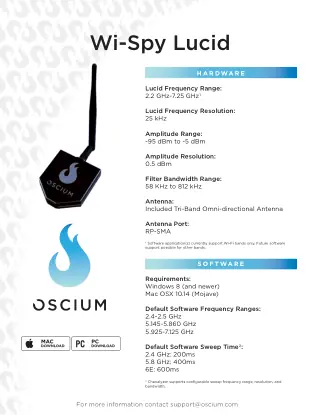
Hardware range 2.2 to 7.25 GHz with 25 kHz frequency resolution. Amplitude range -95 dBm to -5 dBm at 0.5 dB resolution, so it shows Wi-Fi and non-Wi-Fi transmitters alike: Bluetooth, microwave ovens, baby monitors and 802.15.4 sensors.
Software
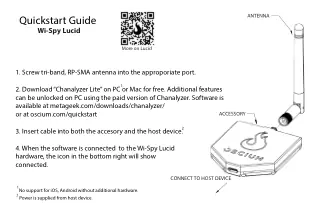
Works with Chanalyzer (Windows), the free Chanalyzer Lite (Windows and macOS), WiFi Explorer Pro and TamoGraph Site Survey. The supplied tri-band omnidirectional antenna fits an RP-SMA port, so a directional antenna can replace it.
In the Field
Weighs 57 g (0.125 lb) and measures 2.375 x 2.625 x 0.5 in. Sweeps 2.5x faster than the previous Wi-Spy generation. For hardware, Chanalyzer and the Device Finder antenna together, see the Spectrum Bundle.
Downloads
Datasheets
Why Engineers Choose the OSCIUM Wi-Spy Lucid Wi-Fi 7 Spectrum Analyser | 2.4GHz, 5GHz and 6 GHz Bands
Wi-Fi and Non-Wi-Fi Interference
Wi-Fi 6E and Wi-Fi 7 Deployment
Field Portability
The OSCIUM Wi-Spy Lucid (OSC2567-1) is a USB-C tri-band Wi-Fi 7 spectrum analyser covering 2.2 GHz to 7.25 GHz, which takes in the 2.4 GHz, 5 GHz and full 6 GHz (5.925 to 7.125 GHz) bands. It resolves 25 kHz frequency steps over an amplitude range of -95 dBm to -5 dBm and runs with Chanalyzer on Windows and the free Chanalyzer Lite on macOS. Wireless engineers use Wi-Spy Lucid to find interference at Layer 1 during pre-deployment surveys, 6 GHz channel planning and post-install troubleshooting.
Who It Is For
Checking 5.925 to 7.125 GHz occupancy before deploying Wi-Fi 6E or Wi-Fi 7 access points. Tracing non-802.11 interference in the 2.4 GHz band, including 802.15.4 (ZigBee) traffic, using the Chanalyzer channel guides. Recording an intermittent fault overnight in Chanalyzer and producing a Report Builder report for the client.
Wi-Spy Lucid suits WLAN survey engineers, network support teams handling throughput complaints, and RF test engineers checking coexistence on 2.4, 5 and 6 GHz products.
Tri-Band Wi-Fi 7 Spectrum Analyser From 2.2 GHz to 7.25 GHz
Wi-Spy Lucid visualises RF activity across 2.4 to 2.5 GHz, 5.145 to 5.860 GHz and 5.925 to 7.125 GHz: the bands used by Wi-Fi 7, Wi-Fi 6/6E and legacy 2.4 GHz and 5 GHz equipment. Filter bandwidth runs from 58 kHz to 812 kHz. Oscium states that Lucid sweeps 2.5x faster than the previous Wi-Spy generation, so short bursts are more likely to land on the trace.
Layer 1 Visibility a Wi-Fi Scanner Cannot Give You
A Wi-Fi scanner such as inSSIDer only sees Wi-Fi networks. As a Wi-Fi 7 spectrum analyser, Lucid sees the raw RF environment, showing 802.11 and non-802.11 transmitters on the same display. That matters when throughput drops and no neighbouring SSID explains it. In Chanalyzer 5, Wi-Fi scan data from the laptop's own wireless adapter is overlaid on the Wi-Spy spectrum data, so channel occupancy and interference can be read together.
Chanalyzer Software and Wi-Fi 7 Support
Chanalyzer Lite is free for Windows and macOS (10.14 Mojave and newer). It gives frequency cursors, Wi-Fi channel overlays and channel guides for 802.11b, 802.11g, 802.11n 20 MHz (2.4 GHz only) and 802.15.4 (ZigBee). The full Chanalyzer runs on Windows 8 and newer and adds recording, playback and Report Builder. Wi-Fi 7 (802.11be) support needs Chanalyzer 5.15 or later. Lucid also works with partner tools: Hamina, WiFi Explorer Pro from Intuitibits and TamoGraph Site Survey from Tamos.
Specifications
| Frequency range | 2.2 GHz to 7.25 GHz |
|---|---|
| Wi-Fi bands visualised | 2.4 to 2.5 GHz, 5.145 to 5.860 GHz, 5.925 to 7.125 GHz |
| Frequency resolution | 25 kHz |
| Amplitude range | -95 dBm to -5 dBm |
| Filter bandwidth | 58 kHz to 812 kHz |
| Amplitude resolution | 0.5 dB |
| Default Chanalyzer sweep time | 200 ms (2.4 GHz), 400 ms (5 GHz), 600 ms (6 GHz); range, resolution and bandwidth configurable |
| Chanalyzer resolution | 390 kHz (2.4 GHz), 1.396 MHz (5.8 GHz), 1.786 MHz (6E) |
| Host interface | USB-C |
| Antenna port | RP-SMA |
| Supplied antenna | Tri-band omnidirectional |
| Dimensions | 2.375 x 2.625 x 0.5 in (60 x 67 x 13 mm) |
| Weight | 0.125 lb (57 g) |
| Host software | Chanalyzer (Windows 8 and newer), Chanalyzer Lite (Windows, macOS 10.14 and newer) |
Limitations
- The full Chanalyzer licence is not in the box contents. Chanalyzer Lite covers live viewing; recording, playback and Report Builder need the paid version, which is Windows only.
- iPhone and iPad use is only possible with the Oscium Nomad and a Hamina Onsite licence.
- The supplied antenna is omnidirectional. To physically locate a source, fit a directional antenna to the RP-SMA port, such as Oscium's tri-band Device Finder antenna (OSC2100) (6 dBi).
- No sub-GHz coverage. For 755 to 928 MHz IoT bands, choose the WiPry 790x.
Compare Oscium Spectrum Analysers
All current Oscium spectrum analysers we stock:
| Model | Frequency coverage | Price |
|---|---|---|
| Wi-Spy Lucid (OSC2567-1) | 2.2 GHz to 7.25 GHz, tri-band | £895 |
| WiPry 790x | 755 MHz to 928 MHz | £528 |
| Spectrum Bundle (SPB-2025) | Tri-band RF analysis bundle, see its page for contents | £1,495 |
What's Included
- Wi-Spy Lucid spectrum analyser
- Tri-band omnidirectional antenna
- USB-C to USB-C cable
- USB-A to USB-C cable
- Ruggedised carry case
Order the Wi-Spy Lucid at £895 ex VAT. For a formal quotation or a check on Chanalyzer licensing for your team, contact Debug Store, supplying test equipment to engineers for 55+ years.
Frequently Asked Questions
Does the Wi-Spy Lucid Support Wi-Fi 7?
Yes. Lucid covers the full 6 GHz band (5.925 to 7.125 GHz) used by Wi-Fi 6E and Wi-Fi 7, and Chanalyzer supports Wi-Fi 7 from version 5.15 with a Wi-Spy Lucid.
Answered by John Legg, Director, Debug Store
Which Software Do I Need to Use the Wi-Spy Lucid?
Free Chanalyzer Lite runs on Windows and macOS 10.14 and newer for live viewing. The paid Chanalyzer runs on Windows 8 and newer and adds recording, playback and Report Builder.
Answered by John Legg, Director, Debug Store
Can I Use the Wi-Spy Lucid with an iPhone or iPad?
Only with the Oscium Nomad and a Hamina Onsite licence, which together unlock iOS support. Otherwise Lucid connects by USB-C to a Windows or macOS computer.
Answered by John Legg, Director, Debug Store
Can I Fit a Directional Antenna to Find an Interference Source?
Yes. The antenna port is RP-SMA. Oscium's Device Finder is a tri-band (2.4, 5 and 6 GHz) directional antenna with 6 dBi gain and an RP-SMA connector.
Answered by John Legg, Director, Debug Store
Last reviewed: 30/10/2026
| Ordering information | |
|---|---|
| Part number (SKU) | OSC2567-1 |
| Manufacturer | Oscium |
| EAN | 5055383603763 |
| Warranty | 12 months |
| Shipping weight | 1.0 kg |
- 1 ×Wi-Spy Lucid spectrum analyser
- 1 ×Tri-band antenna
- 1 ×USB-C to USB-C cable
- 1 ×USB-A to USB-C cable
- 1 ×Ruggedised carry case
Questions and Answers
-
What Is the 6 GHz Band and Why Is Ofcom's Approval of It Significant?
Ofcom has opened the lower part of the 6 GHz band (5925-6425 MHz) to licence-exempt use. That lets Wi-Fi 6E expand into new spectrum, giving faster and more reliable wireless connections. Oscium's own pages refer to the US (FCC) approval; the UK allocation is Ofcom's.
-
What Is Wi-Spy Lucid?
Wi-Spy Lucid gives you visibility of all three Wi-Fi bands: 2.4 GHz, 5 GHz and 6 GHz (Wi-Fi 6/6E). It helps you pinpoint the source of interference and optimise wireless performance, however complex your environment.
-
What Are the Three Wi-Fi Bands?
The three Wi-Fi bands are 2.4 GHz, 5 GHz and 6 GHz.
-
What Devices Operate Within the Wi-Fi Bands?
Wi-Fi operates in the 2.4 GHz, 5 GHz and 6 GHz bands. Other electronic devices use these bands too, such as baby monitors, cordless phones, garage door openers and microwave ovens.
-
How Does Wi-Fi Interference Occur?
Wi-Fi interference occurs when several electronic devices operate in the same frequency range, disrupting signals and lowering connection speeds.
-
How Can Wi-Spy Lucid Help with Wi-Fi Interference?
Wi-Spy Lucid helps you pinpoint the source of Wi-Fi interference, however complex your environment. It identifies devices operating in the same frequency range and gives you the information to optimise your Wi-Fi network.
-
Can Devices in Nearby Buildings or Residences Cause Wi-Fi Interference?
Yes, especially in the 2.4 GHz band, which can reach the length of a football field. Wi-Spy Lucid helps you pinpoint the source of the interference and optimise your Wi-Fi network.

No questions match your search.
