
Mikroelektronika d.o.o.
RS485 7 Click Board™
RS485 7 Click Board™
SKU: MIKROE-5659
Couldn't load pickup availability
Key Features
Overview
Introducing the RS485 7 Click Board™: Revolutionize Your Industrial Communication
Experience the future of industrial communication with the RS485 7 Click Board™, a sleek and compact add-on board designed to transform your RS485 network communication. Powered by Texas Instruments' THVD1424, a state-of-the-art full duplex RS485 transceiver, this game-changing device promises unparalleled data rate customization.
Unlock the Power of Pin-Controlled Features
Discover the endless possibilities of THVD1424's various pin-controlled features, such as an integrated 120Ω termination resistor, cutting-edge slew rate control, and seamless switching between half and full duplex mode. With a high immunity to IEC Contact Discharge ESD events, your bus pins are fully protected without any additional system-level components.
Experience Low Power Consumption and Hot Plug-In Capability
Save on energy with the THVD1424's impressively low power consumption and enjoy the convenience of glitch-free power-up/power-down functionality. Hot plug-in capability means you can effortlessly integrate the RS485 7 Click Board™ into your existing setup, making it perfect for industrial and multi-point applications over extended cable runs.
Effortless Software Development with mikroSDK
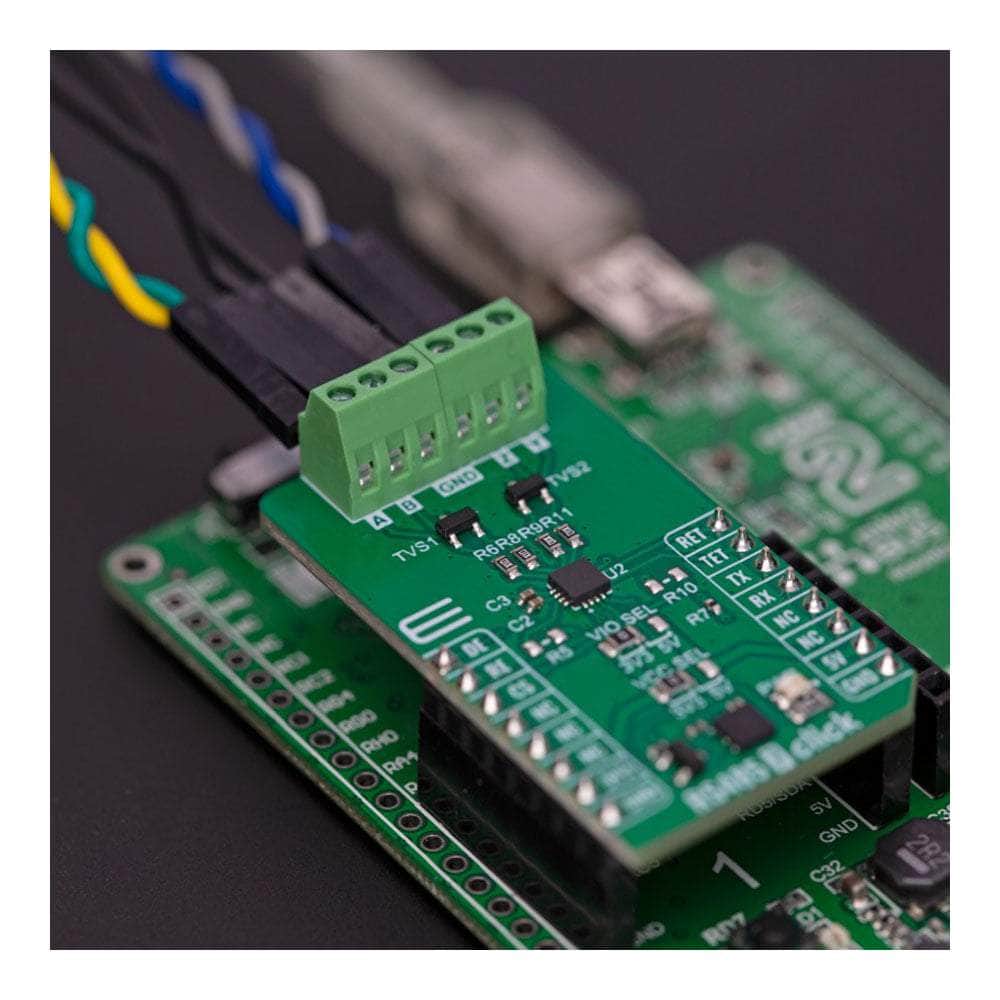
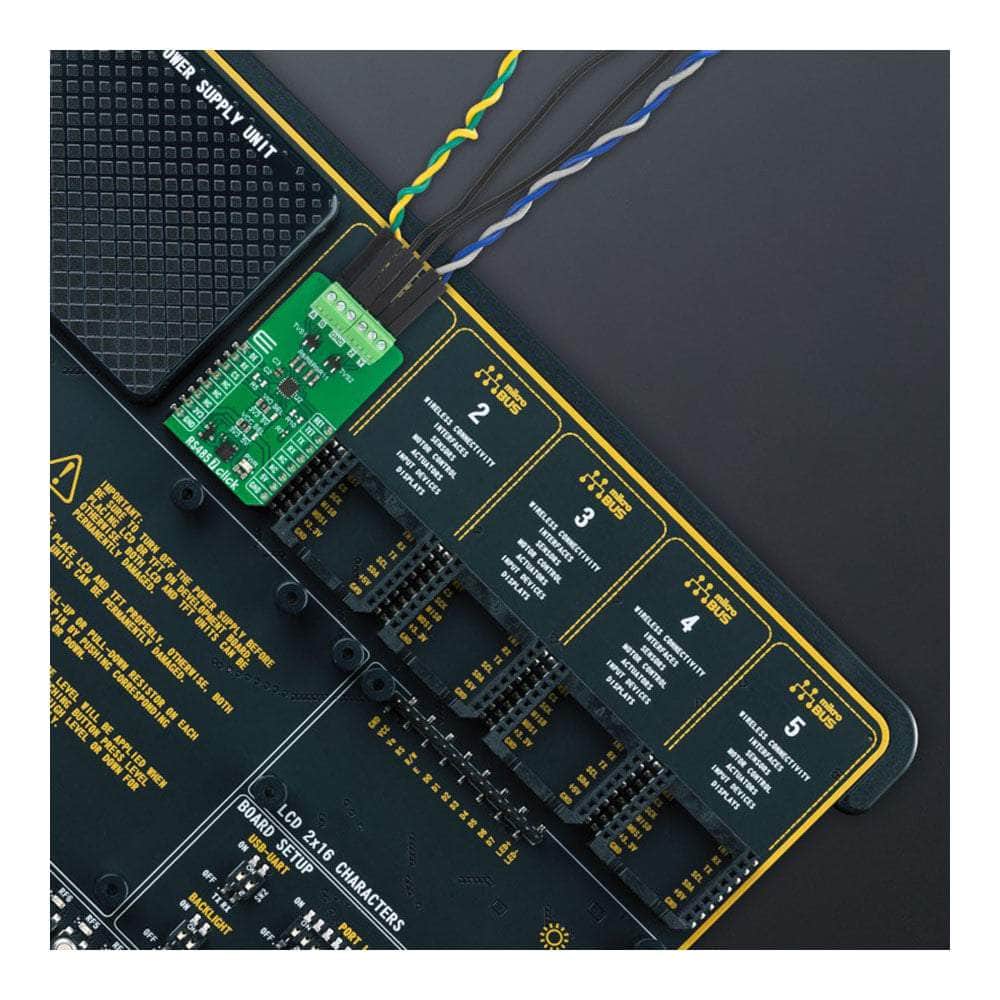
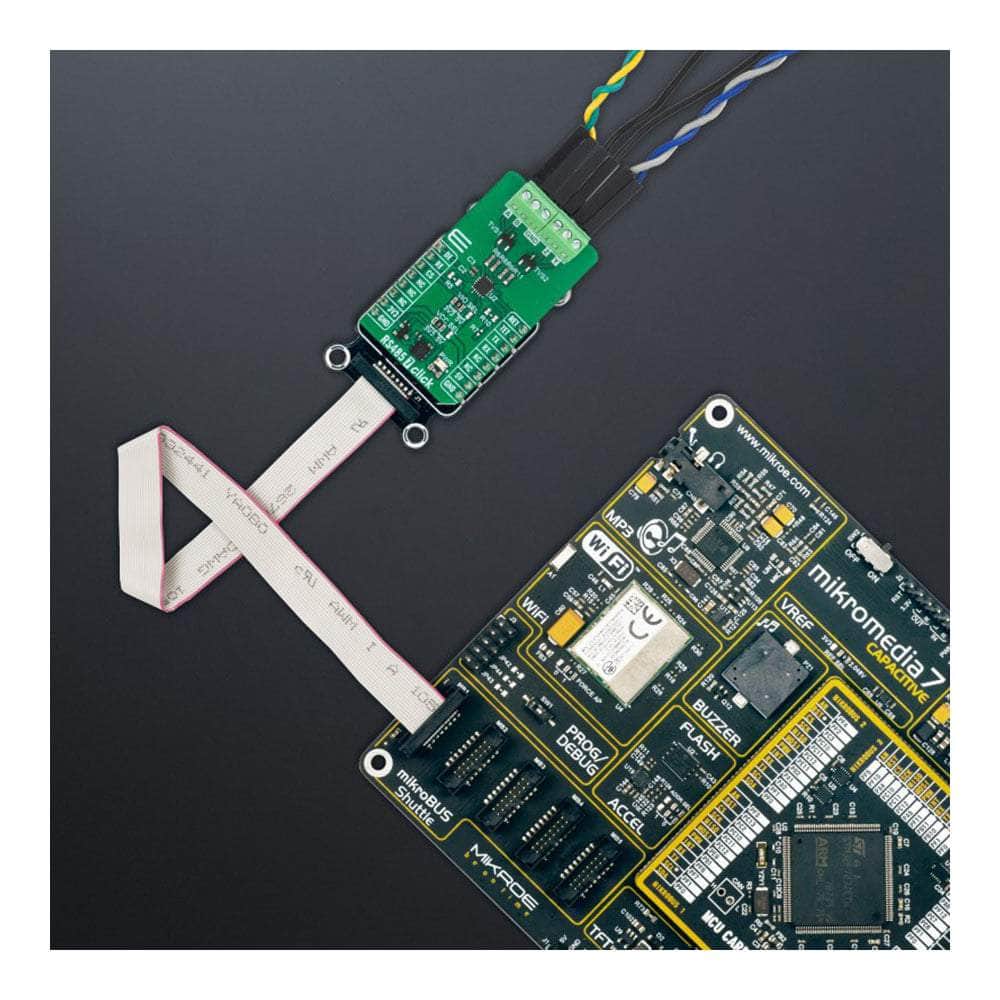
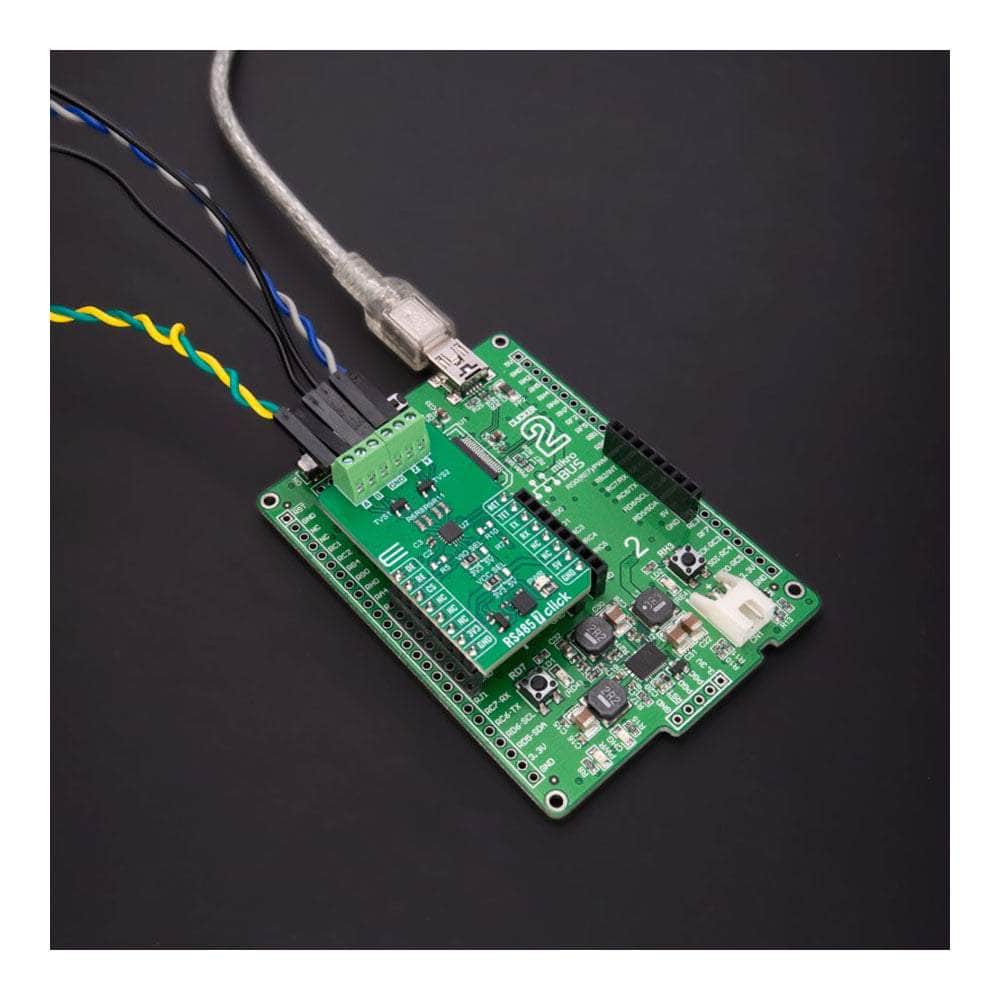
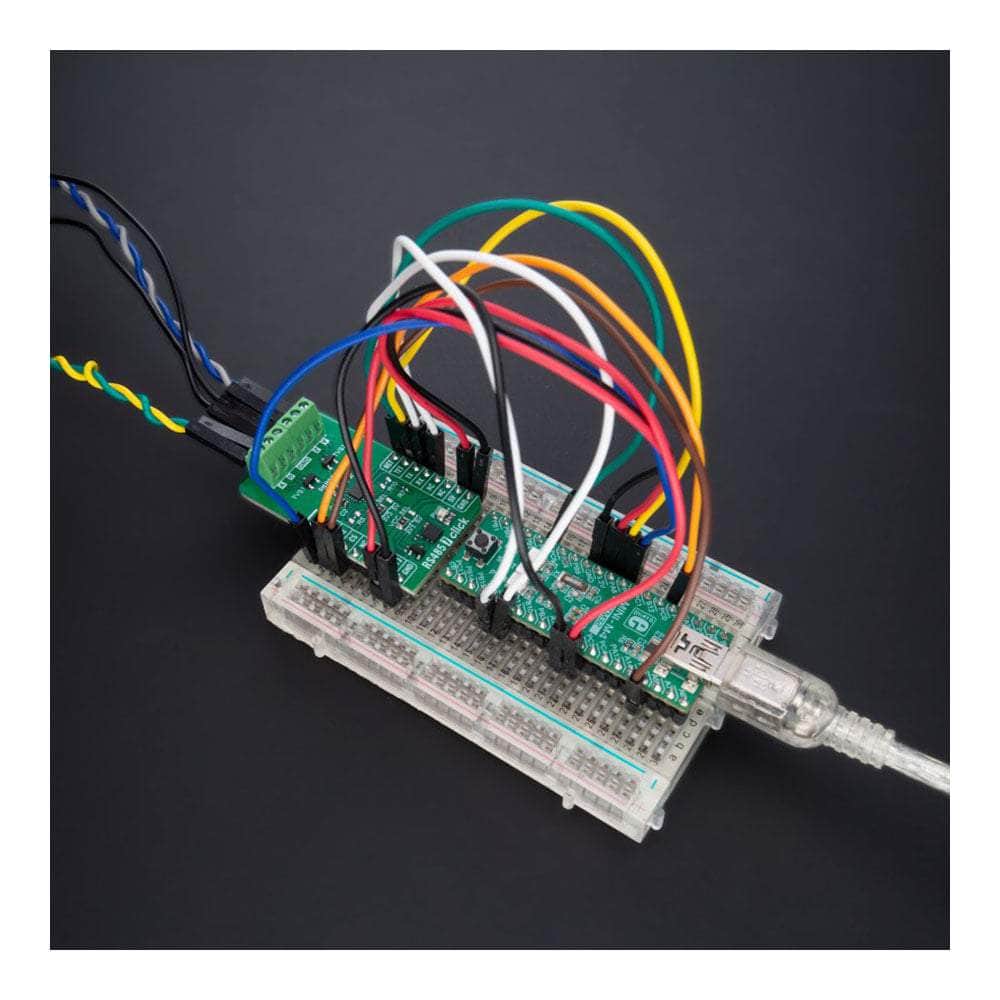
Maximize your efficiency with the RS485 7 Click Board™, supported by a mikroSDK-compliant library that includes user-friendly functions to simplify software development. Fully tested and ready for use, this Click board™ integrates seamlessly with any system equipped with the mikroBUS™ socket, allowing you to focus on what matters most—your project.
Upgrade Your Communication System Today
Don't let outdated technology hold you back. Invest in the RS485 7 Click Board™ and witness the remarkable difference it brings to your industrial communication network. Get ready to revolutionize your workflow and elevate your projects to new heights!
Downloads
How Does The RS485 7 Click Board™ Work?
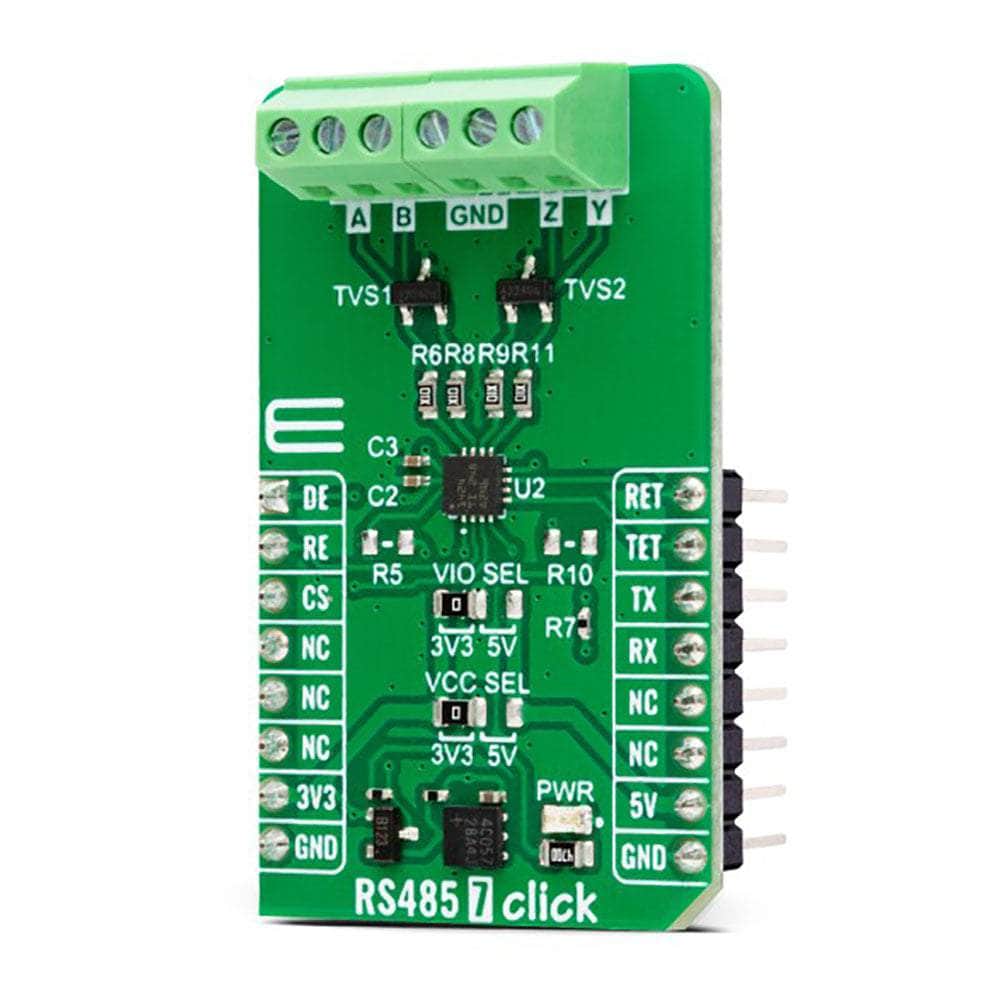
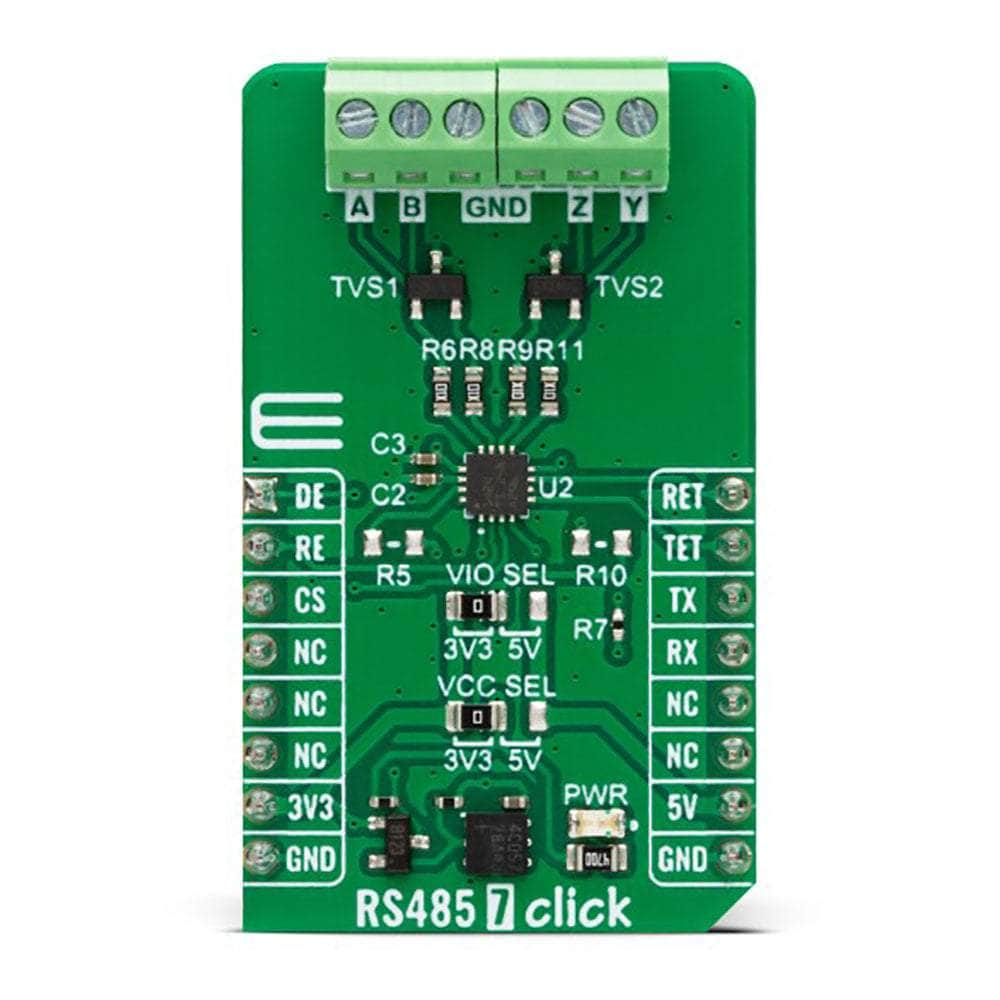
The RS485 7 Click Board™ is based on the THVD1424, a flexible RS-485 transceiver from Texas Instruments for asynchronous data transmissions. The THVD1424 has two termination resistors of nominal 120Ω, one across Y/Z and another across A/B. Both termination resistors are enabled or disabled using pins RET and TET pins of the mikroBUS™ socket, routed to the default positions of PWM and INT pins of the mikroBUS™ socket. Both termination resistors can be enabled or disabled, independent of the state of the driver or receiver. Termination is OFF if the device is unpowered or in thermal shutdown. Internal ESD protection circuits protect the transceiver against Electrostatic Discharges (ESD) according to IEC 61000-4-2 of up to ±8kV (Contact Discharge), ±15kV (Air Gap Discharge), and against electrical-fast-transients (EFT) according to IEC 61000-4-4 of up to ±4kV.
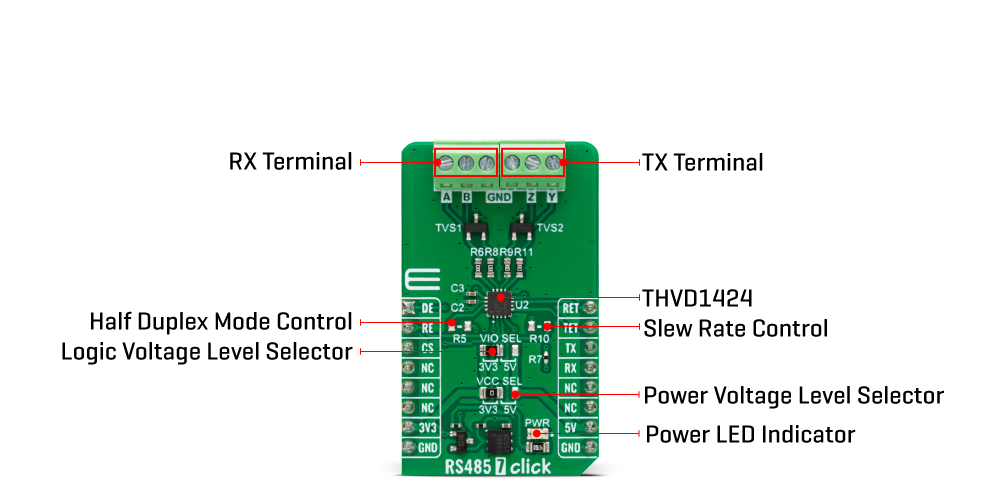
The THVD1424 RS-485 transceiver can be used in half-duplex or full-duplex RS-485 networks by populating an onboard R5 resistor. Full duplex mode is the default state of this board (with unpopulated R5 resistor), where Y and Z terminal pins are driver output pins, and A/B pins are receiver input pins. By populating the R5 resistor, Half duplex mode is activated where the driver and receiver share the same bus pins (Y/Z pins are both driver and receiver pins). The device state is then controlled via two mikroBUS™ pins labelled DE and RE (driver and receiver enable/disable), routed to the default positions of the AN and RST pins of the mikroBUS™ socket.
The THVD1424 can also be used in slow-speed or fast-speed RS485 networks by populating a slew rate control R10 resistor. By default, with the R10 resistor unpopulated, the maximum speed of operation for both driver and receiver is 20Mbps. By populating it, the maximum speed of operation for both driver and receiver is 500kbps, where the receiver path has an additional noise filtering feature enabled. The THVD1424 also has built-in protection features such as supply undervoltage, bus short-circuit, and thermal shutdown.
The RS485 7 Click Board™ can operate with either 3.3V or 5V logic voltage levels selected via the VIO SEL jumper. This way, both 3.3V and 5V capable MCUs can use the communication lines properly. Also, the main power supply of the RS485 transceiver can be selected between 3.3V or 5V voltage levels selected via the VCC SEL jumper. The wide common-mode voltage range and low input leakage on bus pins make this Click board™ suitable for multi-point applications over long cable runs. However, the Click board™ comes equipped with a library containing easy-to-use functions and an example code that can be used, as a reference, for further development.
SPECIFICATIONS
| Type | RS485 |
| Applications | It can be used for industrial and multi-point applications over long cable runs |
| On-board modules | THVD1424 - full duplex RS485 transceiver from Texas Instruments |
| Key Features | Highly flexible, selectable power and logic voltage levels, configurable half and full duplex mode, pin-configurable 120Ω termination resistor on bus pins, configurable data rate, bus I/O protection, low power consumption, glitch-free power-up/power-down for hot plug-in capability, protection features, and more |
| Interface | GPIO, UART |
| Compatibility | mikroBUS |
| Click board size | M (42.9 x 25.4 mm) |
| Input Voltage | 3.3V or 5V |
PINOUT DIAGRAM
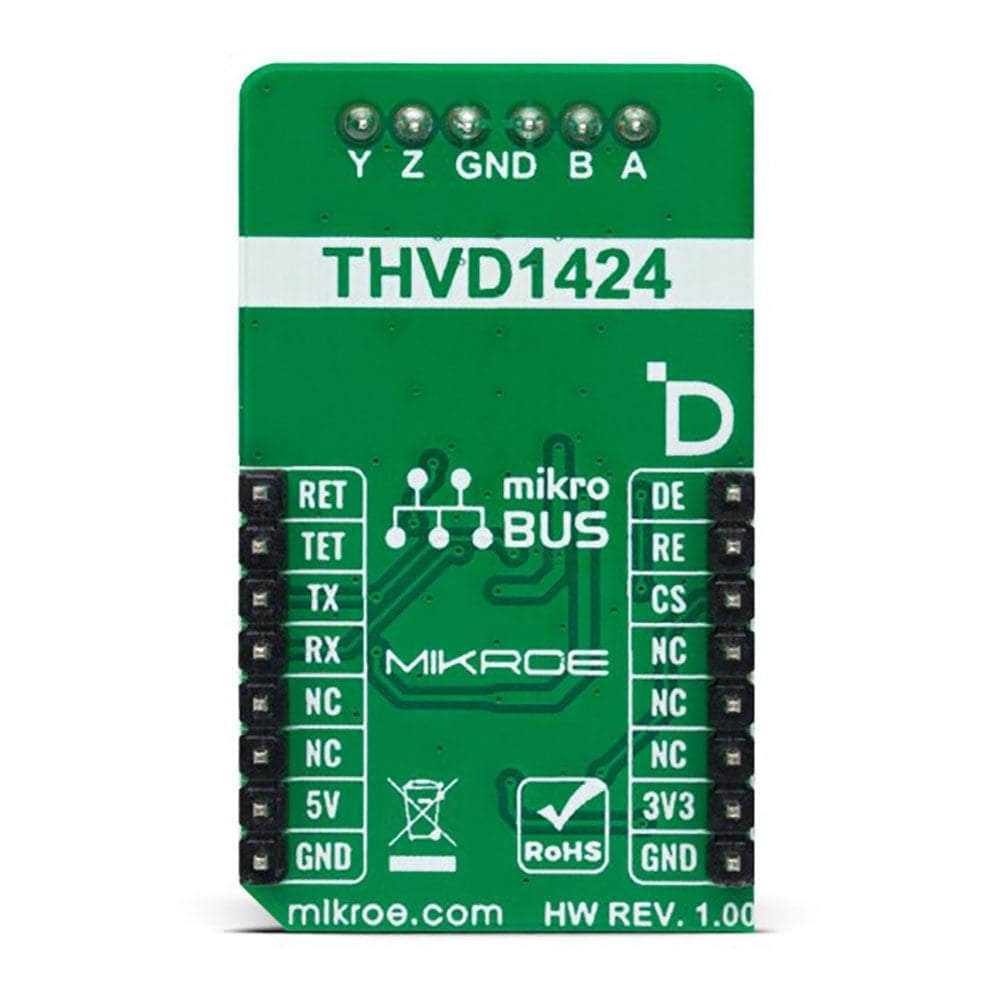
This table shows how the pinout of the RS485 7 Click Board™ corresponds to the pinout on the mikroBUS™ socket (the latter shown in the two middle columns).
| Notes | Pin |  |
Pin | Notes | |||
|---|---|---|---|---|---|---|---|
| Driver Enable | DE | 1 | AN | PWM | 16 | RET | RX Termination Control |
| Receiver Enable | RE | 2 | RST | INT | 15 | TET | TX Termination Control |
| NC | 3 | CS | RX | 14 | TX | UART TX | |
| NC | 4 | SCK | TX | 13 | RX | UART RX | |
| NC | 5 | MISO | SCL | 12 | NC | ||
| NC | 6 | MOSI | SDA | 11 | NC | ||
| Power Supply | 3.3V | 7 | 3.3V | 5V | 10 | 5V | Power Supply |
| Ground | GND | 8 | GND | GND | 9 | GND | Ground |
ONBOARD SETTINGS AND INDICATORS
| Label | Name | Default | Description |
|---|---|---|---|
| LD1 | PWR | - | Power LED Indicator |
| JP1 | VCC SEL | Left | Power Voltage Level Selection 3V3/5V: Left position 3V3, Right position 5V |
| JP2 | VIO SEL | Left | Logic Voltage Level Selection 3V3/5V: Left position 3V3, Right position 5V |
| R5 | R5 | Unpopulated | Half Duplex Mode Control Jumper |
| R10 | R10 | Unpopulated | Slew Rate Control Jumper |
RS485 7 CLICK ELECTRICAL SPECIFICATIONS
| Description | Min | Typ | Max | Unit |
|---|---|---|---|---|
| Supply Voltage | 3.3 | - | 5 | V |
| Data Rate | 0.5 | - | 20 | Mbps |
| ESD Protection | - | ±8 | - | kV |
| General Information | |
|---|---|
Part Number (SKU) |
MIKROE-5659
|
Manufacturer |
|
| Physical and Mechanical | |
Weight |
0.02 kg
|
| Other | |
EAN |
8606027384950
|
Questions and Answers
-
What Features Does the RS485 7 Click Board™ Offer?
The THVD1424 transceiver on the RS485 7 Click Board™ offers:
- pin-controlled on-chip 120Ω termination resistor
- pin-controlled slew rate control
- pin-controlled switching between half and full duplex mode
- IEC Contact Discharge ESD immunity, so no additional protection components are needed
- low power consumption and glitch-free power-up/power-down, which allow hot plug-in
On the Click board™, termination is switched from the mikroBUS™ pins, while slew rate and duplex mode are set by fitting resistors: R10 selects the 500kbps slew rate (20Mbps by default) and R5 selects half duplex (full duplex by default).
-
What Are the Benefits of Using the RS485 7 Click Board™?
The RS485 7 Click Board™ is designed for industrial and multi-point applications over long cable runs. It is compact, and a mikroSDK-compliant library simplifies software development.
-
Is the RS485 7 Click Board™ Easy to Use?
Yes. The RS485 7 Click Board™ is fully compatible with the mikroBUS™ standard and is ready for any system with a mikroBUS™ socket. A mikroSDK-compliant library simplifies software development.
-
What Applications Is the RS485 7 Click Board™ Suitable For?
Industrial automation, control systems, sensor networks, building automation and other industrial uses. The RS485 7 Click Board™ also suits multi-point applications over long cable runs.
No questions match your search.