
Lipowsky Industrie Elektronik GmbH
Lipowsky Baby-LIN-3-Single LIN Bus Simulator
Lipowsky Baby-LIN-3-Single LIN Bus Simulator
SKU: 8001022
Couldn't load pickup availability
Key Features
Overview
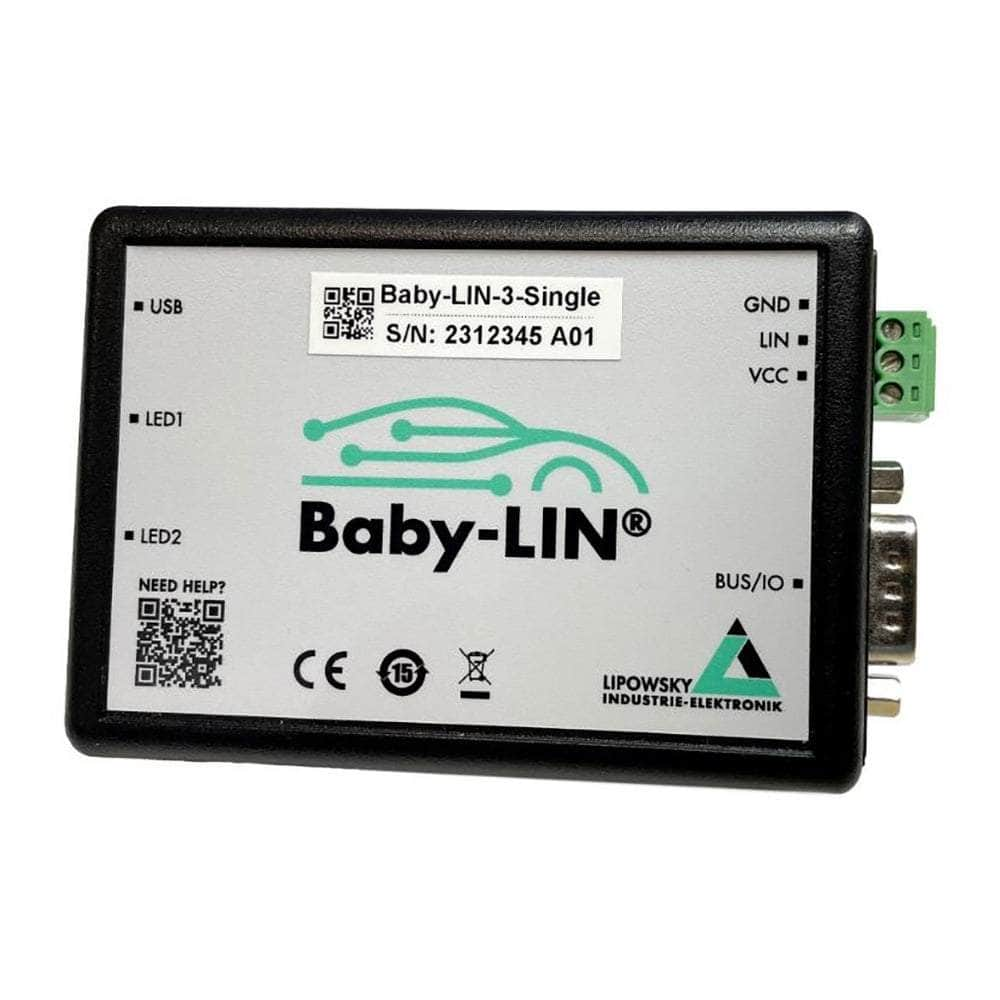
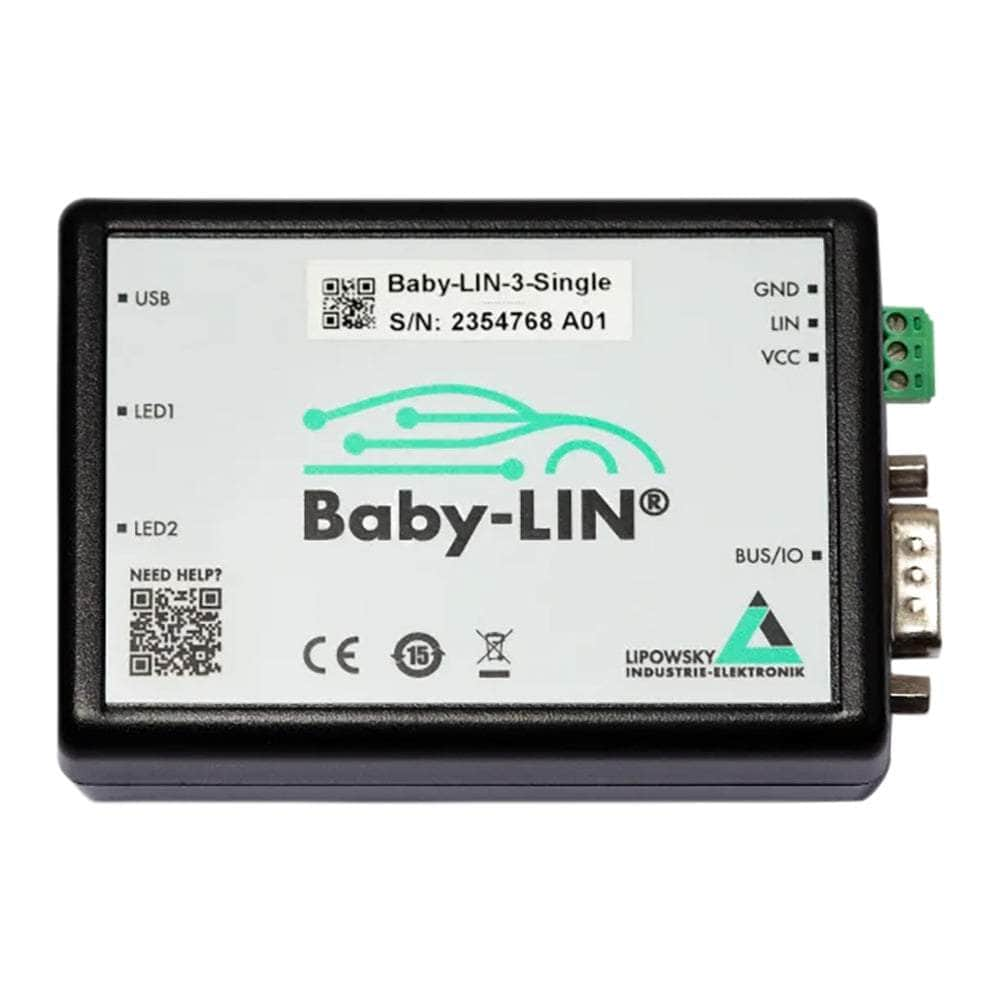
The Baby-LIN-3-Single is Lipowsky's single-channel USB LIN bus simulator: one galvanically isolated LIN interface, LIN 1.2 to 2.2 including Cooling and SAE J2602, 8 to 26 VDC, up to 115,200 baud, LIN on a 3-pin terminal and a male SUB-D9. It runs as master, slave or monitor from LINWorks or the Baby-LIN DLL, or stand-alone without a PC. For LIN plus CAN choose the Baby-LIN-3-Dual; for a keypad and display choose the Baby-LIN-3-RC.
Downloads
Datasheets
User Manuals
Quick Start Guides
Application Notes
Why Engineers Choose the Lipowsky Baby-LIN-3-Single LIN Bus Simulator
Accelerated Development Cycles
Reliable Test Environment Creation
Complete Protocol Coverage
The Lipowsky Baby-LIN-3-Single is a USB LIN bus simulator with one galvanically isolated LIN interface, support for LIN 1.2, 1.3, 2.0, 2.1 and 2.2, and an on-board voltage range of 8V to 26V. It runs as LIN master, LIN slave or passive monitor from a PC, and can also run stand-alone without a PC. It is aimed at ECU and actuator development benches, residual bus simulation and endurance test rigs where one LIN channel is enough.
LIN Master, Slave and Monitor from One USB Device
Connected to a PC, the Baby-LIN-3-Single lets the host act as LIN master, as one or more simulated slave nodes, or as a passive monitor on an existing bus. Logging works at up to 100% bus load. Frame data can be read and written in real time, and the Diagnostic Transport Layer (DTL) is supported for diagnostic requests and responses. The LIN interface is galvanically isolated.
Residual Bus Simulation and Stand-Alone Test Runs
As a LIN bus simulator, the Baby-LIN-3-Single replaces the rest of the vehicle network around the node under test: the master schedule and any missing slaves are simulated so a single ECU, sensor or actuator can be exercised on the bench. Simulations are built and run with the LINWorks PC software or from your own application. Once a simulation is loaded, the device can run it without a PC attached, for example for endurance runs, as Lipowsky suggests.
Software, DLL and Host Platforms
Each unit comes with a download licence for the LINWorks suite, which includes the PC software, sample files and documentation. LINWorks runs on Windows 10 and 11 (32 and 64-bit). For automated test, the LIN bus can be controlled from your own programs through the Baby-LIN DLL, available for Windows (x86 and x64), PC-based Linux and Arm-based Linux. The native interface is C/C++, with wrappers for .NET languages, Python, VB6 and LabVIEW. Arm Linux support means the Baby-LIN-3-Single can add a LIN interface to a Raspberry Pi as well as a desktop PC.
Specifications
| Host interface | USB 2.0 (480 Mbit/s), USB-C socket |
|---|---|
| LIN interfaces | 1, galvanically isolated |
| LIN versions | 1.2, 1.3, 2.0, 2.1, 2.2; Cooling and SAE J2602 |
| LIN baud rate | Up to 115,200 |
| Operating modes | LIN master, LIN slave, monitor; stand-alone operation without PC |
| Node simulation | LIN master and slave nodes |
| Diagnostics | Diagnostic Transport Layer (DTL) |
| Logging | Up to 100% bus load |
| On-board voltage | 8V to 26V |
| LIN connectors | 3-pin screw terminal and male SUB-D9 |
| Max. LIN cable length | 30 m |
| Processor | 480 MHz Arm Cortex-M7, 1 MB RAM |
| Operating temperature | -20 to +80 °C |
| Protection | IP20 |
| Size and weight | 92 x 66 x 28 mm, 90 g |
| Connector supplied | 3-pole screw-connection plug (MC 1,5/3-ST-3,81) |
| PC software | LINWorks suite, Windows 10/11 (32/64-bit) |
| DLL interface | Windows (x86, x64), PC-based Linux, Arm-based Linux |
| Programming languages | C/C++; wrappers for .NET, Python, VB6, LabVIEW |
Limitations
- One LIN channel only, and no CAN interface. For LIN plus high-speed CAN in one unit, choose the Baby-LIN-3-Dual.
- No display or keypad. For stand-alone operation with local control, choose the Baby-LIN-3-RC.
- The LINWorks PC software runs on Windows only. On Linux, control is through the DLL from your own code.
- The user manual, the LINWorks software package and firmware updates are downloaded from Lipowsky's site after registering.
Baby-LIN-3-Single Compared with the Baby-LIN-3 Range
| Model | Bus interfaces | Local control | Price ex VAT |
|---|---|---|---|
| Baby-LIN-3-Single (this product) | 1 x LIN | None, PC or stand-alone | £550 |
| Baby-LIN-3-Dual | 1 x LIN, 1 x CAN high-speed (ISO 11898-2), CAN FD by paid activation | None, PC or stand-alone | £720 |
| Baby-LIN-3-RC | LIN | Integrated keypad, display and I/O interface | £705 |
Typical Applications
Simulating the body controller master schedule to bench-test a LIN window-lift or seat motor ECU. Logging a fully loaded LIN 2.2 bus on a vehicle harness to trace a missing or corrupted frame. Driving a LIN sensor from a Python test script on a Raspberry Pi in an automated end-of-line or endurance rig.
The Baby-LIN-3-Single suits automotive electronics engineers developing or validating a single LIN node, and test engineers who need a scriptable, isolated LIN interface for a PC or embedded Linux host.
What's Included
- Baby-LIN-3-Single device
- USB-C 2.0 cable, 1m, type A to type C
- 3-pole screw-connection plug (MC 1,5/3-ST-3,81)
- SUB-D9 female plug with solder cups
- Download licence for the LINWorks suite (PC software, sample files, documentation)
Lipowsky's datasheet (v1.2, February 2026) lists the SUB-D9 plug; the web page does not. We will confirm the box contents on request.
Order the Baby-LIN-3-Single from £550 ex VAT. To check if your setup needs CAN as well as LIN, send us the bus details and we will confirm the right Baby-LIN-3 model, or request a formal quotation. See all LIN bus simulators.
Frequently Asked Questions
Does the Baby-LIN-3-Single Support CAN?
No. It has one LIN interface only. The Baby-LIN-3-Dual combines a LIN interface with a high-speed CAN interface (ISO 11898-2), which can be upgraded to CAN FD by paid activation.
Answered by John Legg, Director, Debug Store
Can I Control It from Python or LabVIEW on Linux?
Yes. The Baby-LIN DLL is available for PC-based and Arm-based Linux as well as Windows, with a native C/C++ interface and wrappers for Python, .NET, VB6 and LabVIEW. The LINWorks graphical software itself runs on Windows 10 and 11.
Answered by John Legg, Director, Debug Store
Last reviewed 30/10/2026.
Sources (3 manufacturer pages)
| Ordering information | |
|---|---|
| Part number (SKU) | 8001022 |
| Manufacturer | Lipowsky Industrie Elektronik GmbH |
| EAN | 5055383604586 |
| Warranty | 12 months |
| Shipping weight | 0.5 kg |
- 1 ×Baby-LIN-3-Single device
- 1 ×USB 2.0 cable, USB-A to USB-C, 1 m
- 1 ×3-pole plug with screw connection (MC 1,5/ 3-ST-3,81)
- 1 ×LINWorks suite download licence
Questions and Answers
-
How Does the Baby-LIN-3-Single Compare to Higher-end Automotive Test Equipment?
Premium automotive test systems may add protocols such as CAN-FD or FlexRay. The Baby-LIN-3-Single is a LIN-only device, so it suits LIN-specific applications.
-
Can Multiple Baby-LIN-3-Single Devices Be Used Simultaneously?
Lipowsky's public datasheet does not describe running several devices from one PC or synchronising them. Check the LINWorks documentation, or ask us, before planning a multi-device setup.
-
What Voltage Range Does the Device Support for Automotive Applications?
The Baby-LIN-3-Single runs from 8-26 VDC, which covers 12V automotive systems. A charging 24V system can exceed 26V, so check your supply's maximum before connecting.
-
Is the Baby-LIN-3-Single Compatible with the Baby-LIN-II?
Yes. LDF (LIN Description Files) and SDF (Session Description Files) created for the Baby-LIN-II work without changes once LINWorks is updated to the latest version. The software framework and DLL API are the same, so your test procedures and custom applications keep working. The hardware differs: USB-C instead of Mini-USB, and a larger enclosure.
-
What Improvements Does the Baby-LIN-3-Single Have Over the Baby-LIN-II?
The Baby-LIN-3-Single improves on the Baby-LIN-II and keeps your existing files working.
- 480 MHz Cortex-M7 processor, 60% faster than its predecessor
- 1 MB RAM
- High-speed USB 2.0 via USB-C, replacing Mini-USB
- LIN available on both a 3-pin terminal and a SUB-D9 connector
- Galvanic isolation between the PC and the bus electronics
- Larger enclosure, with an operating range of -20 to +80 °C
Existing LDF/SDF files transfer once LINWorks is updated.
-
Can the Baby-LIN-3-Single Operate Without a Connected PC?
Yes. Program test sequences in the LINWorks software, upload them to the device, and it runs continuous tests on its own. This suits endurance testing, production lines and long-duration automotive ECU validation.
-
What Makes the Baby-LIN-3-Single Suitable for LIN Testing?
The Baby-LIN-3-Single offers:
- Galvanic isolation
- A 480MHz processor
- LINWorks software
- Master and slave simulation modes
- LIN 1.2 to 2.2, plus Cooling and SAE J2602
- 3-pin, SUB-D9 and USB-C connections
-
How Does the Galvanic Isolation Benefit Automotive Testing Applications?
Galvanic isolation stops electrical interference between the PC and the target automotive electronics and breaks ground loops. This keeps data capture reliable during development and testing.
-
What Connection Options Are Available for Integrating with Automotive Systems?
The Baby-LIN-3-Single has both a 3-pin screw terminal connector and a male SUB-D9 connector. This covers setups from breadboard prototyping to test benches with standard automotive connectors.
-
What Is Included with the LINWorks Software Suite?
The included LINWorks licence provides:
- Session configuration tools
- LDF (LIN Description File) editing
- Bus monitoring software
- Data logging
- Macro programming for automated test sequences
- API libraries for custom application development in multiple programming languages
-
What LIN Protocol Versions Does the Baby-LIN-3-Single Support?
It supports LIN protocol versions 1.2 through 2.2, plus the Cooling and SAE J2602 standards. Baud rates up to 115,200 are supported for applications outside the LIN specification.

No questions match your search.