

Acute Technology, Inc
Acute Technology MSO3124E Mixed-Signal Oscilloscope - 6-in-1 Instrument | 200MHz | USB-Powered
Acute Technology MSO3124E Mixed-Signal Oscilloscope - 6-in-1 Instrument | 200MHz | USB-Powered
SKU: MSO3124E
Couldn't load pickup availability
Key Features
Overview
Revolutionary 6-in-1 Mixed-Signal Test Instrument
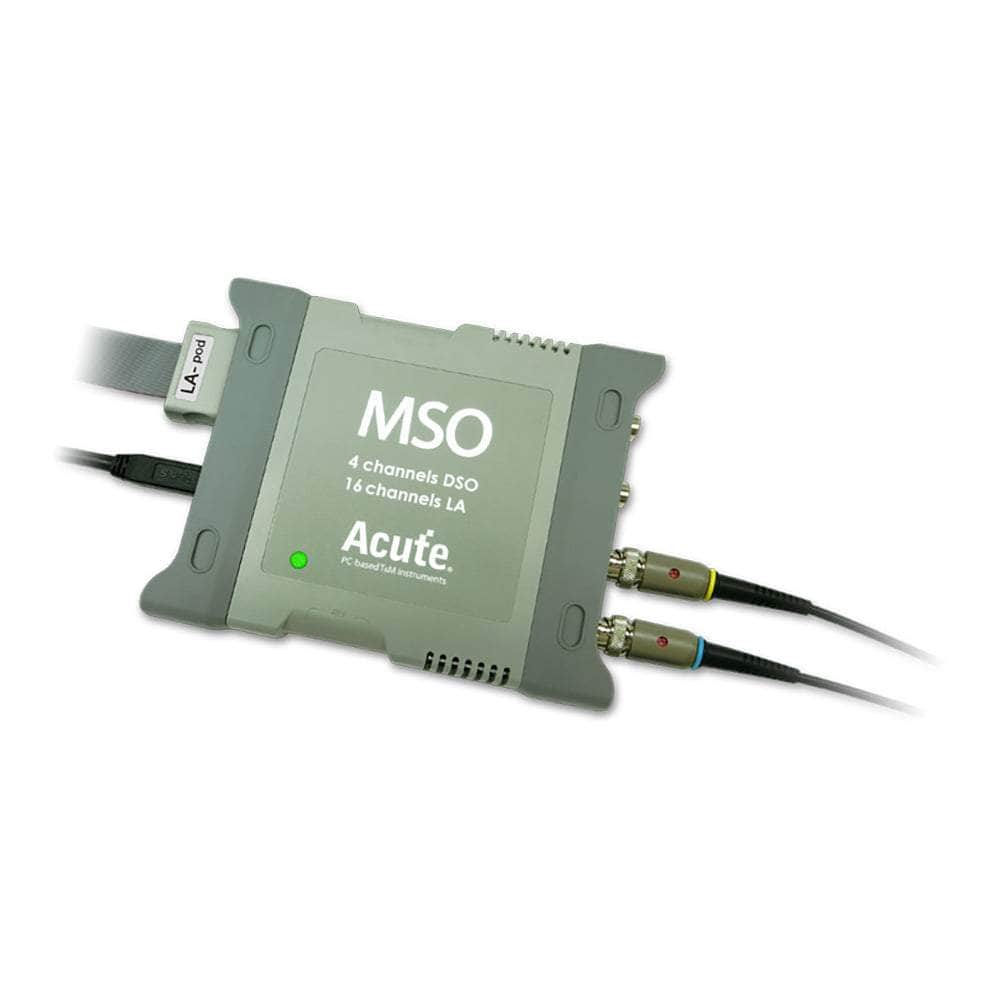
The Acute Technology MSO3124E represents a breakthrough in portable test equipment, combining six essential instruments into one compact, USB-powered unit. This innovative mixed-signal oscilloscope delivers professional-grade performance whilst requiring no external power supply, making it the ideal solution for field testing, laboratory work, and embedded system development.
Unmatched Versatility and Performance
Featuring 4 analog channels with 200MHz bandwidth and 1GS/s sampling rate, plus 16 digital channels with 2GS/s timing analysis, the MSO3124E enables comprehensive mixed-signal debugging. The instrument includes over 100 protocol decoders supporting modern interfaces including CAN 2.0B/FD, I²C, SPI, UART, USB PD 3.1, and MIPI I3C 1.1.1, ensuring compatibility with today's complex embedded systems.
PC-Based Flexibility
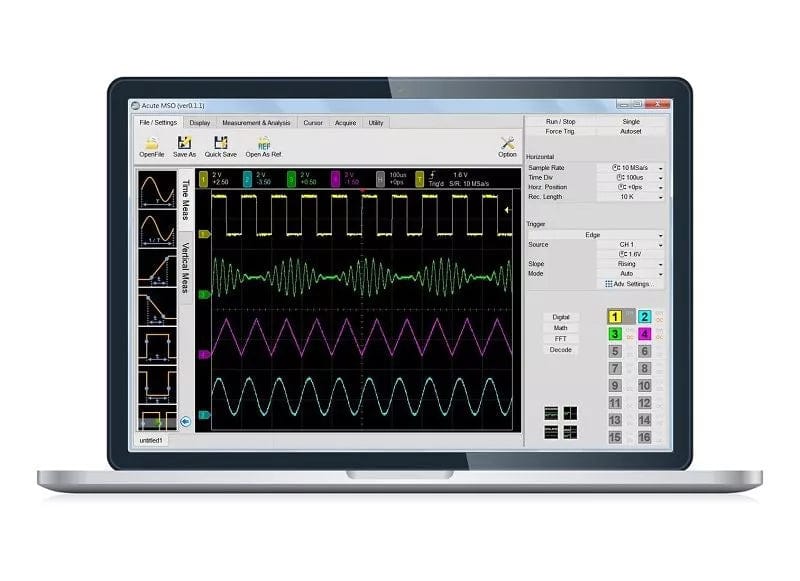
The MSO3000 series leverages your PC's processing power and display capabilities, providing superior analysis tools whilst maintaining exceptional portability. With 512Mpts record length per analog channel and 4Gb total memory, engineers can capture extended signal activity with remarkable detail. The streaming mode utilises PC RAM for virtually unlimited data capture duration.
The MSO3124E stands apart from traditional benchtop oscilloscopes through its unique combination of advanced features, USB bus power capability, and comprehensive protocol analysis. Available as part of the MSO3000 series alongside the MSO3124B and high-resolution MSO3124H variants, each optimised for specific application requirements.
Downloads
Why Engineers Choose The Acute Technology MSO3124E Mixed-Signal Oscilloscope - 6-in-1 Instrument | 200MHz | USB-Powered
Unmatched Portability
Comprehensive Analysis Capability
Superior Value Proposition
Open protocol interface
If the desired protocol is not included in the more than 100 protocol interpreters, or if there is a need to integrate a custom protocol, the open protocol interface of the MSO3000 series is a helpful feature. To implement a custom decoding function, simply write a Dynamic Link Library (DLL) and add it to the plugin folder of the installation directory. The structural design of the DLL describes the LA Open Decode Interface.
Multiple Trigger Functions
Edge Trigger: Trigger on a rising/falling/both/alternate edge.
Pattern Trigger: Trigger when the logic inputs make the selected function true.
Trigger Hold Off : Holdoff time adjustable up to 10s.
Runt Trigger: Use 2 voltage thresholds and pulse width to trigger on either alternating/positive/negative running signals.
Analogue: 4CH, 1 GS/s S/R, 200 MHz bandwidth
Group I: Edge, either, external, falling, rising, video, width
Group II: Runt, pattern/status, timeout, transition, setup/hold, B-trigger, B-event, window
Bus I: BiSS-C, CAN 2.0B/CAN FD, DALI, DP_Aux[1], I2C, I2S, LIN2.2, Modbus, Profibus, SENT, SPI, SVI2, UART UART(RS232), USB1.1, . ..
Bus II: SVI3[2], SVID[3]
[1] Optional DP_Aux adapter required.
[2] On request from an AMD approved user. SVI3 bus triggers/decoders are ONLY supported by MSO3124V.
[3] At the request of a user who has signed CNDA with Intel. SVID bus trigger/decoding are supported ONLY by MSO3124V.
Digital: 16 CH, 2 GS/s timing analysis, 250 MHz state analysis
Bus Trigger I: CAN2.0B/CAN FD, HID over I2C, I2C, I2S, LIN2.2, MIPI I3C 1.1, SENT, SPI, UART, USB PD 3.1, ...
Bus Trigger II: DALI, LPC, MDIO, Mini/Micro LED, MIPI RFFE 3, MIPI SPMI 2, PMBus, Profibus, SMBus, SVI2, ...
Bus Trigger III: eMMC 4.5, eSPI, MII, RGMII, RMII, SD 3.0 (SDIO 2.0), serial Flash (SPI NAND), SVI3[2], SVID[3]
Protocol Analyser I: CAN2.0B/CAN FD, HID via I2C, I2C, I2S, LIN2.2, MIPI I3C 1.1, SENT, SPI, UART, USB PD 3.1, ...
Protocol Analyser II: DALI, MDIO, Mini/Micro LED, MIPI RFFE 3, Modbus, PMBus, Profibus, SMBus, USB1.1
Protocol Analyser III: eSPI, MII, RGMII, RMII, SVI3[2], SVID[3]
Bus decoding: CAN 2.0B/CAN FD, DP_Aux[1], eSPI, I²C, I²S, MII, MIPI I3C 1.1, MIPI RFFE 3, MIPI SoundWire, SPI, SPI Flash, SVI3[2], SVID[3], UART , USB PD 3.1, ...(100+)
[1] Optional DP_Aux adapter required.
[2] ONLY on request from users authorised by AMD, SVI3 trigger & PA & bus decoding supported ONLY by MSO3124H/V.
[3] ONLY on request from users signed CNDA with Intel, SVID trigger and PA & bus decoding supported ONLY by MSO3124H/V.
| General Information | |
|---|---|
Part Number (SKU) |
MSO3124E
|
Manufacturer |
|
| Physical and Mechanical | |
Weight |
1.0 kg
|
| Other | |
EAN |
5055383616329
|
Questions and Answers
-
What Operating Systems Are Supported by the MSO3124E Software?
The MSO3124E software runs on Windows 7/8/10/11 (64-bit). Acute lists Linux and macOS support as a planned free update. It needs a USB 3.0 connection and at least 8GB RAM (16GB recommended).
-
Can Multiple MSO3124E Units Be Connected Together for More Channels?
Yes. Up to 4 MSO3124E units can be stacked with stack cables, giving up to 16 analogue channels with synchronised triggering from the master unit. The digital channel count stays at 16.
-
What Accessories and Probes Are Included with the MSO3124E?
The MSO3124E comes with:
- 250MHz oscilloscope probes
- logic analyser pod with LA20P flying lead cables
- grippers
- USB 3.0 Y cable with Type-C adapter
- stack cable
- carrying bag
-
How Does the Streaming Mode Work for Long-Term Data Capture?
On the logic analyser channels, streaming (transitional storage) sends data to the PC's hard drive or SSD for long recordings, limited by the PC's performance. It is not available with the analogue channels enabled. This suits intermittent fault detection and long-term monitoring of digital signals.
-
Which Model of the MSO3000 Series Is Best for Me?
The best MSO3000 model depends on your application. All models share the same 4-channel 200MHz analogue specification, 16 digital channels, USB bus-powered operation and 6-in-1 functionality.
- MSO3124E: entry-level model for general mixed-signal debugging, with basic triggering and cost-effective protocol analysis.
- MSO3124B: adds advanced triggering, including runt, pattern, timeout and bus triggers.
- MSO3124H: 16-bit high-resolution acquisition (at up to 100MS/s) for precision measurements, power integrity and low-noise work.
- MSO3124V: built-in electrical validation functions for I²C and MIPI I3C.
Intel SVID and AMD SVI3 support is available on the MSO3124H and V on request, subject to AMD approval or a signed Intel CNDA.
-
What Makes the MSO3124E Different From Traditional Benchtop Oscilloscopes?
The MSO3124E is USB bus-powered, so it needs no external power supply and is fully portable. It also combines six instruments in one compact unit, where traditional oscilloscopes need separate instruments for mixed-signal analysis:
- oscilloscope
- logic analyser
- protocol analyser
- DVM
- frequency counter
- data logger
-
Which Protocols Does the MSO3124E Support for Analysis and Triggering?
The MSO3124E supports over 100 protocol decoders, including CAN 2.0B/CAN-FD, I²C, SPI, UART, USB PD 3.1, MIPI I3C 1.1.1, I²S, LIN2.2, Modbus and PMBus. It offers protocol decoding, plus protocol triggering on the logic analyser channels.
-
Can the MSO3124E Be Used for Automotive ECU Development and Diagnostics?
Yes. The MSO3124E has dedicated CAN 2.0B and CAN-FD support, works with differential probes and offers mixed-signal analysis for automotive electronics development and diagnostics.
-
How Does the MSO3124E Compare to More Expensive Tektronix or Keysight Mixed-Signal Oscilloscopes?
Premium instruments offer higher bandwidth options, but the MSO3124E costs a fraction as much. It includes 100+ protocol decoders (often expensive options on premium scopes), USB portability and 6-in-1 functionality.
-
What Is the Maximum Record Length and Sampling Rate of the MSO3124E?
Analogue: 512Mpts at 1GS/s with one channel, falling to 128Mpts at 250MS/s with all four channels (record length halves when the logic analyser channels are also active). Digital: 512Mpts at 2GS/s on 8 channels, or 256Mpts at 1GS/s on all 16. Streaming to the PC extends logic analyser captures.
-
Is the MSO3124E Suitable for Power Electronics and SMPS Design?
Yes, for general SMPS work. The MSO3124E has 200MHz bandwidth, works with differential probes and decodes power management buses such as PMBus. It has the basic trigger set (edge, width and video). If you need runt, timeout or bus triggers, choose the MSO3124B, or the MSO3124H for 16-bit resolution.
No questions match your search.