

Total Phase, Inc
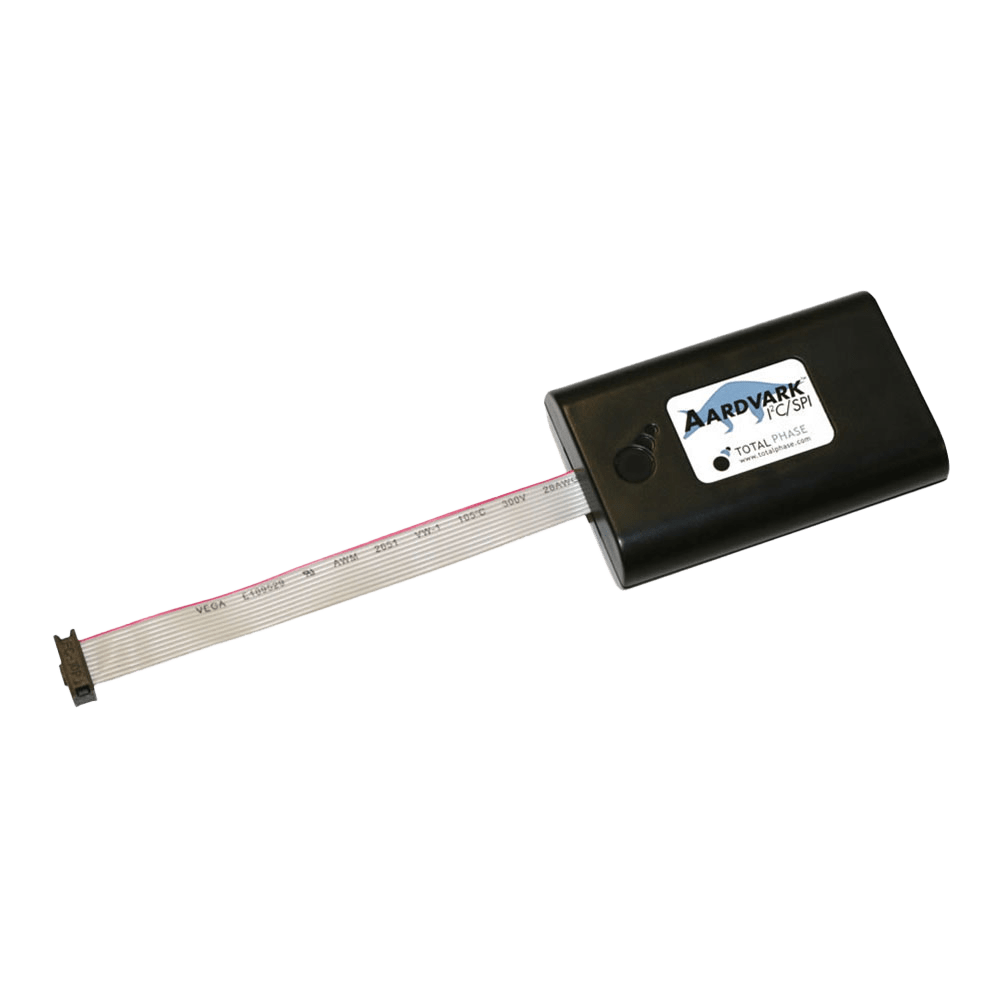
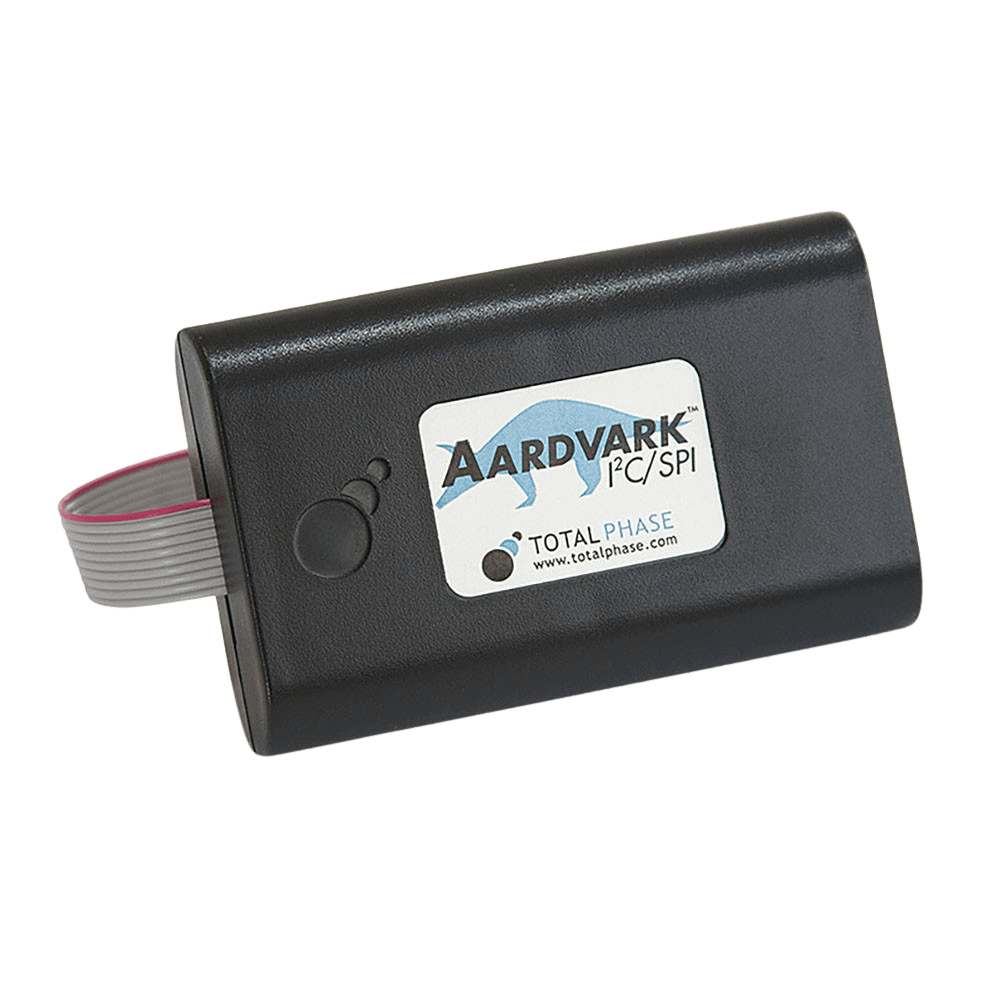
Total Phase Aardvark I2C/SPI Host Adapter
Total Phase Aardvark I2C/SPI Host Adapter
SKU: TP240141
Couldn't load pickup availability
Key Features
Overview
Buy an Aardvark I2C/SPI and get 10% off a Beagle I2C/SPI*
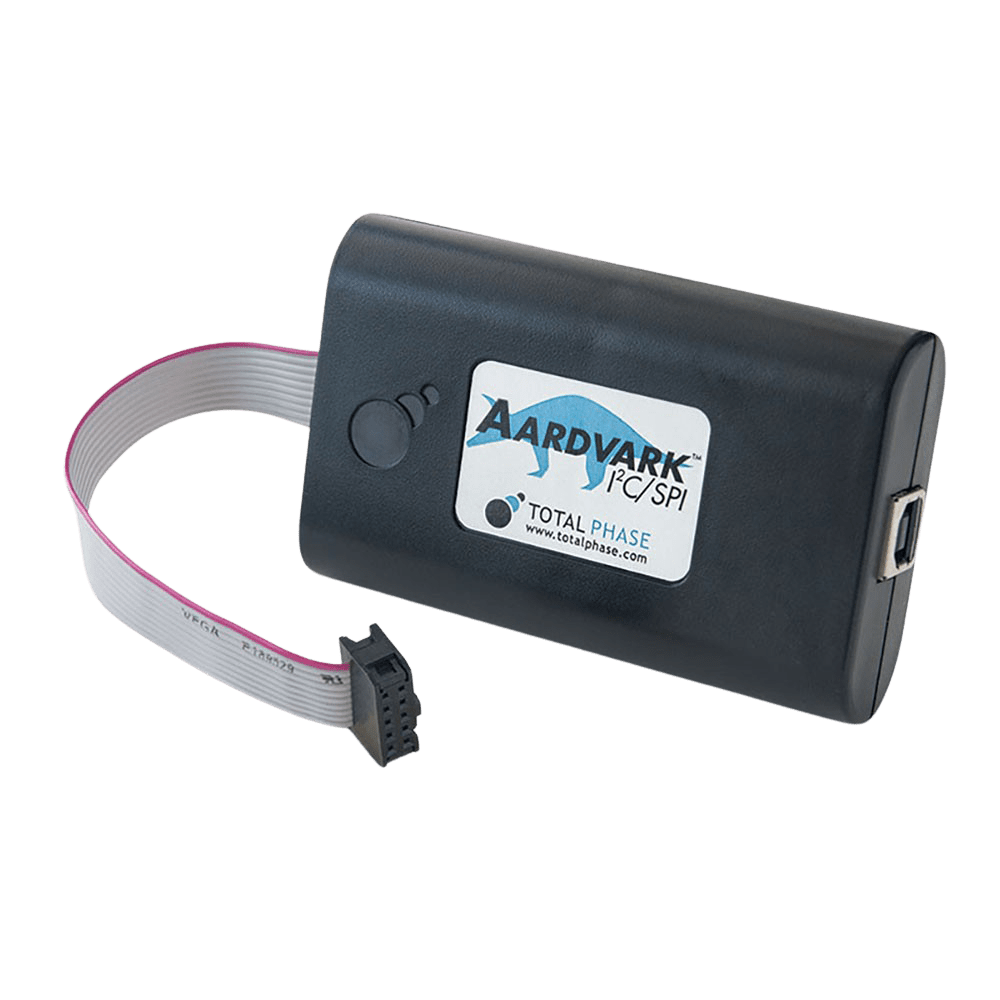
The Total Phase Aardvark I2C/SPI Host Adapter is a USB-powered tool that enables direct, bidirectional communication with I2C and SPI devices from a Windows, Linux or macOS computer. It supports master and slave operation up to 800 kHz for I2C and up to 8 MHz/4 MHz for SPI master/slave, making it suitable for sensor evaluation, EEPROM/Flash programming, and automated test workflows. The standard 2×5 IDC target connector provides I2C, SPI and up to six GPIO lines; +5 V target power is available for low-current devices.
The Total Phase Aardvark is a widely adopted industry-standard tool for I2C and SPI development and debugging workflows.
The included Control Center Serial software simplifies configuration and message transactions, with XML batch scripting for automation. Flash Center streamlines programming of I2C and SPI memories using an extensible parts library. Cross‑platform APIs (C/C/C#, Python, .NET) and LabVIEW drivers are available for integration into custom tooling.
Aardvark sits within a family of Total Phase tools: the higher‑performance Promira Serial Platform adds integrated level shifting and much higher I2C/SPI speeds, while the Beagle I2C/SPI Protocol Analyzer provides non‑intrusive bus capture—often used alongside Aardvark for concurrent generate‑and‑monitor workflows.
For engineers who need a dependable, well‑supported host adapter for everyday I2C/SPI bring‑up and production scripting, Aardvark delivers capability without complexity.
Technical Specifications Summary (I2C/SPI Engineering Overview)
The Total Phase Aardvark I2C/SPI Host Adapter (TP240141) is a professional-grade USB to I2C/SPI adapter designed for embedded development, debugging, and production test environments.
Key Technical Capabilities
- I2C master and slave operation up to 800 kHz
- SPI master up to 8 MHz and SPI slave up to 4 MHz
- Standard 2×5 IDC interface with I2C, SPI, and GPIO support
- Up to 6 configurable GPIO lines for control and monitoring
- USB-powered device (no external power supply required)
- Cross-platform support: Windows, Linux, and macOS
- API support for C, C++, C#, Python, and .NET
- Works with Control Center and Flash Center software tools
This specification set makes the Aardvark one of the most widely used I2C SPI protocol adapters in professional engineering environments.
Where the Aardvark Fits in Development Workflows
The Aardvark is commonly used as a bridge between software and hardware in embedded systems development and is typically used for:
- Early-stage hardware bring-up
- Firmware development and register-level debugging
- Sensor and peripheral validation over I2C
- SPI Flash and EEPROM programming
- Manufacturing test automation workflows
- Regression testing of embedded firmware
- Device communication verification before production release
This makes it a core tool for engineers working with I2C and SPI communication debugging and validation.
Downloads
Why Engineers Choose The Total Phase Aardvark I2C/SPI Host Adapter
Industry Standard Tool
Master/Slave Flexibility
Complete Software Ecosystem
Full Description
The Total Phase Aardvark I2C/SPI Host Adapter is a USB-powered host adapter designed for electronic design engineers who need reliable, controllable access to I2C and SPI buses during bring-up, debugging, and production scripting. Operating as both master and slave, it supports I2C at up to 800kHz and SPI at up to 8MHz in master mode (4MHz in slave mode), with a standard 2×5 IDC target connector exposing I2C (SCL/SDA), SPI (MOSI/MISO/SCLK/SS) and up to six GPIO signals. It interfaces over USB to Windows, Linux, and macOS, and is supplied with the Control Center Serial GUI, Flash Center programming utility, and cross-platform APIs for C/C/C#, Python and .NET. With target power output available at +5V for low-current devices and a compact footprint that fits easily on a crowded bench, it provides a dependable link between a computer and digital peripherals without imposing unnecessary complexity.
USB to I2C Master/Slave Control up to 800kHz for Fast Bring-up
As an I2C host adapter, the Aardvark operates in both master and slave modes across typical development speeds from a few kilohertz up to 800kHz. This covers Standard-mode (100kHz) and Fast-mode (400kHz) devices comfortably and provides headroom for designs that push closer to 800kHz during evaluation. Master mode enables scripted register access, burst reads, and device initialisation sequences, while slave mode allows engineers to emulate peripherals to test a host SoC’s behavioural edge cases. In practice, this means a board with a temperature sensor and an EEPROM can be validated quickly by writing configuration registers, verifying ACK/NACK behaviour, and reading back calibration data under repeatable conditions. The direct benefit is reduced time-to-first-success during board bring-up: with deterministic control of bit rate, addressing (7-bit/10-bit), and transaction framing, engineers can focus on root cause rather than fighting tool setup.
SPI Master to 8MHz and Slave to 4MHz for Peripheral Exercise
On SPI, Aardvark supports master mode up to 8MHz and slave mode up to 4MHz, with control over mode (CPOL/CPHA), bit order, and chip select handling across the 2×5 IDC header. These rates are well suited to common flash memories, DACs/ADCs, motor controllers and LED drivers that are rarely exercised above 10MHz during early validation. By driving deterministic patterns and parsing responses in the same session, an engineer can rapidly iterate on timing hypotheses—switching between Mode 0 and Mode 3, for example—to isolate sampling edge issues. When used as an SPI slave, Aardvark can emulate a sensor or memory device to verify that a microcontroller’s SPI driver adheres to command framing and timing requirements, a practical way to catch off-by-one and CS deassertion bugs before firmware freeze. The measurable outcome is fewer lab cycles and clearer pass/fail criteria for interface readiness.
Standard 2×5 IDC Target Connector with I2C, SPI and up to Six GPIOs
The adapter’s 2×5 IDC (2.54mm pitch) target connector presents a predictable, lab-friendly pinout: I2C (SCL, SDA), SPI (MISO, MOSI, SCLK, SS), ground, +5V target power for low-current devices, and up to six GPIO lines. Engineers benefit from quick swaps between fixtures and DUTs using ribbon cables that are already commonplace on mixed-signal benches. GPIOs can toggle control pins such as resets, enables, or mode selects, or sample status lines to coordinate test steps. This consolidation reduces the need to juggle multiple USB widgets for simple digital manipulation. In a concrete scenario, a GPIO can hold a PMIC in shutdown while SPI writes a configuration to a companion device; then a GPIO release triggers power-up to verify a clean boot sequence under scripted control.
Control Center Serial GUI for Interactive Debugging and Repeatable Automation
The supplied Control Center Serial application makes the Aardvark immediately productive without writing code. Engineers can configure bit rates (I2C up to 800kHz; SPI up to 8MHz), bus modes, and active lines, then compose transactions interactively to poke registers or stream data. Crucially, the GUI supports batch execution via XML scripts, so a proven manual sequence can be captured once and re-run as an automated regression across firmware revisions or PCB spins. This is particularly useful for validating that a board still boots and enumerates properly after an ECO, or that an I2C expander’s configuration survives power cycles. For teams, scripts become lightweight test fixtures—repeatable, reviewable, and version-controlled—without the upfront cost of a full test framework.
Flash Center Utility for I2C/SPI EEPROM and Flash Programming
For memory programming tasks, the Flash Center utility streamlines operations on I2C and SPI EEPROMs and NOR flash devices using an extensible parts library. Engineers can select a device, set the required speed (e.g., I2C at 400kHz for 24-series EEPROMs or SPI at several megahertz for 25-series flash), and program images with automatic page handling and erase/write sequencing. This saves time compared to hand-coding page-aligned transactions and status polling, and reduces the chance of subtle mistakes such as failing to wait for WIP bits to clear. In production support, this enables quick field updates to peripheral images or calibration data. During development, it’s invaluable for restoring golden images after deliberate corruption tests or validating that bootloaders correctly read a known-good payload.
Cross-Platform APIs for C/C/C#, Python and .NET to Integrate with Test Benches
The Aardvark includes cross-platform APIs and bindings for C, C++, C#, Python and .NET on Windows, Linux and macOS. This allows the adapter to plug into existing test harnesses and CI pipelines. Engineers can write concise scripts to exercise I2C at 100kHz for power-on defaults, then switch to 800kHz to stress-read buffers, or sweep SPI from 1MHz to 8MHz to bracket timing margins. Return codes and exceptions can be mapped directly to pass/fail criteria and logged alongside firmware and PCB revision identifiers. Integrating these scripts with a logic analyser such as a Saleae mixed-signal instrument provides protocol decode corroboration, so a single test run both drives traffic and captures waveforms for later review, tightening feedback loops between hardware and firmware.
Master/Slave Emulation for Host and Peripheral Testing
Bidirectional capability is central to the Aardvark’s role in the lab. In master mode, it stands in for a microcontroller to validate sensors, PMICs, expanders, and displays before firmware is stable. In slave mode, it emulates the target peripheral to harden host drivers, particularly valuable when the real device is back-ordered or when controlled error injection is needed. For instance, by emulating an I2C temperature sensor that NACKs every fourth transaction at 400kHz, firmware robustness to transient errors can be characterised without specialised fixtures. Similarly, an SPI slave emulation at 4MHz can check that the host asserts chip select for the entire frame and respects required inter-byte delays, preventing field issues caused by marginal timing.
Everyday Debugging Scenarios: From Simple Checks to Edge Cases
In a simple scenario, an engineer validating a new sensor board uses I2C master mode at 100kHz to read WHO_AM_I, confirms the expected ID, then increases to 400kHz to stream measurements while adjusting GPIO-controlled ranges. If a register write appears ineffective, a quick cross-check with a logic analyser’s protocol decode confirms a missed stop condition; adjusting the transaction resolves it immediately. In another common case, programming a 25-series SPI flash at 8MHz to load a boot image takes minutes via Flash Center, after which the engineer uses slave mode at 4MHz to emulate a slightly slower device and ensure the host tolerates extended busy times. For edge cases, an engineer can script mid-transaction resets using a GPIO line while monitoring bus behaviour, reproducing elusive bugs such as stuck lines or CS race conditions and capturing them for the firmware team to fix.
Power and Physical Considerations for Bench Efficiency
The adapter is USB bus-powered, eliminating an external PSU and simplifying bench wiring. Target power at +5V is available for low-current devices, which is convenient when validating small breakout boards or low-power peripherals that do not yet have a stable on-board supply. The compact enclosure and standard ribbon cable reduce strain on fragile headers and make it straightforward to leave the adapter connected during extended testing. Engineers focused on 1.8V targets can pair the Aardvark with a suitable level shifter to align logic thresholds, maintaining signal integrity while exercising devices at representative speeds. This modular approach avoids over-investing in features that are only occasionally required, while keeping the core interface accessible and predictable.
Choosing the Right Tool in the Total Phase Ecosystem
The Aardvark sits alongside other Total Phase tools to cover a wide range of serial workflows. For designs that need much higher bus speeds or integrated, selectable voltage levels, consider stepping up to the Promira Serial Platform, which extends I2C into the multi-megahertz range and SPI beyond tens of megahertz with configurable level shifting and additional I/O resources. For non-intrusive capture and deep timing analysis, pair the Aardvark with a protocol analyser such as a Saleae mixed-signal logic analyser; this combination lets one tool generate traffic while the other provides timestamped protocol decode and waveform context. Where SPI throughput alone is critical at higher master rates, the Cheetah SPI Host Adapter is an alternative optimised for speed. Selecting among these options ensures the lab covers generation, capture, and performance corners without redundancy.
Aardvark vs Other I2C/SPI Tools
When selecting an I2C SPI host adapter, it is important to understand how the Aardvark compares to other tools in the same category.
Aardvark vs Low-Cost USB I2C Adapters
Basic USB-to-I2C converters typically:
- Only support master mode
- Lack SPI support or advanced control
- Do not include APIs or automation tools
The Aardvark provides:
- Full master and slave operation
- SPI support up to 8 MHz
- Professional-grade APIs and scripting tools
- Reliable use in production environments
Aardvark vs Total Phase Promira Serial Platform
The Promira Serial Platform is designed for higher-performance applications.
- Promira → higher speed, advanced voltage control, extended features
- Aardvark → cost-effective, widely used for everyday development and debugging
For most engineering workflows, the Aardvark provides the ideal balance of capability and simplicity.
Aardvark vs Beagle Protocol Analyzer
- Aardvark → active communication tool (generates I2C/SPI traffic)
- Beagle → passive monitoring tool (captures and analyses bus traffic)
Many engineers use both together for full debugging visibility.
Who Should Use the Total Phase Aardvark
The Aardvark I2C/SPI Host Adapter is ideal for:
- Embedded systems engineers
- Firmware developers
- Hardware validation engineers
- Electronics design teams
- Production test engineers
- R&D laboratories
- University engineering departments
It is especially useful where direct USB to I2C SPI communication is required for testing and automation.
UK Availability – TP240141 Total Phase Aardvark
The Total Phase Aardvark I2C/SPI Host Adapter (TP240141) is available for purchase in the UK from The Debug Store with full manufacturer compatibility and official software support.
It is widely used as a USB to I2C SPI adapter for embedded development, firmware debugging, EEPROM programming, and SPI Flash programming applications.
Engineers in the UK looking for a reliable I2C SPI host adapter often choose the Aardvark for its proven performance and cross-platform support.
Whether referenced as:
- Total Phase Aardvark UK
- Aardvark I2C SPI host adapter
- USB to I2C SPI adapter
- TP240141 Total Phase Aardvark
This product remains a standard tool in professional embedded engineering workflows
Related Products
For higher performance and integrated level shifting, explore the Total Phase Promira Serial Platform serial host adapter. For dedicated high-speed SPI generation, see the Total Phase Cheetah SPI Host Adapter for fast SPI master. To complement Aardvark with capture and protocol decode, consider a Saleae logic analyser mixed-signal instrument for protocol decode and timing correlation during debugging. If low-voltage targets are common, add a suitable level shifter; pairing Aardvark with a Total Phase Level Shifter Board for I2C/SPI voltage translation helps maintain signal integrity on 1.8V or 2.5V buses.
| General Information | |
|---|---|
Part Number (SKU) |
TP240141
|
Model |
|
Manufacturer Manufacturer of the product
|
|
| Functional Features | |
Applications |
|
| Electrical | |
Power Source |
|
Interface Types |
|
Interface Features |
|
Interface Speed |
|
Interface Connections |
|
| Software | |
Included Software |
|
Software Updates |
|
Host OS Compatibility Works with these Operating Systems
|
|
API/SDK |
|
Automation |
|
| Physical and Mechanical | |
Dimensions |
|
Weight |
1.0 kg
|
Operating Temperature |
|
| Other | |
Certifications |
|
EAN |
5055383601769
|
Questions and Answers
-
How Long Is the Aardvark Warranty?
2 years. The warranty period is also shown in the warranty details on this page.
-
Can My Aardvark Be Upgraded?
Yes. The Aardvark firmware is stored in internal flash memory and can be updated free of charge when Total Phase releases new firmware. -
How Is the Aardvark Powered?
The Aardvark is powered from the host computer over USB and draws less than 100 mA, so no external power supply is needed. It can also supply +5 V to a target on pins 4 and 6 of the 10-pin connector, up to 25 mA per pin (hardware v2.00 and later), which suits small low-current target boards. -
Does the Aardvark Support I2C Clock Stretching?
Yes, the Aardvark supports clock stretching as a Master or a Slave.
Only the slave device can initiate clock stretching, to extend an I2C bus cycle. Not all I2C master or slave devices support it, so check this if you rely on clock stretching.
-
Can the Aardvark Support Multiple Slave Addresses?
Yes and no. The Aardvark can only act as one I2C address node at a time, but you can change the slave address as required using the Aardvark API software. -
The Aardvark Supports I2C and SPI Buses. Can It Be Used with Any Other Interfaces?
Yes. The Aardvark host adapters also support:- Display Data Channel (DDC)
- System Management Bus (SMBus)
- Power Management Bus (PMBus)
- Smart Battery Bus (SBBus)
- Intelligent Platform Management Interface (IPMI)
- Two-Wire Interface (TWI)
-
What Problems Does the Total Phase Aardvark i2C/SPI Host Adapter Solve?
It connects a computer to I2C and SPI devices so you can debug, test and program them. This saves development time and reduces the risk of damaging the target device during testing and debugging. -
Is Their a CAD File Available for This Part?
No, the design files are proprietary. The Aardvark is a simple shape that is easy to measure for placing in your equipment, and many customers build it into production test rigs. -
What GPIO Capabilities Does the Aardvark Provide?
The Aardvark provides up to 6 GPIO pins.
- In I2C-only mode, the four SPI pins (MISO, SCLK, MOSI, SS) become GPIO 02, 03, 04 and 05.
- In SPI-only mode, the two I2C pins (SCL, SDA) become GPIO 00 and 01.
Each pin can be set as input or output, with internal pull-up resistors available on inputs. The aa_gpio_change function detects pin state changes within a set timeout, giving interrupt-like operation. All GPIO pins use 3.3V logic with a maximum drive current of 10 mA per pin.
-
Can the Aardvark Adapter Be Used for Programming EEPROMs and Flash Memory?
Yes. The Aardvark can program I2C and SPI EEPROMs and Flash memory.
The included Flash Centre Software supports over 500 memory chips from manufacturers including Atmel, Microchip, Intel, STMicroelectronics and Cypress. Its XML-based device library can be extended for custom memory devices.
It can read, write, erase and verify memory with built-in error checking. It handles devices such as 24FC series EEPROMs and AT25 series SPI Flash, in page write and random access modes. For production, you can use several Aardvark adapters at once for parallel programming.
-
Which Programming Languages and Operating Systems Does the Aardvark Support?
The Aardvark API supports C, C#, Python 2 and 3, .NET, VB.NET and VB6. A LabVIEW driver is available as a separate download from Total Phase.
Total Phase currently lists support for Windows 7, 10 and 11, Linux (Red Hat, SuSE, Ubuntu, Fedora) and macOS 13 or later, on Intel and Apple Silicon. Control Center Serial, Flash Center and the API are free to download from Total Phase.
-
Can I Program I2C/SPI Memory Devices?
Yes. The Aardvark supports programming a wide range of EEPROM and Flash memory devices with Flash Center™ software, for embedded development and production programming. -
What Industries Use the Aardvark I2C/SPI Host Adapter?
It is widely used in embedded systems development, automotive electronics, industrial hardware design and semiconductor testing, wherever reliable I2C and SPI communication is required. -
Can the Aardvark Be Used for Production Testing?
Yes. It is commonly used in automated production test systems for programming, verifying, and debugging I2C and SPI devices during manufacturing workflows. -
Is the Aardvark Suitable for Beginners?
Yes. While designed for professional engineers, it is also widely used in academic environments and training labs for learning embedded systems and protocol debugging. -
Can the Aardvark Be Used with Other Interfaces Besides I2C and SPI?
Yes. As well as I2C and SPI, the Total Phase Aardvark supports these related protocols:
- Display Data Channel (DDC)
- System Management Bus (SMBus)
- Power Management Bus (PMBus)
- Smart Battery Bus (SBBus)
- Intelligent Platform Management Interface (IPMI)
- Two-Wire Interface (TWI)
-
Why Is the Total Phase Aardvark Preferred Over Basic USB to I2C/SPI Adapters?
Because it supports both I2C and SPI protocols, includes professional APIs for automation, and allows both master and slave operation for full protocol testing and debugging in development and production environments. -
Can the Aardvark Adapter Be Used in Production Testing Environments?
Yes.
Its programmable interface and scripting support let you build automated test sequences, which speeds up quality control. Because it handles both I2C and SPI, it can test a range of components on a production line, from sensors to memory chips.
-
What Software Is Included with the Aardvark Adapter?
The Aardvark comes with Total Phase's Control Center software.
It gives a graphical interface for configuration and control, plus real-time monitoring, data capture and analysis of I2C and SPI traffic. It also supports scripting for automated testing.
-
Can the Aardvark Adapter Be Used for Debugging I2C Communication Issues?
Yes. The Aardvark monitors bus activity in real time and, with the analysis features in Control Center software, helps you find I2C problems such as missing ACK signals.
You can capture and analyse transactions, detect timing violations and emulate I2C devices to isolate faults.
-
Does the Aardvark Adapter Support Multi-master I2C Configurations?
Yes. The Aardvark supports I2C multi-master configurations, where several master devices share the same I2C bus. This is useful when multiple controllers need to start communication independently, for example in distributed control systems or IoT applications. -
What Is the Total Phase Aardvark I2C/SPI Host Adapter?
The Total Phase Aardvark I2C/SPI Host Adapter is a USB-to-I2C/SPI interface for electronic design engineers.
It connects your computer (Windows, Linux or macOS) to embedded systems so you can communicate with I2C and SPI devices for prototyping, debugging and programming. It works as master or slave, with I2C up to 800 kHz and SPI up to 8 MHz (master) or 4 MHz (slave). It also provides up to 6 GPIO pins.
-
Can Multiple Aardvark Adapters Be Used Simultaneously on One System?
Yes. You can connect and run several Aardvark adapters at once on one host computer.
Each one gets a unique port number, which you can find with the aadetect utility or the aa_find_devices API function. Software can open handles to several adapters and control each one independently through separate API calls. Each device draws less than 100 mA, and USB provides enough bandwidth and power for multiple adapters.
Typical uses:
- parallel (gang) programming of memory devices
- monitoring different bus segments at the same time
- independent control of separate embedded systems
- parallel testing in production
Control Centre Software can manage multiple connected Aardvark adapters through its device selection interface.
-
What Protocols and Communication Standards Does the Aardvark Support Beyond Basic I2C and SPI?
As well as standard I2C and SPI, the Aardvark supports several related standards and variants.
I2C-based standards:
- Display Data Channel (DDC)
- System Management Bus (SMBus)
- Power Management Bus (PMBus)
- Smart Battery Bus (SBBus)
- Intelligent Platform Management Interface (IPMI)
- Two-Wire Interface (TWI)
It also handles repeated start conditions, 10-bit addressing, combined format transactions, clock stretching and multi-master configurations.
For SPI, you can set clock polarity and phase, slave select polarity, and MSB-first or LSB-first bit order. Other SPI variants and custom protocols can be handled through the GPIO.
You can add further protocols, including proprietary ones, by writing your own software with the API. The GPIO can also be used for bit-banged protocols or custom signalling.
-
What Is the Maximum Cable Length and Distance Limitations for the Aardvark?
The standard Aardvark ribbon cable is 130.175 mm (5.125 inches) long with a 1.27 mm (0.050 inch) pitch.
Longer cables reduce signal integrity, especially for SPI at up to 8 MHz. Lower-speed I2C at 100 to 400 kHz tolerates longer runs better than fast SPI. If you need a longer connection, keep it as short as the fixture allows and check the signals with an oscilloscope.
Aardvark adapters cannot be daisy-chained. Several Aardvarks can run from one host PC, each appearing as its own port, which is the usual way to cover several targets.
The USB connection to the host follows normal USB 2.0 cable limits of up to 5 metres.
-
Can the Aardvark Adapter Be Used for Testing Sensors with I2C Interfaces?
Yes. It can act as master or slave on the I2C bus, so you can simulate a microcontroller talking to a sensor, verify sensor outputs, test different I2C speeds and stress-test sensors under various conditions.
The software tools also handle data logging and analysis for sensor characterisation and quality assurance.
-
Is There a Python API Available for the Aardvark Adapter?
Yes. Total Phase provides a Python API for configuring the Aardvark, sending and receiving data, and analysing communication. Use it for custom test scripts, automated data collection, or integrating the Aardvark into larger software systems. -
Does the Aardvark Adapter Support GPIO Functionality?
Yes. The Aardvark has GPIO (General Purpose Input/Output) pins that work alongside the I2C and SPI interfaces. Use them for custom signalling, triggering external events, controlling extra hardware, chip select lines for multiple SPI devices, or synchronising with other test equipment. -
Does the Aardvark Adapter Have I2C Pull-up Resistors?
Yes. The Aardvark has fixed 2.2 kΩ pull-up resistors on SCL and SDA, which can be switched on or off in software (hardware v2.00 and later). The value is not adjustable. If your bus needs a different pull-up value, switch the Aardvark pull-ups off and fit the resistors on the target. -
Can the Aardvark Adapter Be Used as an Alternative to NI-845x Adapters?
Yes, for many applications it's a lower-cost alternative. The NI-845x adapters integrate with the National Instruments ecosystem, while the Aardvark offers comparable I2C and SPI functionality at a lower price. It suits development and test work where the full NI ecosystem isn't needed. -
Is the Control Center Software Compatible with XML Scripting?
Yes. The Control Center software supplied with the Aardvark supports XML scripting for automated test and control sequences.
You can define device configuration, data transmission and response analysis in XML. This is useful for repeatable test procedures, automating firmware updates, or integrating the Aardvark into larger automated test frameworks.
-
How Does the Aardvark Adapter Compare to the Beagle Protocol Analyser?
Both are Total Phase products, but they do different jobs.
The Aardvark is for interfacing and basic analysis. It takes an active part in I2C and SPI communications, which suits interactive debugging and development.
The Beagle is a protocol analyser for passive monitoring and in-depth analysis. It offers higher capture speeds, more detailed timing analysis, and handles more complex protocol scenarios.
Many developers use the Aardvark day to day and the Beagle for specialised debugging and performance optimisation.
-
How Does the Aardvark Adapter Compare to the Promira Serial Platform?
The Aardvark covers I2C to 800 kHz and SPI to 8 MHz (master) at a lower price. The Promira Serial Platform is the step up: I2C to 3.4 MHz, SPI master up to 12.5, 40 or 80 MHz depending on the licence level, SPI slave up to 20 MHz, eSPI support, and built-in level shifting from 0.9 to 3.3 V.
Promira supports I2C, SPI and eSPI. It does not support CAN; for CAN, see the Total Phase Komodo CAN interfaces.
-
What Interfaces Does the Aardvark Support?
As well as I2C and SPI, the Aardvark supports related serial interfaces: DDC, SMBus, PMBus, SBBus, IPMI and TWI.


No questions match your search.