

Picotest
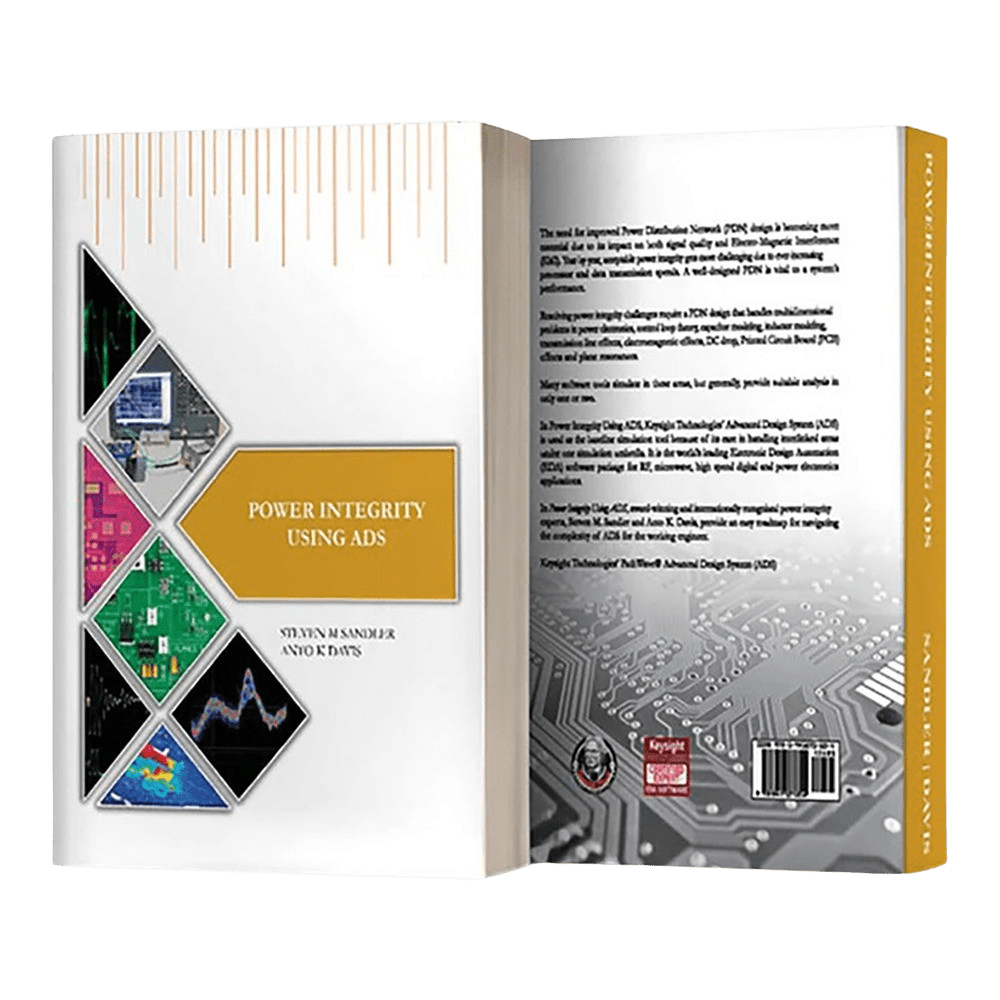
Power Integrity Using ADS Book
Power Integrity Using ADS Book
SKU: ADSBK
Couldn't load pickup availability
Key Features
Overview
The Definitive Guide to Power Integrity Simulation with ADS
Power Integrity Using ADS represents the first comprehensive textbook specifically addressing power distribution network (PDN) simulation within Keysight's industry-leading Advanced Design System environment. This authoritative guide bridges the gap between theoretical power integrity concepts and practical implementation through proven simulation methodologies.
Authored by internationally recognised power integrity expert Steven M. Sandler, this essential reference incorporates over 40 years of power systems engineering experience. The book demonstrates how ADS's unique Harmonic Balance simulator delivers ultra-fast time domain and spectral analysis of switching power supply waveforms whilst avoiding the lengthy simulation times typically associated with transient analysis.
Comprehensive Coverage for Professional Engineers
The text systematically covers end-to-end PDN simulation including measurement-based VRM modelling, capacitor and inductor characterisation, and decoupling optimisation strategies. Each chapter includes downloadable ADS workspaces enabling hands-on validation of theoretical concepts. Engineers learn to implement flat impedance design methodologies that ensure stable power delivery for high-speed digital systems operating at increasingly demanding performance levels.
Unlike general power integrity texts, this book specifically addresses the challenges of modern wide-bandgap devices including gallium nitride (GaN) components that switch at gigahertz frequencies. The measurement-based modelling approach ensures high-fidelity simulations that accurately predict real-world PDN performance, enabling engineers to optimise designs before prototype fabrication.
Downloads
Why Engineers Choose the Power Integrity Using ADS Book
Proven Industry-Leading Expertise
Practical ADS Implementation Focus
Modern Wide-Bandgap Device Coverage
The need for Power Distribution Network (PDN) simulation is essential due to its impact on power rail compliance, signal integrity, and electro-magnetic interference (EMI). Evolutionary increases in data rates and edge speeds, coincident with decreasing power rail voltages put ever more pressure on power integrity and system engineers to maintain optimum system performance.
Power integrity assurance requires end-to-end simulation including analog and power electronics, as well as, power-aware signal integrity simulation. This also includes details, such as control loop assessment, capacitor and inductor modeling, and DC IR drop including remote sense lines and Printed Circuit Board (PCB) effects.
Keysight Technologies' Pathwave Advanced Design System (ADS), the world's leading Electronic Design Automation (EDA) software package, addresses analog, RF, microwave, high speed digital and power electronics applications, including PCB effects, in a single simulation environment.
Pathwave ADS provides this much needed end-to-end capability including large signal, non-linear Harmonic Balance (HB) simulation. The ADS Harmonic Balance simulator provides ultra-fast time domain and spectral content of switching power supply waveforms and power rail noise without the long simulation times or convergence issues typically associated with transient simulation.
In "Power Integrity Using ADS", award-winning, internationally recognized power integrity guru, and Keysight Certified EDA expert, Steven M. Sandler and Anto K. Davis, share their simulation experience and workspaces to provide a quick and easy guide to best Power Integrity design practices and simulation techniques.
Chapter 1 – An Introduction to ADS
Keysight Technologies' PathWave® Advanced Design System ('ADS') provides a modular simulator environment for practical power integrity studies. This chapter is for those who are not familiar with ADS to get started on the basics. It contains only the basic features necessary for power integrity analysis used in this book. Sample Workspaces are provided.
WORKSPACE DOWNLOAD
| Chapter 2 |
This simulation workspace utilizes schematic driven time domain simulations to design low noise power delivery networks (PDN). The design starts with a simple model of a power delivery network to verify the expected natural step response, forced sinusoidal and square wave responses. The model complexity is increased to add multiple resonances to represent the voltage regulator module (VRM), the PCB inductance with bulk capacitors, and the ceramic decoupling capacitors. An optimizer is then used to search for the maximum voltage noise or rogue wave excursion that can exist with the multiple resonances and a forced digital load pattern from a real world PDN. |
| Chapter 3 |
The workspace has the following sections:
|
| Chapter 4 |
The Workspace contains two folders - "01_InductorModeling" and "02_FerriteBeadsModeling." Both the inductor and ferrite bead models use measured data to obtain the parameters. Sample measured data is available inside the folders "...\AEM_FERRITE_BEADS_wrkndatanInductorMeasuredDatan" and "...\AEM_FERRITE_BEADS_wrkndatanFerriteBeadsMeasuredDatan" Refer to [5, chapter7] for high-fidelity DC biased measurements. The ADS Optimizer is used to tunethe model parameters. A component (inductor or ferrite bead) model can be createdwith its measurement data and the procedure is explained in this chapter. |
| Chapter 5 |
The workspace follows along with the examples in the video and has the following sections:
|
| Chapter 6 & 7 |
This workspace is used by Chapter 6 and Chapter 7. The state space models explained in this workspace are based on measurement results. The power integrity eco-system can be built with the measurement based models by including the PCB layout effects. The Workspace contains the following topics,
|
| Chapter 8 |
This workspace is used by Chapter 9 and Chapter 8. The decoupling capacitor optimizations explained in this workspace are required to obtain a flat impedance profile which is essential for power integrity. The Workspace contains the following topics,
|
| Appendix A |
This Workspace studies various cases of anti-resonant peak formation when two capacitors are connected in parallel. It has the following sections:
|
| Appendix B |
The workspace contains one schematic for studying the effect of ground loop on 2-port shunt-through impedance measurements and how the common mode transformer breaks this loop. The transformer coupling coefficient T=1 breaks the ground loop. The condition T=0 is equivalent to NOT having a transformer in the loop. The Zg is the impedance of the ground loop. The IEC safety standard allows you to have a maximum of 50? in the ground loop which is utilized by some VNAs to break the ground loop. However, this is less effective than having a ground loop breaking common mode transformer or a solid state ground loop breaker. The Zg can be 1nH+0.1m?(represents a small impedance) or 1nH+50m?(allowed maximum impedance through IEC standards). The 1nH represents that the two ports of the VNAs are physically separated and will have a small inductance of the connection. |
| Appendix C |
This Workspace explains with example what the die/chip sees as impedance looking into the PDN. This impedance is not same as the transfer impedance between VRM and the die/chip. The 2-port shunt-through impedance configuration is used to measure ultra-low impedance(m?s and lower) in power integrity measurements. Its connection geometry is such that both the ports are connected to the same point. The differences between the different type of port connections are explained with examples in this Workspace. |
| Downloads |
Questions and Answers
-
Is This Book Suitable for Engineers New to Power Integrity Simulation?
Yes, with some background. It runs from fundamental concepts to advanced techniques, so it suits engineers at various experience levels. Chapter 1 introduces the ADS basics used in the book, and some background in power electronics helps.
-
How Does Flat Impedance Design Methodology Benefit PDN Performance?
Flat impedance design minimises the PDN resonances that cause voltage excursions and power delivery instability. The book teaches practical techniques for achieving flat impedance profiles across the relevant frequency ranges, giving stable power delivery for high-speed digital systems.
-
What Author Credentials Make Steven Sandler a Recognised Power Integrity Authority?
Steven Sandler:
- has over 40 years of power systems engineering experience
- founded Picotest, which specialises in power integrity solutions
- is a Keysight Certified EDA expert
- is an award-winning power integrity expert and educator
-
Does the Book Cover Capacitor and Inductor Modelling for Power Integrity Applications?
Yes. The book covers measurement-based capacitor and inductor modelling for accurate PDN simulation, and shows how to characterise passive components across the frequency ranges relevant to power integrity.
-
How Can This Book Help Reduce Power Integrity Design Iterations?
It teaches measurement-based modelling and flat impedance design in ADS, so you can predict PDN performance before prototype fabrication. Finding and fixing power integrity issues at the simulation stage significantly reduces design iterations.
-
What Makes This ADS Power Integrity Book Unique Compared to General Power Integrity Texts?
It focuses on power integrity simulation in Keysight's Advanced Design System (ADS), with downloadable ADS workspaces and hands-on simulation exercises. It shows how the ADS Harmonic Balance simulator gives fast time domain and spectral results for switching power supply waveforms and power rail noise.
-
Does the Book Cover Measurement-based Modelling Techniques for VRM Characterisation?
Yes. The book covers the measurement-based voltage regulator module (VRM) modelling in depth. They give high-fidelity simulations that predict real-world PDN performance, so you can validate designs before prototype fabrication.
-
Are Downloadable ADS Workspace Files Included with the Book Purchase?
Yes. Downloadable ADS workspace files with hands-on simulation exercises are available from Picotest's product page for the book, so you can apply power integrity design principles in your own ADS environment.
-
Does the Book Cover Wide-Bandgap or GaN Devices?
The book does not list a dedicated GaN or wide-bandgap chapter. It focuses on PDN, capacitor, inductor and VRM modelling and simulation in ADS.
-
What Simulation Advantages Does ADS Harmonic Balance Provide for Power Integrity Analysis?
The ADS Harmonic Balance simulator gives ultra-fast time domain and spectral analysis of switching power supply waveforms, without the long run times of transient analysis. This allows rapid design iteration and frequency domain characterisation.
No questions match your search.