


SEGGER Microcontroller GmbH
SEGGER 6-Pin Nadeladapter
SEGGER 6-Pin Nadeladapter
SKU: 8.06.16
Zahlungsmethoden
- Banküberweisung
Verfügbarkeit für Abholungen konnte nicht geladen werden
Key Features
Overview
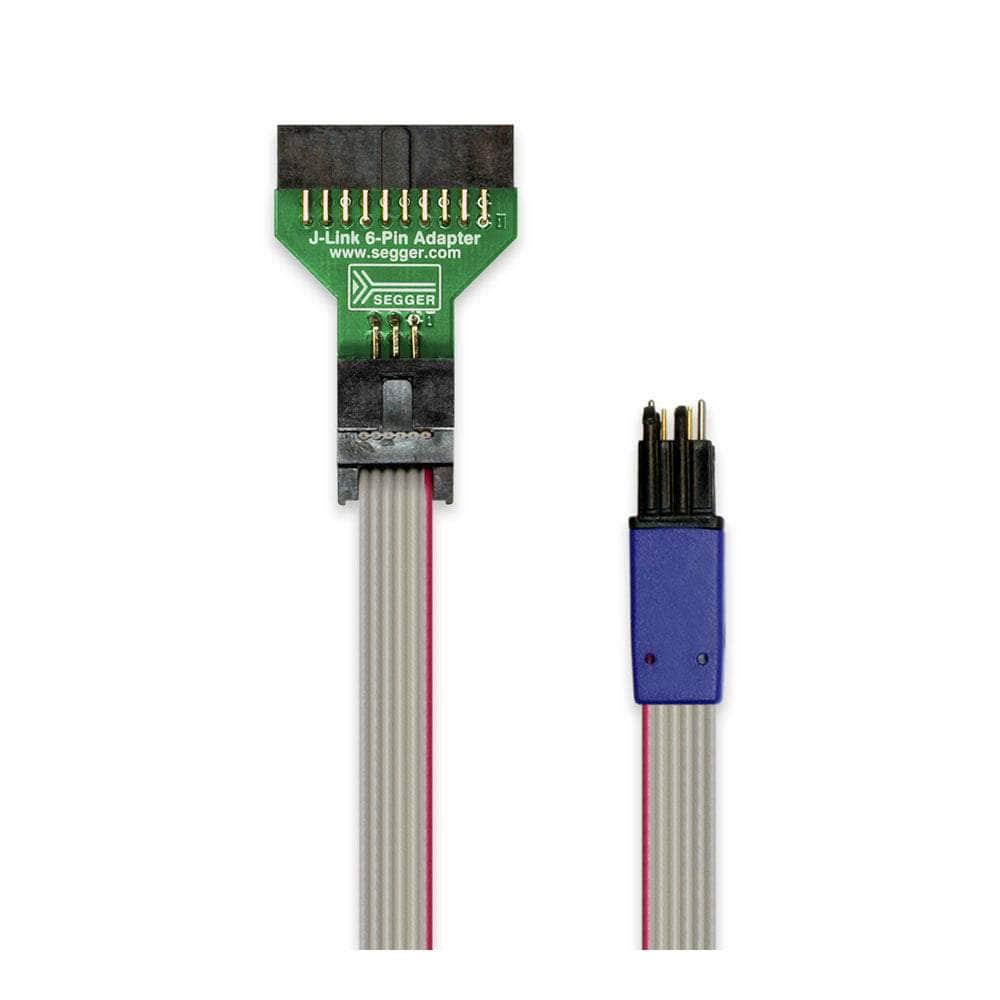
The SEGGER 6-Pin Needle Adapter (8.06.16) connects a J-Link or Flasher to a PCB that has no debug connector, through six spring pins on a 0.05" pad footprint. It carries SWD with SWO: VTref, SWDIO, nRESET, SWCLK, GND and SWO. For JTAG or target power, choose the SEGGER 10-Pin Needle Adapter.
Why Engineers Choose the SEGGER 6-Pin Nadeladapter
Eliminate Headers On Production PCBs
Orientation-Safe, Repeatable Contact
Fits Existing J-Link Workflows
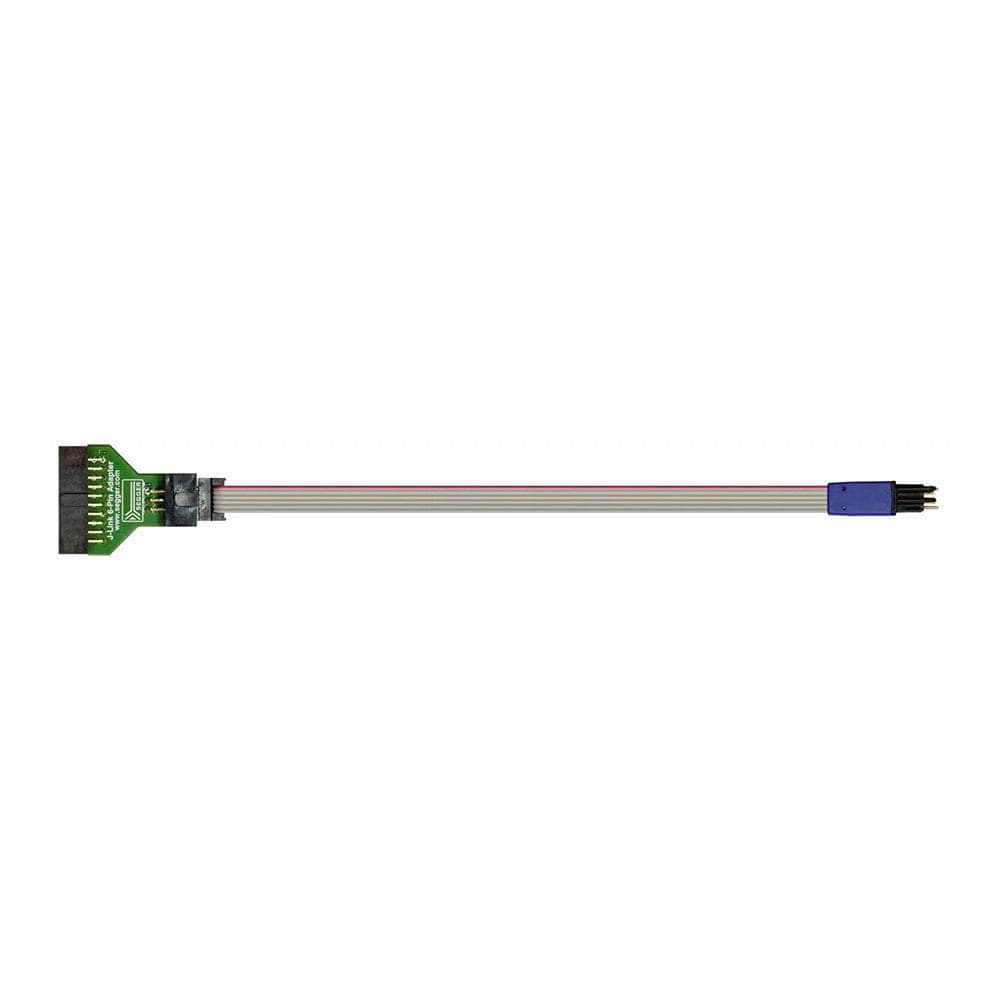
The SEGGER 6-Pin Needle Adapter (part number 8.06.16) connects a J-Link or Flasher to a PCB that has no mating connector or programming header, adapting the standard 20-pin 0.1" connector to a 6-pin, 0.05" needle pattern. Spring pins land on pads in the target footprint, and three locating pins stop the adapter being fitted the wrong way round. It is the smaller of SEGGER's two needle adapters, for SWD programming and debug on boards where even the 10-pin needle footprint takes too much space.
SWD Access Without a Connector on the PCB
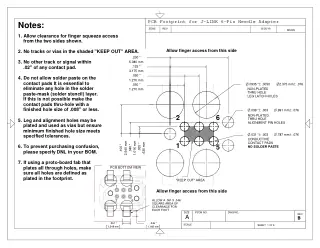
No additional connector is needed on the target, only the 6-pin footprint, which SEGGER states is smaller than that of the 10-Pin Needle Adapter. The six needles carry VTref, SWDIO, nRESET, SWCLK, GND and SWO (pins 1 to 6 in SEGGER's pinout drawing). The adapter has high-reliability spring pins for secure contact, three locating pins for positioning, and two support legs on each side that can be cut off if space is tight. Lay out the pads to SEGGER's 6-pin footprint drawing and its layout notes: no solder paste on the contact pads, and no other track within 0.02" of a pad.
Suitable J-Link and Flasher Models
The probe side is the standard J-Link 20-pin 0.1" connector found on most J-Link models. SEGGER lists the 6-Pin Needle Adapter as suitable for Flasher Pro, Flasher Pro XL, Flasher Compact and Flasher Portable PLUS, and for J-Link Pro PoE, J-Link Pro, J-Link WiFi, J-Link PLUS Compact and J-Link BASE Compact. Pin assignments and adapter options are in our SEGGER J-Link 20-pin connector pinout guide.
Specifications
| Probe side | J-Link 20-pin, 0.1" |
|---|---|
| Target side | 6-pin, 0.05" needle pattern (no connector fitted) |
| Signals (pin) | VTref (1), SWDIO (2), nRESET (3), SWCLK (4), GND (5), SWO (6) |
| Contacts | High-reliability spring pins |
| Positioning | 3 locating pins; 2 support legs each side (can be cut off) |
| Footprint | SEGGER 6-pin needle footprint, 0.05" pad pitch; SEGGER's drawing lists Tag-Connect part TC2030-IDC |
| Part number | 8.06.16 |
What's Included
One 6-pin Needle Adapter and one 6-pin cable with pins and legs. No J-Link or Flasher is included.
Limitations
- No JTAG. SEGGER states the 6 pins are not enough for JTAG and points to the 10-Pin Needle Adapter instead.
- No target supply pin. The 10-Pin Needle Adapter adds a 5V-Supply pin, so the target can be powered from J-Link or Flasher.
- The target PCB must carry SEGGER's 6-pin needle footprint.
- SEGGER's suitable-products list for this adapter does not include J-Link Ultra or the Classic models, although they have the same 20-pin connector. Ask us before ordering for one of those.
6-Pin Needle Adapter Compared with Related Adapters
| Adapter | Target side | Interfaces | Price ex VAT |
|---|---|---|---|
| 6-Pin Needle Adapter (this product) | 6-pin, 0.05" needle pattern | SWD with SWO | £110 |
| 10-Pin Needle Adapter | 10-pin, 0.05" needle pattern | JTAG and SWD signals, optional target power | £114 |
| 9-Pin Cortex-M Adapter | 9-pin, 0.05" Samtec FTSH header | JTAG, SWD, SWO | £35 |
Order the 6-Pin Needle Adapter for £110 ex VAT, or ask us for a formal quotation. See the full range in our SEGGER debug probes collection.
Frequently Asked Questions
Should I Choose the 6-Pin or the 10-Pin Needle Adapter?
Choose the 6-pin for SWD where board space is the constraint; its footprint is the smaller of the two. Choose the 10-pin if you need JTAG or want the option to power the target through the probe.
Answered by John Legg, Director, Debug Store
Last reviewed 16/11/2026.
| General | |
|---|---|
| Probe side | J-Link 20-pin, 0.1" |
| Contacts | High-reliability spring pins |
| Positioning | 3 locating pins; 2 support legs each side (can be cut off) |
| Footprint | SEGGER 6-pin needle footprint, 0.05" pad pitch; SEGGER's drawing lists Tag-Connect part TC2030-IDC |
| Part number | 8.06.16 |
| Host and Target Interface | |
| Target side | 6-pin, 0.05" needle pattern (no connector fitted) |
| Signals (pin) | VTref (1), SWDIO (2), nRESET (3), SWCLK (4), GND (5), SWO (6) |
| Ordering information | |
| Part number (SKU) | 8.06.16 |
| Manufacturer | SEGGER Microcontroller GmbH |
| EAN | 5055383614318 |
| Warranty | 12 Monate |
| Shipping weight | 0.02 kg |
- 1 ×6-pin Needle Adapter
- 1 ×6-pin cable with pins and legs

Questions and Answers
-
Will It Work with J-Link BASE/PLUS/PRO and SEGGER Flashers?
Yes, it is designed for the J-Link and Flasher families via the 20-pin 0.1″ connector. See also the J-Link BASE Compact.
-
What PCB Footprint Size Should I Plan For?
Use SEGGER’s published pad pattern from the datasheet. The footprint is very small (smaller than the 10-pin version's), which helps with dense layouts.
-
How Does This Compare to Bed-of-Nails Fixtures?
Versus custom bed-of-nails fixtures, a needle adapter needs no connector fitted to the PCB, only a small pad footprint, and its locating pins position it consistently for programming.
-
Any Workflow Tips for First Bring-Up?
Follow SEGGER SWD pin guidance (VTref, RESET handling, optional SWO). Verify pull-ups/downs per device vendor before first connection.
-
What If I Need a Different Connector Standard Later On?
SEGGER provides adapters such as the 50-Mil 10-Pin Patch Adapter and the Target Supply Adapter to cover other scenarios.
-
What Problem Does the 6-Pin Needle Adapter Solve?
It enables SWD debug/programming on boards without connectors, reducing BoM and PCB area while preserving J-Link workflows.
-
Which Signals Are Available on the 6-Pin Footprint?
VTref, SWDIO, SWCLK, RESET, GND and optional SWO for trace/printf. For JTAG signals, use the 10-pin version.
-
Does It Supply Power to the Target?
No, the 6-pin version is intended for SWD signalling. If you need JTAG and the 5 V target-power pin via needle connection, use the 10-pin needle adapter (8.06.04).
-
How Does It Ensure Correct Orientation?
A three-pin locating pattern keys the adapter so it only mates one way. This reduces operator error and rework.
-
Is This the Same as Tag-Connect?
The footprint is the Tag-Connect TC2030 pattern (SEGGER's footprint drawing carries Tag-Connect's part numbers); the signal assignment is SEGGER's. Check SEGGER's pinout drawing against your target before laying out the pads. The 10-pin variant includes a 5 V supply pin.


No questions match your search.
