

TESTEC Elektronik GmbH
TESTEC TT-MX-212 250MHz x10 Passive Oscilloscope Probe
TESTEC TT-MX-212 250MHz x10 Passive Oscilloscope Probe
SKU: 11110
Couldn't load pickup availability
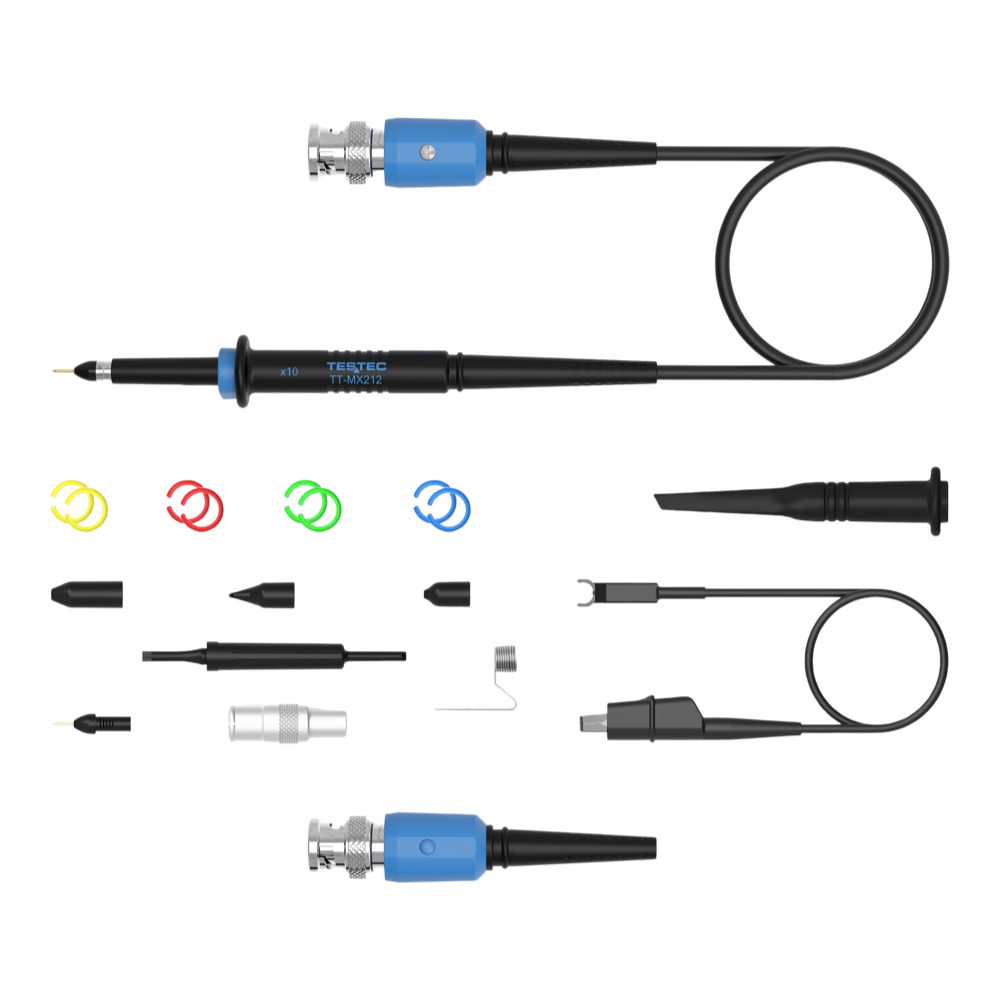
Key Features
Overview
The Testec TT-MX 212 is a professional-grade passive oscilloscope probe engineered for mid-to-high-frequency signal analysis in demanding electronic testing environments. Part of the TT-MX series, this probe offers switchable 10:1 attenuation, delivering a bandwidth of 250MHz (20MHz in 1:1 mode) to ensure accurate waveform capture across diverse applications, including circuit debugging, power electronics, and embedded system development.
Designed for safety and reliability, the TT-MX 212 supports Measurement Category II (CAT II) ratings up to 400Vrms, with transient overvoltage protection up to 1500V. Its 10MΩ input impedance minimises circuit loading, while the 5mm sharp-tip design ensures stable contact with miniature components. The probe features a 1.2m shielded cable and a compensation range of 8–25pF, ensuring compatibility with most oscilloscopes. For users requiring 1:1 attenuation, the TT-MX 312 variant provides a dedicated 10MHz bandwidth mode.
Ideal for engineers prioritising safety and precision, the TT-MX 212 complies with IEC 61010-031 and EN 61326 standards, making it suitable for industrial and laboratory environments. Its robust construction, ergonomic grip, and Pollution Degree 2 rating ensure reliable performance in non-conductive, dry conditions with occasional condensation.
Downloads
| General Information | |
|---|---|
Part Number (SKU) |
11110
|
Manufacturer |
TESTEC Elektronik GmbH
|
| Physical and Mechanical | |
Weight |
0.5 kg
|
| Other | |
EAN |
5055383622429
|
Questions and Answers
-
How Do I Calibrate It?
There is no user calibration in the metrological sense. The TT-MX 212 is a passive 10:1 probe with a fixed divider (±2% DC accuracy from the factory). What you adjust is compensation, which matches the probe's divider capacitance to the scope input capacitance.
Adjust it whenever you move the probe to a different oscilloscope or input channel. Correct compensation preserves the amplitude accuracy of the measured waveform.
Low-frequency compensation (the routine one)
- Connect the probe to the scope channel and apply a 1 kHz square wave, from a generator or the scope's own calibrator output.
- Set the channel to 10:1 and get a couple of cycles on screen at a reasonable vertical gain.
- Adjust the trimmer in the BNC connector box until the square wave has a flat top. Rounded corners mean under-compensated, overshoot means over-compensated.
Compensation range is 8 to 25 pF, which covers essentially any 1 MΩ scope input.
High-frequency compensation
Testec sets this at the factory and states it is not normally needed. If you do adjust it, apply a 1 MHz square wave from a generator with an edge speed better than 1.4 ns and trim the adjuster in the BNC connector box for a flat top. Do this only after LF compensation is correct, and only with a generator that has a genuinely fast edge. A slow-edged source will lead you to trim in an error.
No questions match your search.