
SEGGER Microcontroller GmbH
SEGGER Flasher Compact In-Circuit Programmer
SEGGER Flasher Compact In-Circuit Programmer
SKU: 5.19.00
Couldn't load pickup availability
Key Features
Overview
The SEGGER Flasher Compact delivers professional-grade in-circuit flash programming in a space-efficient design ideal for production rigs and automated test equipment. This powerful programmer supports thousands of microcontrollers, SoCs, and external flash devices across all major architectures including ARM Cortex, RISC-V, AVR, PIC, and MSP430.
Operating in true stand-alone mode, the Flasher Compact eliminates PC dependencies once configured, storing up to 128MB of firmware images and programming configurations internally. The device programs internal MCU flash, external (Q)SPI memories, and parallel NOR flash devices with industry-leading speed and reliability.
How it connects
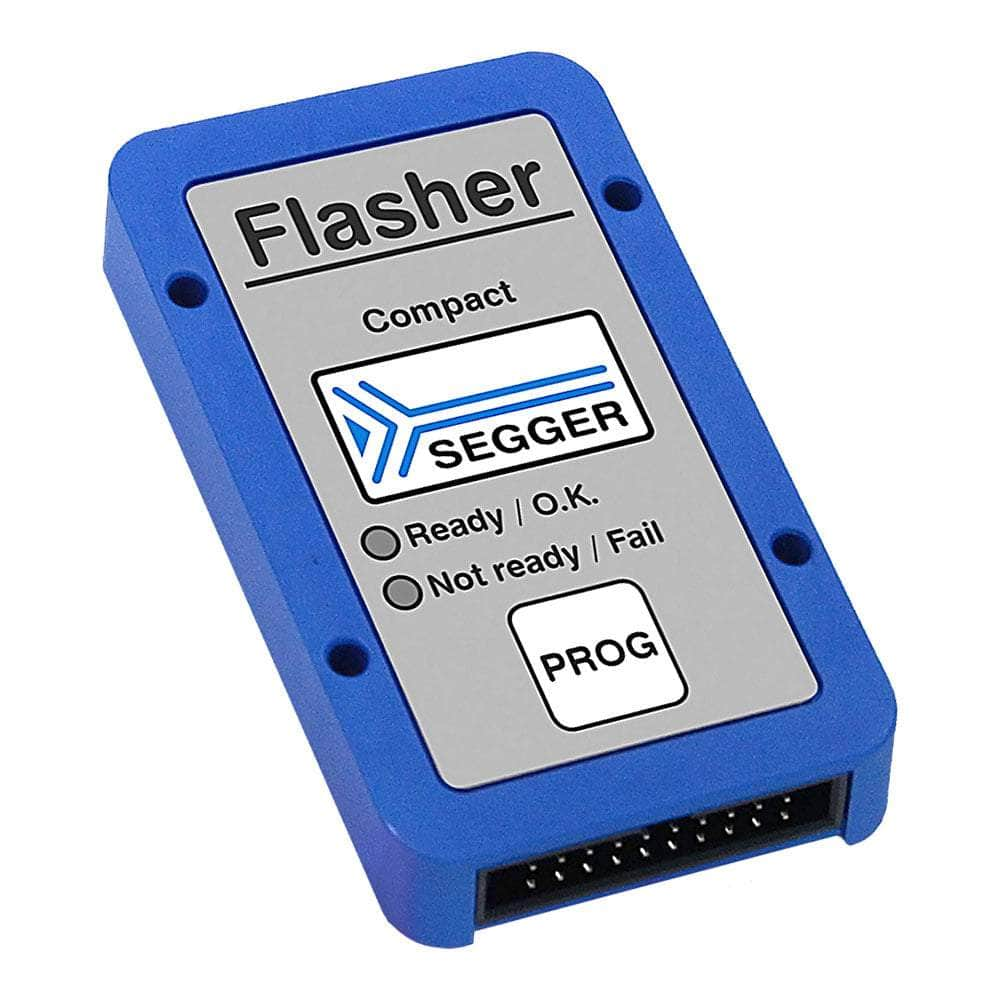
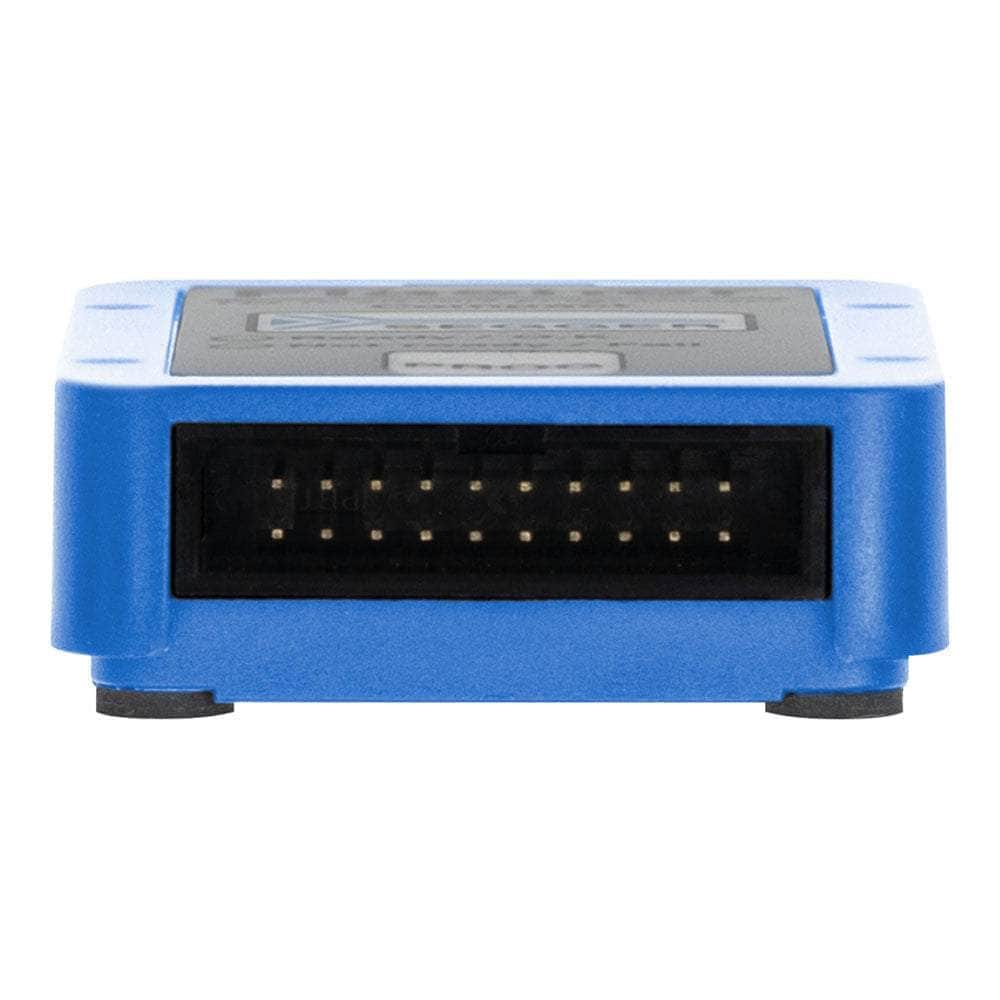
This Flasher uses SEGGER's standard 20-pin 0.1" (2.54 mm) connector. For JTAG and SWD targets the pin assignment is the same as J-Link: VTref (pin 1), SWDIO/TMS (pin 7), SWCLK/TCK (pin 9), nRESET (pin 15) and GND (pin 4). Other target interfaces use interface-specific assignments, so check the SEGGER Flasher manual for your interface. Full JTAG, SWD and SPI pin tables: SEGGER J-Link 20-pin connector pinout.
Downloads
Why Engineers Choose the SEGGER Flasher Compact In-Circuit Programmer
Space-Constrained Production
Stand-Alone Reliability
Scalable Volume Production
Advanced Stand-Alone Flash Programming for Space-Constrained Production
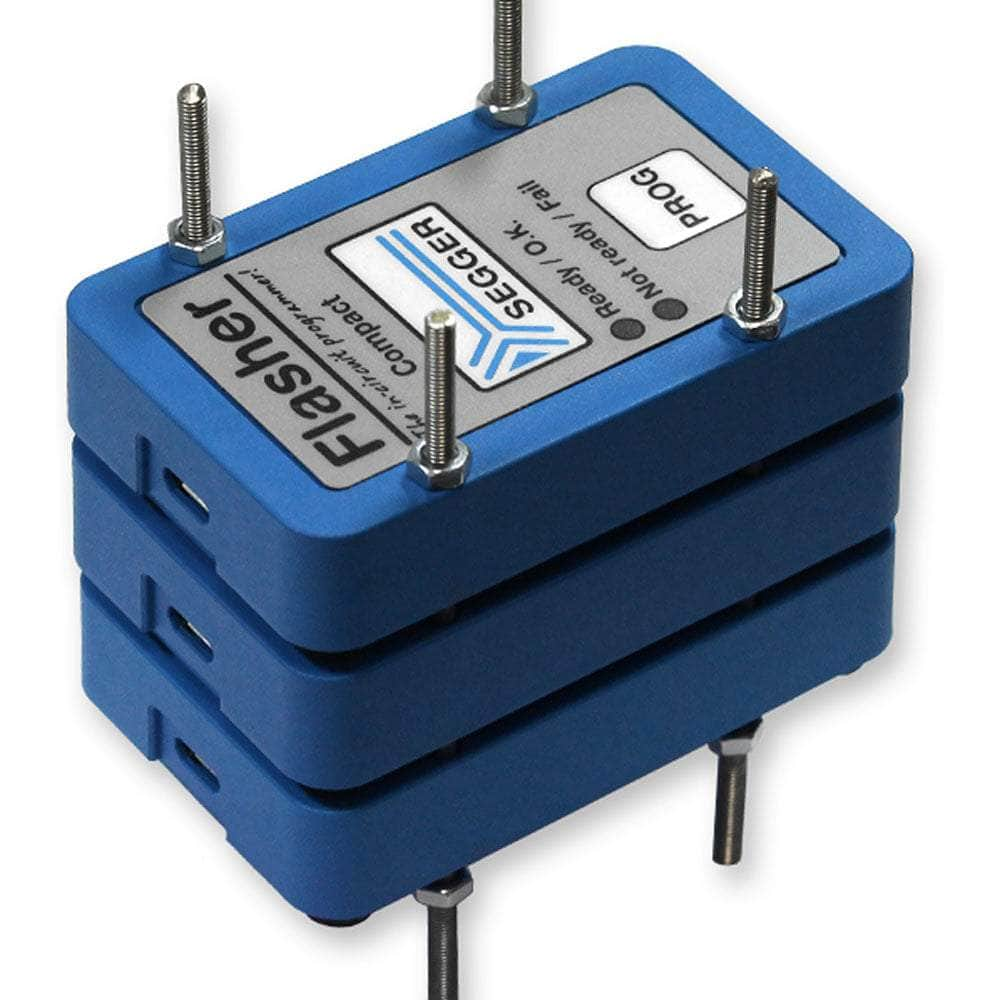
The SEGGER Flasher Compact is a powerful universal in-circuit flash programmer designed specifically for integration into production rigs and automated test equipment (ATE) where space is at a premium. This compact programming solution delivers the same robust performance as the full-sized Flasher PRO in a credit card-sized form factor.
Key Programming Capabilities
| Flash Memory Types | Interface Support | Target Voltage Range |
|---|---|---|
| Internal MCU/SoC Flash | JTAG, SWD, UART, PDI | 1.2V to 5V |
| External (Q)SPI Flash | SPI, QSPI, C2, cJTAG | Up to 400mA supply |
| Parallel NOR Flash | ICSP, ISP, SWIM, UPDI | 50MHz max speed |
Stand-Alone Operation
Once configured using SEGGER's J-Flash software, the Flasher Compact operates completely independently without a PC connection. The device stores firmware images and programming configurations in its massive 128MB internal memory, enabling reliable production programming with just a button press.
Production Ready: No additional licences required. All supported devices are included with free firmware updates and flash loader additions for the device lifetime.
Gang Programming Expansion
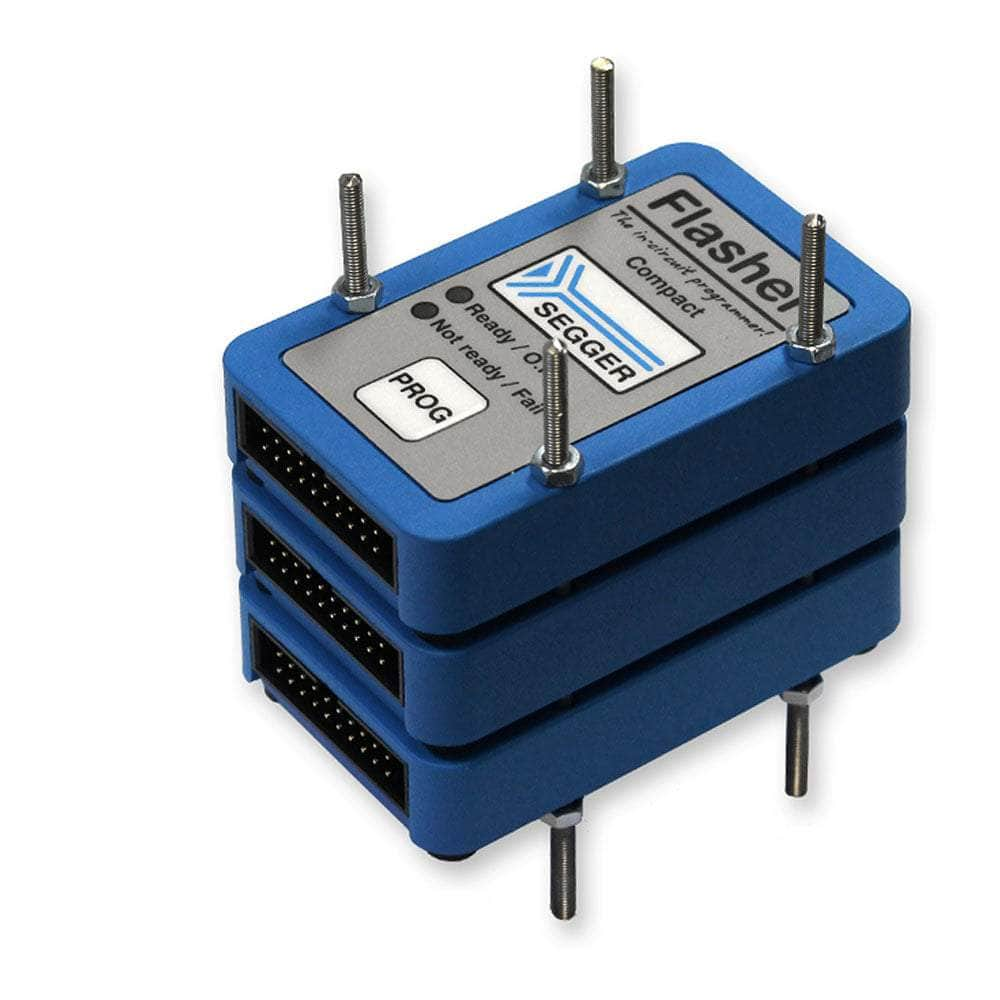
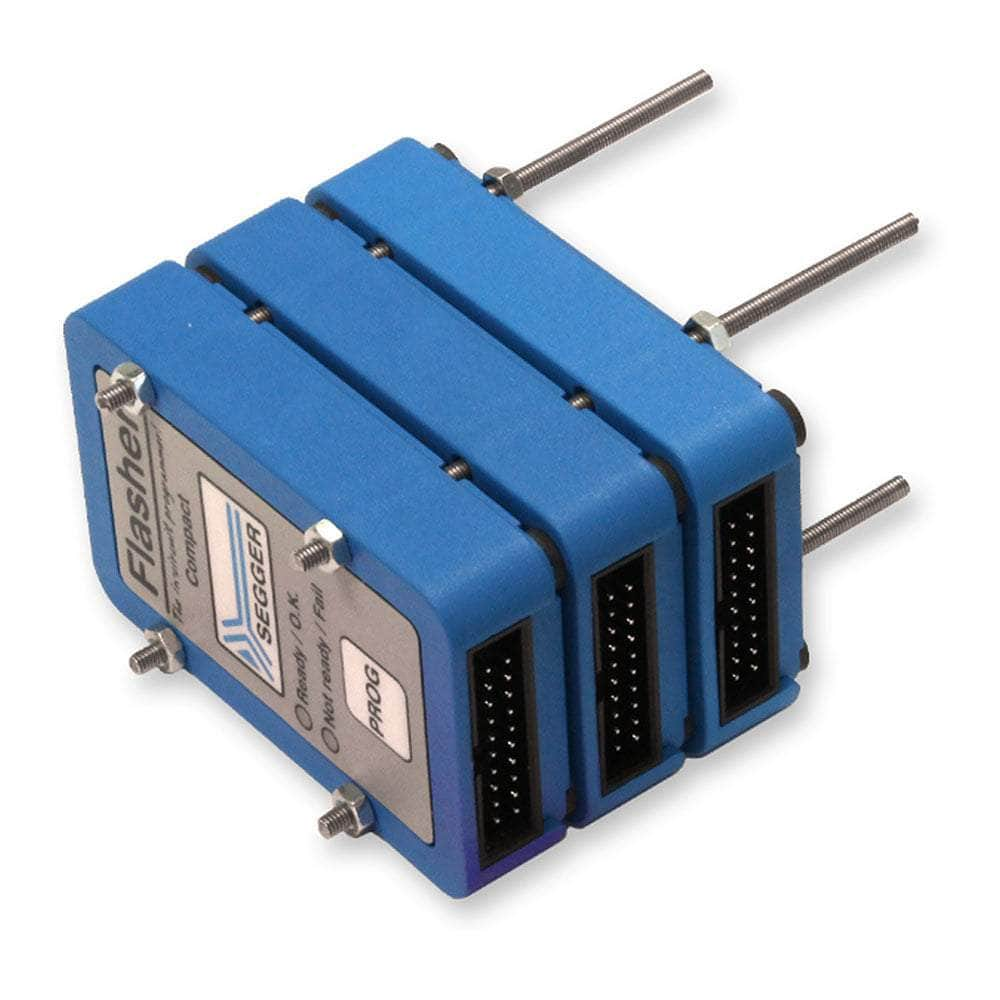
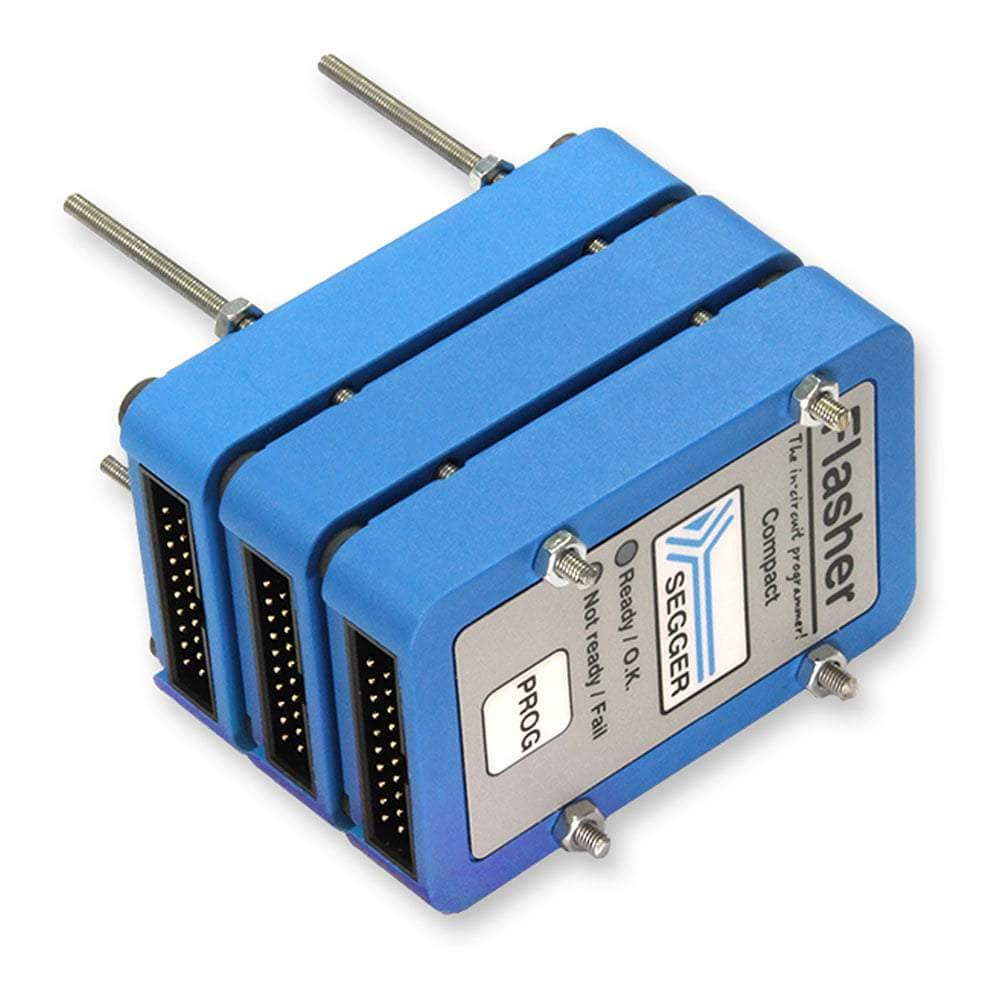
For high-volume production, connect multiple Flasher Compact units to a Flasher Hub-12 or Flasher Hub-4 to create powerful gang programming systems supporting up to 24 parallel programming channels.
Wiring Quick-Start
The Flasher Compact uses a standard 20-pin IDC connector with 0.1" (2.54mm) pitch for target connections:
| Pin | Signal | Pin | Signal |
|---|---|---|---|
| 1 | VTref | 2 | NC |
| 3 | nTRST | 4 | GND |
| 5 | TDI | 6 | GND |
| 7 | TMS/SWDIO | 8 | GND |
| 9 | TCK/SWCLK | 10 | GND |
| 11 | RTCK | 12 | GND |
| 13 | TDO/SWO | 14 | GND |
| 15 | nRESET | 16 | GND |
| 17 | UART_TX | 18 | GND |
| 19 | 5V Supply | 20 | GND |
Note: Pin 1 (VTref) must be connected to target voltage for proper operation. The programmer senses this voltage to set appropriate logic levels.
Physical Integration
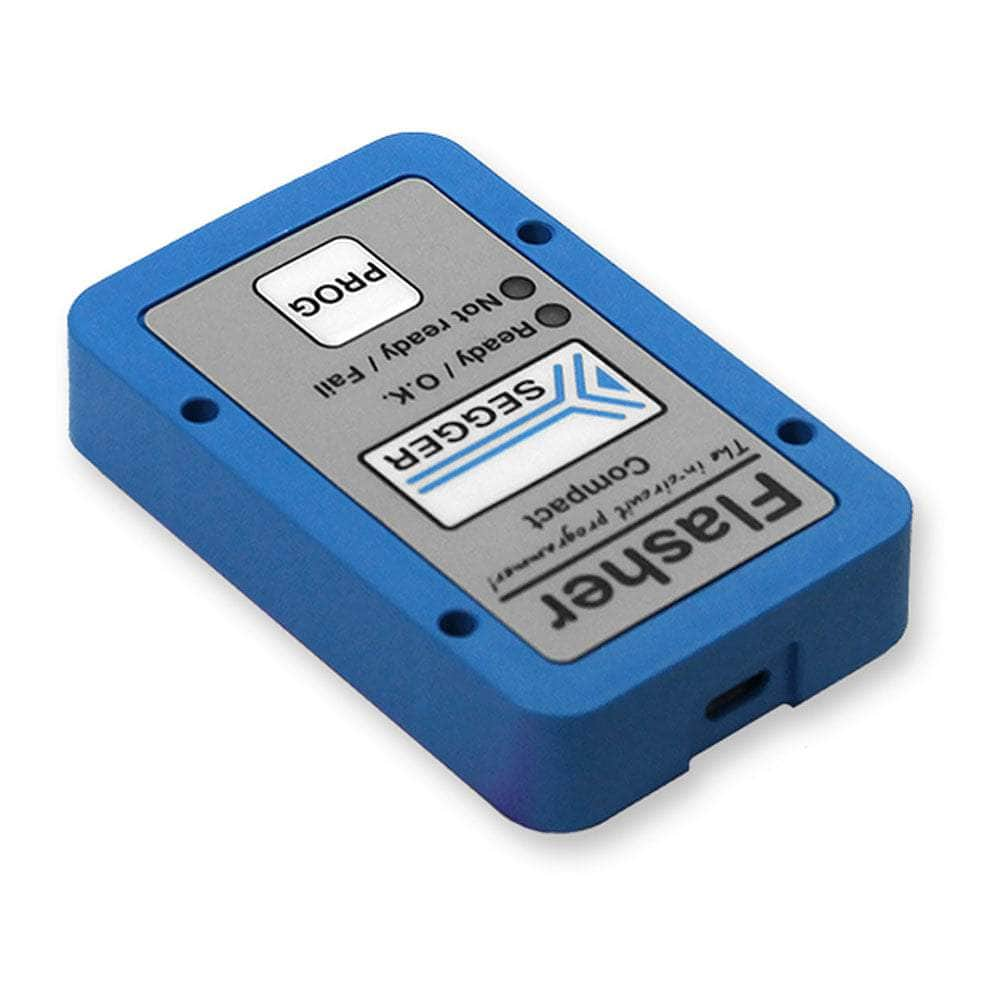
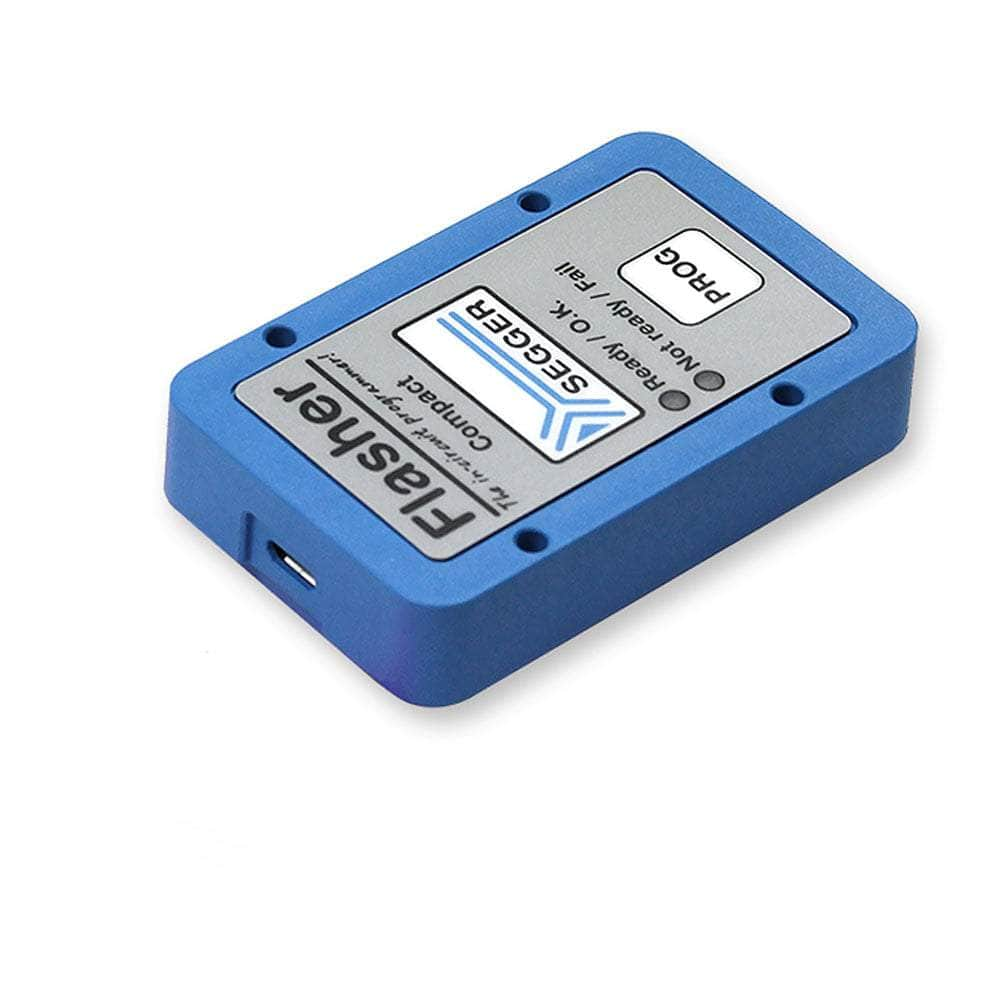
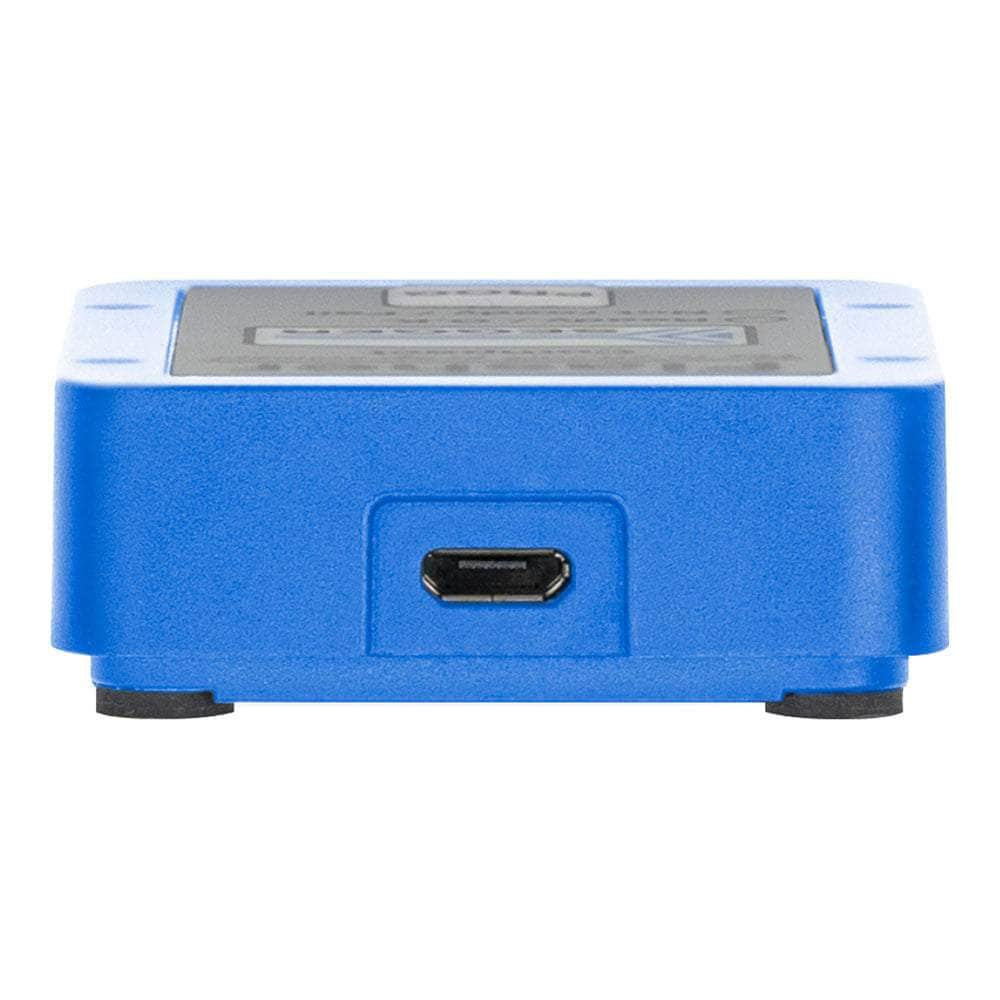
Measuring just 70mm × 45mm × 18mm and weighing only 40g, the Flasher Compact includes four mounting holes for secure installation in production equipment. The USB-C interface provides both power and data communication with a single cable.
| General Information | |
|---|---|
Part Number (SKU) |
5.19.00
|
Manufacturer |
|
| Physical and Mechanical | |
Weight |
0.5 kg
|
| Other | |
EAN |
5055383699568
|
Questions and Answers
-
What Power Supply Does the Flasher Compact Require?
The Flasher Compact is powered entirely through its USB-C connection, drawing about 130 mA when idle and up to 500 mA when it also powers the target. No external power supply is needed. The unit can also provide up to 400mA at 5V to power target devices during programming.
-
How Does the Flasher Compact Differ From the Flasher PRO?
The Flasher Compact has the same programming capabilities as the Flasher PRO in a smaller unit designed for production integration. The differences are its compact size with mounting holes, a USB-C interface and no built-in Ethernet or RS232.
-
How Is the Flasher Compact Configured and Controlled?
The Flasher Compact is configured with SEGGER's J-Flash and U-Flash tools. It can also be controlled via command-line tools for automated production workflows.
-
Is the Flasher Compact Suitable for Field Service Applications?
Yes, but SEGGER's Flasher Portable PLUS is designed specifically for portable field updates, with integrated battery power. The Flasher Compact is optimised for fixed production and ATE installations where space efficiency is critical.
-
What Is the Difference Between the Flasher and J-Link for Programming Devices?
J-Link is a debug probe that can also program devices, while Flasher is designed for production programming.
J-Link connects to your PC and IDE for interactive debugging, code stepping and breakpoints during development, with unlimited flash breakpoints on most J-Link models and real-time debugging. Flasher runs stand-alone once configured, storing firmware images internally, so it gives reliable, repeatable production programming in manufacturing without a PC.
-
What Microcontrollers Does the SEGGER Flasher Compact Support?
The Flasher Compact supports Arm Cortex, RISC-V, Microchip AVR/PIC, Texas Instruments MSP430, Renesas RX/RL78, STM8, SiLabs 8051 and NXP/PowerPC architectures. The full device list is on SEGGER's website, and new devices are added regularly at no extra cost.
-
Can the Flasher Compact Operate Without a Computer Connection?
Yes, the Flasher Compact operates in true stand-alone mode once configured. After initial setup using J-Flash software, it stores firmware images and programming configurations in its 128MB internal memory. Programming is initiated by pressing the PROG button or, when used with a Flasher Hub, via the Hub's hardware handshake lines or remote commands.
-
How Do I Set Up Gang Programming with Multiple Flasher Compact Units?
Connect up to 4 Flasher Compact units directly to a Flasher Hub-4, or up to 12 units to a Flasher Hub-12, using USB-C. SEGGER says a setup scales to 24 devices programmed in parallel. Each programmer runs independently with its own firmware image, so you can program identical or different targets in parallel.
-
What Is the Programming Speed Compared to Other Solutions?
The Flasher Compact achieves near-theoretical maximum programming speeds using SEGGER's optimised flash algorithms. JTAG/SWD interfaces operate up to 50MHz, with actual programming speeds dependent on target device capabilities and memory size.
-
Does the Flasher Compact Include Software and Device Support?
Yes, the Flasher Compact includes J-Flash programming software for Windows, Linux, and macOS, plus free future firmware updates and new device support. No additional licences are required for any supported devices, including future additions.
-
Can I Program External SPI Flash Memories Directly?
Yes, the Flasher Compact programs external SPI and QSPI flash memories either through the connected microcontroller or by direct connection to the memory chip. This supports applications requiring separate boot flash programming or firmware storage in external memory.


No questions match your search.