
Microwave Click: Motion Detection Sensor
Video notes
Microwave Click uses the PD-V11 24 GHz microwave motion sensor as a proximity detector, with an analogue output. MikroE gives a short demonstration of the board.
Mikroelektronika d.o.o.
SKU: MIKROE-2781
Payment methods
Couldn't load pickup availability


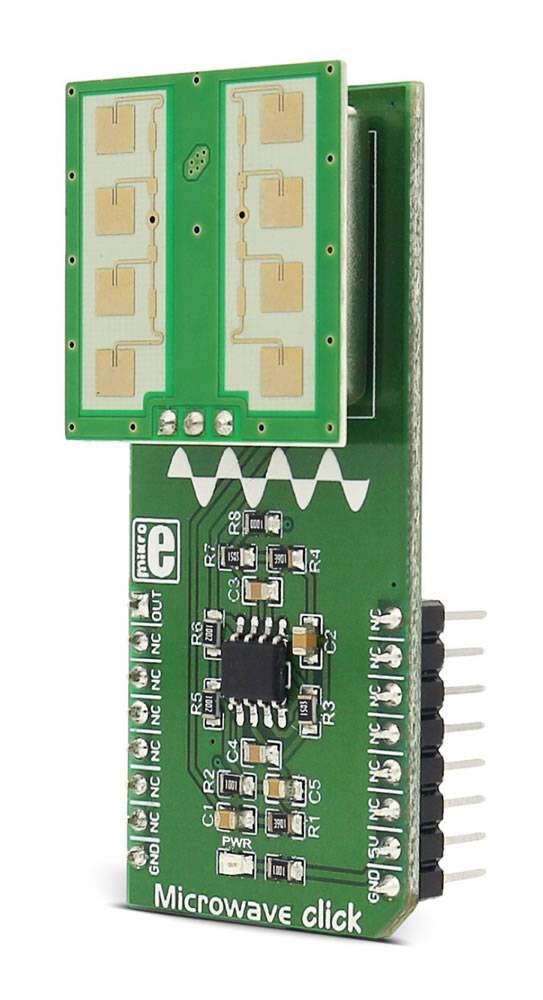
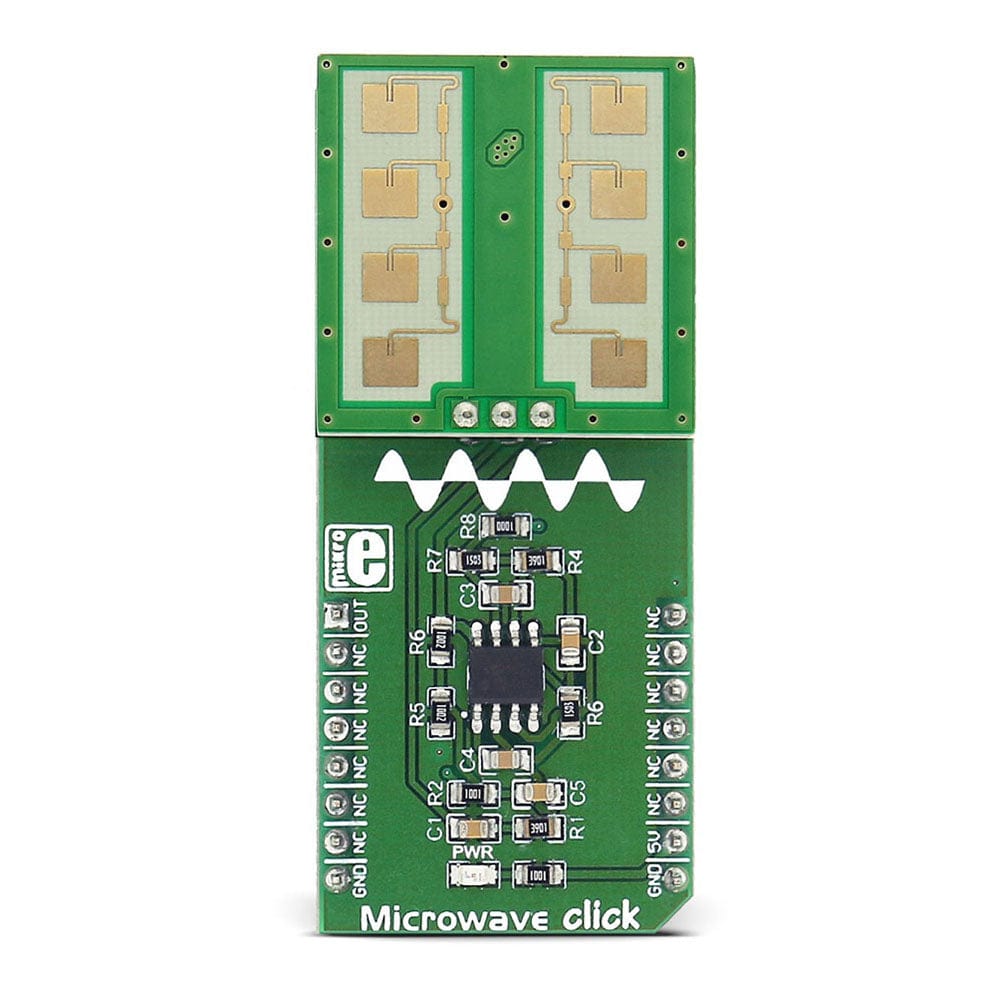
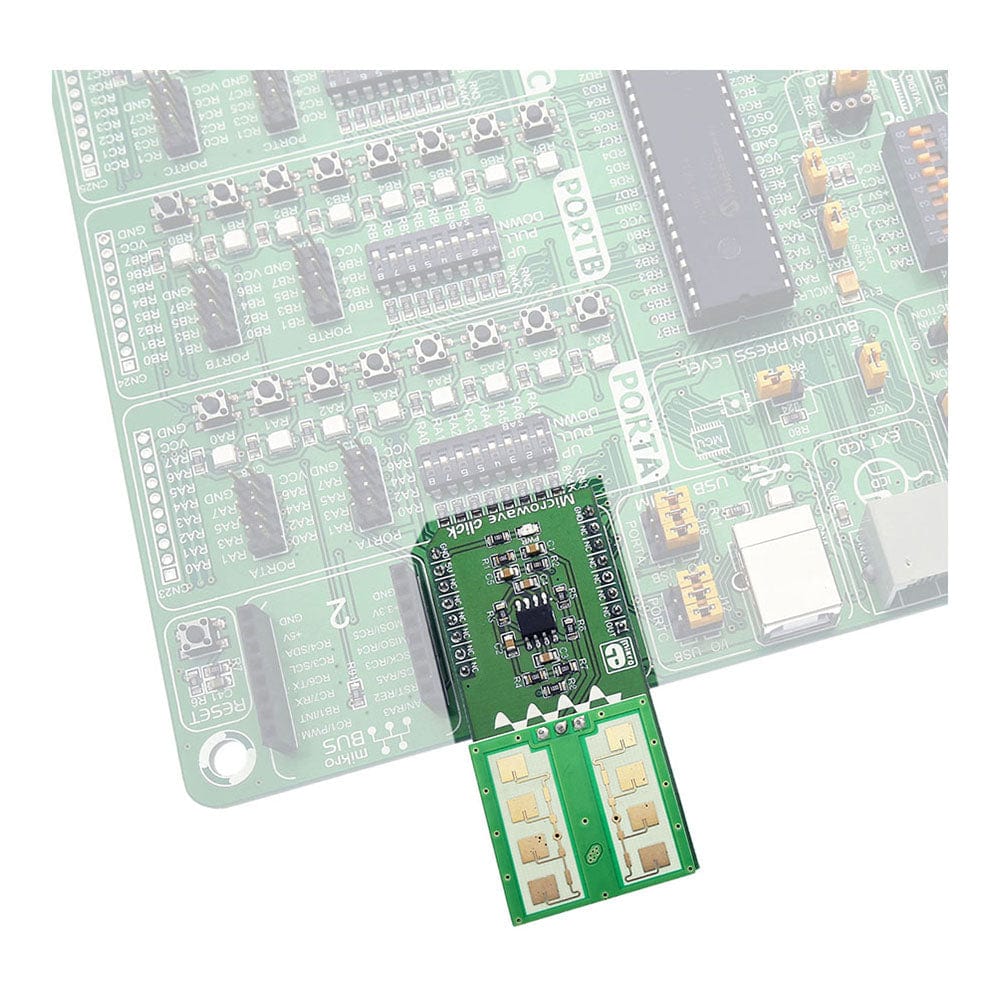
The Microwave Click Board™ detects movement, thanks to the PD-V11 a 24GHz microwave motion sensor. The typical use for Microwave Click Board™ is a proximity or motion detector in various applications and devices.
The Microwave Click Board™ can detect movement or proximity by using the Doppler effect. The onboard microwave motions sensor transmits waves and picks them back as they hit an object, with their frequency changed.
The board does not need optical visibility to work, and the waves can penetrate many kinds of barriers and obstacles.
Video notes
Videos are hosted on YouTube and load only when you press play.
The Microwave Click Board™ detects movement, thanks to the PD-V11 a 24GHz microwave motion sensor. The typical use for Microwave click is a proximity or motion detector in various applications and devices.
The Microwave Click Board™ can detect movement or proximity by using the Doppler effect. The onboard microwave motions sensor transmits waves, and picks them back as they hit an object, with their frequency changed.
Microwave Click Board™ does not need optical visibility to work, and the waves can penetrate many kinds of barriers and obstacles.
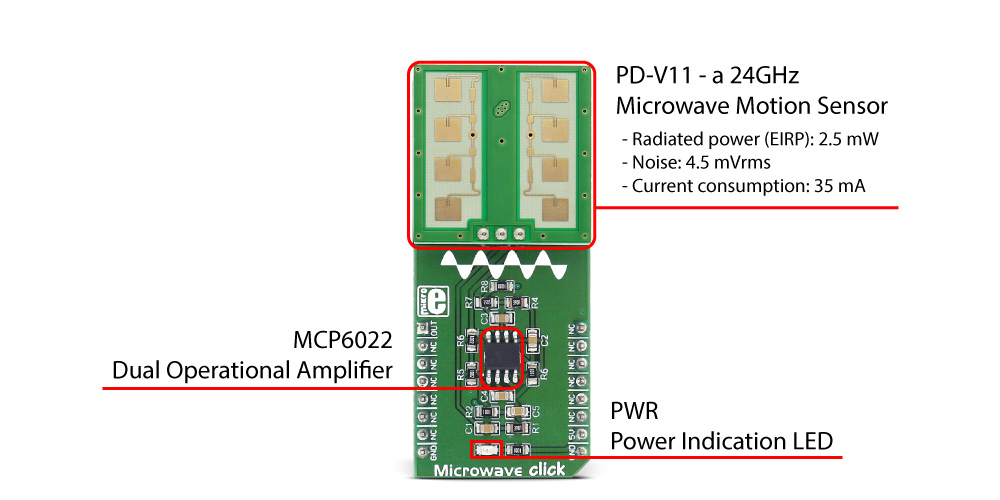
The Microwave Click Board™ detects movement of objects utilizing Doppler effect. When the PD-V11 microwave sensor is powered on, it starts transmitting radio waves of fixed frequency. As the waves hit a moving object they are reflected back toward PD-V11 microwave motion sensor, with their frequency changed, depending on speed and direction of object's movement.
The Doppler effect - a change in frequency of a wave for the observer and object move closer or further apart from one another. A typical example of the Doppler effect is when a vehicle with siren passes and you hear the pitch drop of the siren.

The PD-V11 microwave motion sensor low power consumption, low noise, and a low wireless power output. See the datasheet to learn more.
The PD-V11 microwave motion sensor picks up reflected waves and converts them to a voltage signal. This signal has the magnitude of several hundred microvolts, so it's sent to the MCP6022 which amplifies the signal, in order to make it readable over the Analog pin on the mikroBUS™. This signal is amplified up to 3.3V.
Once amplified, the signal is routed to the Analog pin (OUT) on the mikroBUS™ line. The proximity of the object can be determined by measuring the amplitude of this signal, and speed/direction by determining its frequency.
The range at which the Microwave Click Board™ can detect movement depends on the way the algorithm is written (see the Software Support section).
| Type | Motion |
| Applications | ideal solution for building safety and security applications, entrance and exit management applications, and other applications that rely on a reliable moving object detection |
| On-board modules | PD-V11 a 24GHz microwave motion sensor which detect motions using doppler effect |
| Key Features | PD-V11 microwave motion sensor has low power consumption, low noise, and a low wireless power output |
| Interface | Analog |
| Compatibility | mikroBUS |
| Click board size | L (57.15 x 25.4 mm) |
| Input Voltage | 5V |
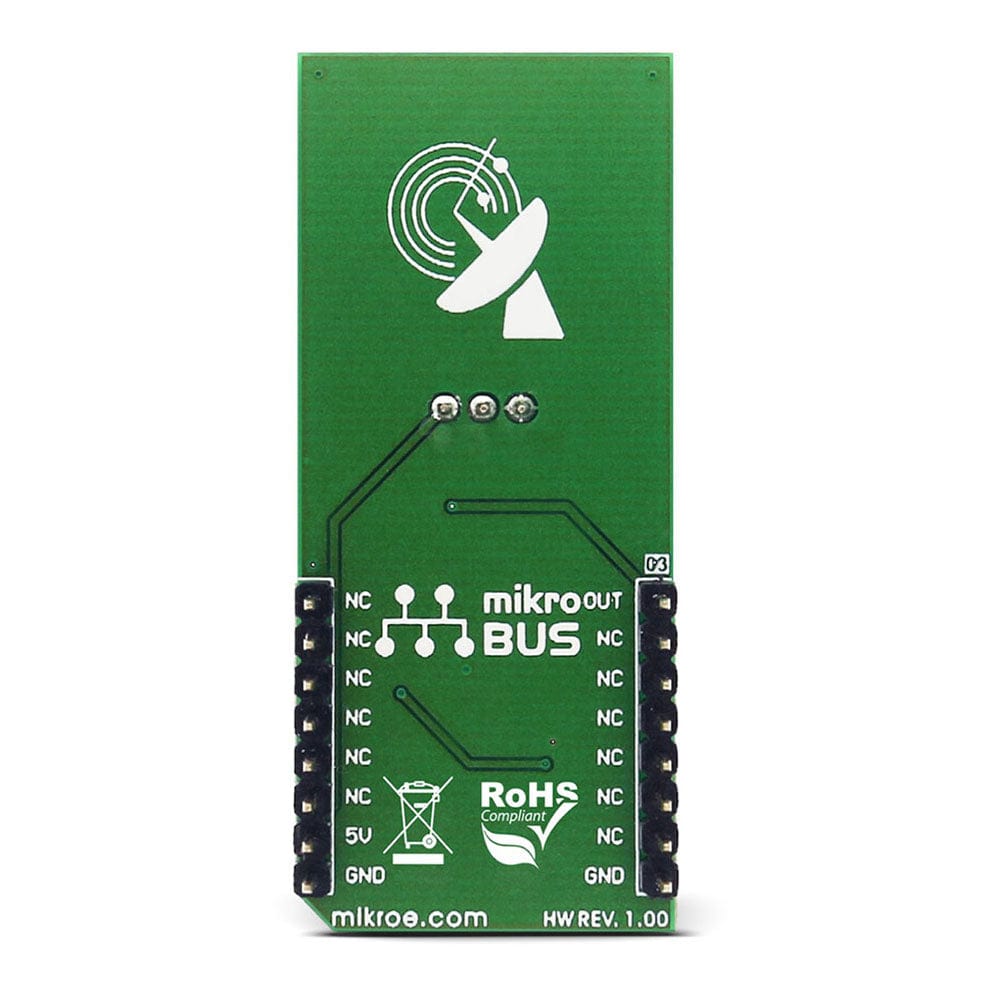
This table shows how the pinout of the Microwave Click Board™ corresponds to the pinout on the mikroBUS™ socket (the latter shown in the two middle columns).
| Notes | Pin |  |
Pin | Notes | |||
|---|---|---|---|---|---|---|---|
| Amplified sensed signal output | OUT | 1 | AN | PWM | 16 | NC | |
| NC | 2 | RST | INT | 15 | NC | ||
| NC | 3 | CS | TX | 14 | NC | ||
| NC | 4 | SCK | RX | 13 | NC | ||
| NC | 5 | MISO | SCL | 12 | NC | ||
| NC | 6 | MOSI | SDA | 11 | NC | ||
| NC | 7 | 3.3V | 5V | 10 | +5V | Power supply | |
| Ground | GND | 8 | GND | GND | 9 | GND | Ground |
| Label | Name | Default | Description |
|---|---|---|---|
| PWR | Power | - | Power LED, lights green when the power supply is established properly. |
| Overview | |
|---|---|
| Category | Motion |
| Applications | ideal solution for building safety and security applications, entrance and exit management applications, and other applications that rely on a reliable moving object detection |
| Key components | |
| On-board modules | PD-V11 a 24GHz microwave motion sensor which detect motions using doppler effect |
| Features | |
| Key features | PD-V11 microwave motion sensor has low power consumption, low noise, and a low wireless power output |
| Interfaces | |
| Interface | Analog |
| Compatibility | mikroBUS™ |
| Electrical | |
| Input voltage | 5V |
| Physical | |
| Click board size | L (57.15 x 25.4 mm) |
| Compliance | |
| Country of origin | Serbia |
| RoHS | Compliant |
| Ordering information | |
| Part number (SKU) | MIKROE-2781 |
| Manufacturer | Mikroelektronika d.o.o. |
| EAN | 8606018711628 |
| Warranty | 12 months |
| Shipping weight | 0.025 kg |
 Microwave Click Board™
Contact us to confirm the full contents of the box.
No questions have been asked about this product yet. Ask our engineers below and we'll reply by email.
