
Lineeye Co Ltd
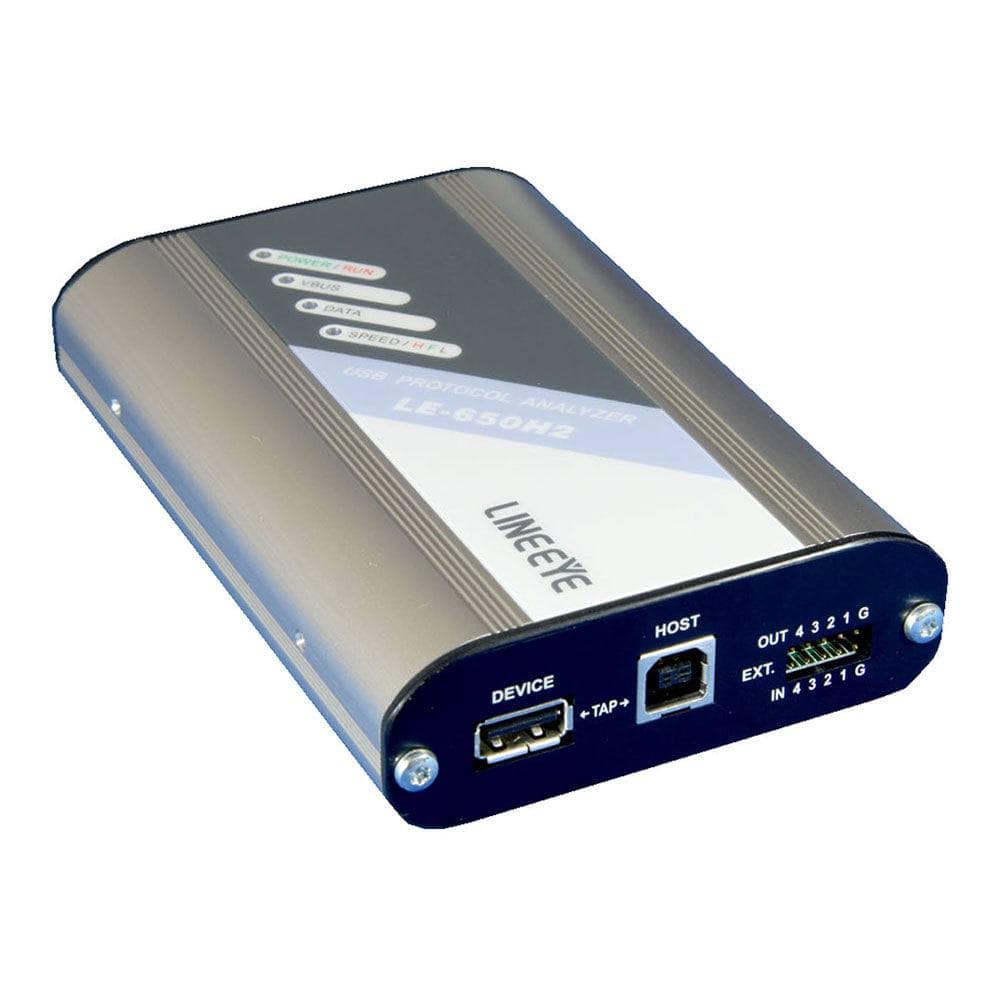
Lineeye LE-650H2 USB 2.0 Protocol Analyzer
Lineeye LE-650H2 USB 2.0 Protocol Analyzer
SKU: LE-650H2
Couldn't load pickup availability
Key Features
Overview
Professional USB 2.0 Protocol Analysis Solution
The Lineeye LE-650H2 is a hardware-based USB protocol analyzer designed for engineers developing and debugging USB 2.0 devices and drivers. This compact aluminum-housed analyzer provides comprehensive monitoring capabilities for USB 1.1 and 2.0 communications, automatically detecting High-Speed (480 Mbps), Full-Speed (12 Mbps), and Low-Speed (1.5 Mbps) operation modes.
Featuring continuous data recording up to 10GB on PC hard drives, the LE-650H2 enables engineers to capture extensive USB traffic without interrupting real-time analysis. The analyzer includes intelligent packet translation with class-specific decoding for standard device requests, descriptors, and various USB device classes including HID, Mass Storage, and Communications.
The device offers real-time VBUS power consumption monitoring with voltage, current, and power measurement capabilities. Advanced triggering and filtering functions allow precise capture of specific events, whilst statistical analysis features provide comprehensive transfer rate and data volume reporting. The LE-650H2's non-intrusive design connects seamlessly between USB hosts and devices via standard USB cables.
For enhanced functionality, engineers can upgrade to the LE-650H2-A Advanced model, which extends recording capacity to 40GB and supports high-speed VBUS logging capabilities.
Downloads
Why Engineers Choose The Lineeye LE-650H2 USB 2.0 Protocol Analyzer
Efficient USB Debugging
Long-Term Data Capture
Power Consumption Analysis
While recording 480Mbps high-speed transfer data of USB 2.0 to the hard disk of the PC via a large capacity memory of LE-620HS, displays the contents of that data on the screen of the PC in detail at real time. It can identify PING and the split transaction at high speed.
Easy operation USB analyzer with auto tracking of the USB Speed
Without affecting the communication carrying data between the analyzer and target device, the LE-650H2 series USB analyzer internally records large amounts of data and simultaneously transfer it to a connected PC via USB. The analyzer automatically detects the speed of the target devices (480/12/1.5 Mbps), so a speed setting is unnecessary. If the device is connected through a hub of differing speed, measurement can be started by simply pressing the space bar of the PC.
Smaller and Lighter
LE-650H2 has almost the same functions as the conventional model of the PC connectable USB analyzer LE-620HS has, but it is smaller and lighter by employing an aluminum case and 8-layer PCB.
Continuous Recording up to 10GB on HDD or SSD
The data measured by the USB analyzer is continuously transferred to the PC and recorded as log files with a maximum of 2GB (Can be specify every 1MB) on the HDD or SSD of the PC. Furthermore, it is possible to form a ring buffer to record maximum of 5 log files continuously by using repetitive recording mode. The measurement log data can be displayed and scrolled during measurement, which is effective for an extended analysis of rare communications failures.
Clearly Detailed Monitor Display
USB packets are clearly displayed by transaction. The device can identify PING and the split transaction at high-speed. Standard descriptors/device requests, descriptors of Communication/Printer class, and peculiar device requests of HUB/HID/Audio/Communication/Mass storage class are translated and displayed in detail, therefore the difficult-to-understand USB protocols can be intuitively understood.
Powerful Sequential Trigger
Trigger condition by a certain transmission data or an external signal condition Up to 16 actions can be set which will be executed when the trigger condition is established.
With these triggers you can control logging by synchronizing with external signal or cooperate with another measurement equipment by switching the external trigger signal to ON when a specify data is detected. It will help your analysis.
Perfect Offline Analysis Features
Data can be easily found among the huge volume of recorded data by using the filter function. It incorporates a advanced search function, such as searching for a standard request, class-divided request and class command.
Development efficiency is boosted to a higher level by using color-coded customization features for packet types and mark/jump features.
Detailed translation is possible by specifying the class for the data without emulation information.
Questions and Answers
-
What Triggering Capabilities Does the LE-650H2 Offer for Capturing Specific Events?
The analyser supports up to 16 sequential triggers, which can be combined for complex captures:
- Packet triggers (specific token/data/handshake combinations)
- Error triggers (CRC/PID errors)
- Bus state triggers (reset/suspend/disconnect)
- External triggers via the 10-pin connector
- VBUS triggers on voltage/current thresholds
-
How Does the LE-650H2 Handle High-Speed USB Traffic Without Data Loss?
The LE-650H2 has 128MB of capture memory and streams the log to the PC over USB 2.0. The buffer absorbs bursts while data is written to the PC, and you can view and scroll the captured data during measurement.
-
What Filtering Options Are Available for Analyzing Large USB Datasets?
Log filters let you leave out SOF, IN-NAK, OUT-NAK, SETUP-NAK and PING packets, or keep only chosen addresses and endpoints, so captures stay smaller. Display filters hide the same kinds of packets. Search finds packet types, device requests and errors, and the statistics view shows transaction counts, bytes and average transfer rates.
-
Does the LE-650H2 Support USB Hub Analysis and Split Transactions?
Yes. The LE-650H2 analyses traffic through USB hubs and identifies split transactions (SPLIT packets), used when a high-speed hub carries full- and low-speed traffic. It also displays hub descriptors and requests.
-
What Are the PC System Requirements for Using the LE-650H2?
The LE-650H2 needs:
- Windows 7, 8.1, 10 or 11
- Core 2 Duo processor or later (Core i series recommended)
- 1GB RAM minimum
- USB 2.0 High-Speed port
- Enough disk space for data logging
It is powered from the PC's USB port (400mA maximum) and needs no separate power supply.
-
Can the LE-650H2 Measure USB Device Power Consumption?
Yes. The LE-650H2 monitors VBUS in real time, measuring voltage (0-8V), current (-0.9A to 1A) and power consumption of connected USB devices. Power data is shown graphically and can be logged alongside USB communication data.
-
What USB Speeds Does the LE-650H2 Support for Protocol Analysis?
The LE-650H2 analyses High-Speed (480Mbps), Full-Speed (12Mbps) and Low-Speed (1.5Mbps) USB 2.0/1.1 traffic and detects the speed automatically. Behind a hub running at a different speed, press the space bar to start measuring.
-
How Does Hardware-Based Analysis Differ From Software-Based USB Analyzers?
Hardware analysers like the LE-650H2 sit in line with the bus and capture traffic without affecting the communication. Software analysers run in the host's USB stack, can affect system performance and miss bus-level events. The LE-650H2 captures bus events including resets, suspend, disconnect and chirp.
-
What Is the Maximum Continuous Recording Capacity of the LE-650H2?
The standard LE-650H2 records continuously up to 10GB on the PC's hard drive or SSD. For longer recordings, the LE-650H2-A (Lineeye's Advance model) records up to 40GB and adds high-speed VBUS logging.
-
Which USB Device Classes Can the LE-650H2 Decode and Analyze?
The analyser decodes:
- Standard device requests
- HID class-specific requests
- Mass Storage/Bulk-Only Transport
- Communication Device Class (CDC)
- Audio class
- Printer class
- USBTMC
- Video class
- Hub class
- Wireless controller (Bluetooth HCI; may need a software update licence)

No questions match your search.