
Hantek Electronic Co Ltd
Hantek HT8100 High-Voltage Differential Probe 100MHz
Hantek HT8100 High-Voltage Differential Probe 100MHz
SKU: HT8100
Couldn't load pickup availability
Key Features
Overview
The Hantek HT8100 is a professional 100MHz high-voltage differential probe designed for safe measurement of floating circuits in power electronics applications. Featuring dual attenuation ratios of 1:50 and 1:500, it enables measurement of differential voltages up to 130V and 1300V respectively whilst maintaining excellent common-mode rejection ratio of ≥80dB at DC.
Built with robust safety specifications including 1000Vrms CAT II and 600Vrms CAT III ratings, this probe incorporates visual over-range warning via red LED indicators to prevent damage during high-voltage measurements. The compact design includes standard BNC output connectivity for universal oscilloscope compatibility.
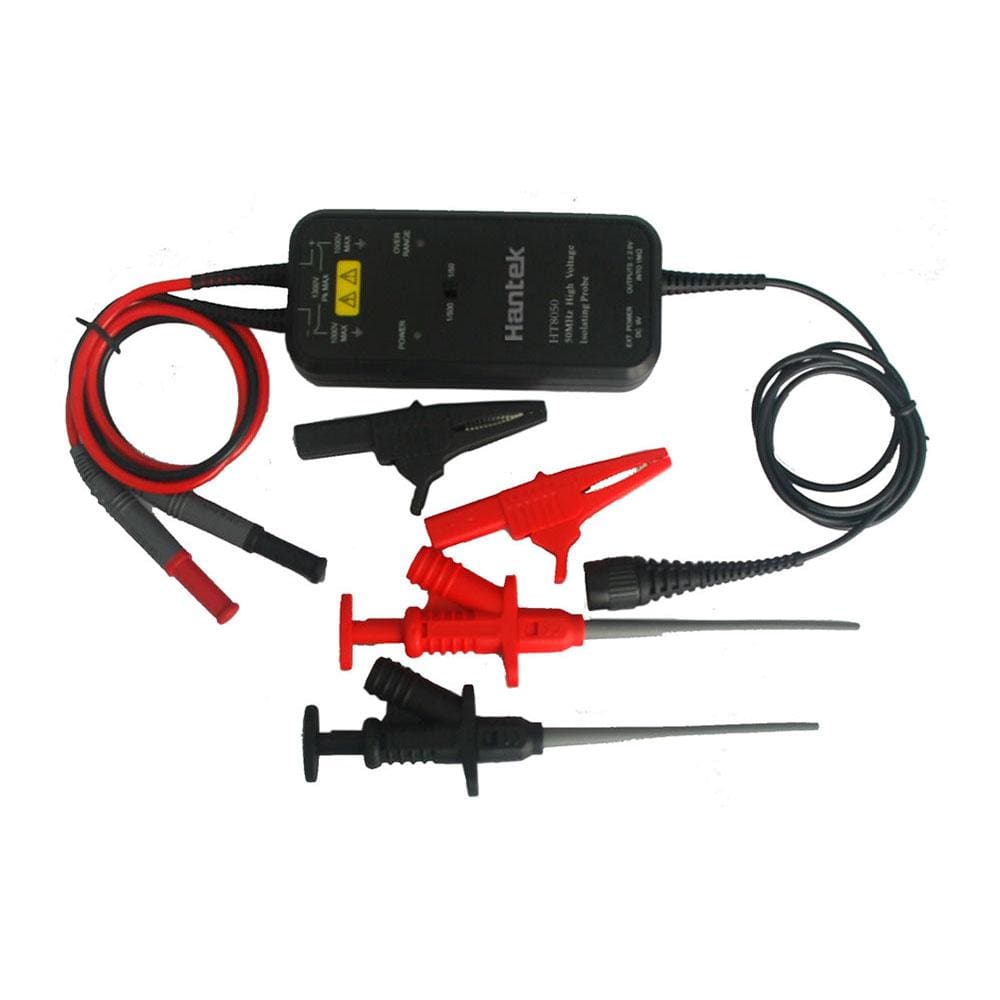
Essential for switching power supply design, motor drive applications, and oscilloscope measurements requiring galvanic isolation from earth ground. Includes comprehensive accessory kit with alligator clips, pincer clips, and AC power adapter for immediate deployment.
Downloads
Why Engineers Choose The Hantek HT8100 High-Voltage Differential Probe 100MHz
Safety First
Floating Measurements
Cost-Effective Performance
Overview
The Hantek HT8100 high-voltage differential probe represents essential test equipment for power electronics engineers working with floating circuits, switching power supplies, and motor drive systems. Unlike standard oscilloscope probes that reference measurements to ground, this differential probe safely measures voltage differences between two floating points whilst providing galvanic isolation from the oscilloscope ground plane.
Key Applications
Power Electronics Design
Essential for measuring drain-to-source voltages (VDS) in MOSFETs, collector-emitter voltages in IGBTs, and voltage drops across freewheeling diodes in half-bridge and full-bridge configurations. The probe's 100MHz bandwidth captures fast switching transients in modern SiC and GaN power devices.
Motor Drive Systems
Critical for analysing three-phase inverter outputs, measuring phase-to-phase voltages, and debugging PWM modulation schemes without creating dangerous ground loops through the measurement system.
Switching Power Supply Debug
Enables safe measurement of transformer primary and secondary voltages, isolation barrier testing, and ripple analysis in flyback, forward, and LLC resonant converters.
Technical Specifications
| Parameter | HT8100 Specification |
|---|---|
| Bandwidth (-3dB) | 100MHz |
| Rise Time | ≤3.5ns |
| Attenuation Ratios | 1:50, 1:500 (user selectable) |
| Maximum Differential Voltage | ±130V (1:50), ±1300V (1:500) |
| Common Mode Input Range | 1000Vrms CAT II, 600Vrms CAT III |
| Input Impedance | 4MΩ±1% (single-ended), 8MΩ±1% (differential) |
| Input Capacitance | ≤8pF (single-ended), ≤4pF (differential) |
| CMRR | ≥80dB (DC), ≥60dB (100Hz), ≥50dB (1MHz) |
| Accuracy | ±2% |
| Noise Floor | ≤2mVrms (1:50), ≤1mVrms (1:500) |
Safety Considerations
The HT8100's safety certification covers both installation categories: CAT II for outlets and plug-connected equipment, and CAT III for distribution panels and fixed installations. The over-voltage detection system provides visual warning when inputs exceed ±140V (1:50 range) or ±1400V (1:500 range), protecting both probe and measurement equipment.
Connection and Setup
Physical Connections
The probe features colour-coded input leads: red for positive input, black for negative input. Standard BNC output connects to any oscilloscope channel. The external AC adapter supplies isolated DC power, eliminating dependence on oscilloscope probe power interfaces.
Grounding Strategy
Unlike single-ended probes, the HT8100 requires no ground connection to the circuit under test. This floating operation prevents ground loops whilst maintaining measurement accuracy through excellent common-mode rejection specifications.
Measurement Techniques
MOSFET Drain-Source Voltage
// Typical VDS measurement setup 1. Set oscilloscope to DC coupling 2. Select appropriate probe attenuation (1:50 for <130V, 1:500 for >130V) 3. Connect red lead to MOSFET drain 4. Connect black lead to MOSFET source 5. Configure oscilloscope vertical scale: Vpp_expected / attenuation_ratio / 8 6. Set trigger on rising edge at 10% of expected voltage Isolation Testing
For transformer isolation measurements, connect probe inputs across the isolation barrier. The high CMRR specification ensures accurate measurement of small differential signals even with kilovolts of common-mode voltage present on both windings.
Comparison with Alternatives
| Approach | Safety | Accuracy | Cost | Limitations |
|---|---|---|---|---|
| HT8100 Differential Probe | CAT III rated | ±2%, >50dB CMRR | Moderate | 100MHz bandwidth limit |
| Two Single-Ended Probes (Math) | Poor | Poor CMRR | Low | Ground loop risk |
| Isolated Oscilloscope | Excellent | Excellent | Very High | Equipment cost |
| Optically Isolated Probe | Excellent | Excellent | Very High | Complexity, cost |
Maintenance and Calibration
Annual calibration verification ensures continued measurement accuracy. Check probe compensation using the oscilloscope's built-in calibration signal, and inspect input cables for damage that could compromise safety ratings. The probe requires 20-minute warm-up for specified accuracy performance.
Troubleshooting Common Issues
No Signal Display
- Verify AC adapter connection and green POWER LED illumination
- Check BNC cable connection to oscilloscope input
- Confirm oscilloscope channel is enabled and properly scaled
Measurement Instability
- Twist input leads together to reduce noise pickup
- Avoid extending input cables beyond supplied length
- Ensure probe and oscilloscope have completed 20-minute warm-up
Over-Range Indication
- Red LED warning indicates input voltage exceeds selected range
- Switch to higher attenuation ratio (1:500) for voltages above 130V
- Verify circuit voltage levels before connection
| General Information | |
|---|---|
Part Number (SKU) |
HT8100
|
Manufacturer |
Hantek Electronic Co Ltd
|
| Electrical Specifications | |
Bandwidth |
|
| Physical and Mechanical | |
Weight |
0.2 kg
|
| Other | |
EAN |
5055383626656
|
Questions and Answers
-
What Accessories Are Included with the HT8100?
The package includes:
- Probe with integral BNC output cable (about 90cm)
- AC power adaptor (DC9V 1000mA)
- Red and black alligator clips
- Red and black pincer clips
- Instruction manual
-
What Is the Common-Mode Rejection Ratio Specification?
CMRR is ≥80dB at DC, ≥60dB at 100Hz (Hantek's product page gives this figure at 100kHz) and ≥50dB at 1MHz. That keeps differential measurements accurate with high common-mode voltages present.
-
How Long Are the Input Cables for Measurement Flexibility?
The input leads are about 25cm long (the manual gives 30cm) and the output cable about 90cm. That gives enough reach for most measurements while limiting noise pickup.
-
What Input Impedance Does the Probe Present to the Circuit?
Input impedance is 4MΩ±1% from each input to ground and 8MΩ±1% between the two inputs, with input capacitance ≤8pF single-ended to ground and ≤4pF between inputs.
-
Is the HT8100 Suitable for Automotive Power System Measurements?
Hantek lists motor drive design, AC inverters, UPS and switch-mode power supplies as applications. In our view its ratings (up to ±1300V differential, CAT II 1000V) also suit automotive work such as motor controllers, 48V systems and EV charging circuits within those limits.
-
What Is the Maximum Differential Voltage the HT8100 Can Measure?
Up to ±130V (DC + peak AC) on the 1:50 range and ±1300V (DC + peak AC) on the 1:500 range. That covers most power electronics applications.
-
Is This Probe Safe for Measuring Mains-Powered Circuits?
Yes. The HT8100 is rated CAT II 1000V and CAT III 600V, with a maximum common-mode input voltage of 1000Vrms CAT II or 600Vrms CAT III. It is suitable for industrial power measurements.
-
What Bandwidth Does the HT8100 Offer for High-Frequency Measurements?
100MHz bandwidth (-3dB) with ≤3.5ns rise time. That is enough for switching transients in most power converters, including SiC and GaN designs whose edges are slower than the probe's 3.5ns rise time.
-
Can I Use This Probe with Any Brand of Oscilloscope?
Yes. It has a BNC output, so it works with any oscilloscope that has a BNC input. It has its own power adaptor, so it doesn't need a probe power interface on the oscilloscope.
-
How Does the Over-Range Warning System Work?
A red over-range LED lights when the input exceeds the selected range. Hantek's product page gives the thresholds as ≥130V on the 1:50 range and ≥1300V on the 1:500 range; the manual gives a detection level of 140V±4V and 1400V±40V.
No questions match your search.