
Hantek Electronic Co Ltd
Hantek HDG3103C 100MHz 3-Channel Function Generator
Hantek HDG3103C 100MHz 3-Channel Function Generator
SKU: HDG3103C
Couldn't load pickup availability
Key Features
Overview
The Hantek HDG3103C delivers professional-grade signal generation in a compact, cost-effective package suitable for electronic engineers, researchers, and educational laboratories. This versatile instrument combines five essential functions: arbitrary waveform generation, pulse generation, function generation, harmonic generation, and frequency measurement up to 80MHz.
Featuring dual high-performance channels with 100MHz capability plus a third channel operating up to 20MHz, the HDG3103C provides exceptional flexibility for multi-signal testing scenarios. The instrument's DDS-based architecture ensures excellent frequency stability (±1ppm) and low phase noise (-105dBc/Hz at 10kHz offset), making it suitable for demanding RF and communication applications.
Engineers choose the HDG3103C for its comprehensive feature set, reliable performance, and competitive pricing compared to equivalent instruments from major manufacturers. The instrument integrates seamlessly with existing test setups through standard connectivity options and supports both manual operation and automated testing environments.
Explore complementary test equipment including digital oscilloscopes and benchtop power supplies to create complete measurement solutions.
Downloads
Why Engineers Choose The Hantek HDG3103C 100MHz 3-Channel Function Generator
Multi-Channel Flexibility
Professional Performance
Comprehensive Functionality
High-Performance Function Generation for Professional Testing
The Hantek HDG3103C represents a comprehensive 5-in-1 test solution combining function generator, arbitrary waveform generator, pulse generator, harmonic generator, and frequency meter capabilities in a single compact instrument. With 100MHz maximum frequency output and three independent channels, this generator delivers professional-grade signal generation for electronic design validation, circuit testing, and research applications.
Advanced Signal Generation Technology
Built using Direct Digital Synthesis (DDS) technology, the HDG3103C produces stable, low-distortion signals with exceptional frequency accuracy. The 16-bit vertical resolution and 250MSa/s sampling rate ensure precise waveform reconstruction across all operating frequencies.
| Channel | Maximum Frequency | Sample Rate | Resolution |
|---|---|---|---|
| CH1/CH2 | 100MHz | 250MSa/s | 16-bit |
| CH3 | 20MHz | 125MSa/s | 16-bit |
Comprehensive Waveform Library
Generate standard waveforms including sine, square, triangle, pulse, and noise signals plus access to over 160 built-in arbitrary waveforms covering medical (ECG), mathematical (Gaussian, Lorentz), and engineering applications. The 2Mpts memory depth enables creation of complex, detailed waveforms for advanced testing scenarios.
Advanced Modulation Capabilities
Support for multiple modulation schemes including AM, DSB-AM, FM, PM, ASK, FSK, PSK, BPSK, QPSK, and PWM enables comprehensive testing of communication systems and mixed-signal circuits. The built-in harmonic generator produces up to 16th order harmonics for filter testing and harmonic analysis.
Wiring Quick-Start
Connect the HDG3103C BNC output (50Ω impedance) to your oscilloscope or device under test using a quality coaxial cable. Ensure impedance matching by setting the load impedance to 50Ω in both instruments for accurate amplitude readings.
Basic Connection: HDG3103C CH1 Output → 50Ω BNC Cable → Oscilloscope CH1 Input Ground Reference: Ensure both instruments share common ground Load Setting: Configure both devices for 50Ω impedance Intuitive Operation
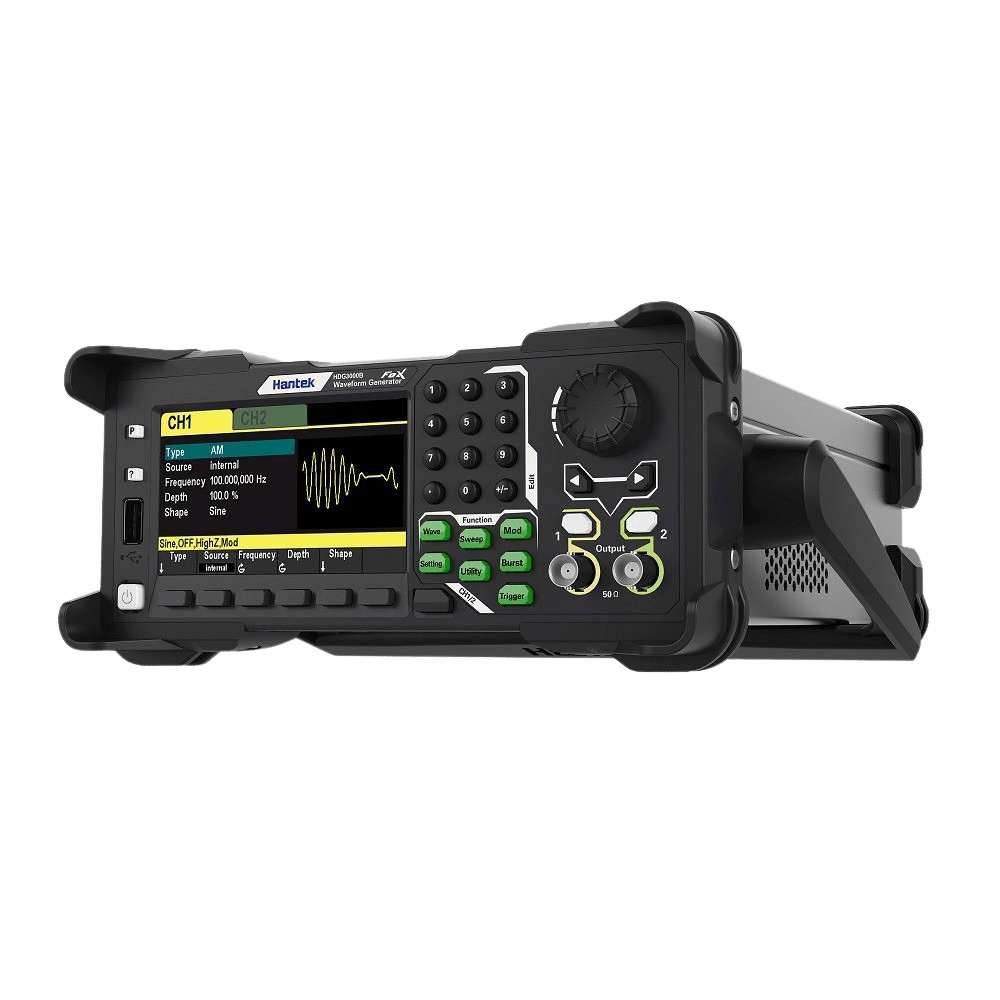
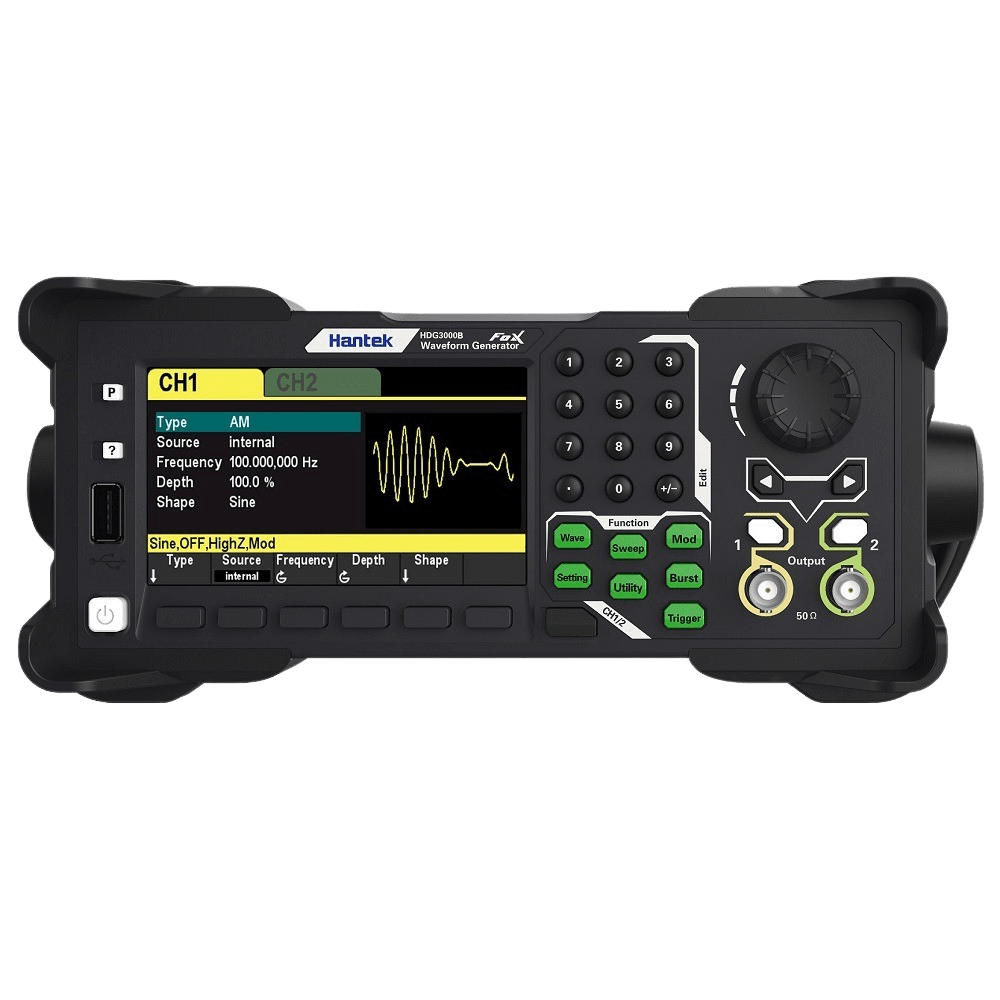
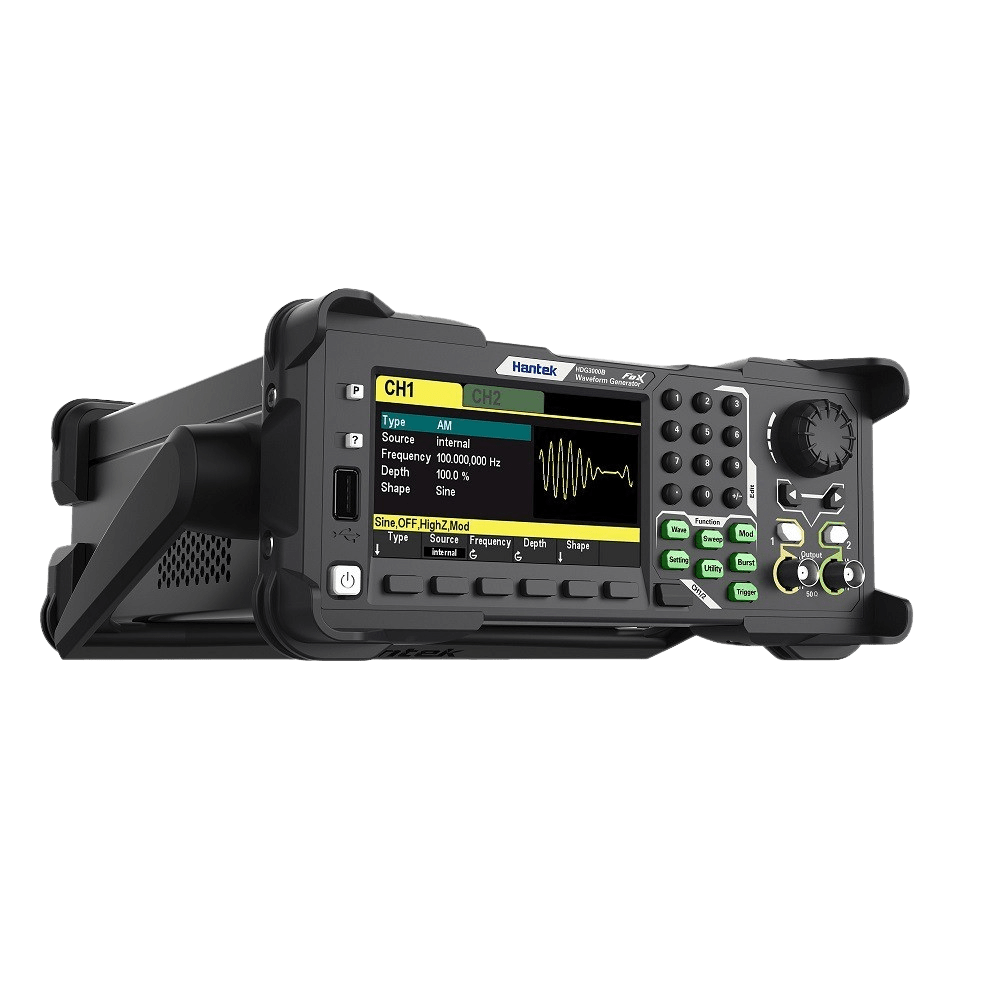
The 4.3-inch colour TFT LCD display provides clear visualisation of all parameters, whilst the dedicated numeric keypad and intuitive menu structure enable rapid configuration changes. Built-in help system provides context-sensitive guidance for all functions.
| General Information | |
|---|---|
Part Number (SKU) |
HDG3103C
|
Manufacturer |
|
| Physical and Mechanical | |
Weight |
5.0 kg
|
| Other | |
EAN |
5055383604296
|
Questions and Answers
-
What Is the Frequency Stability and Accuracy of the HDG3103C?
Hantek specifies a frequency accuracy of ±1ppm (18 to 28°C). Hantek does not publish a phase noise figure for the HDG3000C series. Where you need a shared or more stable reference, lock it to an external 10MHz source through the rear 10MHz input.
-
Can I Synchronise Multiple HDG3103C Units for Complex Test Scenarios?
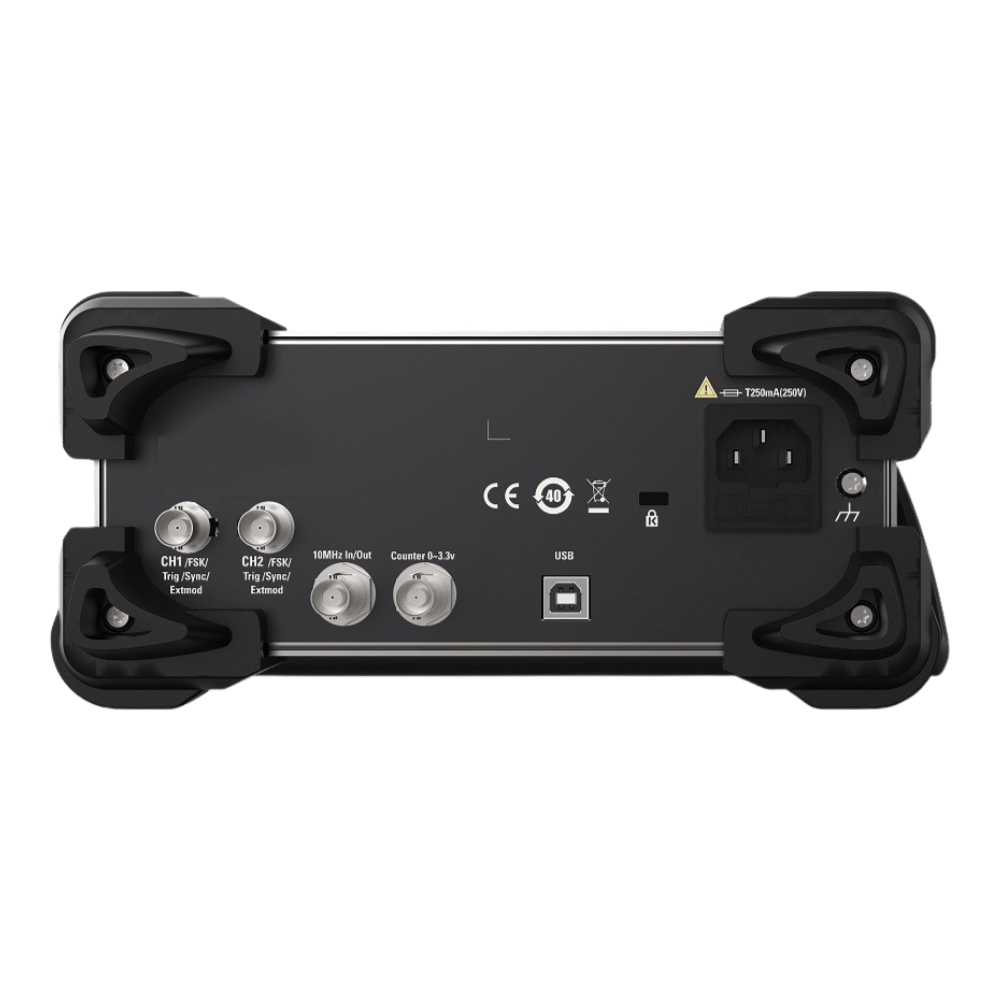
Yes, to a shared reference. The rear-panel 10MHz reference in and out connectors are, in Hantek's words, used to synchronise multiple instruments, so several units can run from one reference clock. The rear trigger input accepts a TTL trigger. Hantek does not document a procedure for phase-aligning the outputs of separate units.
-
How Does the HDG3103C Compare to Entry-Level Generators?
Many entry-level generators have two channels; the HDG3103C has three. Compared with them it offers:
- channels 1 and 2 to 100MHz with 250MSa/s sampling and 16-bit resolution
- a third channel with a reduced specification (12-bit, sine to 20MHz)
- a built-in harmonic generator on channels 1 and 2
-
What Accessories Are Included with the HDG3103C?
Hantek lists these standard accessories:
- power cord
- USB cable
- one BNC-to-BNC cable (HT322)
- two alligator clip leads (HT324)
The user manual and PC software are downloads from Hantek's website.
-
Does the HDG3103C Support Remote Control and Automation?
Yes. Its USB Device interface supports SCPI commands for remote control from PC applications, so you can integrate it into automated test sequences and data logging systems for production testing.
-
What Is the Difference Between the Three Channels on the HDG3103C?
Channels 1 and 2 run to 100MHz with 250MSa/s sampling and 16-bit resolution. Channel 3 is 12-bit at 125MSa/s: sine to 20MHz, square to 5MHz and arbitrary waveforms to 15MHz. All three channels output arbitrary waveforms; Hantek documents the modulation and harmonic functions for channels 1 and 2.
-
Can the HDG3103C Generate Complex Modulated Signals for RF Testing?
Yes. It supports these modulation types:
- AM, DSB-AM, FM and PM
- ASK, FSK, PSK, BPSK and QPSK
- PWM
The built-in arbitrary waveform capability lets you create custom communication signals and test patterns.
-
How Does the Harmonic Generator Function Work?
On channels 1 and 2 it adds harmonics up to the 16th order to the fundamental, and you set the amplitude and phase of each harmonic. The highest usable order is limited by the channel's maximum frequency divided by the fundamental. This is useful for testing harmonic filters, analysing frequency response and generating complex spectral content.
-
What File Formats Does the HDG3103C Support for Arbitrary Waveforms?
Arbitrary waveforms use Hantek's .hwf file format. You create them in Hantek's PC software, downloaded from hantek.com, and load them into the generator from a USB stick. Hantek does not list CSV import.
-
Is the HDG3103C Suitable for Automotive Electronics Testing?
Yes. It can simulate automotive sensor signals, test ECU inputs and generate pulse patterns for automotive communication protocols. The pulse generator function supports precise timing.
No questions match your search.