
Saleae, Inc
Saleae Logic Pro 16 Logic/Analogue Analyser
Saleae Logic Pro 16 Logic/Analogue Analyser
SKU: SAL-00116
Couldn't load pickup availability
Key Features
Overview
The Saleae Logic Pro 16 Logic/Analogue Analyser (SKU SAL-00115) delivers professional-grade mixed-signal debugging in a compact USB package. It offers 16 multi-use channels capable of capturing both digital and analogue data—up to 500 MS/s on 4 channels or 100 MS/s when all 16 are in use, with analogue sampling at up to 50 MS/s and 12-bit resolution. These capabilities allow engineers to analyse complex signal interactions, spot intermittent faults and validate timing-sensitive protocols efficiently. The unit includes advanced protocol decoders (SPI, I²C, CAN, UART, SWD and more), flexible triggering and cross-platform compatibility (Windows, macOS, Linux), alongside a generous buffer depth limited only by host memory. Housed in a robust carry-case and bundled with wire harnesses, micro-gripper clips, and USB 3.0 cable, it also features a 12-month warranty and draws on the same software foundation used across Saleae’s product line – including the Logic 8 and Logic Pro 8 variants. For projects demanding extensive channel count and mixed-signal insight, the Logic Pro 16 stands out for its balance of performance, usability and portability—making it a compelling choice for embedded-systems validation.
See also the Saleae Logic Pro 8 and Saleae Logic 8 for lower-channel alternatives.
Downloads
Why Engineers Choose The Saleae Logic Pro 16 Logic/Analogue Analyser
High‑channel flexibility for full capture
Ultra-fast sampling and deep memory
Polished software + cross-platform support
Full Description
The Saleae Logic Pro 16 is a professional mixed-signal ⓘ USB ⓘ logic analyser ⓘ designed for Electronic Design Engineers who need deep visibility into both digital and analogue behaviour on complex embedded systems. With 16 dual-purpose inputs that each capture digital and analogue, digital sampling up to 500 MS/s ⓘ (on up to four channels, or 100 MS/s ⓘ across all sixteen), analogue sampling up to 50 MS/s ⓘ at 12-bit resolution ⓘ, and bandwidths of 100 MHz ⓘ (digital) and 5 MHz (-3 dB) ⓘ (analogue), it provides the performance and workflow efficiency required for board bring-up, firmware validation and regression debugging. Inputs tolerate ±25 V ⓘ with an operating analogue range of ±10 V ⓘ, and a typical input impedance of 2 MΩ || 10 pF ⓘ. Cross-platform Logic 2 software supports extensive protocol decode ⓘ, measurements, bookmarking, triggering and export.
Mixed-signal capture on every channel
All sixteen inputs are multi-use, meaning each can record digital and analogue simultaneously. This enables correlation of logic-level transitions with analogue effects like supply droop, ground bounce or ringing without re-probing. For example, when chasing an intermittent I²C ⓘ NACK ⓘ, you can observe SDA ⓘ/SCL ⓘ decoding alongside analogue traces that show overshoot from long stubs. The result is fewer reconnections and complete captures that reflect real-world behaviour.
Sampling performance and bandwidth
The analyser samples digital signals at up to 500 MS/s ⓘ on four channels via USB 3.0 ⓘ, or 100 MS/s ⓘ on all sixteen channels. Analogue capture reaches 50 MS/s ⓘ with 5 MHz (-3 dB) ⓘ bandwidth at 12-bit resolution. These figures align with MCU ⓘ/SoC ⓘ buses such as SPI ⓘ, UART ⓘ, SWD ⓘ, JTAG ⓘ and PWM ⓘ. Sampling above the Nyquist criterion ⓘ preserves timing integrity and pulse width accuracy.
Wide signal range and thresholds
Each input withstands ±25 V ⓘ, with an operating analogue range of ±10 V ⓘ. Digital thresholds support mixed-voltage systems (1.2 V, 1.8 V, 3.3 V and 5 V logic) on one capture, reducing external level shifters. This allows analysis of RS-232 ⓘ, RS-485 ⓘ or TTL ⓘ signals. The 2 MΩ || 10 pF ⓘ input preserves edge rates on high-impedance nets.
Logic 2 software with protocol decode
Logic 2 (Windows, macOS, Linux) decodes SPI ⓘ, I²C ⓘ, UART ⓘ, CAN ⓘ, LIN ⓘ, I²S ⓘ, PCM ⓘ, MDIO ⓘ, USB 2.0 ⓘ and more. Engineers can annotate frames, search events, and export to CSV ⓘ, VCD ⓘ, Binary or MATLAB ⓘ. An Automation API ⓘ enables scripted workflows and custom decoders.
Deep captures using host memory
The Logic Pro 16 streams via USB 3.0 SuperSpeed ⓘ into system RAM ⓘ, so capture length is limited mainly by PC resources and activity density. This enables long recordings to catch rare CRC ⓘ faults or supply droops during RF transmit bursts, while keeping navigation responsive.
Triggering for fault isolation
Edge and pulse-width triggers isolate faults quickly. For example, a bootloader UART at 3 Mbaud ⓘ may be disturbed by EMI ⓘ from a nearby DC-DC converter ⓘ. On SPI ⓘ, triggering on long CS ⓘ assertions helps catch firmware stalls that violate timing, reducing debug cycles.
Everyday debugging scenarios
Consider an STM32 board failing to configure a QSPI ⓘ flash: capture SPI lines at 100 MS/s ⓘ while sampling the 3.3 V rail at 1–3 MS/s ⓘ. The timeline reveals a mode-bit mismatch and a POR ⓘ voltage sag. For an I²C ⓘ device failing at 1 MHz, decoded frames show marginal SCL high-time ⓘ, while analogue traces show ringing, prompting pull-up adjustments. On CAN ⓘ, error frames correlate with VDD ⓘ droop, confirming the need for additional bulk capacitance. For motor control, sampling PWM ⓘ and shunt current together reveals loop timing without additional instruments.
Choosing the right model
For fewer channels, the Saleae Logic Pro 8 logic analyser offers 8 channels, 500 MS/s ⓘ (four channels) or 100 MS/s ⓘ (all eight), and 50 MS/s ⓘ analogue. If your work is mainly low-to-mid-speed digital with occasional analogue context, the Saleae Logic 8 mixed-signal analyser is a practical choice. For wide buses or multiple SPI/I²C peripherals, the 16-channel Logic Pro 16 preserves full timing relationships in a single capture.
Interoperability with other debug tools
The Logic Pro 16 integrates with complementary tools. Pair it with the Total Phase Aardvark I²C/SPI host adapter to generate traffic while capturing responses, or the Total Phase Promira Serial Platform for eSPI ⓘ and scripting. For high-channel analysis, explore the Acute LA4000 Plus Series logic analyser; for portable mid-range with timing/state modes, see the Acute TravelLogic 34-Channel logic analyser. These tools extend stimulus and state analysis while the Saleae provides rapid correlation and documentation.
Specifications
Channels: 16 digital, 16 analogue (shared). Digital sample rates: up to 500 MS/s ⓘ (four channels), 100 MS/s ⓘ (sixteen channels). Digital bandwidth: 100 MHz ⓘ. Analogue sample rates: up to 50 MS/s ⓘ, 12-bit ⓘ. Analogue bandwidth: 5 MHz (-3 dB) ⓘ. Analogue input operating range: ±10 V ⓘ; absolute max: ±25 V ⓘ. Input impedance: 2 MΩ || 10 pF ⓘ. Interface: USB 3.0 ⓘ. Software: Logic 2 (Windows/macOS/Linux); exports CSV/VCD/MATLAB/Binary ⓘ; Automation API and SDK available.
Related products on The Debug Store
For compact setups, the Saleae Logic Pro 8 mixed-signal logic analyser provides fewer channels with the same interface. To exercise I²C/SPI targets during capture, use the Total Phase Aardvark I²C/SPI host adapter or the Total Phase Promira Serial Platform. For more channels and timing/state modes, see the Acute LA4000 Plus Series logic analyser or the Acute TravelLogic 34-Channel logic analyser.
| General Information | |
|---|---|
Part Number (SKU) |
SAL-00116
|
| Physical and Mechanical | |
Weight |
0.5 kg
|
| Other | |
EAN |
5055383614332
|
Questions and Answers
-
What Protocol Decoders Are Included with the Logic Pro 16?
The Logic Pro 16 has built-in decoders for:
- SPI
- I²C
- UART
- CAN
- USB (Low Speed and Full Speed)
- 1-Wire
- HDMI-CEC
- JTAG
- LIN
- Manchester
- MDIO
- MIDI
- Modbus
There are many others. You can also add community-developed protocol analysers or write your own with the Protocol Analyzer SDK.
-
What Software Platforms Does the Logic Pro 16 Support?
The Logic Pro 16 uses Saleae's Logic 2 software on Windows 10/11, macOS 12 or later and Ubuntu 20.04+ 64-bit. It includes measurement tools and automation through the Python API.
-
Can the Logic Pro 16 Handle Automotive and Industrial Bus Protocols?
Yes, within limits. ±25V input protection and logic level support from 1.2V to 5.5V suit automotive work. The inputs are single-ended (one wire per signal), so it connects to CAN, LIN and similar buses without extra hardware, but check Saleae's voltage guidance for your bus.
-
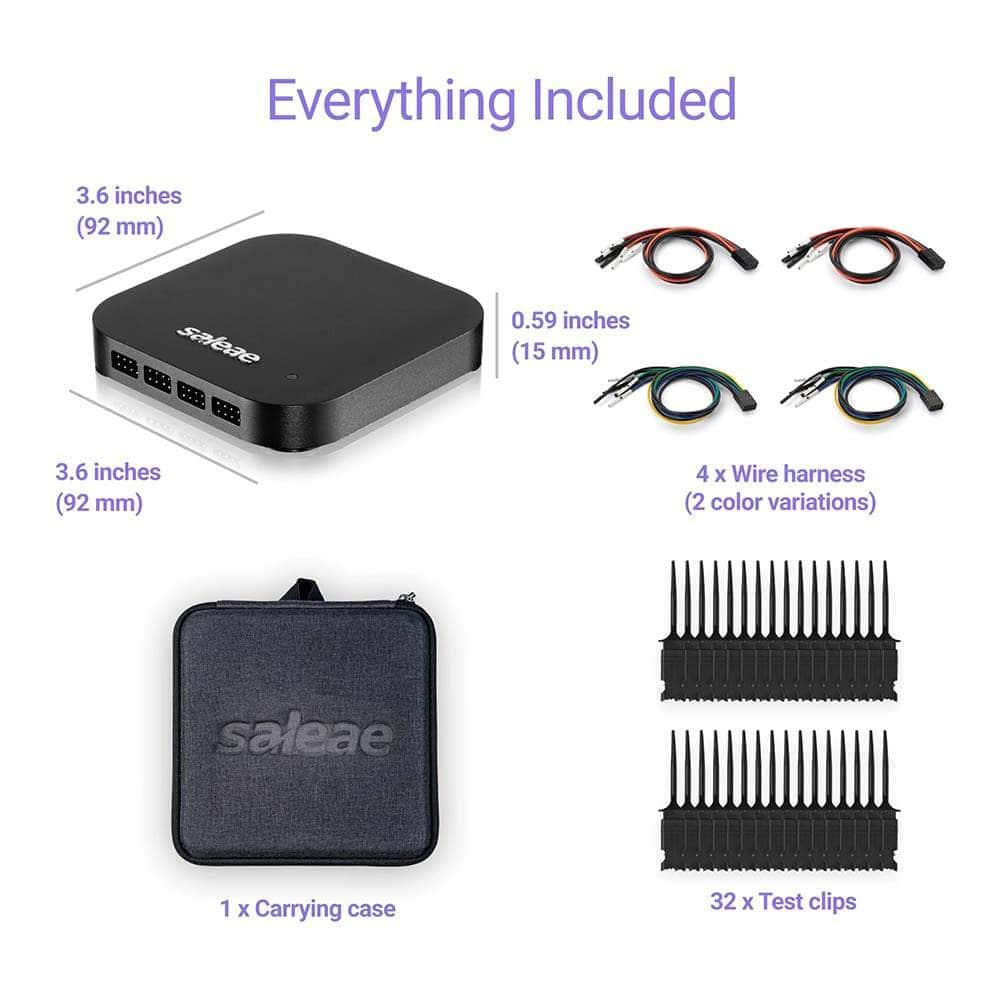
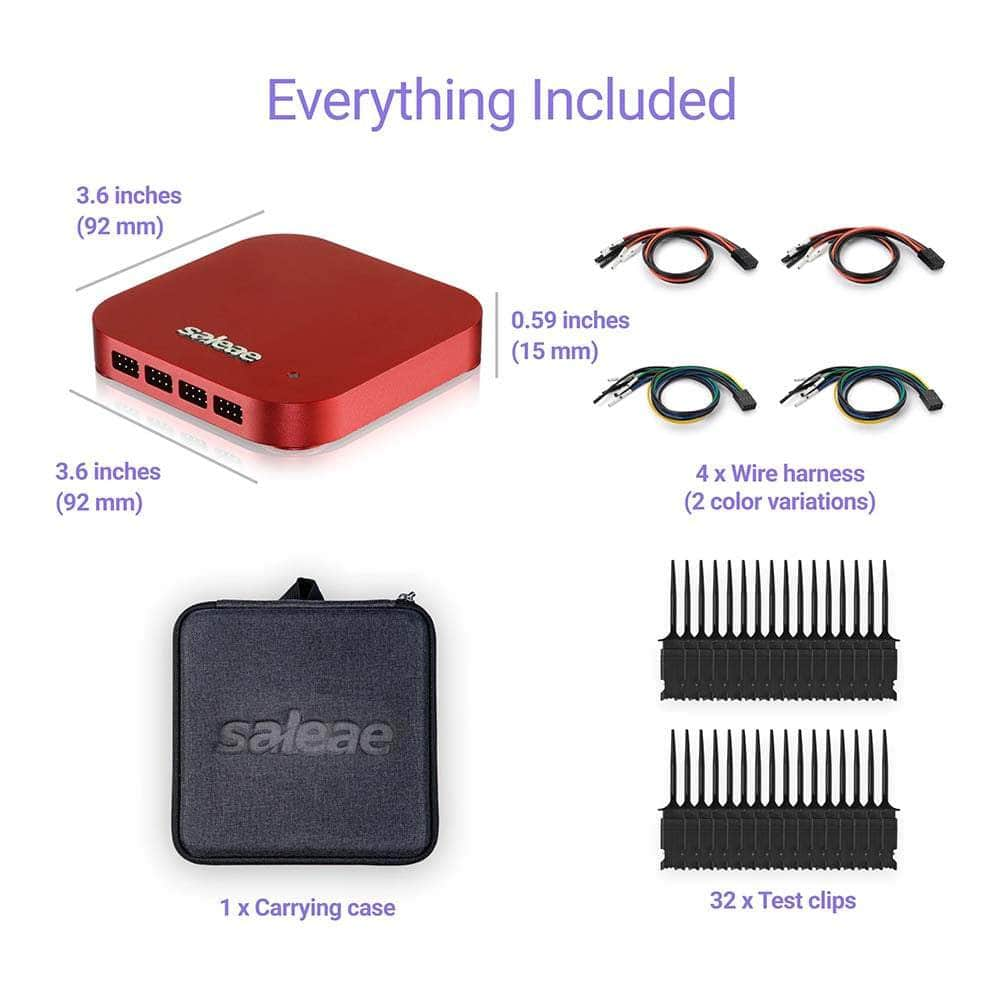
What Accessories Are Included with the Logic Pro 16?
The Logic Pro 16 comes with:
- 4x 4-channel wire harnesses with independent ground wires
- 32 micro-gripper hooks
- carrying case
- USB 3.0 cable
- Getting Started Guide
The dedicated ground connections minimise crosstalk, which matters most for high-speed digital signals.
-
What Warranty and Support Does Saleae Provide for the Logic Pro 16?
Saleae handles its 3-year warranty directly, wherever you bought the device, and doesn't need the original receipt.
-
What Are the Main Features of the Saleae Logic Pro 16?
The Logic Pro 16 combines 16-channel digital analysis with simultaneous analogue recording on all 16 channels. Its streaming architecture gives sample depth limited only by PC memory, rather than a fixed hardware buffer.
It comes with a 3-year direct manufacturer warranty.
-
How Does the Streaming Architecture Benefit Electronic Design Engineers?
Data streams continuously to your computer's RAM instead of limited onboard memory, so you can capture for as long as PC memory allows: seconds at the full analogue rate, hours on slow buses. That helps with intermittent issues, protocol violations and rare signal events. Unlike analysers with fixed buffers, the Logic Pro 16 records until your computer's memory runs out. Saleae quotes 10+ billion samples as typical.
-
Can the Logic Pro 16 Analyse High-voltage Signals Directly?
Yes. The Logic Pro 16 has ±25V input protection and handles RS-232, RS-422 and RS-485 signals directly, without external level shifters. The inputs are single-ended, so for RS-422 and RS-485 probe one leg of the pair. The analogue input range is -10V to +10V, and selectable digital thresholds (0.6V, 0.9V, 1.65V) support logic families from 1.2V to 5.5V.
No questions match your search.