
FlexRay, SENT and PSI5 Protocols
FlexRay is a fault-tolerant 10 Mbit/s vehicle network with a fixed time schedule, used for chassis and powertrain backbones where CAN was not deterministic enough. SENT and PSI5 carry sensor readings to an ECU: SENT as pulse widths on one wire from a single sensor, PSI5 as current pulses on the sensor's supply, either point to point or with several sensors sharing one bus. All three need decoders that understand their timing; a logic analyser or oscilloscope with the right decoder and probe is the usual way in.
FlexRay
A FlexRay node connects through a transceiver to one or two channels (A and B), each a differential pair, BP and BM. The two channels can carry the same frames for redundancy, or different frames for double the bandwidth. Communication runs in a repeating cycle, numbered 0 to 63. Each cycle has a static segment of equal, pre-allocated time slots, one frame ID per slot, followed by a dynamic segment where nodes send event-driven frames in priority order, then a symbol window and idle time used for clock correction.
| Frame Part | Contents |
|---|---|
| Header (5 bytes) | Indicator bits, 11-bit frame ID, 7-bit payload length in 16-bit words, 11-bit header CRC, 6-bit cycle count |
| Payload | 0 to 254 bytes |
| Trailer | 24-bit frame CRC |
Every node keeps a synchronised global time by measuring the arrival of sync frames sent by several nodes, so a frame that arrives in the wrong slot is a clock or configuration fault, not just a late message. A decoder reads the frame ID and cycle count from each header, so it needs only the bit rate to label frames; to check that frames arrive in the right slot, or to turn payloads into named signals, you also need the cluster's schedule and signal database.
SENT (SAE J2716)
SENT carries data one way, from sensor to ECU, on a single signal wire with 5 V supply and ground. The sensor sends a falling edge to start each field; the time between falling edges, counted in ticks of typically 3 µs, encodes a 4-bit nibble. A frame starts with a calibration (sync) pulse of 56 ticks that lets the ECU measure the sensor's actual tick length, then a status nibble, usually six data nibbles carrying one or two 12-bit values, and a 4-bit CRC.
Slower data, such as sensor IDs and diagnostics, rides in the status nibble across many frames (the slow serial channel). Throttle position, pedal, pressure and steering angle sensors are typical users.
PSI5
PSI5 (Peripheral Sensor Interface 5) connects airbag crash sensors, and increasingly other sensors, to an ECU over two wires that carry both power and data. The ECU supplies the sensor with a voltage and may send synchronisation pulses by raising that voltage; the sensor answers by modulating the current it draws, Manchester coded, at 125 kbit/s or 189 kbit/s. To capture PSI5 you therefore measure current, with a current probe or across a sense resistor, not just voltage.
Older and Regional Buses
SAE J1850 was one of the US OBD-II diagnostic and in-vehicle networks used before CAN became mandatory for OBD-II in 2008: VPW at 10.4 kbit/s on one wire (General Motors and Chrysler) and PWM at 41.6 kbit/s on a differential pair (Ford). CXPI (ISO 20794) is a single-wire bus from Japan positioned as a more responsive, clock-carrying alternative to LIN for body electronics, at up to 20 kbit/s.
Common Faults and How to Find Them
| Bus | Symptom | What to Check |
|---|---|---|
| FlexRay | Node never joins the cluster | Capture start-up: look for the node's sync and startup frames and compare its cycle and slot configuration with the cluster |
| FlexRay | Errors on one channel only | Termination, stubs or a damaged pair on that channel; compare BP and BM on a differential probe |
| SENT | ECU rejects frames intermittently | Measure the sync pulse: tick length outside the allowed tolerance, or noise creating extra falling edges |
| SENT | Values jump by large steps | Nibble order or the 12-bit value layout differs between sensor and ECU; decode with the sensor's data format |
| PSI5 | Sensor not recognised after power-up | Capture the initialisation phase in current; check supply voltage at the sensor and the current modulation depth |
Tools for Analysing and Decoding FlexRay, SENT and PSI5
Watch tools capture and decode. FlexRay is differential, so probe BP and BM with a differential probe or through a transceiver's receive output; SENT is single-ended 5 V; PSI5 needs a current measurement.
Logic Analysers With Automotive Decoders
| Product | Role | Capability | Price ex VAT |
|---|---|---|---|
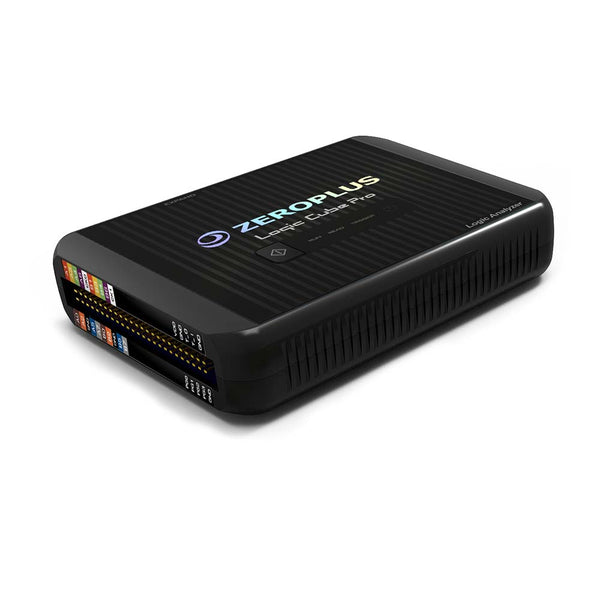
| ZeroPlus LAP-C Pro Series | Watch | Logic analyser for automotive work; ZeroPlus lists FlexRay, SENT, PSI5 and DSI Bus decoders, so ask us to confirm which are supplied with your LAP-C Pro model | £925 |
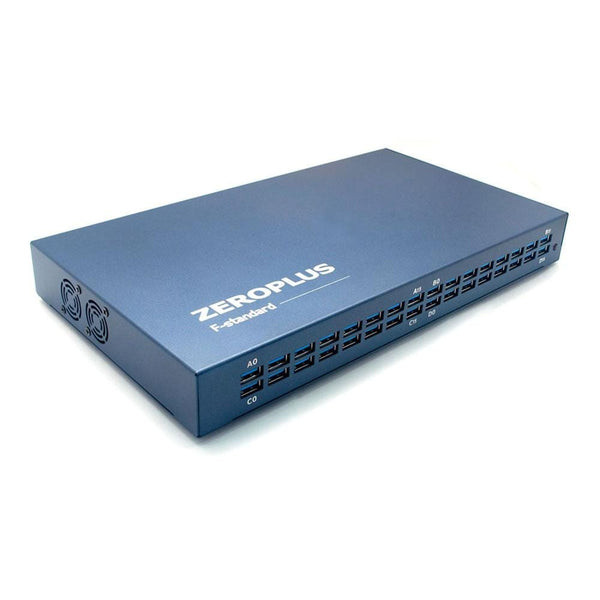
| ZeroPlus LAP-F 40/64-Channel | Watch | 40 or 64 channels, for several channels or sensors at once; ZeroPlus lists its automotive decoders separately from the LAP-F1's standard set, so ask us to confirm which are supplied | £1,350 |
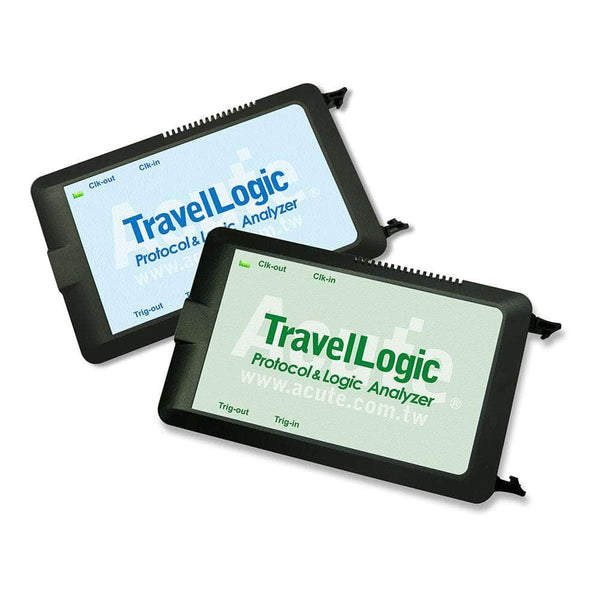
| Acute TravelLogic 34-Channel | Watch | Logic analyser running Acute's decoder library, which includes FlexRay, PSI5 and CXPI; SENT and J1850 decoders are supplied on request from Acute | £1,161.65 |
Probes
| Product | Role | Capability | Price ex VAT |
|---|---|---|---|
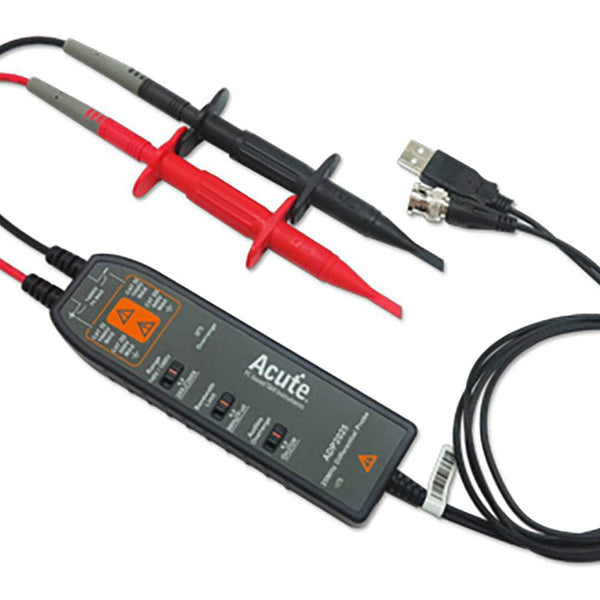
| Acute 25 MHz Differential Probe | For FlexRay BP and BM and other differential automotive buses | £332.54 | |
| Acute 100 MHz Differential Probe | Higher bandwidth for fast edges and signal integrity work | £457.17 |
For CAN, CAN FD and LIN in the same vehicle, see our CAN and LIN guides. Tell us the bus, data rate and what you need to trigger on and we will recommend a set-up.
Frequently Asked Questions
Is FlexRay Still Used?
Yes, in existing chassis, steering and powertrain systems from several manufacturers, though new designs increasingly use CAN FD and automotive Ethernet for backbones. Many vehicles in service, and many test benches, still need FlexRay analysis.
Why Does SENT Use Pulse Lengths?
Measuring time between falling edges is cheap and tolerant of noise and level shifts: the sensor needs only a simple output, the ECU a timer capture input, and the sync pulse at the start of each frame calibrates out the sensor's clock error.
Can I Decode SENT With a UART Decoder?
No. SENT has no start and stop bits or fixed bit time; values are pulse durations in ticks. Use a SENT decoder and set the nominal tick time, typically 3 µs.
How Do I Probe PSI5?
Measure the sensor current, either with a current probe on the supply wire or as the voltage across a small sense resistor, because PSI5 data is current modulation. The ECU's synchronisation pulses appear on the voltage.
Do I Need a Differential Probe for FlexRay?
For bus-level work, yes: BP and BM are a differential pair, and a differential probe shows the real bus states. Alternatively, probe the transceiver's receive data pin on the node, which is single-ended logic.
Where to Start with FlexRay, SENT and PSI5
More Protocols
By John Legg CEng, Director, Debug Store. Updated 12 November 2026.
