


Micsig
Micsig DP Series High-Voltage Differential Probe
Micsig DP Series High-Voltage Differential Probe
SKU: DP1502
Couldn't load pickup availability
Key Features
Overview
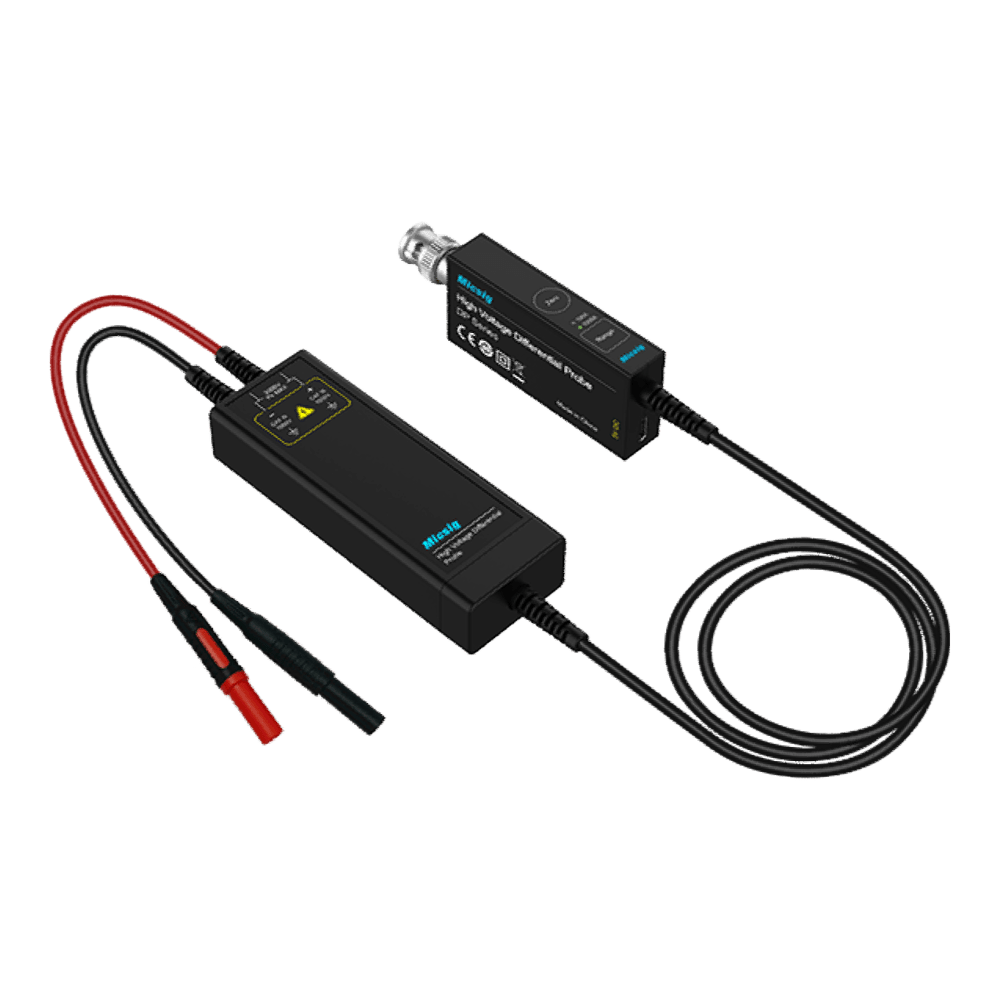
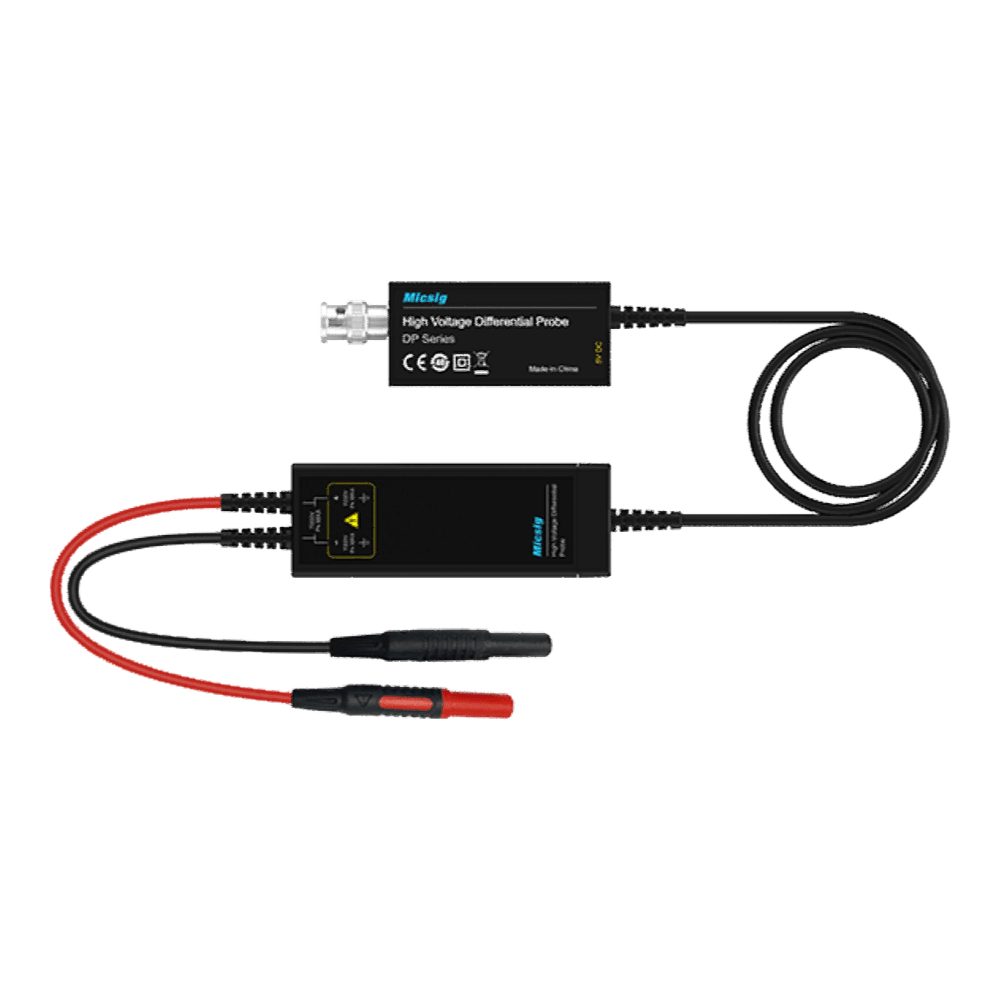
The Micsig DP Series High-Voltage Differential Probe delivers exceptional measurement fidelity for professional engineers testing high-voltage and floating signals. Available in comprehensive bandwidth variants from 100 MHz to 500 MHz (models DP700-DP705) and voltage ranges from 700 Vpk to 7000 Vpk (models DP700-DP7005), this probe series excels at power electronics, motor drives and semiconductor testing applications.
Superior Signal Integrity with Advanced SigOFIT Technology
Built on Micsig's proven SigOFIT technology, the DP Series achieves industry-leading common-mode rejection ratio of >80 dB at DC and >60 dB at 100 kHz. Ultra-low noise floor (as low as 5 mVrms) and excellent bandwidth flatness (<0.5 dB amplitude variation) ensure accurate differential readings free from common-mode interference. High input impedance (up to 60 MΩ) and minimal capacitive loading (<3 pF) preserve circuit integrity during measurements.
Enhanced Usability and Safety Features
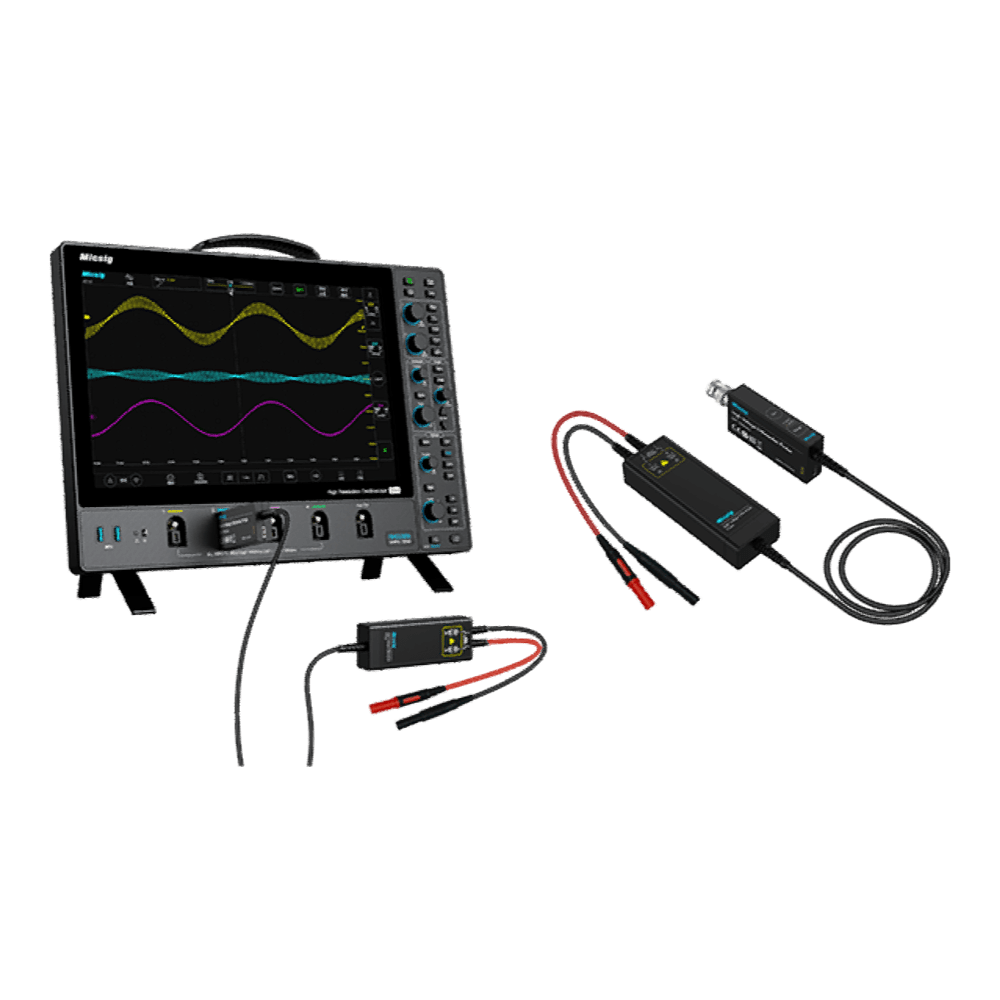
Compact 2cm-thin metal housing provides robust EMI protection whilst standard BNC interface guarantees compatibility with any 50 Ω oscilloscope. One-press auto-zero calibration, dual-range attenuation switching and visual/audible overvoltage alarms simplify operation and enhance safety. USB-powered operation eliminates battery concerns during extended measurements. Engineers requiring even higher isolation can explore our SigOFIT Optical-Fibre Isolated Probe series for applications demanding up to 180 dB CMRR.
Downloads
Why Engineers Choose The Micsig DP Series High-Voltage Differential Probe
Proven Measurement Accuracy
Enhanced Productivity
Universal Compatibility
| General Information | |
|---|---|
Part Number (SKU) |
DP1502
|
Manufacturer |
Micsig
|
| Physical and Mechanical | |
Weight |
5.0 kg
|
| Other | |
EAN |
5055383618996
|
Questions and Answers
-
How Accurate Are Measurements Across the Specified Bandwidth?
Micsig quotes a typical accuracy of ±2%. It doesn't publish a numeric amplitude flatness figure, so check the datasheet for the model you plan to use.
-
What Makes the DP Series Suitable for Floating Measurements?
High common-mode voltage capability and high CMRR let you safely measure signals referenced to high potentials, without ground loops.
-
Which Oscilloscope Brands Are Compatible with DP Series Probes?
Any oscilloscope with a BNC input that matches the probe's output impedance: 1 MΩ for the 100 MHz and 200 MHz models, 50 Ω for the 300 MHz models (DP1503 and DP3003). Micsig says the probes suit most oscilloscope brands but doesn't name any, so check the input impedance setting on your scope.
-
How Do I Minimise Noise in Sensitive Measurements?
- use dual-range selection for the best signal-to-noise ratio (the lower range has the lower noise)
- enable the 5 MHz bandwidth limit when appropriate
- make sure the probe is zeroed, with the inputs shorted and after a warm-up of about 10 minutes
-
What Maintenance Is Required for Long-term Reliability?
Three simple steps:
- run the auto-zero calibration periodically
- protect the probe tips from mechanical damage
- store the probe in a case when not in use (a case is an optional accessory)
-
What Voltage Ranges Are Available Across the DP Series Models?
The DP Series comes in four voltage ranges, each with a choice of bandwidths:
- 700 Vpk (DP700, DP702)
- 1500 Vpk (DP1500, DP1502, DP1503)
- 3000 Vpk (DP3000, DP3002, DP3003)
- 7000 Vpk (DP7000, DP7002)
The last digit of the model number sets the bandwidth: 0 for 100 MHz, 2 for 200 MHz and 3 for 300 MHz. The 300 MHz models are in the 1500 V and 3000 V families only.
-
Which Bandwidth Should I Select for High-speed Switching Measurements?
For GaN and SiC power devices, choose a 300 MHz model (DP1503 or DP3003). For traditional silicon devices, the 100 MHz and 200 MHz models, such as the DP700 and DP702, work well.
-
What Safety Certifications Do DP Series Probes Maintain?
Safety category ratings vary by model and are listed per category in Micsig's quick guide, so check the rating for the probe you choose. Common-mode voltage handling goes up to 7000 V depending on the model.
-
Can I Use the 5 MHz Bandwidth Limit for Switch-mode Power Supply Measurements?
Yes. The 5 MHz bandwidth limit is available across the series and suppresses high-frequency switching noise. It slows edges, so it preserves the fundamental only when the switching frequency is well below 5 MHz.
No questions match your search.