
Array Electronic Co Ltd
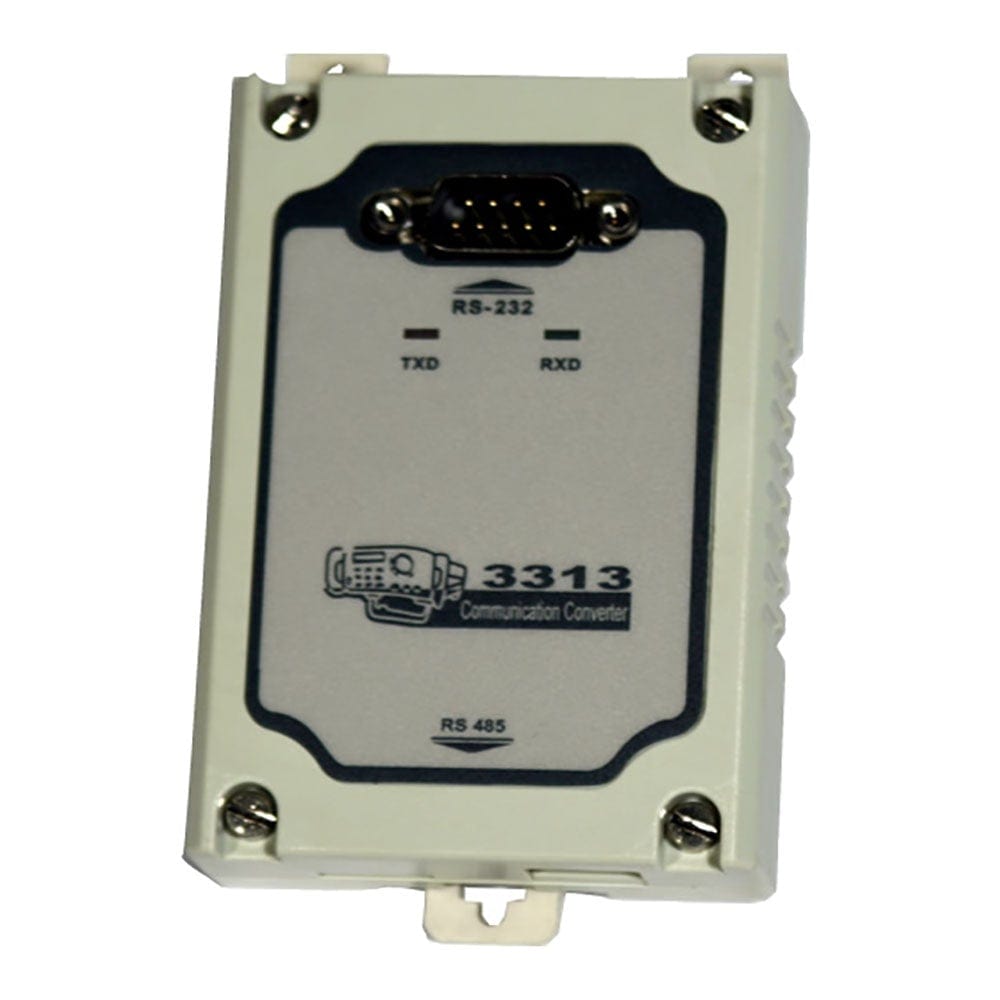
Array 3313 RS-232C to RS-485 Converter for Multidrop Networks
Array 3313 RS-232C to RS-485 Converter for Multidrop Networks
SKU: 3313
Couldn't load pickup availability
Key Features
Overview
The converter features optical isolation for protection against ground loops and electrical interference. Port-powered operation eliminates the need for external power supplies, whilst LED status indicators simplify installation and troubleshooting. The robust design supports industrial temperature ranges and provides reliable communication over distances up to 1200 metres.
Downloads
Why Engineers Choose The Array 3313 RS-232C to RS-485 Converter for Multidrop Networks
Extended Communication Range
Multidrop Networking
Plug-and-Play Operation
Professional RS-232 to RS-485 Conversion
The Array 3313 RS-232C to RS-485 Converter enables seamless connection between PC serial ports and multidrop RS-485 networks. Designed specifically for Array Electronic loads and power supplies, this converter extends communication range up to 1200 metres whilst supporting up to 32 devices on a single network.
Key Technical Specifications
| Parameter | Specification |
|---|---|
| Input Interface | RS-232C (DB-9 Male) |
| Output Interface | RS-485 (Terminal Block) |
| Maximum Distance | 1200m (4000 feet) |
| Network Devices | Up to 32 nodes |
| Data Rate | Up to 115.2 kbps |
| Power Supply | Port-powered from RS-232 |
| Isolation | Optical isolation |
Wiring Quick-Start
Connect the RS-485 lines using twisted pair cable:
Terminal A (Data+) → RS-485 A line Terminal B (Data-) → RS-485 B line Terminal GND → Signal ground Multidrop Network Configuration
The 3313 converter enables PC connection to multiple Array Electronic devices in a daisy-chain topology. Each device requires a unique address (0-254) for individual control and monitoring. The differential signalling provides excellent noise immunity in industrial environments.
Compatible with Array Electronic:
- 3710A/3711A Electronic Loads
- 3644A/3645A/3646A Power Supplies
- 364XA Series DC Power Supplies
- 371X Series Programmable Loads
Installation Notes
The converter requires no external power supply when connected to a standard PC serial port. The optical isolation protects connected equipment from ground loops and voltage spikes. LED indicators show power and communication status for easy troubleshooting.
| General Information | |
|---|---|
Part Number (SKU) |
3313
|
Manufacturer |
|
| Physical and Mechanical | |
Weight |
0.5 kg
|
| Other | |
EAN |
5055383600632
|
Questions and Answers
-
How Do I Configure Device Addresses on the Network?
Set each instrument's address on its front panel: press Menu and select Address Set (364X) or Address (371X). Addresses run from 0 to 31 on 364X supplies and 0 to 254 on 371X loads; give each instrument a unique address.
-
What Baud Rates Are Supported?
Array does not publish the converter's own baud range. The 364X and 371X instruments support 4800, 9600, 19200 and 38400 baud. Lower speeds are generally more reliable over long cable runs.
-
Can I Use the 3313 with Non-Array Equipment?
Array lists the 3313 only as an accessory for its own instruments and does not state compatibility with other RS-485 devices. It may work with other equipment using the same RS-485 wiring, but match the communication parameters and addressing, and test it before relying on it.
-
How Do I Troubleshoot Communication Problems?
Check that termination resistors are installed at the network ends. Check RS-485 polarity (A to A, B to B), and make sure every instrument has a unique address and the same baud rate as the software.
-
Is the 3313 Isolated?
Yes. Array describes the 3313 as an isolated RS-232 to RS-485 adaptor, which helps prevent ground loops. Array does not publish the isolation type or rating, or any other protection features.
-
What Array Electronic Devices Are Compatible with the 3313 Converter?
The 3313 is designed for Array electronic loads and power supplies in the 364X and 371X series, including the 3710A/3711A electronic loads and 3644A/3645A/3646A power supplies. Each device needs a unique address for multidrop operation.
-
How Many Devices Can Be Connected to a Single 3313 Converter?
Array does not state a maximum. Standard RS-485 allows 32 unit loads on one segment. Each instrument needs a unique address, set on its front panel: 0 to 31 on 364X supplies and 0 to 254 on 371X loads.
-
What Cable Type Should I Use for RS-485 Connections?
Use twisted pair cable with 120Ω characteristic impedance. Install 120Ω termination resistors at both network ends. For distances over 100 metres, use shielded twisted pair cable with proper grounding.
-
Does the 3313 Require External Power?
Array's wiring diagram shows a +5V supply pair on the bus cable to the instruments, but Array does not state how the 3313 itself is powered. Check the diagram before installation, or ask us.
-
What Is the Maximum Communication Distance?
Array does not publish a maximum distance. The RS-485 standard allows up to about 1200 metres (4000 feet) at lower baud rates, and higher speeds need shorter cables. A common rule of thumb is speed × distance ≤ 10^8 bit/s × metres.


No questions match your search.