

SEGGER Microcontroller GmbH
SEGGER Flasher Hub-12 Control Module
SEGGER Flasher Hub-12 Control Module
SKU: 5.01.20
Zahlungsmethoden
- Banküberweisung
Verfügbarkeit für Abholungen konnte nicht geladen werden


Key Features
Overview
The Flasher Hub-12 is a gang programming control unit with twelve USB-C 2.0 High Speed downstream ports, each driving a Flasher Compact as an independent programming channel. It scales to 24 channels with external USB hubs, is controlled over Ethernet, USB or RS232, and has built-in web and FTP servers. It runs from an 8 to 30 VDC supply at up to 60 W.
Downloads
User Manuals
Why Engineers Choose the SEGGER Flasher Hub-12 Control Module
Maximum Production Capacity
Professional Integration
Zero Ongoing Costs
The SEGGER Flasher Hub-12 (part number 5.01.20) is a gang programming control unit with twelve USB-C 2.0 High Speed downstream ports, each driving a Flasher Compact as an independent programming channel, scalable to 24 channels with external USB hubs. It is controlled over Ethernet, USB or RS232, has built-in web and FTP servers, and runs from an 8 to 30 VDC supply at up to 60 W. It suits high-volume production lines programming twelve or more boards in parallel without a PC on the line.
Twelve-Channel Gang Programmer for High-Volume Production
In Direct Mode the Hub-12 manages up to twelve Flasher Compact modules, each connected straight to one of its front-panel USB-C ports as a separate programming channel, with no extra USB hubs. Flex Mode connects up to 24 Flasher Compact modules through USB hubs, and each module can be assigned dynamically to any available channel. SEGGER only provides technical support for setups built with SEGGER USB Hubs. Each channel works independently with its own programming image and settings, so different firmware variants can be programmed at the same time in one setup. The supported CPU cores and target interfaces are those of the connected Flasher Compacts.
Stand-Alone Operation and Production Integration
Channels are set up once with SEGGER's Flasher software, matched to the target flash device. A PC is needed only for that one-time configuration; the Hub-12 then runs as a stand-alone unit controlled through TELNET or RS232 using the built-in ASCII command interface. The built-in web server handles control and configuration and shows real-time status for every connected channel, and programming logs can be retrieved for production tracking and quality assurance. The FTP server takes firmware and configuration uploads and returns log files, so a central production server can push stable releases straight to the hub as part of an automated deployment pipeline. Unique data such as serial numbers, MAC addresses and digital signatures can be programmed into each target, even in parallel runs.
Power and Housing
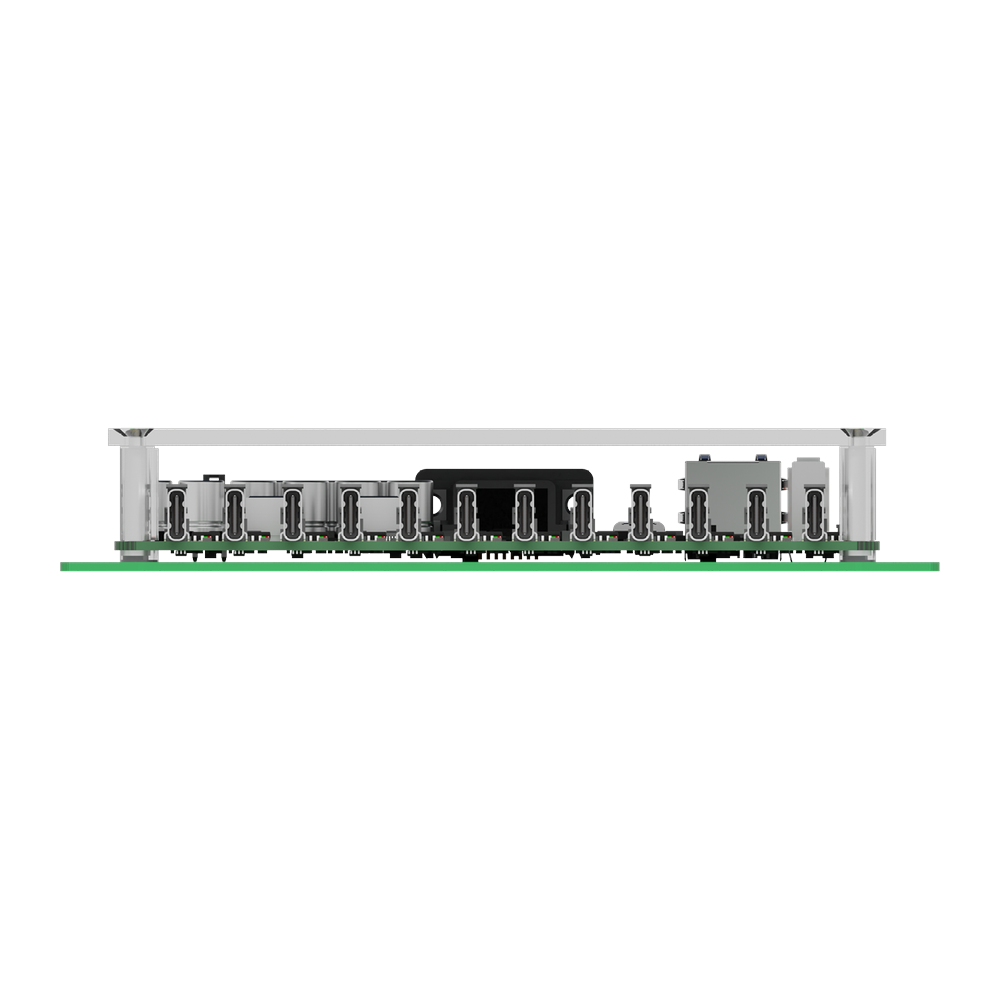
The Hub-12 has a chassis around the board with the twelve USB-C connectors on its front panel. It runs from 8 to 30 VDC with reverse polarity protection; power depends on the connected downstream devices, and for maximum load the input supply must provide 12 VDC or more.
Specifications
| USB Flasher interface | 12 x USB-C 2.0 High Speed (downstream) |
|---|---|
| Host interfaces | USB 2.0 High Speed (upstream), USB Type-A (downstream), Ethernet, RS232 9-pin |
| Channels | Up to 12 Flasher Compact (Direct Mode); up to 24 with USB hubs (Flex Mode) |
| Power supply | 8 to 30 VDC, reverse polarity protected, max. 60 W (depends on connected devices; 12 VDC or more for maximum load) |
| Power consumption | Max. 15 W |
| Construction | Chassis with 12 front-panel USB-C connectors |
| Operating temperature | +5°C to +60°C |
| Storage temperature | -20°C to +65°C |
| Relative humidity | Less than 90% rH, non-condensing |
| Host OS | Windows and Linux (x86-64, ARM64); macOS (x86-64, Apple Silicon) |
What's Included
- Flasher Hub-12
- USB-C cable
- Power connector
Limitations
- The Hub-12 does not program targets itself. Each channel needs a Flasher Compact, sold separately.
- SEGGER names only the Flasher Compact as the module the Flasher Hub controls.
- The maximum is 24 channels in Flex Mode, the same as the Hub-4; Flex Mode needs external USB hubs, and SEGGER supports only setups with SEGGER USB Hubs.
- A PC is still needed for the one-time channel configuration.
- No power supply unit is listed in the box, only the power connector.
Flasher Hub-12 Compared with Related SEGGER Products
| Model | Direct channels | Max. channels | Max. input power | Price ex VAT |
|---|---|---|---|---|
| Flasher Hub-12 (this product) | 12 | 24 (Flex Mode) | 60 W | £3,005 |
| Flasher Hub-4 | 4 | 24 (Flex Mode) | 30 W | £2,005 |
| Flasher Compact (one channel) | n/a | n/a | USB powered | £920 |
Typical Applications
Twelve Flasher Compacts programming a twelve-up panel of Cortex-M or RISC-V boards in a single pass. A line that runs two product variants side by side, with each channel carrying its own image. Release images pushed by FTP from a central build server, with per-channel logs pulled back for traceability.
Choose the Hub-12 when the line needs more than four channels without external USB hubs; for four channels or fewer, the Hub-4 does the same job in a smaller unit.
Order the Flasher Hub-12 for £3,005 ex VAT, plus one Flasher Compact per channel. Ask us for a formal quotation for a complete gang system. See the full range in our SEGGER debug and programming tools collection.
Last reviewed 16/11/2026.
Sources (3 manufacturer pages)
| General | |
|---|---|
| Construction | Chassis with 12 front-panel USB-C connectors |
| Host and Target Interface | |
| USB Flasher interface | 12 x USB-C 2.0 High Speed (downstream) |
| Host interfaces | USB 2.0 High Speed (upstream), USB Type-A (downstream), Ethernet, RS232 9-pin |
| Channels | Up to 12 Flasher Compact (Direct Mode); up to 24 with USB hubs (Flex Mode) |
| Power | |
| Power supply | 8 to 30 VDC, reverse polarity protected, max. 60 W (depends on connected devices; 12 VDC or more for maximum load) |
| Power consumption | Max. 15 W |
| Software and Compatibility | |
| Host OS | Windows and Linux (x86-64, ARM64); macOS (x86-64, Apple Silicon) |
| Environmental | |
| Operating temperature | +5°C to +60°C |
| Storage temperature | -20°C to +65°C |
| Relative humidity | Less than 90% rH, non-condensing |
| Ordering information | |
| Part number (SKU) | 5.01.20 |
| Manufacturer | SEGGER Microcontroller GmbH |
| EAN | 5055383605712 |
| Warranty | 12 months |
| Shipping weight | 0.6 kg |
- 1 ×Flasher Hub-12 control module
- 1 ×USB-C cable
- 1 ×Power connector
Questions and Answers
-
How Do I Connect More Than 12 Devices to the Hub-12?
Switch the unit to Flex Mode. It then accepts up to 24 Flasher Compact modules through external USB hubs; SEGGER supports setups that use SEGGER USB Hubs.
-
Does the Flasher Hub-12 Need a PC During Production?
No. A PC is needed only for the one-time channel configuration. After that the hub runs stand-alone, controlled through TELNET or RS232.
-
Can I Integrate the Hub-12 Into an Automated Release Workflow?
Yes. The built-in FTP server accepts firmware and configuration updates pushed from a central production server, and returns log files for traceability.
-
What Are the Power Requirements for the Flasher Hub-12?
The Flasher Hub-12 requires 8-30 VDC power supply with reverse polarity protection and maximum 60W capacity. Power consumption is maximum 15W for the control module itself. For maximum load the supply must provide 12 VDC or more.
-
How Many Parallel Programming Channels Can a Flasher Hub-12 Setup Control?
SEGGER's current documentation gives 24 parallel programming channels as the maximum for a Flasher Hub-12 setup. A single Flasher Hub-12 controls up to 12 Flasher Compact units directly, and up to 24 in Flex Mode through powered USB hubs.
-
Can the Flasher Hub-12 Control Module Operate Without a PC Connection?
Yes. The Flasher Hub-12 can run stand-alone, controlled over TELNET or RS232 through its ASCII command interface, with a built-in web interface and FTP server for configuration and file transfer.
-
What Programming Speeds Does the Flasher Hub-12 Control Module Achieve?
The control module runs SEGGER's flash programming algorithms, which get very close to the theoretical minimum programming time of the target hardware.
-
What Technical Support Is Included with the Flasher Hub-12 Control Module?
Each Flasher Hub-12 comes with one year of SEGGER Initial Coverage and Warranty, which covers the hardware warranty and support. At purchase this can be extended to 3 or 5 years in total, and Extended Coverage and Warranty can also be bought later.
-
Which Operating Systems Does the Flasher Hub-12 Control Software Support?
SEGGER's Flasher software package, which is used to set up the Flasher Hub-12, runs on Windows (x86-64 and ARM64), Linux (x86-64 and ARM64) and macOS (x86-64 and Apple Silicon). SEGGER provides a 64-bit Windows installer, DEB, RPM and TGZ packages for 64-bit Linux, DEB and TGZ packages for 64-bit Linux ARM, and Apple Silicon, Intel and Universal installers for macOS.
The hub's own web interface needs only a web browser, so day-to-day operation does not depend on the operating system of the PC.
-
When Should I Choose the Flasher Hub-12 Over the Flasher Hub-4?
Both hubs are used in the same way and share the same documentation. Each can control up to 24 Flasher Compact modules, and each channel can program a different device with a different firmware image. SEGGER describes a Flasher Hub-12 with multiple Flasher Compacts as the perfect solution for high-volume mass production. It brings 12 USB-C Flasher ports out directly instead of 4.
Flasher Hub-12 Flasher Hub-4 Maximum power supply 60 W 30 W Maximum power consumption 15 W 11.5 W Upstream host port USB Type-B USB-C 2.0 High Speed Enclosure Full chassis, with a chassis ground pin on the power connector Ground plate and plexiglass cover Weight (without cables) 660 g 135 g Both run from 8-30 VDC with reverse polarity protection, and both have Ethernet, RS232 9-pin and USB Type-A (downstream) host interfaces.
-
How Do I Set Up a Flasher Hub-12 for the First Time?
SEGGER describes the Flasher Hub as set up and ready to use in less than 10 minutes:
1Connect a supply of 8-30 VDC to the power connector. The Hub-12 connector has three contacts: (+), (-) and chassis ground.2Connect the LAN port. An Ethernet cable is optional according to SEGGER.3Connect each Flasher Compact to the hub with a USB-C cable.4Install the latest Flasher software package on a Windows, Linux or macOS PC.5Update the Flasher Hub firmware to the latest version.6Open the web interface at http://flasherhub-<serial number>/, using the serial number of your unit.If Flasher Compact modules sit behind USB hubs, the Flasher Hub must be configured for Flex Mode and the USB hubs must be powered externally.
-
What Can the Flasher Hub-12 Web Interface and FTP Server Show or Log?
The built-in web server (emWeb) is used for manual operation and monitoring. It shows:
- firmware and hardware versions
- power consumption
- IP configuration and network load
- the current operation and status
- the programming interface in use
The status information can help with troubleshooting, for example alongside a cyclic redundancy check (CRC) for code verification. It also lets you set options such as the subnet mask and gateway, and manages the firmware images and setup files for all connected modules.
The built-in FTP server (emFTP) is used to upload firmware and configuration files from a central production server and to download logs. Each log entry records the result (success or failure), the duration and the serial number if one was programmed. Failed cycles include troubleshooting detail.
-
Which Target Devices Can the Flasher Hub-12 Programme?
The hub controls the channels, but the supported CPU cores and target interfaces depend on the connected Flasher Compact modules rather than on the hub itself. SEGGER lists tens of thousands of devices in hundreds of device families, and the flash loaders for them are included in the Flasher software package.
A device that is not listed can be added with the Flasher SDK, which SEGGER sells separately. FPGAs and CPLDs are programmed with the Flasher BitStreamer, and the Flasher SDK is not required for that.
-
What Is the SEGGER USB Hub (5.01.10) and How Does It Differ From Standard Consumer USB Hubs?
The SEGGER USB Hub (listed by SEGGER as the USB Hub-7) is an industrial-grade, seven-port USB 2.0 Full-Speed hub for Flasher programming stations. It has one USB Type-B upstream port and seven USB Type-A downstream ports. SEGGER lists these features:
- Basic isolation on the upstream port, rated 3 kV DC for 1 second
- An overload limit on each downstream port
- High retention connectors on the upstream and downstream ports
- Testing to EN 61326-1, EN 55011 and EN 55024/55035
- Status LEDs
It is intended for gang programming with SEGGER Flasher Compact units and can connect up to 24 of them through a Flasher Hub-4 or Flasher Hub-12.
-
What Does the Electrical Isolation on the SEGGER USB Hub Protect?
The upstream port has basic isolation rated at 3 kV DC for 1 second, which SEGGER states protects the host system from electrical disturbances.
Safety note. The isolation is basic isolation only. SEGGER states that the hub is not for use with hazardous voltages without further protection measures. Where hazardous voltage is involved, a second protection measure (double or reinforced insulation) is mandatory, and the right method depends on the application. Check your local safety directives. -
What Power Supply Does the SEGGER USB Hub Need?
The SEGGER USB Hub runs from 8-30 VDC with reverse polarity protection and has a maximum power of 30 W, depending on the current drawn by the connected downstream devices. For maximum load, SEGGER specifies an input of 12 VDC or more.
Power connects through a screwable plug (Würth 691317510002, WR-TBL 3175) that accepts solid or stranded wire with a cross-section of 0.2-3.3 mm².
-
Can the SEGGER USB Hub Be Used with Non-SEGGER Devices?
Yes. It is designed for Flasher Compact gang programming, but SEGGER states it can also be used with other SEGGER products such as J-Link, and with other production programmers, including non-SEGGER products.
Using it with the Flasher Compact is optional. SEGGER recommends it because it is production grade, robust and tested, and notes that many hubs on the market are not fully standard compliant, are less reliable and lack electrical isolation.
-
What Are the Environmental and Physical Specifications of the SEGGER USB Hub?
- Operating temperature: +5 °C to +60 °C
- Storage temperature: -20 °C to +65 °C
- Relative humidity: below 90% rH, non-condensing
- Size (without cables): 170 mm x 166 mm x 35 mm
- Weight (without cables): 585 g
-
How Does the SEGGER USB Hub Extend a Flasher Hub-12 Beyond 12 Channels?
The Flasher Hub-12 has 12 USB-C Flasher ports. To go beyond 12 channels, put the hub into Flex Mode and connect Flasher Compact modules through powered USB hubs. With a Flasher Hub-4 or Flasher Hub-12, SEGGER states the SEGGER USB Hub can connect up to 24 Flasher Compacts, and each one can be assigned to any available channel.
-
What Is a High Retention Connector on the SEGGER USB Hub?
The hub has a high retention USB Type-B upstream port and high retention USB Type-A downstream ports. SEGGER describes the retention as there to keep cables secure in busy production environments.
-
Which Industrial Standards Is the SEGGER USB Hub Tested To?
The hub is tested to EN 61326-1, EN 55011 and EN 55024/55035. SEGGER describes these as covering electrical equipment for measurement, control and laboratory use. The CE declaration and other regulatory documents are available from SEGGER.
The hub is designed for production environments and industrial standards, which is relevant if your station has to meet EMC requirements for the equipment it sits beside.
-
Why Use an Industrial USB Hub for Gang Programming with the Flasher Hub-12?
Flex Mode needs powered USB hubs, and SEGGER states that USB hubs connected to the Flasher Hub must be powered externally. An industrial hub is built for this job:
- SEGGER notes that many hubs on the market are not fully standard compliant, are less reliable and lack electrical isolation.
- The SEGGER USB Hub has basic isolation on the upstream port, an overload limit on each downstream port and high retention connectors.
- It runs from the same 8-30 VDC range as the Flasher Hub-12.
- SEGGER only provides technical support for setups that use SEGGER USB hubs.
-
How Does the SEGGER USB Hub Fit Into Automated Test Equipment and Production Lines?
SEGGER designed the hub for production environments, and describes the Flasher Hub-12 as suited to panels with up to 24 devices, maximum speed, in-circuit test (ICT) where space is not critical, and space-distributed programming stations.
Once each channel has been set up on a PC, the Flasher Hub-12 can be controlled without one. It has a built-in ASCII command interface over TELNET and RS232, a web interface for manual operation and monitoring, and an FTP server for uploading firmware and configuration files and downloading logs. The SEGGER USB Hub supplies the extra downstream ports for the Flasher Compacts.
-
How Do I Connect Flasher Compact Units to the Flasher Hub-12?
In Direct Mode, each Flasher Compact connects to one of the 12 front-panel USB-C 2.0 High Speed ports. Each Flasher Compact needs a USB cable to the hub. Current Flasher Compacts use USB-C, while SEGGER's older setup tables list USB-C to USB-micro cables. In Flex Mode, up to 24 Compacts connect through powered USB hubs, such as the SEGGER USB Hub.
Each Flasher Compact acts as a separate programming channel. Over the hub it draws about 130 mA at 5 V, or about 230 mA if it also supplies a 100 mA target supply. The Compact housing measures 70 mm x 45 mm x 18 mm.
-
Which Flasher Hub-12 Interface Should I Use for Which Task?
Interface Specification Ethernet 10/100/1000 Mbit USB Type-B (upstream) USB 2.0 High-Speed USB Type-A (downstream) Listed by SEGGER as a host interface RS232 9-pin Serial, with the ASCII command interface Flasher ports 12 x USB-C 2.0 High Speed For automation, use the ASCII command interface over TELNET or RS232. The web interface (emWeb) is for manual operation and monitoring, and the FTP server (emFTP) handles firmware and configuration uploads and log downloads.
-
Can Each Programming Channel Be Configured Independently Through the Flasher Hub-12?
Yes. Each channel can run its own firmware image and settings, so different variants can be programmed at the same time, or every channel can run the same job for gang programming. Unique data can be programmed per device, including serial numbers, Ethernet MAC addresses, digital signatures and licence keys.
-
What Are the Physical Dimensions and Operating Limits of the Flasher Hub-12?
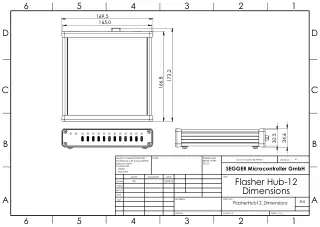
- Size (without cables): 170 mm x 172 mm x 35 mm
- Weight (without cables): 660 g
- Operating temperature: +5 °C to +60 °C
- Storage temperature: -20 °C to +65 °C
- Relative humidity: below 90% rH, non-condensing
-
What Is Supplied with the Flasher Hub-12, and What Coverage Applies?
SEGGER lists the package contents as the Flasher Hub-12, a USB-C cable and a 3-pole power connector. The list does not include a power supply, so you need your own 8-30 VDC supply.
Each Flasher includes one year of Initial Coverage and Warranty, which covers hardware warranty and support. At purchase, coverage can be extended to 3 or 5 years in total, and Extended Coverage and Warranty can also be bought after the initial period. Support applies only to registered products.
-
How Many Flasher Compact Units Can Be Controlled by the Flasher Hub-12?
The Flasher Hub-12 controls up to 12 Flasher Compact units in Direct Mode, and up to 24 in Flex Mode using SEGGER USB Hubs.
-
What Are the Differences Between the Flasher Hub-12 and Hub-4?
Specification Hub-12 Hub-4 USB-C connectors 12 (integrated) 4 Size 170x172x35mm (chassis) 125x78x25mm (compact) Maximum input power 60 W 30 W See also the Flasher Hub-4.
-
What Interfaces Does the Flasher Hub-12 Control Module Support for System Integration?
The Flasher Hub-12 has:
- Ethernet
- USB Type-B upstream
- USB Type-A downstream
- RS232 9-pin
- TELNET
- Built-in emWeb and emFTP servers
-
Does the Flasher Hub-12 Control Module Require Additional Licensing for New Device Support?
No. SEGGER provides all software updates, firmware upgrades and new flash loaders free of charge, with no licence costs or hidden fees.


No questions match your search.
