
MIL-STD-1553 Data Bus
MIL-STD-1553 is the serial data bus used in military aircraft, ground vehicles, ships and satellites: a bus controller commands up to 31 remote terminals over a transformer-coupled, dual-redundant twisted pair at 1 Mbit/s, and every transfer, except a broadcast, gets a status reply within microseconds. For development and fault finding, a logic analyser or oscilloscope with a 1553 decoder, probing the bus differentially, shows each command, status and data word with its timing.
How a 1553 Bus Is Built
A 1553 bus is a shielded twisted pair, terminated at both ends, with each terminal connected through a stub, usually transformer coupled with isolation resistors so a shorted terminal cannot take down the bus. Most systems run two complete buses, A and B, and switch to the other if one fails. The bus controller (BC) starts every transfer; remote terminals (RTs) only answer; a bus monitor records traffic without taking part.
Words and Transfers
- BC to RT: the BC sends a receive command word and up to 32 data words; the RT replies with a status word.
- RT to BC: the BC sends a transmit command; the RT replies with a status word followed by the data words.
- RT to RT: the BC sends a receive command to one RT and a transmit command to another, which sends its status and data directly to the first.
- Mode codes: a subaddress of 0 or 31 turns the word count field into a mode code for bus management, such as transmit status, reset or inhibit a transmitter.
- Timing: an RT must start its response within a few microseconds of the end of the command (4 to 12 µs measured at the bus), and the BC treats a longer silence as no response.
The status word carries the RT address and flags for message error, service request, busy, subsystem flag and terminal flag, so the BC learns about problems in every reply.
Where MIL-STD-1553 Is Used
- Military aircraft and helicopters: mission computers, weapons stores, navigation and displays.
- Land vehicles and ships: vetronics and weapons control systems.
- Spacecraft: satellite command and data handling buses.
- Test equipment: simulators and test sets that stand in for a BC or RT during integration.
Common 1553 Faults and How to Find Them
| Symptom | Likely Cause | What to Check |
|---|---|---|
| RT does not respond | Wrong RT address strapping, or RT transmitter inhibited on that bus | Decode the command word address and look for a status reply on bus A and bus B |
| Message errors reported in status | Parity or Manchester errors from reflections or a damaged stub | Capture the differential waveform; check termination and stub coupling |
| Intermittent no-response | Response time near the limit, or bus switched mid-message | Measure the gap from the end of the command to the status word |
| Wrong data in RT to RT transfers | Receive and transmit commands set with different word counts | Decode both command words of the transfer |
Tools for Analysing and Decoding MIL-STD-1553
Watch tools capture the bus and decode words, transfers and errors. Probe the two bus lines with a differential probe, or as two single-ended channels on a logic analyser that supports that method, and sample at 10 MS/s or more to resolve the 0.5 µs Manchester half-bits.
Logic Analysers With 1553 Decoding
| Product | Role | Capability | Price ex VAT |
|---|---|---|---|
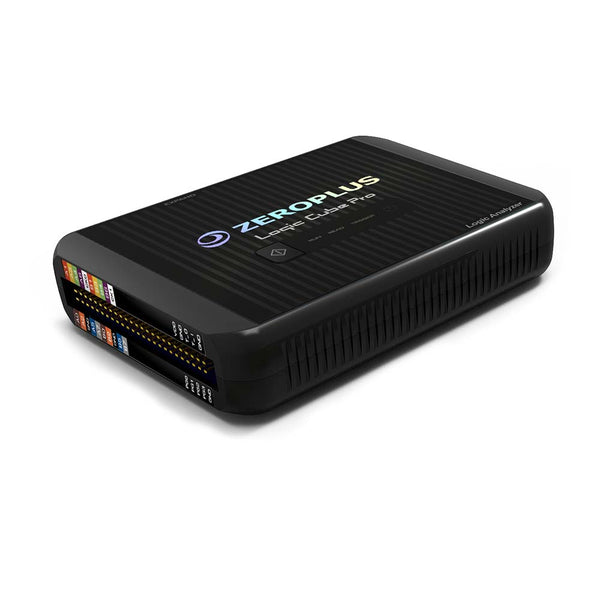
| ZeroPlus LAP-C Pro Series | Watch | Logic analyser with MIL-STD-1553 protocol analysis | £925 |
| Acute TravelLogic 34-Channel | Watch | Logic analyser running Acute's decoder library, which includes MIL-STD-1553; Acute advises probing HI and LO as two single-ended channels or using a differential probe | £1,161.65 |
Differential Probes
| Product | Role | Capability | Price ex VAT |
|---|---|---|---|
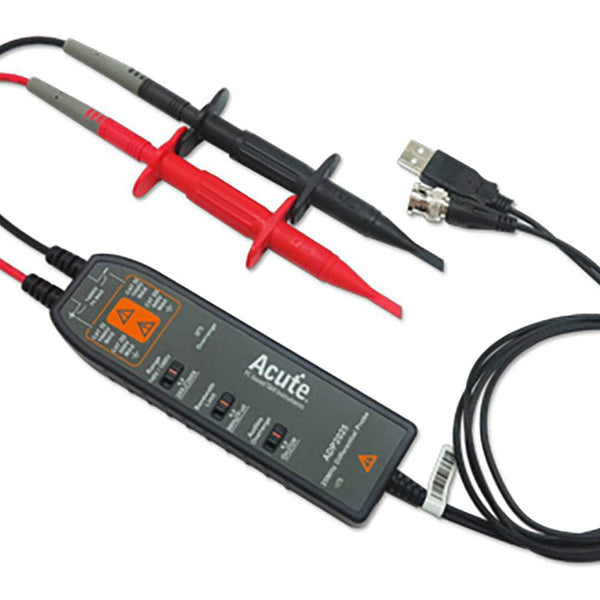
| Acute 25 MHz Differential Probe | For the 1553 twisted pair and other differential buses | £332.54 | |
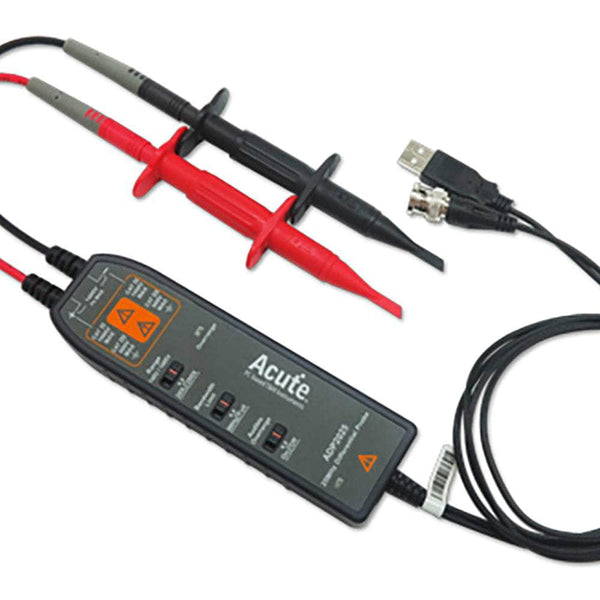
| Acute 100 MHz Differential Probe | Higher bandwidth for edge and reflection analysis | £457.17 |
These tools are for monitoring and development. For certified BC, RT or bus monitor interface cards, tell us your platform and we will advise.
Frequently Asked Questions
How Fast Is MIL-STD-1553?
1 Mbit/s on the wire. Because each word carries 16 data bits in 20 bit times, and each message includes a command and status word plus gaps, useful throughput is lower, typically well under 1 Mbit/s.
What Is the Difference Between MIL-STD-1553A and 1553B?
MIL-STD-1553B, from 1978 with later notices, tightened electrical and timing rules, defined mode codes and broadcast, and is the version used in almost all equipment today.
Can a Logic Analyser Decode 1553 Directly?
Yes, with a 1553 decoder, if the signal reaches its inputs at sensible logic levels: use a differential probe or an interface transceiver output, or follow the vendor's two-channel method. Do not connect logic inputs directly to a transformer-coupled bus at full amplitude.
What Is Bus A and Bus B?
Two independent, identical buses connected to every terminal. The bus controller normally uses one and switches to the other if a terminal stops responding, so a single cable fault does not stop the system.
Where to Start with MIL-STD-1553

More Protocols
By John Legg CEng, Director, Debug Store. Updated 12 November 2026.
