
SMBus and PMBus Protocols
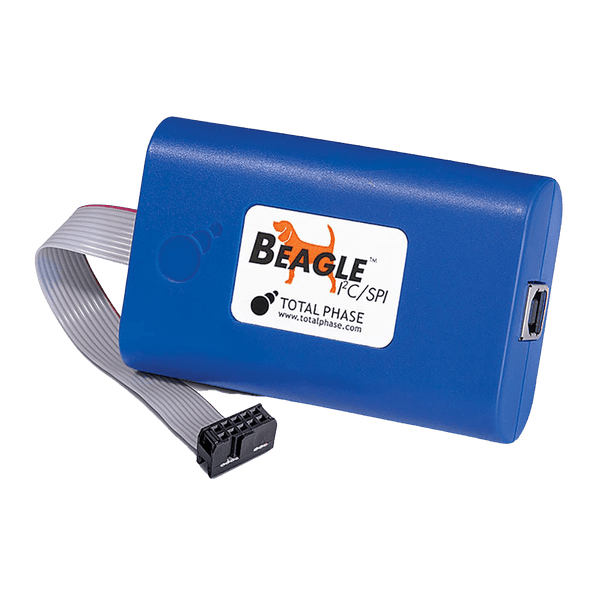
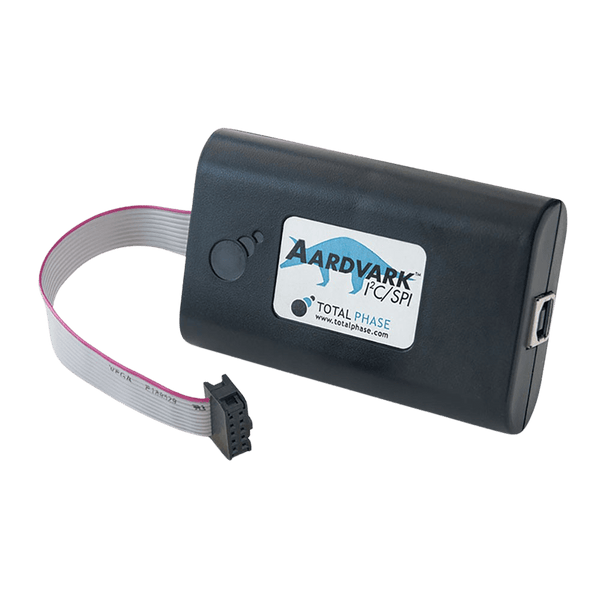
SMBus (System Management Bus) is a two-wire bus built on I2C, with tighter rules: a clock timeout so no device can hold the bus for ever, fixed transaction formats, optional packet error checking and an alert line. PMBus is a command set for power supplies and regulators that runs on top of SMBus. Any I2C protocol analyser captures SMBus traffic, and the Beagle I2C/SPI also decodes SMBus transactions. To send SMBus and PMBus commands from a PC, use an I2C host adapter such as the Aardvark with the commands built in software.
How SMBus Differs From I2C
On the wire, SMBus looks like I2C: open-drain clock and data with pull-up resistors, 7-bit addresses, acknowledge bits, Start and Stop. The difference is in the rules a device must follow. Because SMBus was written for batteries and system management, it assumes a host that must never hang.
| Feature | I2C | SMBus |
|---|---|---|
| Clock speed | From DC (no minimum) to 3.4 MHz and beyond | 10 kHz minimum; 100 kHz classic, 400 kHz and 1 MHz classes from version 3.0 |
| Clock timeout | None: a device may stretch the clock indefinitely | A device that holds SMBCLK low for longer than the timeout (25 to 35 ms) must reset its interface |
| Logic thresholds | Relative to the supply (30% and 70% of VDD) | Fixed input thresholds, so devices on different supplies agree |
| Acknowledge | A target may NACK its address while busy | A target must ACK its own address whenever powered |
| Error checking | None | Optional PEC byte: CRC-8 over the whole transaction |
| Transaction formats | Free form, defined per device | Defined protocols: Quick Command, Send and Receive Byte, Read and Write Byte and Word, Block Read and Write, Process Call |
Most I2C devices work on an SMBus at 100 kHz, and most SMBus devices work on an I2C bus, but a fast I2C target that stretches the clock for a long time, or a controller that pauses mid-transfer with the clock held low, will trip the SMBus timeout.
How an SMBus Transaction Works
- Address and command: the host sends Start, the target address with the write bit, then a one-byte command code that selects a register or function.
- Data: for a write, the host sends one byte, two bytes (low byte first) or a counted block. For a read, the host sends a repeated Start and the address with the read bit, and the target returns the data.
- PEC: if both ends support it, the last byte is a CRC-8 (polynomial x8 + x2 + x + 1) calculated over every byte of the transaction, addresses included. The receiver checks it and discards the transaction on a mismatch.
- Alert: a target with something to report pulls SMBALERT# low. The host reads the Alert Response Address (0001 100) and the alerting device answers with its own address.
PMBus: Commands for Power Supplies
PMBus defines what the command codes mean for power conversion devices, so a host can set and read voltage, current, temperature and fault status in the same way across vendors. Part I covers the transport (SMBus plus the optional CONTROL pin and write protect); Part II defines the commands. A few of the most used:
| Code | Command | What It Does |
|---|---|---|
| 0x00 | PAGE | Selects which output of a multi-rail device the following commands apply to |
| 0x01 | OPERATION | Turns the output on or off and selects margin high or low |
| 0x21 | VOUT_COMMAND | Sets the output voltage |
| 0x79 | STATUS_WORD | Summary of fault and warning bits |
| 0x8B | READ_VOUT | Measured output voltage |
| 0x8C | READ_IOUT | Measured output current |
| 0x8D | READ_TEMPERATURE_1 | Measured temperature |
Values are not plain integers. Most readings use the LINEAR11 format (an 11-bit mantissa and a 5-bit exponent in one word); output voltage uses the format set by VOUT_MODE (0x20), usually ULINEAR16 with the exponent held in VOUT_MODE, though VOUT_MODE can also select VID or DIRECT; some devices use the DIRECT format with coefficients from the datasheet. A decoder that shows raw words will need the conversion done by hand. PMBus 1.3 also added AVSBus, a separate point-to-point link for fast adaptive voltage scaling between a processor and its regulator.
Where SMBus and PMBus Are Used
- Smart batteries: laptop and power tool battery packs report charge, cycle count and temperature to the charger and host over SMBus, using the Smart Battery Data (SBS) command set.
- Servers and telecom: a baseboard management controller (BMC) reads PMBus power supplies, voltage regulators and hot-swap controllers to log power and catch faults.
- PC motherboards: temperature sensors, fan controllers and SPD memory module EEPROMs on the system management bus.
- Point-of-load regulators: digital power controllers set and trim their output voltage over PMBus during production test and margining.
Common SMBus and PMBus Faults and How to Find Them
| Symptom | Likely Cause | What to Check |
|---|---|---|
| Device stops answering after a long transfer | SMBus timeout reset the target because the host or another device held the clock low too long | Capture SMBCLK and measure the longest low period; compare with 25 ms |
| Every reply rejected by the host | PEC enabled on one side only, or calculated without the address bytes | Decode the transaction with PEC checking turned on and compare the received CRC |
| PMBus voltage reads as a nonsense number | LINEAR11 or ULINEAR16 value read as a plain integer, or VOUT_MODE not read first | Read VOUT_MODE (0x20) and convert the mantissa and exponent |
| Wrong rail changes on a multi-output regulator | PAGE not set before the command, or set by another host task | Look for the PAGE write immediately before the command in the capture |
| SMBALERT# stays low | Host never read the Alert Response Address or cleared the fault | Look for a read from address 0x0C (0001 100) after the alert, then CLEAR_FAULTS (0x03) |
| Bus works at 100 kHz, fails at 400 kHz | Pull-ups too weak for the bus capacitance at the faster class | Measure rise time on an oscilloscope against the specification for that speed class |
Tools for Analysing and Driving SMBus and PMBus
Watch tools listen to an existing bus and record every transaction with timestamps. Drive tools act as the SMBus host, to talk to a battery or regulator before the system firmware exists, or to script production tests.
Protocol Analyser
| Product | Role | Capability | Price ex VAT |
|---|---|---|---|
| Total Phase Beagle I2C/SPI (TP320121) | Watch | Non-intrusive I2C monitor to 4 MHz; Data Center software decodes SMBus transactions with PEC checking and Smart Battery commands. PMBus is shown as I2C (no PMBus command decode), and SMBALERT# and CONTROL are not captured | €500,95 |
Logic Analysers and Oscilloscopes With SMBus Decoding
The better choice when you also need SMBALERT#, CONTROL, power-good or enable lines in the same capture as the bus.
| Product | Role | Capability | Price ex VAT |
|---|---|---|---|
| Saleae Logic 8 | Watch | 8 channels, digital and analogue; SMBus analyser built into the Logic 2 software, with PMBus and Smart Battery decode levels | €506,95 |
| Saleae Logic Pro 16 | Watch | 16 channels at higher sample rates; same decoders, room for alert, control and power-good lines | €1.557,95 |
| ZeroPlus LAP-C Pro Series | Watch | Logic analyser with SMBus 2.0 and PMBus 1.1 protocol analysis | €1.157,95 |
| Acute TravelLogic 34-Channel | Watch | Logic analyser running Acute's decoder library, which includes SMBus, PMBus and AVSBus; triggering and protocol analysis depend on the model, so ask us about SMLink and your model | €1.453,95 |
Host Adapters
| Product | Role | Capability | Price ex VAT |
|---|---|---|---|
| Total Phase Aardvark (TP240141) | Drive | I2C controller to 800 kHz; send SMBus and PMBus commands from Control Center Serial or the software API. A GPIO can watch SMBALERT# | €419,95 |
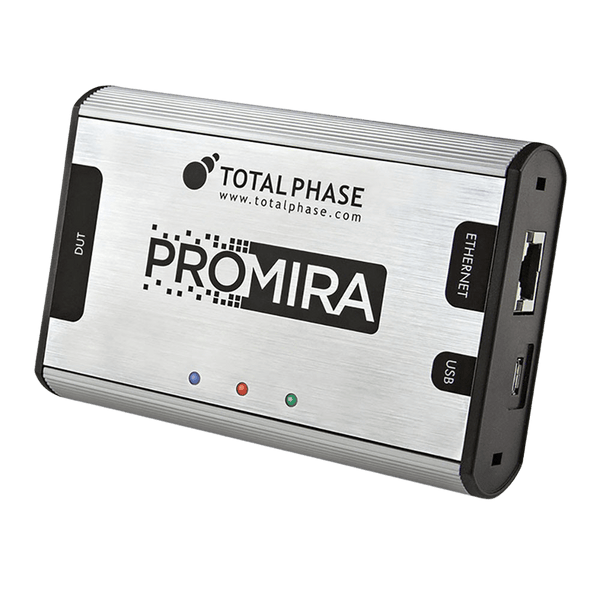
| Promira with I2C Active Level 1 (TP600110) | Drive | I2C controller and target to 1 MHz, covering all SMBus speed classes | €150,95 plus the €1.301,95 Promira |
Neither host adapter builds PMBus commands for you: you write the command codes and data formats in a script or test sequence. For a known-good target while learning a tool, the TP240310 I2C/SPI Activity Board (€100,95) has I2C devices you can reach at SMBus speeds.
For the underlying two-wire bus, including pull-up sizing and speed modes, see our I2C protocol guide. Not sure which tool fits your system? Tell us the devices and bus speed and we will recommend one.
Frequently Asked Questions
Can I Use an I2C Analyser on an SMBus?
Yes. The signalling is the same as I2C apart from small differences in voltage thresholds, so any I2C protocol analyser or logic analyser captures the traffic. What changes is the decode: an SMBus-aware decoder groups bytes into commands, checks the PEC and flags timeouts, which saves working it out by hand.
What Is the SMBus Timeout?
If any device holds the clock low for longer than the timeout, at least 25 ms and no more than 35 ms, every device must reset its bus interface and release the lines. It stops one faulty device locking the whole management bus, which matters on a server or battery that cannot be power cycled easily.
Is PEC Mandatory?
No. Packet error checking is optional in SMBus and PMBus, and each device datasheet says whether it supports it. Host and target must agree: if only one side adds the CRC byte, every transaction will look corrupted.
What Is the Difference Between SMBus and PMBus?
SMBus is the transport: wiring, timing and transaction formats. PMBus is a command language on top of it for power supplies and regulators, with standard codes for voltage, current, temperature and faults, plus an optional CONTROL pin and fixed data formats.
Do I Need a PMBus Decoder?
It helps but is not essential. With an SMBus decode you see the command code and data bytes; you then look up the command and convert LINEAR11 or ULINEAR16 values yourself. A PMBus decoder labels each command in the trace, and some also convert the values, which is faster when you are chasing a fault through thousands of readings.
Where to Start with SMBus and PMBus
More Protocols
By John Legg CEng, Director, Debug Store. Updated 12 November 2026.
