

Total Phase, Inc
Total Phase Aardvark I2C/SPI-Hostadapter
Total Phase Aardvark I2C/SPI-Hostadapter
SKU: TP240141
Verfügbarkeit für Abholungen konnte nicht geladen werden
Works with the Beagle I2C/SPI
The Beagle I2C/SPI Analyser records the bus your Aardvark drives (I2C to 4 MHz, SPI to 24 MHz) without disturbing it.
10% off the Beagle with an Aardvark: Was €502,95 EUR Now €452,66 EUR exc tax
, one per order, applied automatically in the cart.
Key Features
Overview
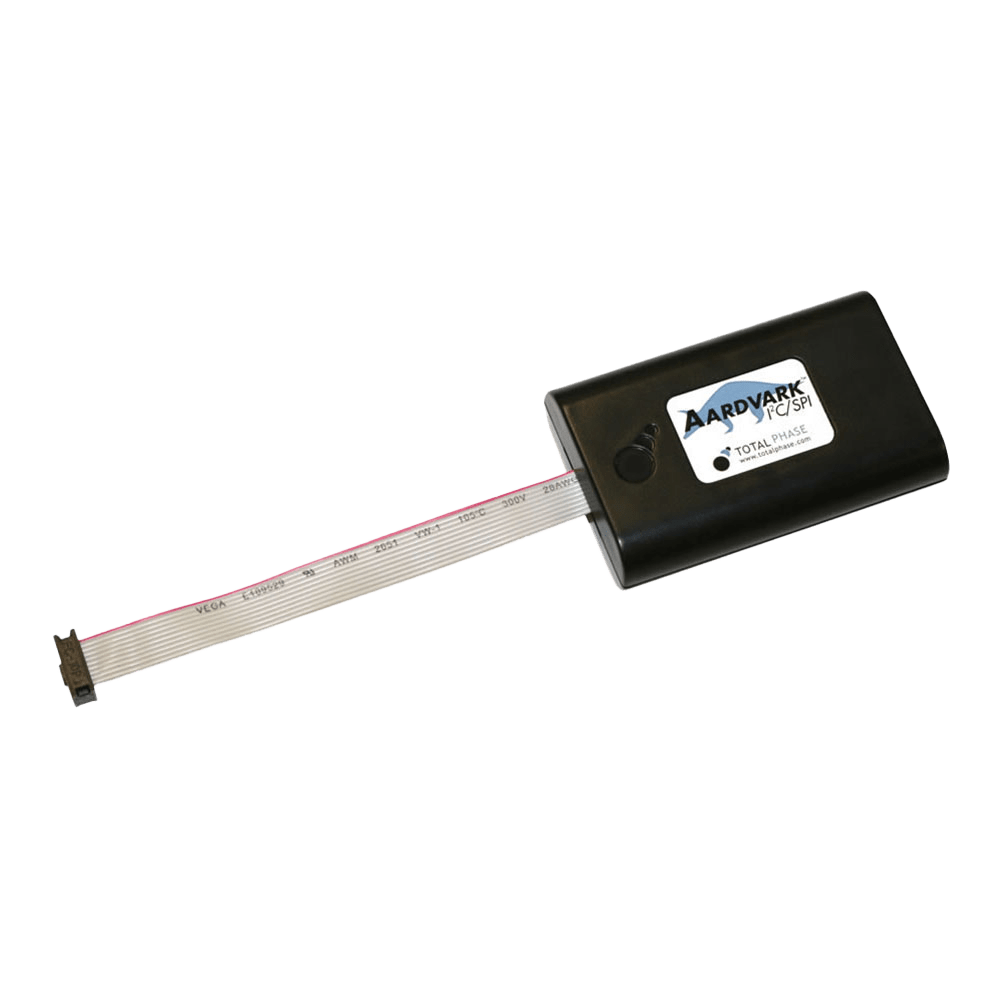
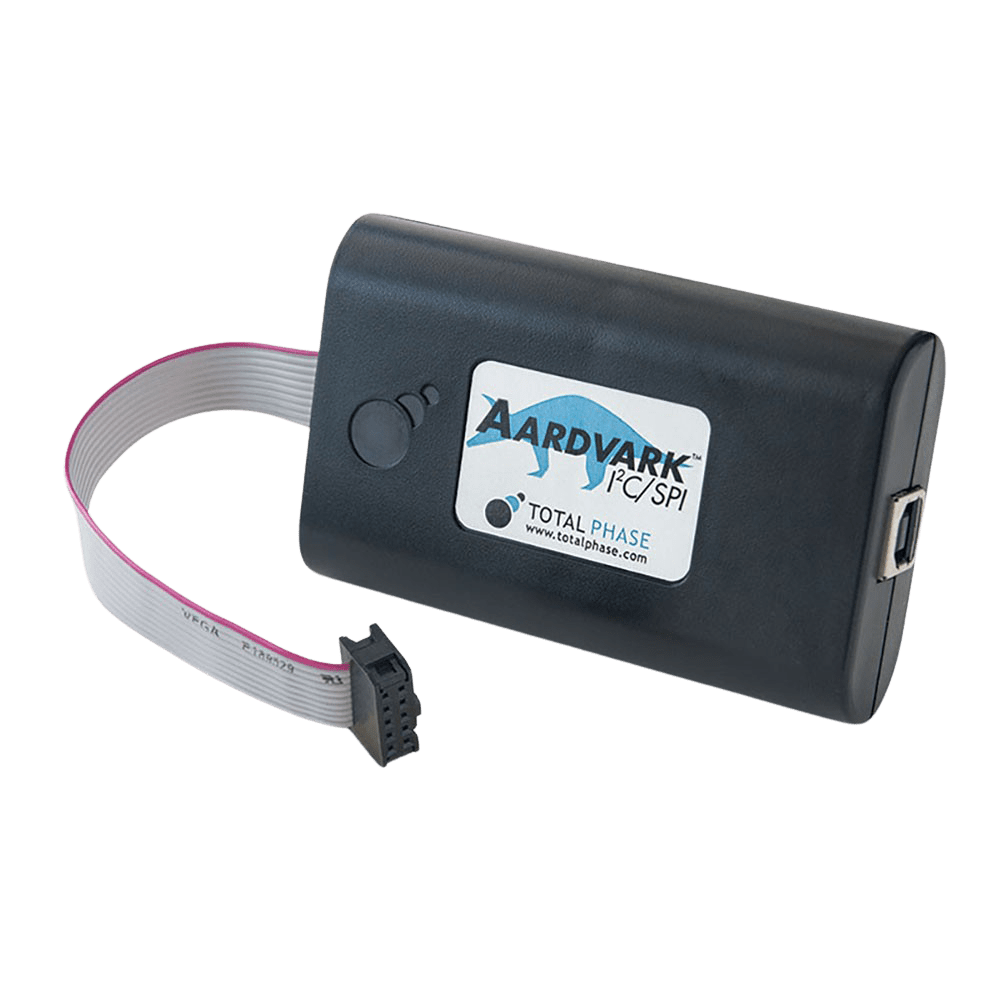
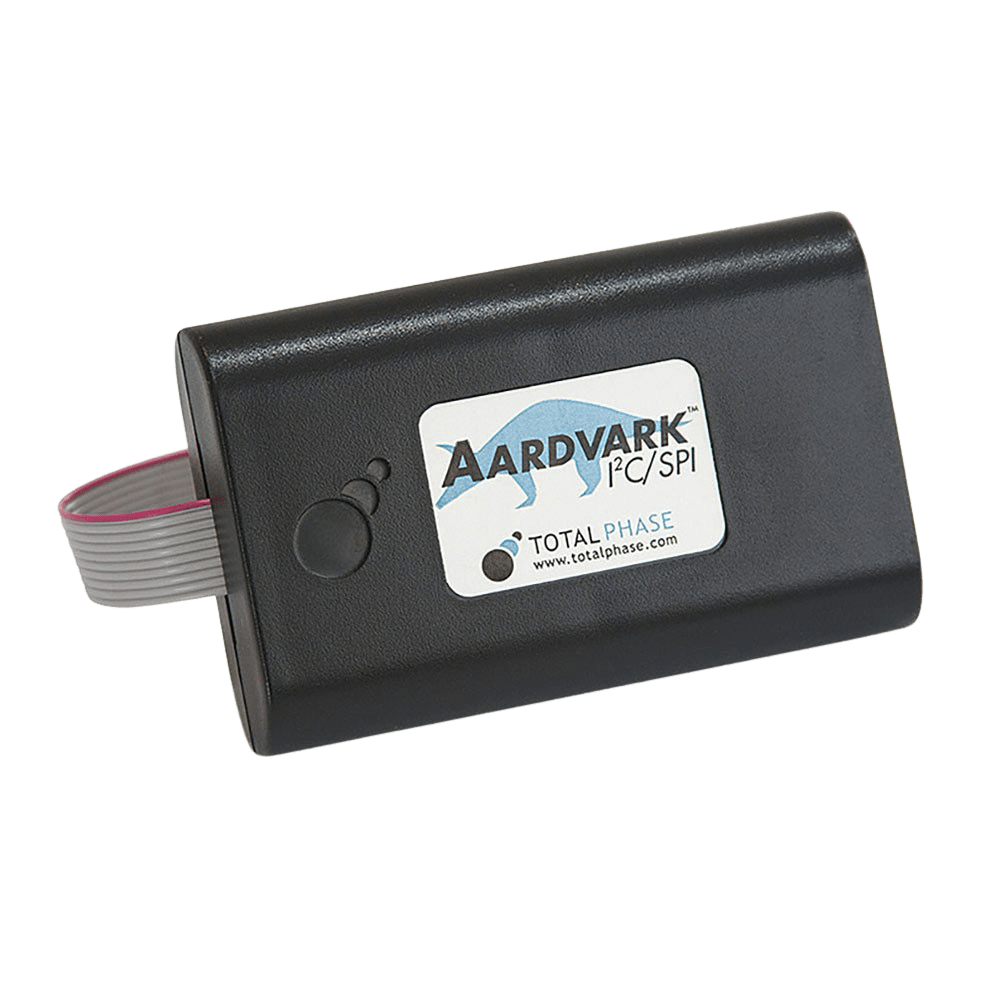
The Total Phase Aardvark I2C/SPI Host Adapter is a USB-powered tool for talking directly to I2C and SPI devices from a Windows, Linux or macOS computer. It runs I2C as a master from 1 kHz to 800 kHz or as a slave, and SPI as a master up to 8 MHz or a slave up to 4 MHz. That covers sensor evaluation, EEPROM and Flash programming, and automated test. The 2×5 IDC target connector carries I2C, SPI and up to six GPIO lines, with +5 V target power (25 mA max) for low-current devices.
Control Center Serial handles configuration and message transactions, with XML batch scripts for automation. Flash Center programs I2C and SPI memories from an extensible parts library. The Aardvark API (C, C++, C#, Python, .NET, VB.NET, VB6) and a LabVIEW driver let you build it into your own tools. All the software is a free download.
For higher speeds and built-in level shifting, step up to the Promira Serial Platform. To see what is happening on the bus without driving it, pair the Aardvark with the Beagle I2C/SPI Analyser.
Downloads
Datasheets
User Manuals
 Total Phase Aardvark I2C/SPI Host AdapterComplete user manual for Total Phase Aardvark I2C/SPI Host Adapter v5.15. Covers hardware specifications, software installation, API documentation, and programming...
Details
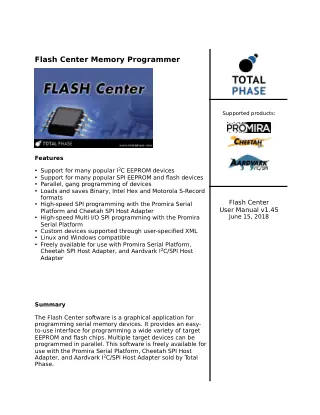 Total Phase Flash Center Memory ProgrammerComplete user manual for Total Phase Flash Center v1.45 software. Learn to program I²C EEPROM, SPI EEPROM and SPI flash...
Details
 Total Phase Aardvark I2C/SPI Host Adapter
Details
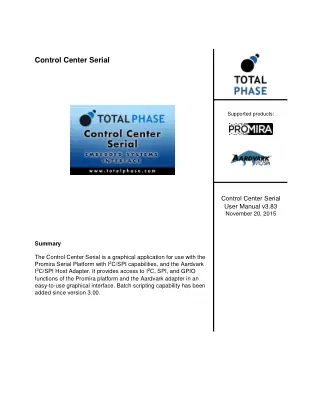 Total Phase Control Center SoftwareComplete user guide for Total Phase Control Center Serial software v3.83, providing graphical interface access to I²C, SPI, and GPIO...
Details
 Total Phase Control Center Serial Software
Details
Application Notes
Why Engineers Choose the Total Phase Aardvark I2C/SPI-Hostadapter
Total Phase's Most Popular Adapter
Master and Slave on Both Buses
Free Software and APIs
Kaufen Sie einen Aardvark I2C/SPI und erhalten Sie 10 % Rabatt auf einen Beagle I2C/SPI*
Wir präsentieren den Total Phase Aardvark I2C/SPI-Hostadapter – die Industriestandardlösung für schnelles und leistungsstarkes Testen und Programmieren von I2C und SPI. Dieser leistungsstarke Adapter wird über USB mit Ihrem Host-PC verbunden und ermöglicht Ihnen das Arbeiten mit dem I2C- oder SPI-Bus unter Windows, Linux oder Mac OS X.
Mit der mitgelieferten Total Phase Control Center-Software können Sie an den Bus angeschlossene Geräte problemlos steuern und testen. Damit eignet sie sich perfekt für Platinentests in einer Produktionsumgebung. Und mit der Möglichkeit, benutzerdefinierte Skripte auszuführen, ist das automatische Testen ein Kinderspiel. Und mit der mitgelieferten kostenlosen Programmiersoftware können Sie Flash-Geräte problemlos programmieren. Und das Beste daran?
Die Total Phase Control Center-Software kann kostenlos heruntergeladen und regelmäßig aktualisiert werden, ohne dass Softwarewartungsgebühren anfallen! Aktualisieren Sie Ihre I2C- und SPI-Tests und -Programmierung noch heute mit dem Total Phase Aardvark I2C/SPI-Hostadapter.
| General | |
|---|---|
| Host interface | USB 2.0 Full Speed (12 Mbps) |
| Power source | USB bus-poweredNo external supply required. Typical 25 mA draw. |
| Target power out | +5 V (low-current devices only)Via pin 4 of 2×5 IDC connector |
| Connector (target) | 2×5 IDC (10-pin, 2.54 mm pitch) |
| Connector (host) | USB Type-A |
| Logic levels | 3.3 V I/O |
| Firmware storage | Internal flash, field upgradeable |
| GPIO | |
| GPIO pins | Up to 6 (shared with I²C/SPI) |
| Direction | Each pin independently input or output |
| Logic level | 3.3 V |
| Max drive current | 10 mA per pin |
| I²C-only mode GPIOs | GPIO 02 to 05 (SPI pins repurposed) |
| SPI-only mode GPIOs | GPIO 00 and 01 (I²C pins repurposed) |
| I²C interface | |
| Modes | Master and Slave |
| Standard mode | 100 kHz |
| Fast mode | 400 kHz |
| Fast-plus mode | 800 kHz |
| Pull-ups | 2.2 kΩ software-selectableEnable/disable via API, no external resistors needed for most targets |
| Clock stretching | Supported (master & slave) |
| 10-bit addressing | Supported |
| Multi-master | Supported (bus arbitration) |
| SMBus | Supported |
| PMBus | Supported |
| DDC / DDC-CI | Supported |
| IPMI | Supported |
| SPI interface | |
| Modes | Master and Slave |
| Max speed (master) | 8 MHz |
| Max speed (slave) | 4 MHz |
| SPI modes | 0, 1, 2, 3 (CPOL/CPHA all combinations) |
| Bit order | MSB first or LSB first |
| SS polarity | Active-low (default) or active-high |
| Word size | 8-bit |
| Full duplex | Supported |
| Ordering information | |
| Part number (SKU) | TP240141 |
| Manufacturer | Total Phase, Inc |
| EAN | 5055383601769 |
| Shipping weight | 1.0 kg |
- Warranty: 2 Jahre
Total Phase Aardvark I2C/SPI-Hostadapter compared with Total Phase Cheetah SPI-Hostadapter and Total Phase TP500110 PROMIRA Serielle Plattform on 8 specifications.
| Specification | This product Total Phase Aardvark I2C/SPI-HostadapterTP240141In stock |
 Total Phase Cheetah SPI-HostadapterTP280121In stock |
 Total Phase TP500110 PROMIRA Serielle PlattformTP500110Available to order |
|---|---|---|---|
| I2C master | Up to 800 kHz | Not supported | Up to 3.4 MHz (I2C Active Level 2) |
| I2C slave | Up to 800 kHz | Not supported | Up to 3.4 MHz (I2C Active Level 2) |
| SPI master | Up to 8 MHz | Up to 40 MHz | Up to 80 MHz (SPI Active Level 3) |
| SPI slave | Up to 4 MHz | Not supported | Up to 20 MHz (SPI Active Level 2 or 3) |
| SPI I/O width | Single | Single | Single/Dual/Quad (SPI Active Level 3) |
| PC interface | Full-Speed USB | High-Speed USB | High-Speed USB and Gigabit Ethernet |
| GPIO | Up to 6 | Not listed | Up to 16 (SPI Active Level 3) |
| Voltage level shifting | Accessory board | Accessory board | Built-in (0.9 V to 3.45 V) |
| Price | €420,95 | €596,95 | €1.305,95 |
Questions and Answers
-
How Long Is the Aardvark Warranty?
2 years from Debug Store. Total Phase's standard hardware warranty is 12 months; Debug Store covers the second year itself, at no extra cost.
-
Can My Aardvark Be Upgraded?
Yes. The Aardvark's internal firmware can be upgraded over USB with Total Phase's aaflash utility when Total Phase releases new firmware.
-
How Is the Aardvark Powered?
The Aardvark is powered from the host computer over USB and draws less than 100 mA, so no external power supply is needed. It can also supply +5 V to a target on pins 4 and 6 of the 10-pin connector, up to 25 mA per pin (hardware v2.00 and later), which suits small low-current target boards.
-
Does the Aardvark Support I2C Clock Stretching?
Yes, the Aardvark supports clock stretching as a Master or a Slave.
Only the slave device can initiate clock stretching, to extend an I2C bus cycle. Not all I2C master or slave devices support it, so check this if you rely on clock stretching.
-
Can the Aardvark Support Multiple Slave Addresses?
Yes and no. The Aardvark can only act as one I2C address node at a time, but you can change the slave address as required using the Aardvark API software.
-
The Aardvark Supports I2C and SPI Buses. Can It Be Used with Any Other Interfaces?
Yes. The Aardvark host adapters also support:
- Display Data Channel (DDC)
- System Management Bus (SMBus)
- Power Management Bus (PMBus)
- Smart Battery Bus (SBBus)
- Intelligent Platform Management Interface (IPMI)
- Two-Wire Interface (TWI)
-
What Problems Does the Total Phase Aardvark I2C/SPI Host Adapter Solve?
It connects a computer to I2C and SPI devices so you can debug, test and program them. This saves development time.
-
Is There a CAD File Available for This Part?
The Aardvark is a simple shape that is easy to measure for placing in your equipment: it measures 55.6 x 22.2 x 89 mm and weighs 64 g. If you need a CAD file, please ask Total Phase.
-
What GPIO Capabilities Does the Aardvark Provide?
The Aardvark provides up to 6 GPIO pins.
- In I2C-only mode, the four SPI pins (MISO, SCLK, MOSI, SS) become GPIO 02, 03, 04 and 05.
- In SPI-only mode, the two I2C pins (SCL, SDA) become GPIO 00 and 01.
Each pin can be set as input or output, with internal pull-up resistors available on inputs. The aa_gpio_change function detects pin state changes within a set timeout, giving interrupt-like operation. All GPIO pins use 3.3V logic with a maximum drive current of 10 mA per pin.
-
Can the Aardvark Adapter Be Used for Programming EEPROMs and Flash Memory?
Yes. The Aardvark can program I2C and SPI EEPROMs and Flash memory.
The included Flash Centre Software has a built-in library of popular memory devices from manufacturers including Atmel, Microchip, Intel, STMicroelectronics and Cypress. Its XML-based device library can be extended for custom memory devices.
It can read, write, erase and verify memory with built-in error checking. For production, you can use several Aardvark adapters at once for parallel programming.
-
Which Programming Languages and Operating Systems Does the Aardvark Support?
The Aardvark API supports C, C#, Python 2 and 3, .NET, VB.NET and VB6. A LabVIEW driver is available as a separate download from Total Phase.
Total Phase currently lists support for Windows 7, 10 and 11, Linux (Red Hat, SuSE, Ubuntu, Fedora) and macOS 13 or later, on Intel and Apple Silicon. Control Center Serial, Flash Center and the API are free to download from Total Phase.
-
Can I Program I2C/SPI Memory Devices?
Yes. The Aardvark supports programming a wide range of EEPROM and Flash memory devices with Flash Center™ software, for embedded development and production programming.
-
What Industries Use the Aardvark I2C/SPI Host Adapter?
Total Phase lists applications for the Aardvark including memory programming, sensors, industrial and home automation and audio processing, wherever reliable I2C and SPI communication is required.
-
Can the Aardvark Be Used for Production Testing?
Yes. It can be used in automated production test systems to program firmware and run automated tests on I2C and SPI devices during manufacturing workflows.
-
Is the Aardvark Suitable for Beginners?
The Aardvark is a professional tool for engineers, but the free Control Center software gives a graphical interface for configuration and control, and the free API is there when you want to script tests.
-
Can the Aardvark Be Used with Other Interfaces Besides I2C and SPI?
Yes. As well as I2C and SPI, the Total Phase Aardvark supports these related protocols:
- Display Data Channel (DDC)
- System Management Bus (SMBus)
- Power Management Bus (PMBus)
- Smart Battery Bus (SBBus)
- Intelligent Platform Management Interface (IPMI)
- Two-Wire Interface (TWI)
-
Why Is the Total Phase Aardvark Preferred Over Basic USB to I2C/SPI Adapters?
Because it supports both I2C and SPI protocols, includes professional APIs for automation, and allows both master and slave operation for full protocol testing and debugging in development and production environments.
-
Can the Aardvark Adapter Be Used in Production Testing Environments?
Yes.
Its programmable interface and scripting support let you build automated test sequences, which speeds up quality control. Because it handles both I2C and SPI, it can test a range of components on a production line, from sensors to memory chips.
-
What Software Is Included with the Aardvark Adapter?
The Aardvark comes with Total Phase's Control Center software.
It gives a graphical interface for configuration and control, plus a transaction log of the messages it sends and receives, which can be exported to CSV. It also supports scripting for automated testing.
-
Can the Aardvark Adapter Be Used for Debugging I2C Communication Issues?
Yes. Through its API status codes the Aardvark reports I2C errors such as missing ACKs on the transactions it takes part in, and the Control Center transaction log records every transaction it sends or receives. For passive bus monitoring use the Beagle I2C/SPI analyser.
You can also emulate I2C devices to isolate faults.
-
Does the Aardvark Adapter Support Multi-master I2C Configurations?
Yes. The Aardvark supports I2C multi-master configurations, where several master devices share the same I2C bus. This is useful when multiple controllers need to start communication independently, for example in distributed control systems or IoT applications.
-
What Is the Total Phase Aardvark I2C/SPI Host Adapter?
The Total Phase Aardvark I2C/SPI Host Adapter is a USB-to-I2C/SPI interface for electronic design engineers.
It connects your computer (Windows, Linux or macOS) to embedded systems so you can communicate with I2C and SPI devices for prototyping, debugging and programming. It works as master or slave, with I2C up to 800 kHz and SPI up to 8 MHz (master) or 4 MHz (slave). It also provides up to 6 GPIO pins.
-
Can Multiple Aardvark Adapters Be Used Simultaneously on One System?
Yes. You can connect and run several Aardvark adapters at once on one host computer.
Each one gets a unique port number, which you can find with the aadetect utility or the aa_find_devices API function. Software can open handles to several adapters and control each one independently through separate API calls. Each device draws less than 100 mA.
Typical uses:
- parallel (gang) programming of memory devices
- independent control of separate embedded systems
- parallel testing in production
Control Centre Software can manage multiple connected Aardvark adapters through its device selection interface.
-
What Protocols and Communication Standards Does the Aardvark Support Beyond Basic I2C and SPI?
As well as standard I2C and SPI, the Aardvark supports several related standards and variants.
I2C-based standards:
- Display Data Channel (DDC)
- System Management Bus (SMBus)
- Power Management Bus (PMBus)
- Smart Battery Bus (SBBus)
- Intelligent Platform Management Interface (IPMI)
- Two-Wire Interface (TWI)
It also handles repeated start conditions, 10-bit addressing, combined format transactions, clock stretching and multi-master configurations.
For SPI, you can set clock polarity and phase, slave select polarity, and MSB-first or LSB-first bit order. Some other SPI variants and custom protocols can be handled through the GPIO at low speeds.
You can add further protocols, including proprietary ones, by writing your own software with the API. The GPIO can also be used for bit-banged protocols or custom signalling, but it is driven by host API calls over USB, so this suits slow signals only.
-
What Is the Maximum Cable Length and Distance Limitations for the Aardvark?
The standard Aardvark ribbon cable is 130.175 mm (5.125 inches) long with a 1.27 mm (0.050 inch) pitch.
Longer cables reduce signal integrity, especially for SPI at up to 8 MHz. Lower-speed I2C at 100 to 400 kHz tolerates longer runs better than fast SPI. If you need a longer connection, keep it as short as the fixture allows and check the signals with an oscilloscope.
Several Aardvarks can run from one host PC, each appearing as its own port, which is the usual way to cover several targets.
-
Can the Aardvark Adapter Be Used for Testing Sensors with I2C Interfaces?
Yes. It can act as master or slave on the I2C bus, so you can simulate a microcontroller talking to a sensor, verify sensor outputs, test different I2C speeds and stress-test sensors under various conditions.
Control Center's transaction log can be exported to CSV for analysis.
-
Is There a Python API Available for the Aardvark Adapter?
Yes. Total Phase provides a Python API for configuring the Aardvark, sending and receiving data, and analysing communication. Use it for custom test scripts, automated data collection, or integrating the Aardvark into larger software systems.
-
Does the Aardvark Adapter Support GPIO Functionality?
Yes. The Aardvark has GPIO (General Purpose Input/Output) pins. The GPIO lines are the I2C or SPI pins repurposed, so you can use them when one of the buses is not in use. Use them for custom signalling, triggering external events, controlling extra hardware, extra chip select lines for SPI devices (switched by host API calls, not by the SPI engine), or synchronising with other test equipment.
-
Does the Aardvark Adapter Have I2C Pull-up Resistors?
Yes. The Aardvark has fixed 2.2 kΩ pull-up resistors on SCL and SDA, which can be switched on or off in software (hardware v2.00 and later). The value is not adjustable. If your bus needs a different pull-up value, switch the Aardvark pull-ups off and fit the resistors on the target.
-
Can the Aardvark Adapter Be Used as an Alternative to NI-845x Adapters?
The Aardvark provides I2C up to 800 kHz and SPI up to 8 MHz as master (4 MHz as slave), in master and slave modes, with a free API and a free LabVIEW driver. For a comparison with the NI-845x adapters, check National Instruments' specifications against your own requirements.
-
Is the Control Center Software Compatible with XML Scripting?
Yes. The Control Center software supplied with the Aardvark supports XML scripting for automated test and control sequences.
You can define device configuration and data transmission in XML. This is useful for repeatable test procedures, automating firmware updates, or integrating the Aardvark into larger automated test frameworks.
-
How Does the Aardvark Adapter Compare to the Beagle Protocol Analyser?
Both are Total Phase products, but they do different jobs.
The Aardvark is for interfacing and basic analysis. It takes an active part in I2C and SPI communications, which suits interactive debugging and development.
The Beagle is a protocol analyser for passive monitoring and in-depth analysis. It offers higher capture speeds, more detailed timing analysis, and handles more complex protocol scenarios.
Many developers use the Aardvark day to day and the Beagle for specialised debugging and performance optimisation.
-
How Does the Aardvark Adapter Compare to the Promira Serial Platform?
The Aardvark covers I2C to 800 kHz and SPI to 8 MHz (master). The Promira Serial Platform is the step up: I2C to 3.4 MHz, SPI master up to 12.5, 40 or 80 MHz depending on the licence level, SPI slave up to 20 MHz, eSPI support, and built-in level shifting from 0.9 to 3.3 V.
Promira supports I2C, SPI and eSPI. For CAN, see the Total Phase Komodo CAN interfaces.
-
What Interfaces Does the Aardvark Support?
As well as I2C and SPI, the Aardvark supports related serial interfaces: DDC, SMBus, PMBus, SBBus, IPMI and TWI.


No questions match your search.