

Total Phase, Inc
Total Phase I2C/SPI Activity Board – TP240310 Target Device Board
Total Phase I2C/SPI Activity Board – TP240310 Target Device Board
SKU: TP240310
Couldn't load pickup availability
Key Features
Overview
- Works standalone or with other Total Phase tools
- Ideal for isolating software bugs from hardware issues
- Variants for CAN/I2C and advanced protocol validation also available: CAN/I2C Activity Board Pro
Downloads
Why Engineers Choose the Total Phase I2C/SPI Activity Board – TP240310 Target Device Board
Reference Platform
Educational Tool
Baseline Validation
I2C/SPI Activity Board For Debugging & Education
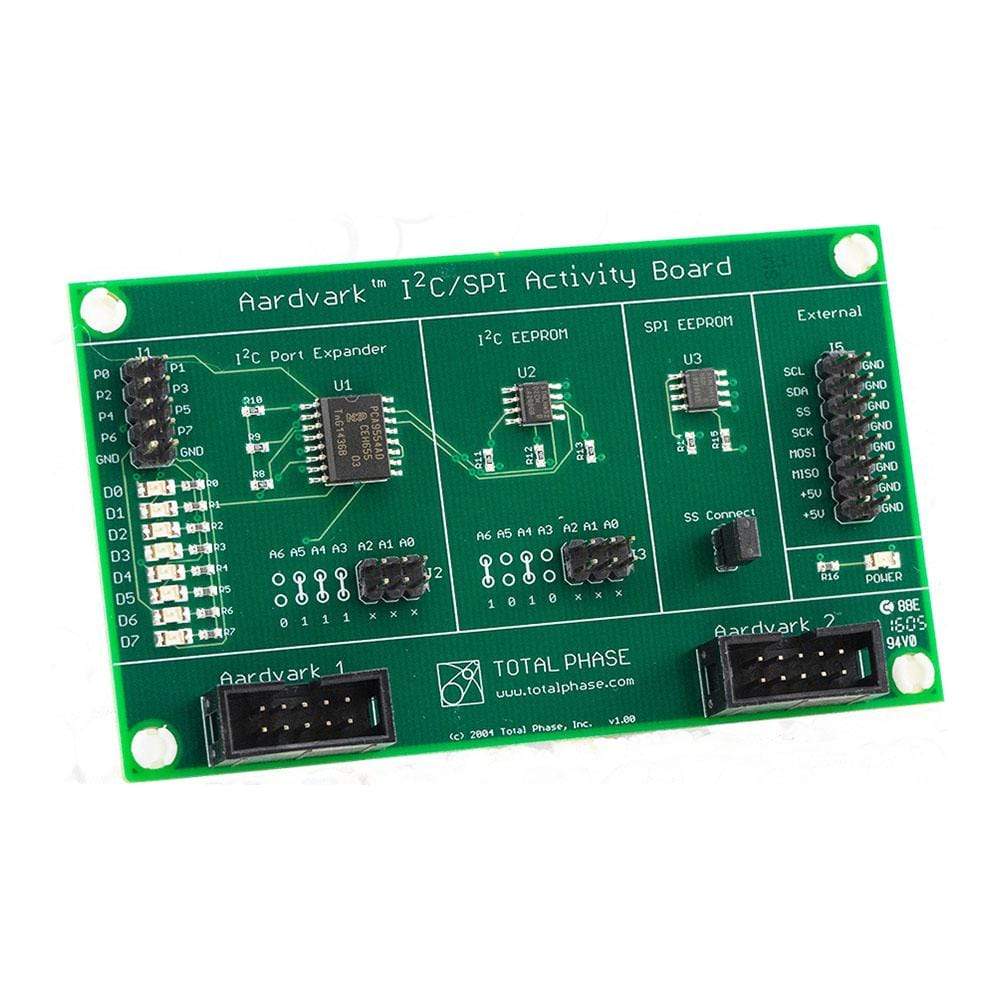
The Total Phase I2C/SPI Activity Board (TP240310) is an essential reference platform for embedded engineers to quickly verify I2C or SPI host adapter operation and software. It provides three distinct slave devices: an 8-bit I2C port expander (PCA9554AD), an I2C EEPROM (AT24C02), and an SPI EEPROM (AT25080A), making it ideal for learning, debugging, and development.
| On-board Devices | Type | Capacity/Function |
|---|---|---|
| PCA9554AD | I2C Port Expander | 8-bit I/O, Address Config, LEDs |
| AT24C02 | I2C EEPROM | 2 Kb / 256 bytes, Configurable Address |
| AT25080A | SPI EEPROM | 8 Kb / 1 KB, Supports SPI Mode 0 & 3 |
Pinouts & Connectors
- J1: Port expander pins/LEDs (P0–P7), direct access
- J2, J3: Jumpers to set address for Port Expander/EEPROM
- J4: SPI slave select link (connect/disconnect two Aardvark adapters)
- J5: External monitor (SCL, SDA, SS, SCK, MOSI, MISO)
- 10-pin: Dual headers for Aardvark I2C/SPI Host Adapter(s)
Wiring Quick-Start
- Connect Aardvark adapter(s) to activity board using 10-pin ribbon cable(s)
- Apply target power via adapter control software
- Monitor board power LED is lit before use
- Configure I2C addresses using jumpers as needed
- Example host software and scripts (C, Python, VB, XML) available from Total Phase
Example: Blinking LEDs (I2C)
# Using Aardvark Python API—Turn on Port Expander LEDs from aardvark_py import * aa = aa_open(0) aa_configure(aa, AA_CONFIG_SPI_I2C) aa_target_power(aa, AA_TARGET_POWER_BOTH) aa_i2c_write(aa, 0x38, AA_I2C_NO_FLAGS, [0x01, 0xFF]) # Set P0 = High aa_close(aa) Component Datasheet Links
Supports daisy-chaining and use with multiple activity boards—see manual for safe usage.
Questions and Answers
-
Is Example Code Provided?
Yes, example scripts in C, Python, Visual Basic and Aardvark XML batch format are available to download in the API package for your Total Phase host adapter.
-
Can I Use Two Aardvark Adapters Simultaneously?
Yes. The board has two adapter connectors, so you can connect two Aardvark adapters and cross-connect them pin for pin (the board must be powered when you do).
-
What Is the Default Address for the I2C Port Expander?
Default is 0x38 (binary 0111000), with jumpers to adjust as needed.
-
Can I Daisy-chain Multiple Activity Boards?
Yes, multiple boards can be connected, but only one should have the SS jumper in place to avoid contention.
-
What Voltages Are Supported?
The board takes target power from the host adapter (+5 V on the Aardvark), switched on in the host software; the Aardvark's I2C/SPI signals are 3.3 V.
-
What Devices Are Included on the I2C/SPI Activity Board?
The board features an I2C port expander, an I2C EEPROM, and an SPI EEPROM; all devices are real ICs and fully documented.
-
Can I Change Device Addresses on the Board?
Yes, both I2C port expander and EEPROM addresses can be modified by fitting jumpers (not supplied) to the address headers.
-
Does It Work with Other I2C Host Adapters?
Yes, while optimised for Total Phase adapters, it is compatible with any host that supports I2C/SPI, has the matching 10-pin Aardvark header and supplies +5 V target power.
-
Can I Connect a Logic Analyser or Protocol Analyser?
Yes, pass-through pins expose all key I2C/SPI lines for connection to external monitoring equipment.

No questions match your search.