
OMICRON-Lab
OMICRON Lab B-WIT 100 Breitband-Injektionstransformator
OMICRON Lab B-WIT 100 Breitband-Injektionstransformator
SKU: P0005758
Verfügbarkeit für Abholungen konnte nicht geladen werden
Key Features
Overview
Advanced Control Loop Stability Analysis
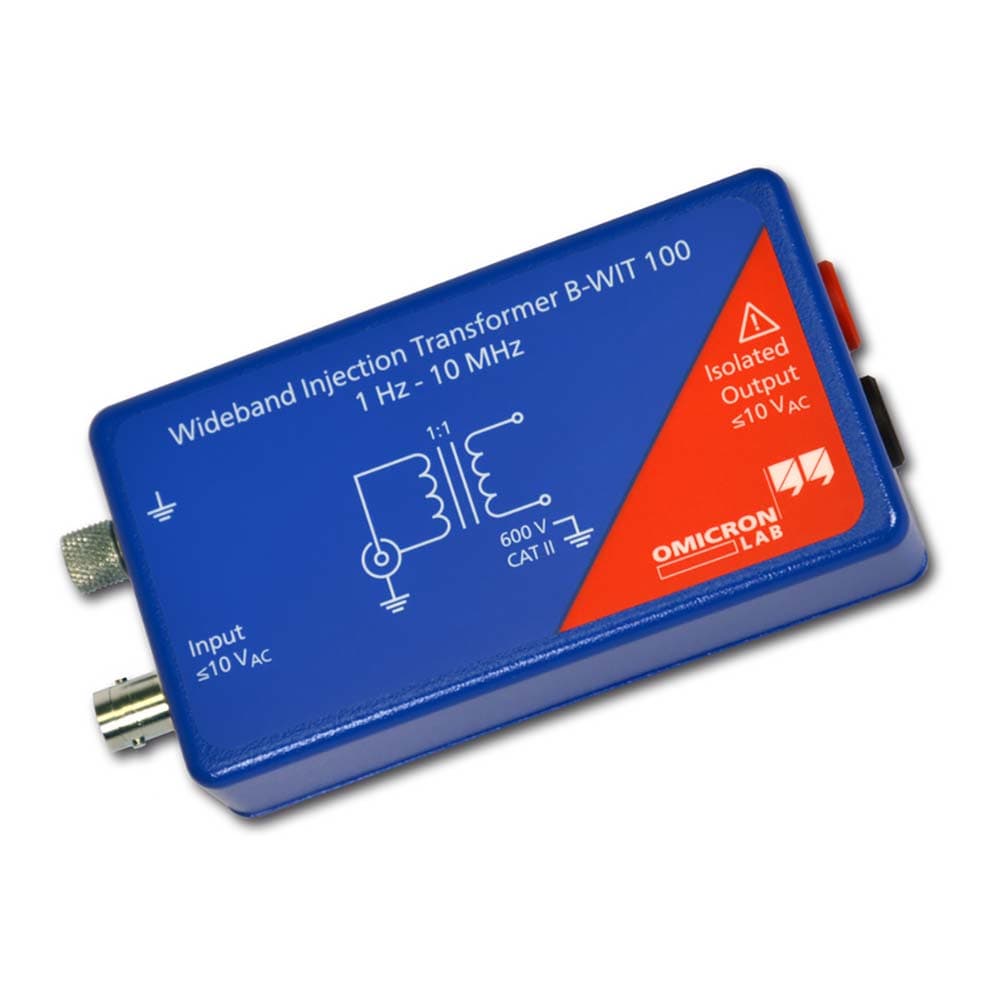
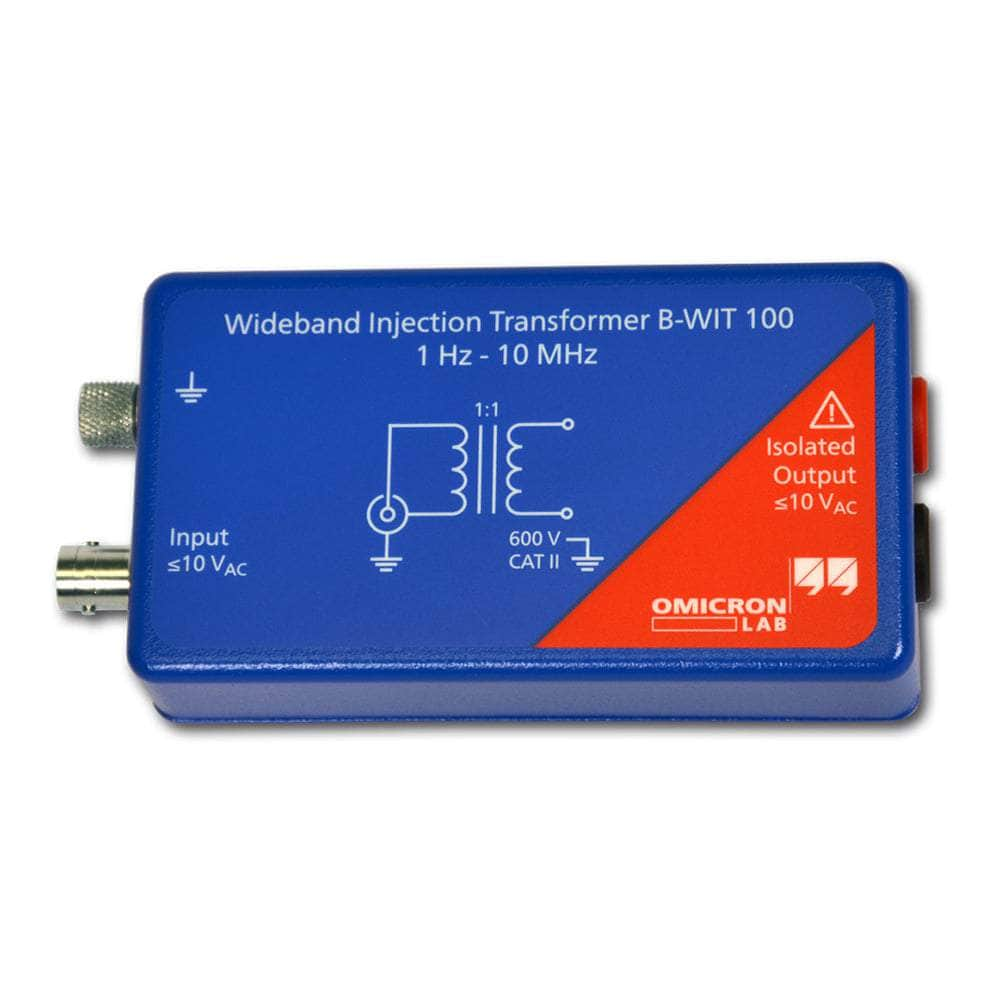
The Omicron-LAB B-WIT 100 Wideband Injection Transformer represents the gold standard for control loop stability measurements in power electronics. Engineered for professional electronic design engineers, this precision instrument enables accurate loop gain and phase margin analysis across an exceptional frequency range from 1Hz to 10MHz, making it ideal for both slow and fast control loops.
Unmatched Frequency Range Performance
The B-WIT 100 combines ultra-wide bandwidth capabilities with superior electrical isolation rated to 600V CAT II, ensuring safe operation across diverse voltage regulator applications. Its 1:1 turns ratio and minimal insertion loss of less than 0.5dB at 10kHz guarantee measurement integrity without compromising circuit performance.
This injection transformer serves as the critical interface between your Bode 100 Vector Network Analyser and the device under test, enabling precise voltage injection measurements essential for stability assessment of switching converters, linear regulators, and power factor correction circuits.
Professional Engineering Applications
The B-WIT 100 excels in applications requiring rigorous stability verification, from high-speed switching converters operating at MHz frequencies to slow PFC regulators at Hz levels. Its exceptional linearity and low primary-secondary capacitance of 120pF ensure minimal circuit loading, whilst the robust mechanical design withstands demanding laboratory environments.
Part of Omicron-LAB's comprehensive measurement ecosystem, the B-WIT 100 pairs seamlessly with the B-LFT 100 Low-Frequency Injection Transformer for applications requiring enhanced low-frequency performance below 1Hz.
Downloads
Why Engineers Choose the OMICRON Lab B-WIT 100 Breitband-Injektionstransformator
Enhanced Measurement Accuracy
Safety and Compliance Assurance
Complete Frequency Coverage
Questions and Answers
-
What Is the Difference Between the B-WIT 100 and B-LFT 100 Injection Transformers?
The B-WIT 100 covers 1 Hz to 10 MHz for general-purpose use. The B-LFT 100 specialises in low-frequency work below 100 kHz, with better performance and maximum signal coupling at very low frequencies for PFC and other slow control loops.
-
Why Is a 1:1 Turns Ratio Important in Injection Transformer Design?
A 1:1 turns ratio gives unity voltage transfer while keeping galvanic isolation. Because loop gain is taken from probes on both sides of the injection resistor, the turns ratio does not affect the result.
-
How Does the B-WIT 100 Compare to the Picotest J2101A?
Compared with Picotest's J2101A (10 Hz to 45 MHz), the B-WIT 100 covers 1 Hz to 10 MHz, so it reaches lower frequencies, while the J2101A goes higher.
-
What Probe Recommendations Work Best with the B-WIT 100?
OMICRON Lab recommends its PML-111O 10:1 passive probes, and warns that standard 10:1 oscilloscope probes can damage the Bode 100 inputs. Keep capacitive loading low, use a probe with an adequate voltage rating for the circuit under test, and use proper grounding.
-
Can the B-WIT 100 Be Used with Network Analysers Other Than the Bode 100?
Yes. The B-WIT 100 has a standard BNC input and 4 mm banana jack outputs, so it works with other network analysers and frequency response analysers.
-
What Frequency Range Does the B-WIT 100 Cover and Why Is This Important?
The B-WIT 100 has a usable frequency range of 1Hz to 10MHz, with -3dB points typically at 7Hz and 5MHz. This covers slow control loops and fast switching converters with crossover frequencies in the MHz range, so one transformer covers most loops. For very slow loops such as PFC, the B-LFT 100 injects more signal at low frequencies.
-
How Does the B-WIT 100 Ensure Safety When Testing High-voltage Power Supplies?
The B-WIT 100 has 600V CAT II compliant isolation between primary and secondary windings. With its earth terminal connected to safety ground and safety-rated probes used, this galvanic separation protects the engineer and test equipment when measuring mains-voltage power supplies.
-
What Makes the B-WIT 100 Superior to DIY Injection Transformer Solutions?
The B-WIT 100 is optimised for signal injection into control loops, with high linearity and low insertion loss.
-
Can the B-WIT 100 Handle DC Current in the Injection Loop?
The brochure lists a maximum DC current of 10 mA (typical saturation 15 mA). Keep DC through the output winding low; the manual warns not to apply DC signals to the output.
-
How Does Insertion Loss Affect Control Loop Measurements?
The B-WIT 100's insertion loss is below 0.5dB at 10kHz, so it does not significantly attenuate the test signal. Keep the injection resistor small (1 to 10 Ω) to limit its effect on the loop.


No questions match your search.