

SEGGER Microcontroller GmbH
SEGGER Target Supply Adapter - Adjustable Power Supply for J-Link Debug Probes
SEGGER Target Supply Adapter - Adjustable Power Supply for J-Link Debug Probes
SKU: 8.06.18
Couldn't load pickup availability
Key Features
Overview
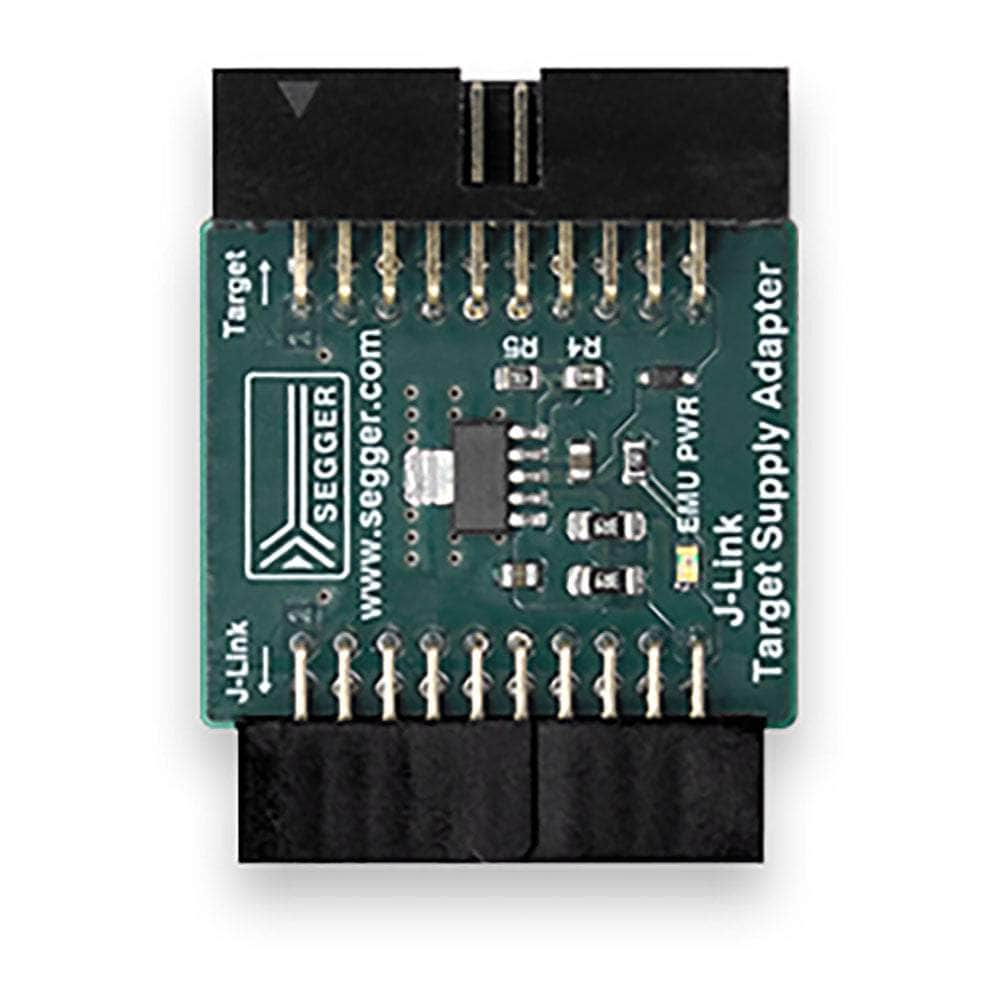
The SEGGER Target Supply Adapter (8.06.18) eliminates the need for separate power supplies during embedded system debugging by providing clean, regulated power directly from your J-Link debug probe. With its default 3.3V output at 400mA, this adapter suits the majority of modern microcontroller applications whilst offering flexibility for custom voltage requirements through simple resistor modification.
Engineered for reliability, the adapter features the MCP1826T LDO voltage regulator and maintains complete electrical isolation between power and debug signal paths. The integrated power LED provides immediate visual confirmation of output status, whilst the robust 20-pin connector system ensures reliable connections in demanding development environments.
Compatible with all SEGGER J-Link debug probes and Flasher programming tools, this adapter integrates seamlessly into existing development workflows whilst providing the power supply flexibility essential for modern embedded development.
Downloads
Why Engineers Choose the SEGGER Target Supply Adapter - Adjustable Power Supply for J-Link Debug Probes
Eliminates External Power Supplies
Flexible Voltage Requirements
Professional Debugging Reliability
Adjustable Power Supply Solution for J-Link Debug Systems
The SEGGER Target Supply Adapter (8.06.18) provides engineers with a reliable, adjustable power supply solution for embedded debugging applications. This compact adapter seamlessly integrates between your J-Link debug probe and target hardware, delivering precisely regulated voltage whilst maintaining full signal integrity across all debug connections.
Technical Specifications
| Parameter | Specification |
|---|---|
| Input Connector | 20-pin 0.1" (2.54mm) socket for J-Link |
| Output Connector | 20-pin 0.1" (2.54mm) header to target |
| Default Output | 3.3V @ 400mA |
| Voltage Range | 0.8V to 3.6V (adjustable via resistor) |
| Voltage Regulator | MCP1826T LDO |
| Power LED | Visual indication of output status |
Current Output Capabilities
| Output Voltage | Maximum Current |
|---|---|
| 3.6V | 400mA |
| 3.3V (default) | 400mA |
| 2.5V | 300mA |
| 1.8V | 200mA |
| 1.0V | 150mA |
Compatible Debug Probes
The adapter maintains full compatibility with the complete SEGGER debug probe family:
- J-Link Pro PoE and J-Link Pro
- J-Link ULTRA+ and J-Link WiFi
- J-Link PLUS (Classic and Compact variants)
- J-Link BASE (Classic and Compact variants)
- Flasher Portable and Flasher ARM
Pin Configuration
The adapter provides transparent pass-through of all debug signals with power delivered via pin 19 of the debug cable. All JTAG, SWD, and auxiliary signals maintain 1:1 connectivity ensuring complete debugging functionality.
Installation and Setup
The Target Supply Adapter requires no external power source or configuration software. Simply insert the adapter between your J-Link debug probe and the debug cable connection to your target hardware. The adapter draws power directly from the J-Link probe, making it ideal for portable debugging solutions.
| General Information | |
|---|---|
Product Type |
Adapter
|
Part Number (SKU) |
8.06.18
|
Manufacturer |
|
| Physical and Mechanical | |
Weight |
0.02 kg
|
| Other | |
EAN |
5055383613700
|
Questions and Answers
-
Can I Use This Adapter with Battery-Powered J-Link Probes?
No J-Link probe is battery powered. The adapter is listed for Flasher Portable PLUS; SEGGER notes that for the Flasher Portable the voltage-setting resistor is an SMD 1206 part rather than 0805.
-
Is Any Configuration Software Required for the Adapter?
SEGGER does not document any software for the adapter. It is placed between your J-Link or Flasher and the debug cable.
-
Does the Adapter Have a Status LED?
SEGGER does not document a status LED on this adapter.
-
What Connector Type Does the Adapter Use?
Standard 20-pin 0.1" (2.54mm) IDC connectors: a socket for the J-Link connection and a header for the target connection.
-
Can This Adapter Power Multiple Target Boards Simultaneously?
The adapter is designed for single-target use. For multiple targets, use individual adapters or the fixed-voltage 5V Target Supply Adapter (500mA) where the target accepts 5V.
-
What Voltage Does the Target Supply Adapter Provide by Default?
The adapter provides 3.3V at up to 400mA by default, suitable for most ARM Cortex-M and similar microcontroller applications.
-
How Do I Adjust the Output Voltage for Different Target Requirements?
Replace a single SMD 0805 resistor on the adapter. The output range is 0.8V to 3.6V, with current limits that vary across that range.
-
Which J-Link Debug Probes Are Compatible with This Adapter?
It works with the J-Link and Flasher models SEGGER lists:
- J-Link PRO
- J-Link ULTRA+
- J-Link PRO PoE and J-Link WiFi
- J-Link PLUS Classic and Compact, and BASE Classic and Compact
- Flasher PRO, PRO XL, Compact and Portable PLUS
-
Does the Adapter Affect Debug Signal Quality or Timing?
No. The adapter passes all debug signals straight through with 1:1 connectivity, so JTAG, SWD and SWO are unaffected.
-
What Is the Maximum Current Capability at Lower Voltages?
Maximum current falls as voltage drops: 200mA at 1.8V and 150mA at 1.0V. Exceeding these limits will damage the adapter.


No questions match your search.