
OMICRON-Lab
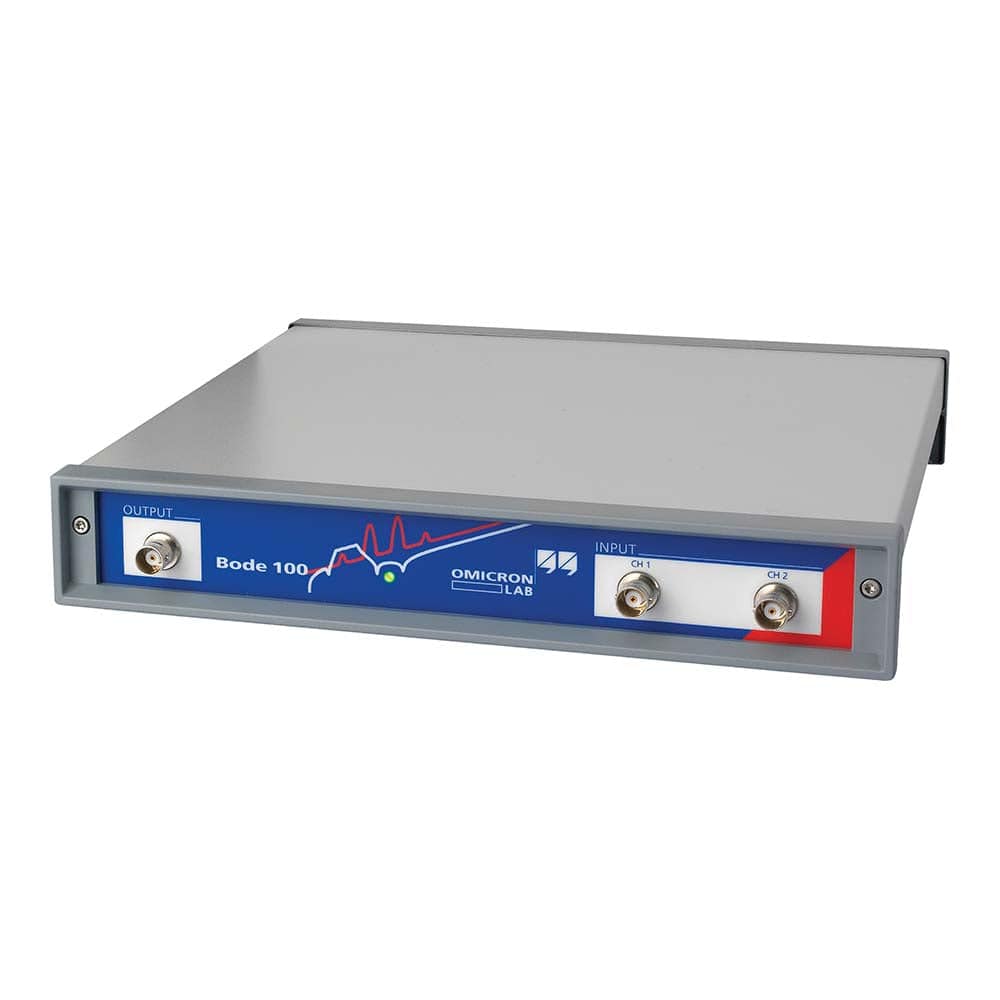
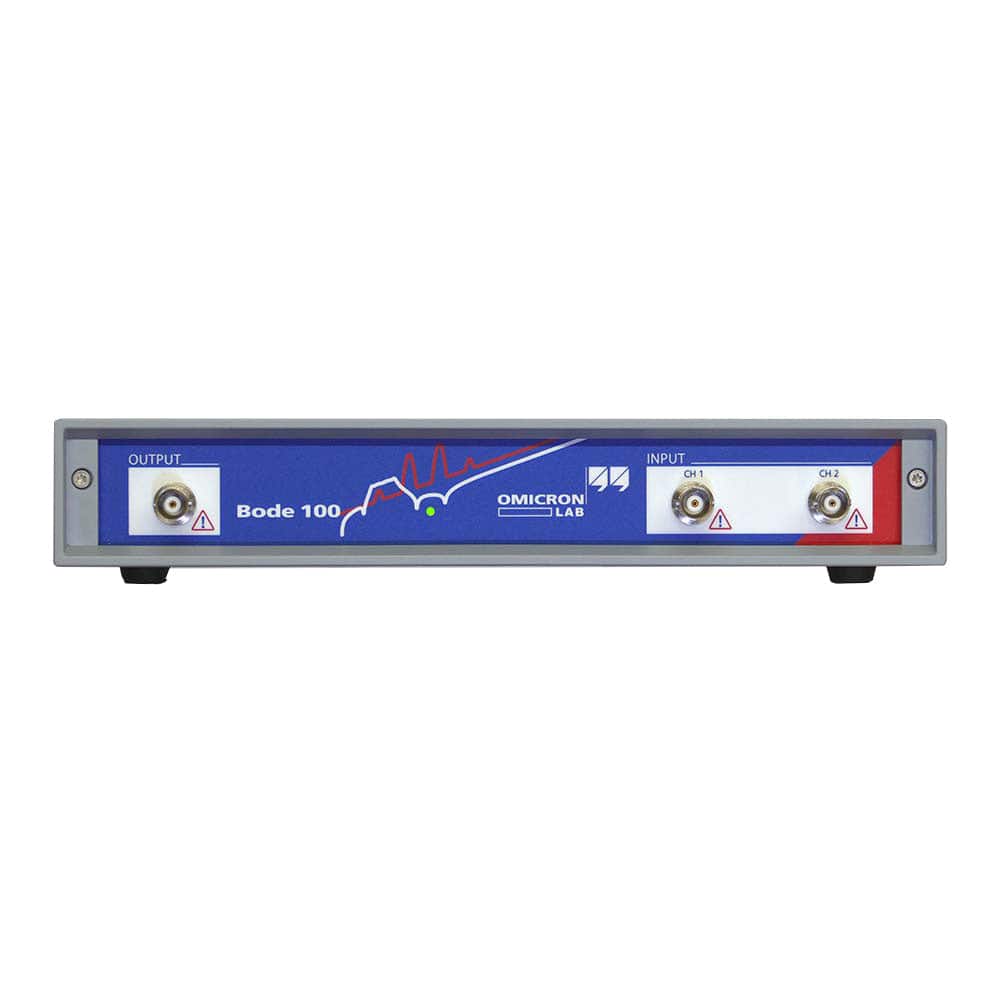
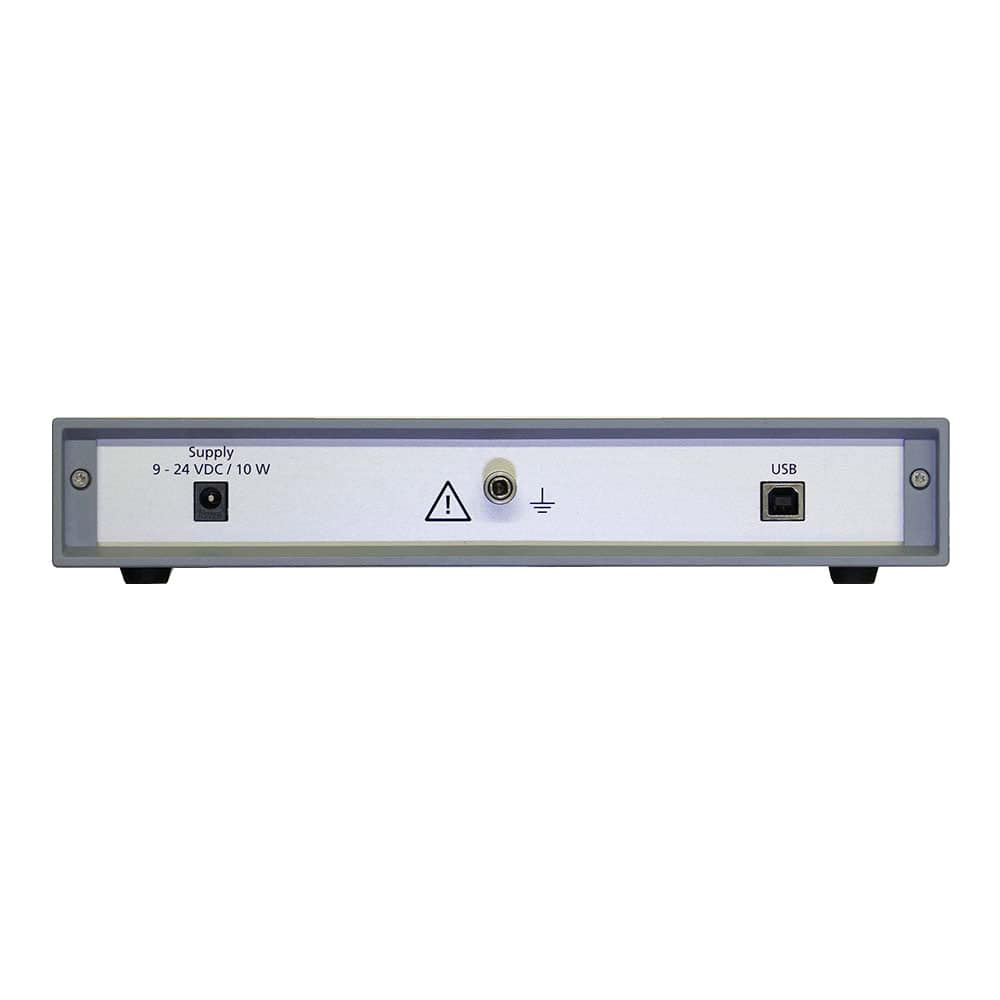
OMICRON Lab Bode 100 Vector Network Analyser (VNA)
OMICRON Lab Bode 100 Vector Network Analyser (VNA)
SKU: P0005755
Couldn't load pickup availability
Key Features
Overview
Revolutionise Your Measurements
Discover an instrument that redefines versatility in the realm of test and measurement. Introducing the Bode-100, the essential tool you never knew you needed until now. Offering unparalleled performance in a compact form factor, this instrument promises to elevate the quality, precision, and efficiency of your work.
Unmatched Versatility
- Vector Network Analyser (VNA)
- Frequency Response Analyser
- Gain/Phase Meter
- Impedance Analyser
Deep Dive Into Features
The Omicron-Lab Bode-100 doesn't just stop at multifunctionality. Dive deeper into the extensive features it brings to the table:
- Sinusoidal Signal Generation: Precisely measures the response of your device under test (DUT) by generating sinusoidal signals across varied frequencies.
- Diverse Measurement Modes: From transmission/reflection, gain, and impedance measurements, choose the mode that best fits your needs.
- Complex Analysis: Measure active and passive circuits' complex gain, impedance, and admittance.
- S-Parameter Sweep: Analyse the swept S-parameters of electronic circuits and filters easily.
- Group Delay Characteristics: Understanding signal delay in your circuits is made simpler.
Ready to Elevate Your Testing Game?
Make sure to integrate the future of test and measurement instruments into your lab. Order your Bode-100 today!
Downloads
Packages:
Standard
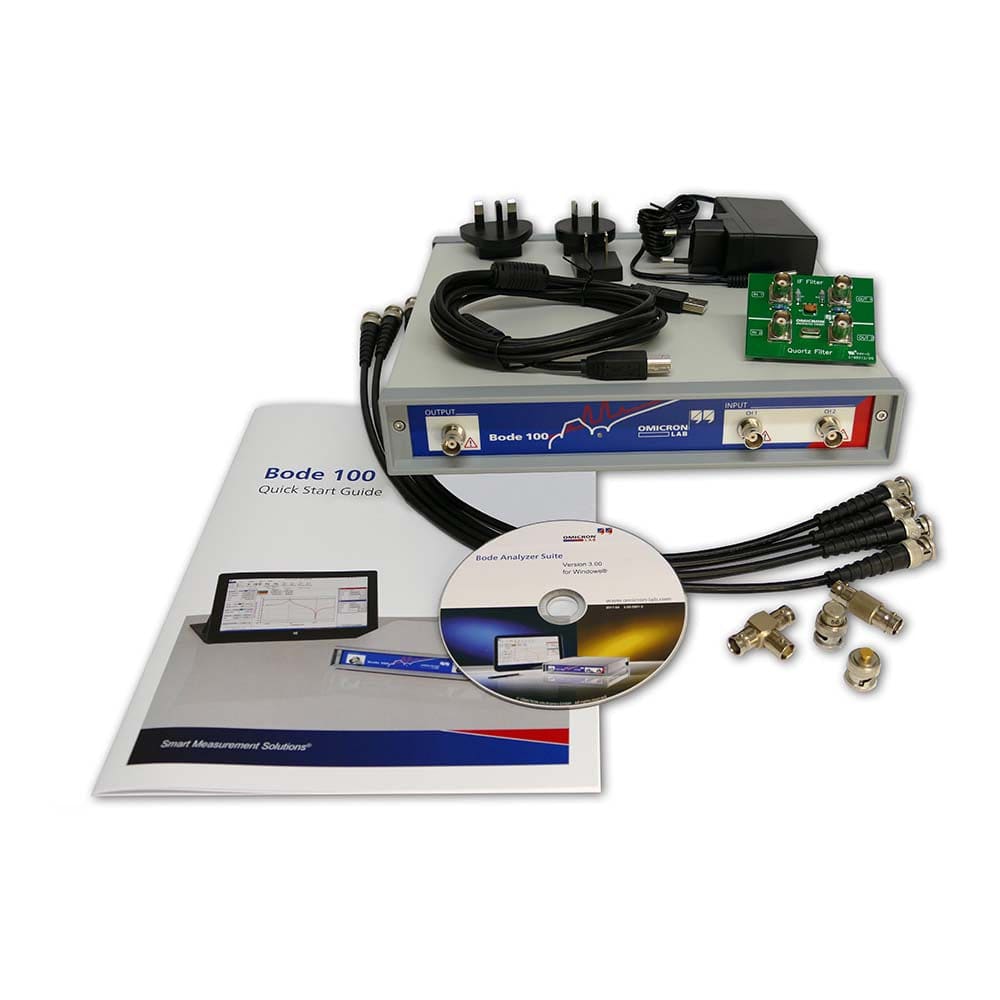
- Bode 100 instrument with calibration certificate
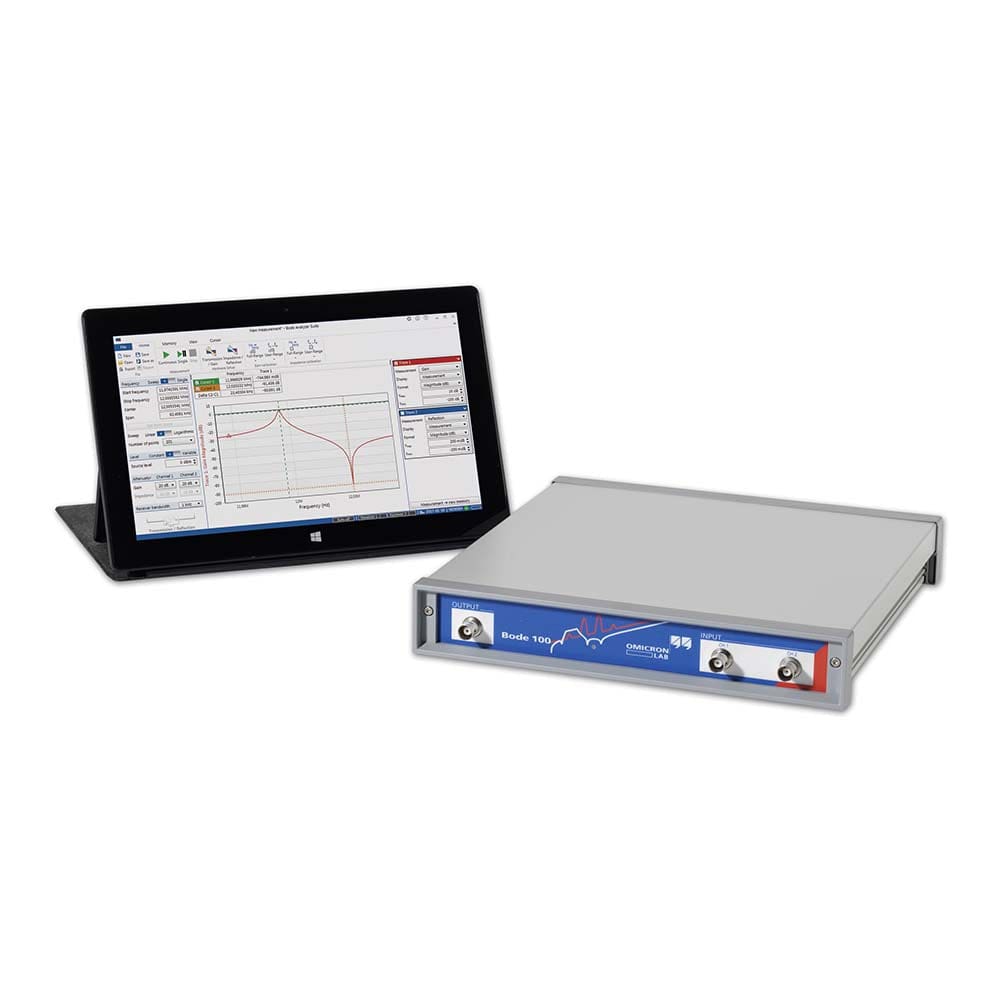
- Bode Analyzer Suite - Software for Windows PC - on DVD
- Printed Quick-Start Guide
- Wide-range AC power adapter (18 W)
- USB-A to USB-B cable
- BNC straight adapter (f-f)
- BNC T connection (f-f-f)
- BNC 50 Ω load (m)
- BNC short (m)
- 4x 0.5m BNC cable (m-m)
- Test objects on PCB (Quartz-filter and IF-filter)
Basic
- Bode 100 instrument with calibration certificate
- Bode Analyzer Suite - Software for Windows PC - on DVD
- Printed Quick-Start Guide
- Wide-range AC power adapter (18 W)
Educational
1x Bode 100 - Vector Network Analyzer
1x B-WIT 100 - Wideband Injection Transformer
1x B-WIC - Impedance Test Fixture
2x PML 111O High Impedance Passive Probe 10:1
1x Carry Case for Bode 100 / 500
*For educational customers only
The Bode 100 is the professional solution to perform accurate and fast frequency sweep measurements from 1 Hz to 50 MHz, essential for power supply design and stable loop operation.
The dedicated hardware offers fast sweep performance together with unsurpassed noise rejection allowing high-dynamic range measurements not only on passive components and linear regulators but also on switching converters.
Together with the Bode Analyzer Suite the Bode 100 is the perfect choice to equip your design lab.
It enables you to analyze systems, control loops, electronic components and much more at a great price-performance ratio. The Bode 100 does not only offer frequency response analysis (FRA) but also vector network analysis (VNA) & impedance analyzer capabilities. Equip yourself and become a happy Bode-User!
Power Electronics Design & Analysis
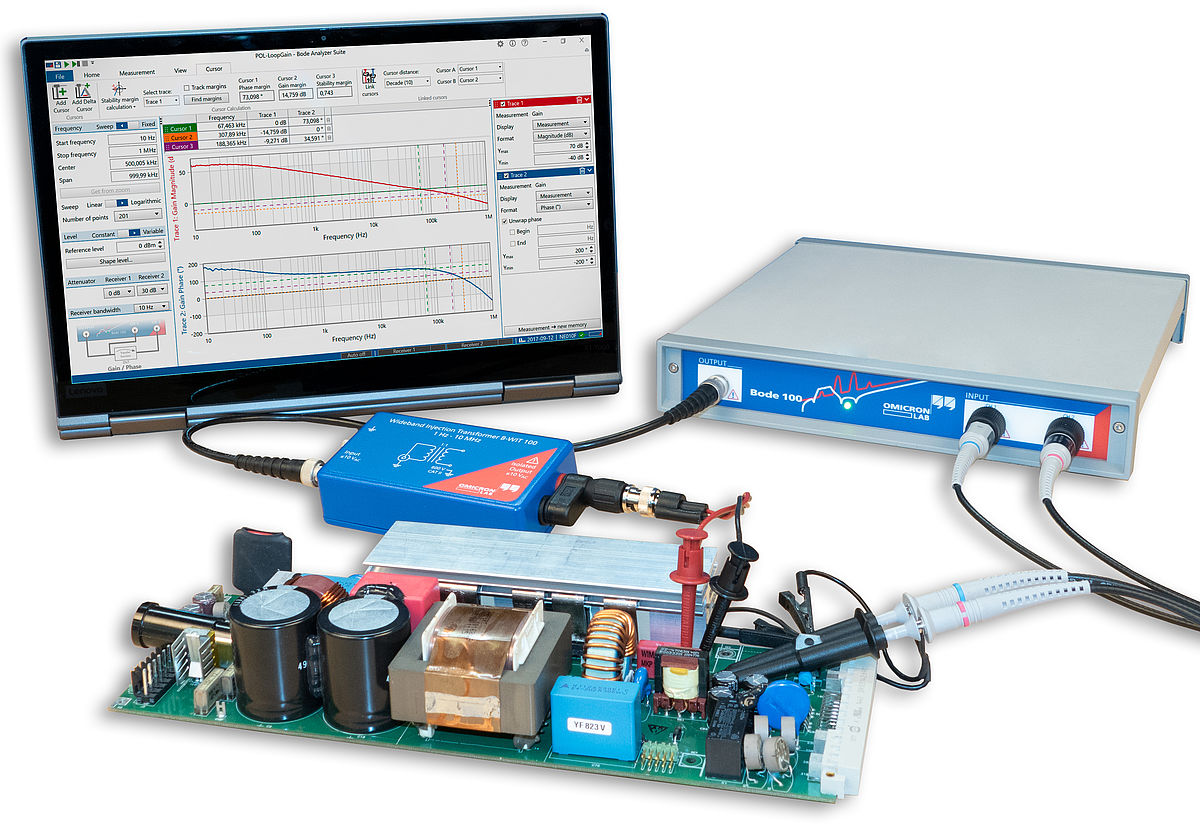
Measuring a transfer function via frequency response analysis is a powerful method for the design of electronic systems such as compensators for switching converters or voltage regulators. The Bode 100 hardware and software are optimized for loop and impedance measurements, stability analysis and much more. Have a look at the following main applications in power electronics to find out how the Bode 100 can support you in your design process:
Loop Gain (Phase Margin & Gain Margin)
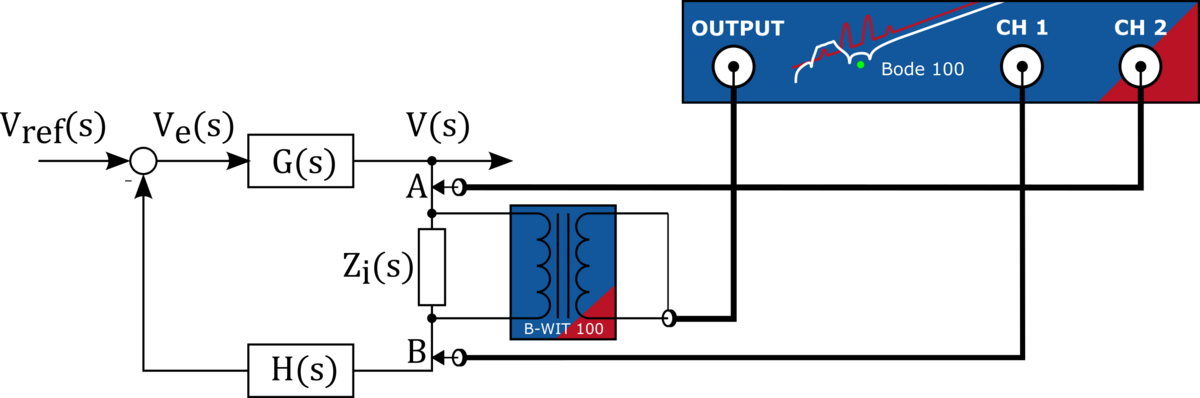
One of the most important steps when characterising or designing the control loop for a power converter. The Bode 100 offers high side-band rejection and a high dynamic range at an unbeatable measurement speed. Perform loop-response measurements within seconds to fully characterise your control loop at various operating points and conditions. Check out how quick and simple stability measurements can be and have a look at our Application Note.
Companion Power Supply Design Software for Bode 100
Working in perfect harmony with Biricha's WDS automated power supply design software, Bode 100 helps to greatly reduce the development time and cost of your power supplies. Use WDS to design stable analog and digitally controlled power supplies in minutes!
The WDS power supply design software from Biricha simplifies power supply design and includes automatic pole-zero placement for optimum compensation. Besides the included topologies such as Buck, Boost, Buck-Boost, Flyback, SEPIC, Full bridge, Half bridge and forward converters, WDS now features the possibility to import a measured plant transfer function from the Bode 100 to design a stable compensator. Check out this webinar from Dr. Ali Shirsavar to learn more about this simple and innovative solution.
Output Impedance (Non-Invasive Stability Measurement)
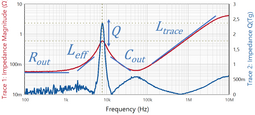
The output impedance plot contains information about the stability of the feedback loop as well as information about the decoupling network. Use the NISM (Non-Invasive Stability Measurement) method to derive the phase margin from a single output impedance measurement. Check out this Application Note to learn how to perform this simple and fast measurement. Check out the Picotest accessories for simplified power integrity measurements.
Input Impedance & Filter Stability
The negative input resistance of a DC/DC converter can lead to oscillations when using an undamped input filter. The Bode 100 provides the possibility to check the input impedance of the converter as well as the impedance spectrum of the filter that could lead to instability problems at resonance. Check out the Application Note on input filter stability to find out more.

Component Impedance Plot
The impedance plot of electronic components provide a deep insight into the AC properties such as capacitor ESR, transformer leakage, AC resistance of windings, self-resonance frequency of inductors and transformers, inductance of shunt-resistors, winding capacitance of transformers etc. Use the Bode 100 to perform fast and accurate impedance measurements from 1 Hz to 50 MHz. Check out our webinar to learn more about the power of the Bode 100 when used as an impedance analyzer.
Power Supply Rejection Ratio (PSRR)
The power supply rejection ratio, also known as power supply ripple rejection, provides information on how well line-disturbances are rejected at the output. This information is especially useful for low-noise supplies and linear regulators. Check out this Application Note to learn how to perform a PSRR measurement.
| General Information | |
|---|---|
Part Number (SKU) |
P0005755
|
Manufacturer |
|
| Physical and Mechanical | |
Weight |
2.0 kg
|
| Other | |
EAN |
5055383623648
|
Questions and Answers
-
What Is the Frequency Range of the Bode-100?
The Bode-100 has a frequency range of 1Hz to 50MHz.
-
What Is the Maximum Measurement Speed of the Bode-100?
Measurement time depends on the receiver bandwidth (RBW). OMICRON Lab gives a theoretical time per point of 1.7 ms at 5 kHz RBW, rising to 2.8 s at 1 Hz RBW.
-
Is the Bode-100 Compatible with Any Software?
The Bode 100 works with OMICRON Lab's Bode-Analyzer software for data analysis and visualisation.
-
What Is the Warranty for the Bode-100?
The Bode-100 comes with a 2-year warranty.
-
What Types of Measurements Can the Bode-100 Perform?
The Bode 100 measures complex gain, complex impedance and admittance, swept S-parameters and group delay from 1 Hz to 50 MHz. Typical uses include:
- control loop stability (gain and phase margin) of DC/DC converters
- input and output impedance
- power-plane impedance for decoupling
- parasitics of components and circuit boards
- reflection and return loss of filters, antennas and amplifiers
- resonance and Q-factor of crystals, RFID and NFC antennas
-
What Is the Omicron-Lab Bode-100?
The OMICRON Lab Bode 100 is a vector network analyser (VNA) for small-signal stability and frequency-domain analysis of electronic circuits.
-
How Does the Bode-100 Handle EMC Filter and Component Characterisation?
The Bode 100 measures both common-mode and differential-mode insertion loss of EMC filters.
With the B-WIC and B-SMC impedance adapters, it can characterise individual filter components, including common-mode chokes and X and Y capacitors, as well as complete filter assemblies. You can use the data to create SPICE models for filter simulation and optimisation. It also detects parasitics and resonances, which helps with EMC compliance and filter design validation.
-
What Calibration Procedures Does the Bode-100 Require, and How Accurate Are the Results?
The Bode 100 supports full-range calibration using open/short/load standards, and user-range calibration for specific frequency spans.
After calibration it achieves gain accuracy of <0.1 dB and phase accuracy of <0.5° in the user-calibrated range. Calibration is automated in the Bode Analyzer Suite software, and calibration standards (including a 50 Ω load and a short circuit) are included. For best accuracy, calibrate regularly, especially when you change the measurement configuration.
-
How Does the Bode-100 Compare to Low-cost VNA Alternatives Like the NanoVNA?
The NanoVNA offers basic VNA functions at very low cost. The Bode 100 gives better dynamic range, accuracy and frequency stability, with a 1 Hz starting frequency, >100 dB dynamic range and a professional software suite.
It also comes with technical support, calibration services and application expertise, and suits critical measurements that need repeatable, traceable results.
-
What Software and Connectivity Options Are Available with the Bode-100?
The Bode 100 includes the Bode Analyzer Suite software for measurement control, data analysis and documentation. Features include:
- Smith chart displays
- polar plots
- memory curves
- mathematical functions
- SPICE model generation
It connects by USB, with full remote control. Data exports to standard formats for MATLAB, Excel and other analysis tools. Regular software updates keep it compatible with current operating systems and add new measurement capabilities.
-
What Unique Competitive Advantages Does the Bode-100 Offer Over More Expensive VNA Solutions?
The Bode 100's main advantages are:
- measurement from 1 Hz, which traditional VNAs can't do
- silent, fanless operation
- compact, portable design
- strong price-performance
Expensive VNAs are better at high frequencies, but the Bode 100 leads at the low frequencies used in power electronics and EMC work. It also replaces a separate FRA and impedance analyser, saving cost. It's the best choice for engineers who don't need frequencies above 50 MHz.
-
What Makes the Omicron-Lab Bode-100 VNA Unique Compared to Traditional Vector Network Analysers?
The Bode 100 measures from 1 Hz, while most traditional VNAs start at much higher frequencies. This makes it well suited to power supply analysis, DC/DC converter stability testing and EMC filter characterisation.
Unlike conventional VNAs focused on RF, it combines a frequency response analyser and a vector network analyser in one compact instrument. You don't need separate instruments, which saves cost and lab space.
-
How Does the Bode-100's Performance Compare to High-end VNAs From Manufacturers Like Keysight and Rohde & Schwarz?
High-end VNAs from Keysight and Rohde & Schwarz cover much wider frequency ranges, up to millimetre-wave.
The Bode 100 covers 1 Hz to 50 MHz and is aimed at power supply, impedance and EMC work in that range. If you don't need frequencies above 50 MHz, it is the better fit.
-
What Specific Applications Is the Bode-100 VNA Particularly Well-suited For?
The Bode 100 is well suited to:
- power supply stability analysis (loop gain measurements)
- DC/DC converter characterisation
- EMC filter insertion loss testing
- component parasitics analysis
- PSRR measurements
- RFID and NFC antenna tuning
- transformer and inductor analysis
- power delivery network (PDN) impedance characterisation
Its low-frequency capability suits power electronics engineers, and its impedance analysis features suit component manufacturers and EMC compliance testing.
-
Can the Bode-100 VNA Perform Automated Measurements and Integrate with Existing Test Systems?
Yes. The Bode 100 can be automated through its .NET-based Bode Automation Interface and a SCPI-compatible command set, so you can integrate it into automated test equipment (ATE) and custom measurement applications. The interface gives programmatic control of all measurement functions, calibration and data acquisition, for production testing and research that needs repeated measurements.
-
What Advantages Does the Bode-100 Offer for Power Supply Engineers Specifically?
The Bode 100 measures stability by voltage injection across a small injection resistor in the loop. It can measure these on switching power supplies without disrupting normal operation:
- loop gain
- output impedance
- PSRR
- input impedance
Narrow-band receivers and high dynamic range give accurate measurements on noisy switching converters, and its speed lets you characterise across multiple operating points.


No questions match your search.