
RS-485 and RS-422 (TIA-485-A)
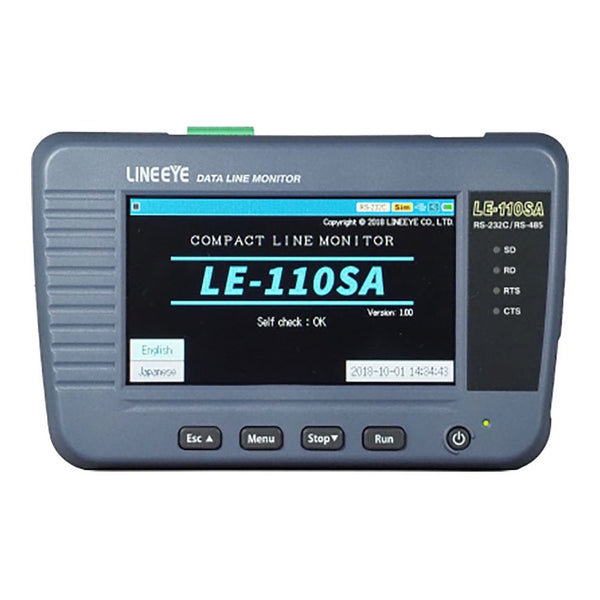
RS-485 (TIA-485-A) is a differential, multi-drop electrical standard: up to 32 standard unit loads share one twisted pair, at up to 10 Mbit/s over short runs or around 100 kbit/s over 1200 m. It defines only the electrical layer, so it carries UART frames for protocols such as Modbus RTU, PROFIBUS DP, BACnet MS/TP and DMX512 in factories, buildings and stage lighting. To monitor a bus, use a line monitor such as the Lineeye LE-110SA or a multi-protocol analyser such as the LE-3500XR(V2), which also decodes Modbus.
How an RS-485 Bus Is Wired
All nodes connect along one twisted pair, labelled A and B (or D+ and D−). This page follows most transceiver datasheets, where A is the non-inverting line and sits more positive than B at idle; the TIA-485-A standard and the Modbus specification name the lines the other way round, and equipment makers use both, so always check the idle polarity. The cable runs from node to node as a line, never a star, with a 120 Ω terminator at each end. Because only one driver may be enabled at a time, there are moments when nothing drives the line; fail-safe bias resistors, usually at the controller, hold it in the idle state so receivers do not read noise as data. A ground or common reference wire keeps every node within the common-mode range of −7 V to +12 V.
In two-wire mode every node transmits and receives on the same pair, so each must turn its driver off as soon as it has finished sending. Four-wire mode uses one pair for each direction and is often used point to point, where it is electrically compatible with RS-422. RS-422 allows one driver and up to 10 receivers; RS-485 allows many drivers on one bus.
How RS-485 Signals Work
A driver puts at least 1.5 V of differential signal onto a terminated bus. Noise picked up along the cable appears on both wires equally and cancels at the receiver, which is why RS-485 works over long cables in electrically noisy plant rooms. The frames themselves are ordinary UART characters; see the UART page for the format.
| RS-232 | RS-422 | RS-485 | |
|---|---|---|---|
| Signalling | Single-ended | Differential | Differential |
| Nodes | 1 driver, 1 receiver | 1 driver, up to 10 receivers | Up to 32 unit loads, many drivers |
| Typical distance | About 15 m | Up to 1200 m | Up to 1200 m |
| Duplex | Full | Full (two pairs) | Half on one pair, full on two |
Where RS-485 Is Used
- Industrial automation: Modbus RTU between PLCs, drives, meters and remote I/O, and PROFIBUS DP.
- Building services: BACnet MS/TP for HVAC controllers.
- Stage lighting: DMX512 uses RS-485 signalling to control dimmers and fixtures.
Common RS-485 Faults and How to Find Them
| Symptom | Likely Cause | What to Check |
|---|---|---|
| No response from any device | A and B swapped at the controller, since labelling varies between manufacturers (a swap at a single device stops only that device responding) | Swap A and B at the controller (or at the one device that stays silent); check the idle polarity with a meter or monitor |
| Random characters between messages | No fail-safe bias, so the idle line floats | Measure A to B with all drivers off: it should be well over +200 mV |
| Errors that rise with cable length or bit rate | Missing termination, or terminators part-way along the line | With power off, measure A to B: about 60 Ω with both terminators fitted |
| First bytes of a reply are lost | Controller still driving the bus when the device answers | Measure the turnaround time between the last request byte and the first reply byte |
| Intermittent errors at some nodes | Ground differences beyond the common-mode range | Run a common reference wire; consider isolated transceivers |
Tools for Analysing and Decoding RS-485
Watch tools tap the bus and record the traffic with timestamps, which is how you see request and reply timing on a Modbus network. Drive tools can also send, to poll a device when the real controller is absent.
Handheld Line Monitor
| Product | Role | Capability | Price ex VAT |
|---|---|---|---|
| Lineeye LE-110SA Line Monitor | Watch Drive | Handheld with 4.3 inch touch screen for RS-232C, RS-422 and RS-485, asynchronous only; presets to 460.8 kbit/s, 921.6 kbit/s with firmware 1.05 or later; triggers, search and simulation | €781,95 |
PC-Connected and Multi-Protocol Analysers
| Product | Role | Capability | Price ex VAT |
|---|---|---|---|
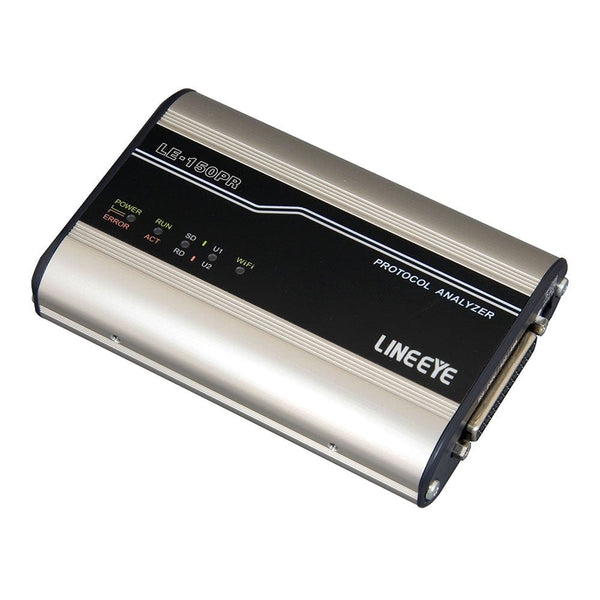
| Lineeye LE-150PF Protocol Analyser | Watch Drive | PC-connected over USB (Wi-Fi where enabled for the country of shipment), or logs to SD card on its own; RS-232C, RS-422 and RS-485, asynchronous; waveform view of the lines | €756,95 |
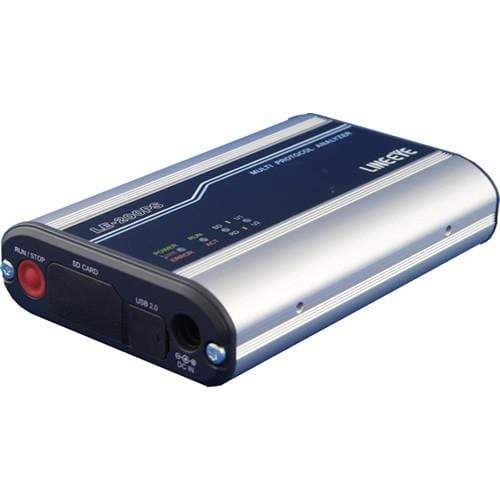
| Lineeye LE-200PF Protocol Analyser | Watch Drive | As the LE-150PF, adding synchronous protocols (SYNC, BSC, HDLC, SDLC) up to 1.544 Mbit/s | €1.276,95 |
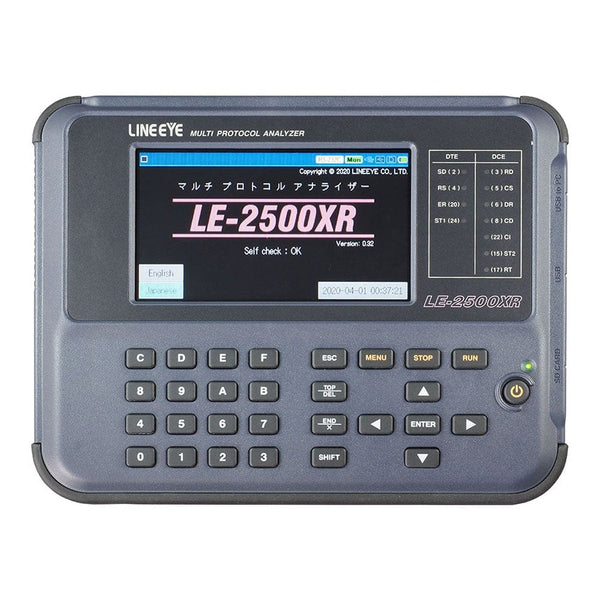
| Lineeye LE-2500XR(V2) Multi-Protocol Analyser | Watch Drive | Stand-alone analyser for RS-232C, RS-422/485 and TTL (UART, I2C, SPI) to 1 Mbit/s (1.544 Mbit/s half duplex); 100 MB capture memory; simulation and bit error rate testing | €1.463,95 |
| Lineeye LE-3500XR(V2) Multi-Protocol Analyser | Watch Drive | Same interfaces and capture memory, faster (to 3.15 Mbit/s half duplex, 2.048 Mbit/s full duplex), with Modbus ASCII and RTU decoding; both models take optional boards for CAN FD, LIN, current loop and RS-530, V.35 and X.21 | €2.089,95 |
Converters
- Lineeye SI-65FA-L LAN to RS-422/485 Interface Converter (€394,95): puts an RS-422 or RS-485 device on an Ethernet network.
Browse every tool in our protocol decoders collection, or tell us the protocol and bit rate on your bus and we will recommend one.
Frequently Asked Questions
What Is the Difference Between RS-485 and RS-422?
Both are differential. RS-422 allows one driver and up to 10 receivers on a pair. RS-485 allows many drivers to share the same bus, taking turns, which makes multi-drop networks such as Modbus RTU possible.
Is RS-485 the Same as Modbus?
No. RS-485 is the electrical layer. Modbus RTU is a protocol that runs over it, defining addresses, function codes and a CRC. Other protocols, such as BACnet MS/TP and DMX512, use RS-485 too.
Do I Need a Ground Wire on RS-485?
The signal is differential, but the receivers still need the voltage on each wire to stay within about −7 V to +12 V of their own ground. A common reference wire keeps it there; without one, ground differences cause errors or damage.
Where Do the Terminating Resistors Go?
One 120 Ω resistor at each physical end of the cable, and nowhere else. Short, slow buses sometimes work without them, but adding them is the first step when errors appear.
How Many Devices Can Share an RS-485 Bus?
The standard allows 32 unit loads. Many modern transceivers present 1/4 or 1/8 of a unit load, allowing 128 or 256 devices, though the protocol may set a lower limit.
Where to Start with RS-485
More Protocols
By John Legg CEng, Director, Debug Store. Updated 3 November 2026.
