I2S and Digital Audio Interfaces
I2S (Inter-IC Sound) is the standard three-wire serial link for carrying digital audio between chips on a board: a bit clock, a word select that marks left and right channels, and a serial data line. TDM, PCM, PDM and MIPI SoundWire are its relatives for more channels, voice, microphones and laptop audio. To watch any of them you need a logic analyser with the matching audio decoder, which turns the bit stream into sample values per channel.
How I2S Is Wired and Clocked
One device, the clock controller, drives the bit clock (SCK, also called BCLK) and word select (WS, also called LRCLK or frame sync). It may be the processor or the codec, depending on which has the better clock source. Data flows on SD in one direction per line; a codec with both a DAC and an ADC has two data lines sharing one set of clocks. Many converters also need a master clock (MCLK), typically 256 or 512 times the sample rate, to run their internal filters.
| Sample Rate | Bits per Channel | Channels | Bit Clock (SCK) | MCLK at 256 fs |
|---|---|---|---|---|
| 44.1 kHz | 16 | 2 | 1.4112 MHz | 11.2896 MHz |
| 48 kHz | 32 | 2 | 3.072 MHz | 12.288 MHz |
| 96 kHz | 32 | 2 | 6.144 MHz | 24.576 MHz |
| 48 kHz | 32 | 8 (TDM) | 12.288 MHz | 12.288 MHz |
Bit clock = sample rate × bits per channel × channels. When the slot is wider than the sample, for example 24-bit audio in 32-bit slots, the extra bits are padded and the format decides where the sample sits in the slot.
How an I2S Frame Works
| Format | Where the MSB Sits | Notes |
|---|---|---|
| I2S (Philips) | One bit clock after WS changes | WS low means left channel |
| Left-justified | On the same clock edge as the WS change | WS high usually means left: check the datasheet |
| Right-justified | LSB lands on the last bit before WS changes | Needs the sample width set correctly on both ends |
| DSP or PCM mode | After a short frame sync pulse | Used for mono or TDM; short-frame and long-frame variants |
The formats look almost the same on an oscilloscope, differing only by a one-bit offset and the WS polarity, so a format mismatch is an easy mistake to make: audio plays, but loud, distorted or with channels swapped.
TDM, PCM, PDM and SoundWire
- TDM (time-division multiplexing): one frame sync pulse per sample period and 4, 8 or 16 slots on one data line, for multi-channel codecs, microphone arrays and automotive amplifiers. Slot width, slot count and frame sync position vary by device.
- PCM: in telephony and Bluetooth modules, a short or long frame sync and one or two 8 or 16-bit voice channels at 8 or 16 kHz.
- PDM (pulse-density modulation): digital MEMS microphones output a 1-bit stream, typically at about 1 to 3.3 MHz in normal mode, with low-power modes from about 0.4 MHz and some parts running up to 4.8 MHz. Two microphones share one data line, one driving on the rising clock edge and one on the falling edge. The processor filters and decimates the stream to PCM; a decoder can show the density as a waveform.
- MIPI SoundWire: a two-wire multi-drop bus (clock and one or more data lanes) for audio and control in laptops and phones. Data moves on both clock edges with a frame structure that interleaves control and audio channels, so it needs its own decoder.
- Intel HD Audio: the PC codec link with a 24 MHz bit clock, SYNC, SDO, SDI and reset. Older PCs used AC'97 on similar pins.
Where Digital Audio Interfaces Are Used
- Codecs and amplifiers: processor to DAC, ADC or class-D amplifier on almost every embedded audio product.
- Voice products: smart speakers and headsets with PDM or TDM microphone arrays feeding a DSP.
- Automotive: TDM between head units, DSPs and amplifiers.
- Bluetooth and cellular modules: PCM voice to the host processor.
- Laptops: HD Audio or SoundWire to the codec and speaker amplifiers.
Common Digital Audio Faults and How to Find Them
| Symptom | Likely Cause | What to Check |
|---|---|---|
| Loud, harsh distortion | Format mismatch (I2S versus left-justified) shifts every sample by one bit | Capture WS, SCK and SD and compare where the MSB starts with each datasheet |
| Left and right swapped | WS polarity differs between devices | Play a left-only test tone and decode which slot it lands in |
| Clicks every few seconds | Two clock domains drifting, so samples are dropped or repeated | Check whether codec and processor share MCLK; measure SCK against the expected rate |
| Silence from one TDM channel | Slot offset or slot count set differently on each device | Decode the TDM frame and count slots from the frame sync |
| Only one PDM microphone works | Both microphones set to the same clock edge by their select pins | Look at the data line on both clock edges |
| Noise or pops on start-up | Clocks started after the codec was unmuted | Capture power-up: MCLK and SCK should be stable before audio starts |
Tools for Analysing and Decoding Digital Audio
Watch tools capture the clocks and data and decode them into sample values per channel, so you can see a test tone, a swapped channel or a stuck bit. Sample at least four times the bit clock, so 12.5 MS/s or more for 48 kHz stereo and 50 MS/s or more for TDM.
| Product | Role | Capability | Price ex VAT |
|---|---|---|---|
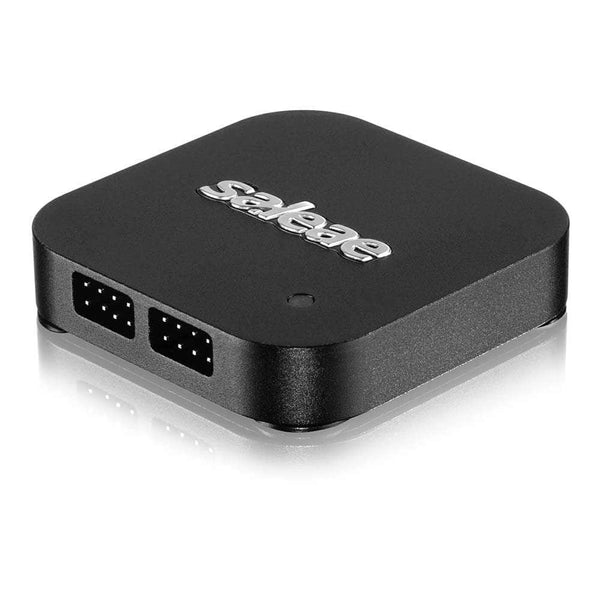
| Saleae Logic 8 | Watch | 8 channels, digital and analogue; I2S/PCM decoder in the Logic 2 software, with export of decoded samples | €506,95 |
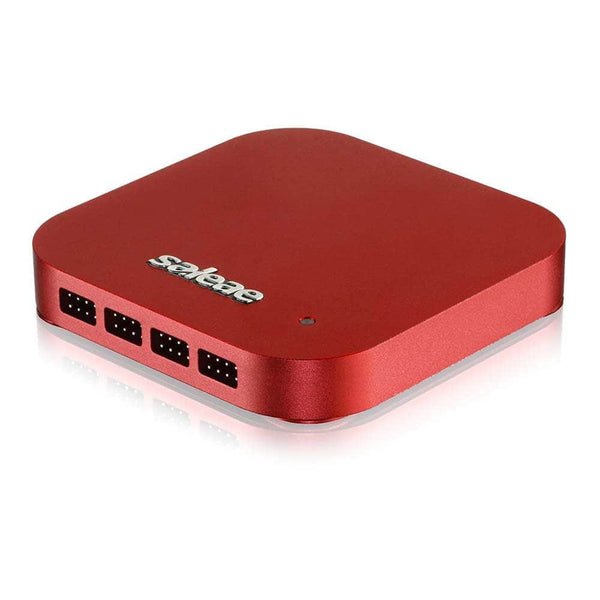
| Saleae Logic Pro 16 | Watch | 16 channels at up to 500 MS/s for several data lines at once; the built-in I2S/PCM decoder handles two channels per instance, so TDM needs several instances or a community TDM extension | €1.557,95 |
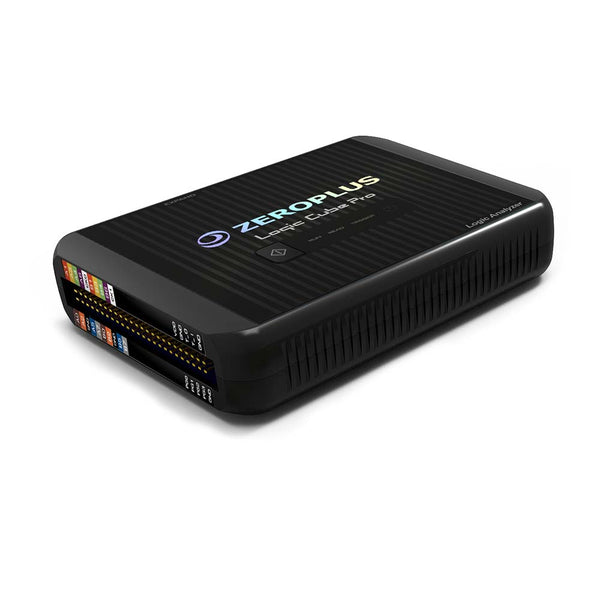
| ZeroPlus LAP-C Pro Series | Watch | Logic analyser; ZeroPlus lists I2S, PCM, HD Audio, S/PDIF, AC97 and SoundWire decoders (ask us to confirm which suit your LAP-C Pro model and bit clock rate) | €1.157,95 |
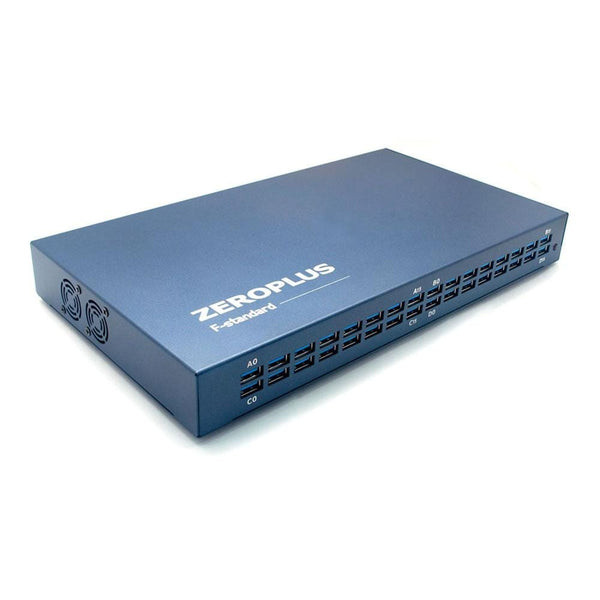
| ZeroPlus LAP-F 40/64-Channel | Watch | 40 or 64 channels for wide TDM and multi-codec captures, with I2S hardware triggering; ask us to confirm audio decoder availability | €1.689,95 |
| Acute TravelLogic 34-Channel | Watch | Logic analyser running Acute's decoder library, which includes I2S, PCM and HD Audio; PDM, TDM and SoundWire decoders are supplied on request from Acute | €1.453,95 |
To check the codec's control interface, usually I2C or SPI, see our I2C and SPI guides. Browse our logic analysers, or tell us your format, sample rate and channel count and we will recommend one.
Frequently Asked Questions
Is I2S the Same as I2C?
No. The names are similar because both came from Philips, but I2C is a two-wire control bus with addresses, and I2S is a clocked stream of audio samples with no addresses or acknowledges. Most audio codecs use both: I2C or SPI to configure them, I2S to carry the audio.
What Is the Difference Between I2S and TDM?
I2S carries two channels, left and right, marked by the level of word select. TDM carries more channels in one frame, marked by a short frame sync pulse, with each channel in a fixed slot. Many codecs support both, selected by a register.
Do I Need MCLK?
Only if one of your devices asks for it. Many DACs and ADCs need a master clock at 256 or 512 times the sample rate for their filters; others generate it internally from the bit clock with a PLL. Check the codec datasheet.
How Do I Capture PDM Microphone Data?
Capture the clock and data at four or more times the PDM clock rate. A PDM decoder converts the 1-bit stream into a waveform by filtering, so you can confirm the microphone responds to sound. Remember that two microphones may share the line on opposite clock edges.
What Sample Rate Do I Need on My Logic Analyser?
At least four times the bit clock. For 48 kHz stereo with 32-bit slots, the bit clock is 3.072 MHz, so 12.5 MS/s or more. For an 8-channel TDM bus at 12.288 MHz, use 50 MS/s or more.
Where to Start with I2S, TDM, PDM and SoundWire
More Protocols
By John Legg CEng, Director, Debug Store. Updated 12 November 2026.
