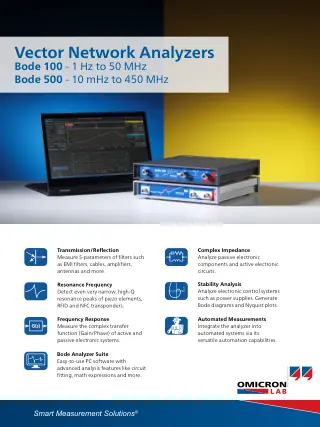
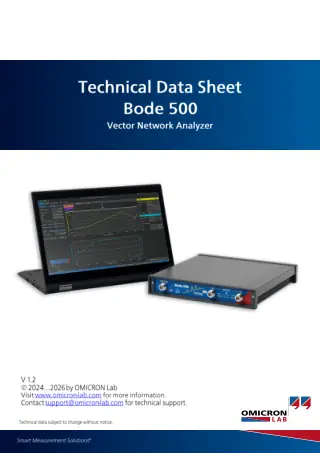
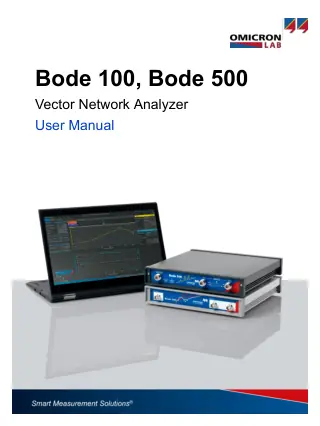
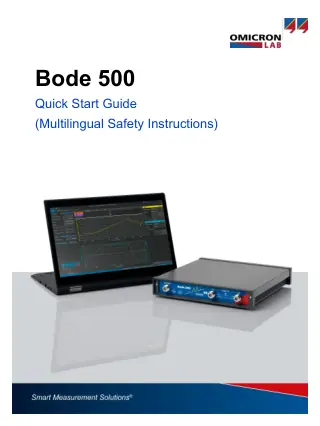
Exploring the Bode 500 Vector Network Analyzer with Dr Ali Shirsavar
Video notes

Are you ready to elevate your testing capabilities to the next level? Look no further than the Bode 500, the latest innovation from OMICRON Lab. With its remarkable features and unmatched benefits, this powerful analyser is set to transform the way you conduct measurements.
The Bode 500 boasts an ultra-wide frequency range, allowing for precise measurements from <1 Hz all the way up to 450 MHz. Say goodbye to limitations and hello to accuracy like never before.
Experience high linearity and an exceptional dynamic range of over 120 dB, making vector network analysis, frequency response analysis, and impedance measurements incredibly accurate. Switch between 50 Ω termination and high impedance (1 MΩ with ac-coupling) for versatile measurements on both active systems and external probes.
With a dynamic range of 56 dB on the output and a maximum power level of 16 dBm, the Bode 500 provides ample signal injection power. Perfect for loop gain and output impedance measurements on switching converters and power distribution networks (PDN). It's the ultimate choice for power integrity verifications and loop stability assessments.
The Bode 500 is not only powerful but also incredibly convenient. It's a silent, fanless, portable instrument that can be powered via Ethernet (PoE), USB (USB-PD), or a standard power supply. Its USB-C and Ethernet interfaces ensure seamless connectivity to your network or control computer.
When paired with the Bode Analyzer Suite, the Bode 500 offers the same user-friendly experience as the beloved Bode 100. Plus, it can be controlled directly via SCPI commands, enabling stand-alone, platform-independent automated measurements.
Ready to revolutionize your testing experience? Don't miss out on the opportunity to take your measurements to new heights with the Bode 500. Register your interest today and embrace a new era of precision and efficiency. Your success starts here.

Video notes
Videos are hosted on YouTube and load only when you press play.
The Bode 500 is the most powerful analyzer from OMICRON Lab. Its ultra-wide frequency range enables precise measurements from 10 mHz to 450 MHz, making it the perfect tool for power integrity verifications and loop stability measurements.
The Bode 500 offers high linearity and a high dynamic range of > 120 dB to enable accurate vector network analysis, frequency response analysis, and impedance measurements. The switchable inputs provide 50 Ω termination and a high impedance setting with ac-coupled 1 MΩ for measurements on active systems and the use with external probes.
With 66 dB of dynamic range on the output and a maximum power level of 16 dBm, the analyzer offers enough signal injection power for loop gain and output impedance measurements on switching converters and power distribution networks (PDN).
The Bode 500 is a silent, fanless, portable instrument that can be powered by Ethernet (PoE), USB (USB-PD), or a standard power supply. The analyzer offers a USB-C and an Ethernet interface for connection to the network or the control computer.

The Bode 500 offers a range of key features that make it the perfect tool for power integrity verifications and loop stability measurements:
The Bode 500 is the perfect tool for a range of applications, including:
| Characteristic | Bode 500 |
|---|---|
| Frequency range | 10 mHz to 450 MHz |
| Dynamic range | > 120 dB |
| Signal source | -50 dBm to 16 dBm |
| Connector type | Type N |
| Source impedance | 50 Ω |
| Ordering information | |
|---|---|
| Part number (SKU) | P0009652 |
| Manufacturer | OMICRON-Lab |
| EAN | 5055383699896 |
| Warranty | 12 months |
| Shipping weight | 4.0 kg |
Lets you prove a DC/DC converter or regulator is stable: injection transformer for loop gain, gain margin and phase margin measurements, usable from 1 Hz to 10 MHz.
£545View product
Reaches slow control loops such as PFC stages, usable from 10 mHz to 100 kHz. OMICRON states it takes the Bode 100's full 2 Vrms output at 1 Hz without saturating.
£760View product
Repeatable impedance measurements on leaded (through-hole) resistors, capacitors and inductors from 1 Hz to 50 MHz. Supplied with a B-CAL calibration board.
£650View product
Repeatable impedance measurements on surface-mount components: the SMD counterpart of the B-WIC.
£650View product
Measure directly at test points on the board, for example both sides of the injection resistor in a loop gain measurement. 10:1 passive probe with a 50 MHz passband.
£235View product
Shows how well a regulator rejects noise on its supply input: injects a signal into the supply input so you can measure power supply rejection ratio (PSRR) from 10 Hz to 10 MHz.
£550View product
Protects the analyser, cables and accessories when you take them between labs or to a customer site.
£135View product
Yes, we can arrange a trial or demonstration of the Bode 500. Contact us to arrange it.
The Bode 500 generates SPICE models from impedance measurement data using curve fitting. You can choose a pre-programmed circuit template or the general network synthesis algorithm, which supports up to 20 poles. Options include:
It exports SPICE netlists for SPICE-based simulators, which cuts model development time.
The Bode 500 connects via USB-C and Ethernet. It can be powered by Power over Ethernet (PoE), USB Power Delivery (USB-PD) or a standard 24W power adapter. Ethernet supports network-based control and data sharing. With PoE or USB-PD, many installations don't need a separate power supply.
Yes. The Bode 500 combines vector network analysis, frequency response analysis and impedance measurement in one instrument. The included Bode Analyzer Suite is easy to use and comes with documentation and tutorial material. Students and researchers can use it to demonstrate power electronics, control system stability and component characterisation, and SPICE model generation gives hands-on experience of measurement-based modelling.
OMICRON Lab provides technical support, calibration and repair directly from the manufacturer. Debug Store, as an authorised distributor, offers local UK support and power electronics application expertise.
Bode Analyzer Suite updates are free downloads. Documentation, application notes and video tutorials are available. The instrument complies with international EMC, RoHS and safety standards.
The Bode 500 is compact and fanless and weighs 2.2 kg, so it suits field testing and on-site troubleshooting. With no fan it's silent, which matters in noise-sensitive environments. PoE and USB-PD powering mean you don't need dedicated power infrastructure, and it operates from +5 to +40 °C. You can carry out power integrity verification and component characterisation at customer sites or in production.
The Bode 500 covers 10 mHz to 450 MHz and is optimised for power integrity and switching converter applications.
Unlike conventional RF-focused VNAs, it combines vector network analysis, frequency response analysis and impedance analysis in one instrument. Its low-frequency performance and 120 dB dynamic range give accurate measurements of power distribution networks (PDNs) and ultra-low impedances. It also generates SPICE models using advanced curve fitting algorithms.
Keysight and Rohde & Schwarz VNAs excel at high frequencies up to several GHz. The Bode 500 specialises in the low- to mid-frequency range used for power integrity verification. It measures from 10 mHz, which suits PDN analysis and switching converter stability measurements that those higher-frequency instruments can't adequately address. It also includes the Bode Analyzer Suite with automated SPICE model generation.
The Bode 500 covers these power integrity tasks:
See also the B-WIT 100 Wideband Injection Transformer.
Yes. The Bode 500 has a standalone SCPI interface over Ethernet or USB-C, so it doesn't need a Windows control computer for automated measurements.
You can program it from any platform using SCPI commands or the SCPI-based LabVIEW driver, and integrate it into existing test systems and automated production.
The Bode 500 offers:
High linearity and a low noise floor allow accurate measurement of impedances from milliohms to megohms. Calibration routines and error correction improve accuracy further.
No questions match your search.