

Oscium
OSCIUM Spectrum Bundle (SPB-2025) - Tri-Band Wi-Fi 6E RF Analysis Toolkit
OSCIUM Spectrum Bundle (SPB-2025) - Tri-Band Wi-Fi 6E RF Analysis Toolkit
SKU: SPB-2025
Couldn't load pickup availability
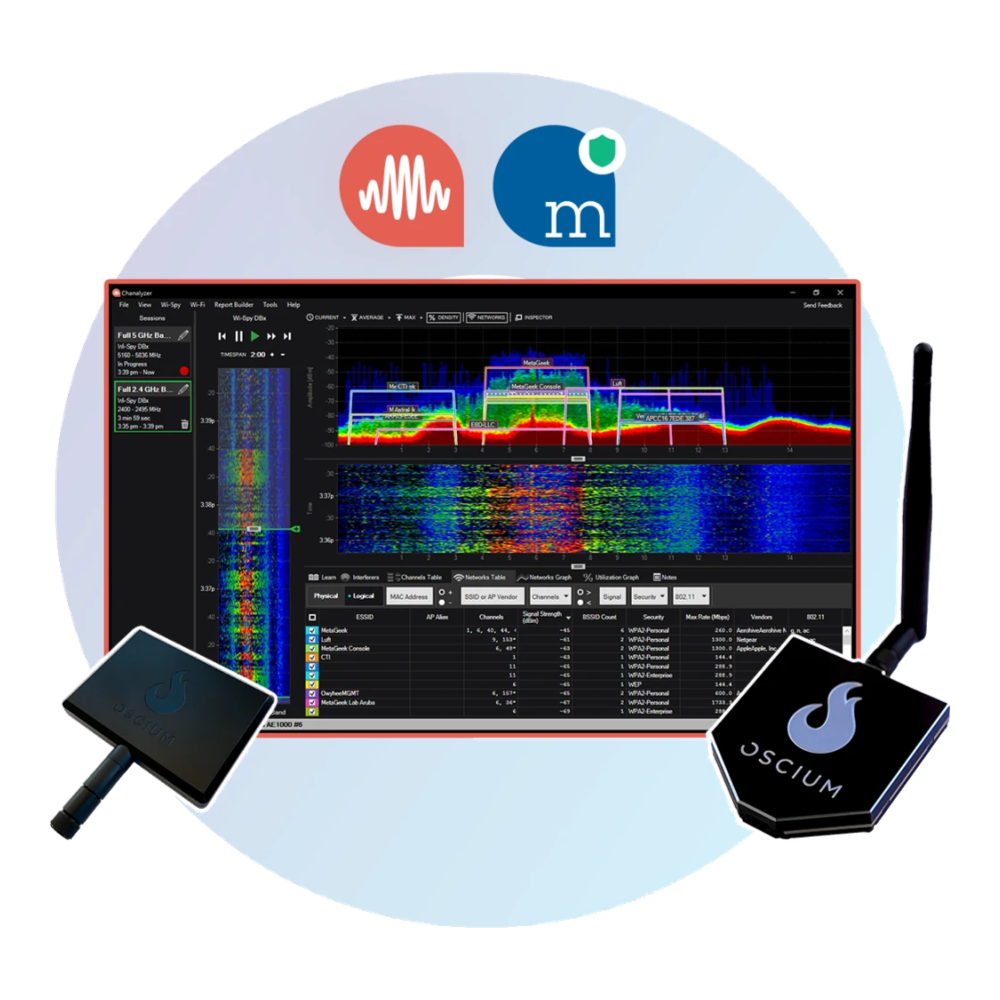
Key Features
Overview
The Oscium Spectrum Bundle (SPB-2025) is a comprehensive RF analysis toolkit designed for engineers tackling modern Wi-Fi 6E and legacy network challenges. Combining the Wi-Spy Lucid tri-band spectrum analyser and Chanalyzer software, this bundle provides real-time visibility across 2.4 GHz, 5 GHz, and 6 GHz bands, including non-Wi-Fi interference detection.
Engineers benefit from the directional Interference Finder Antenna to pinpoint disruptive sources like rogue devices or environmental noise. The Chanalyzer platform integrates AP data with RF metrics, enabling granular analysis of channel saturation, SSID signal strength mapping, and intermittent interference tracking. Report Builder streamlines professional documentation with customisable PDFs for client or internal use.
Unlike competing solutions requiring separate hardware for spectrum analysis and site surveys, the Spectrum Bundle offers an all-in-one workflow. Its compatibility with Wi-Fi 7-ready networks future-proofs deployments while maintaining backward compatibility. For professionals seeking cost-effective alternatives to enterprise-grade systems, this bundle delivers laboratory-grade accuracy in a field-deployable format.
Downloads
Oscium WiPry-Clarity Spectrum Analyzer – The Ultimate Tool for Wireless Professionals
The Oscium WiPry-Clarity Spectrum Analyzer is a must-have tool for wireless professionals who demand the best analysis tools for their work. With advanced hardware and software specifications, the WiPry-Clarity is a state-of-the-art wireless analyzer that can scan, analyze, and troubleshoot wireless networks in real-time.
Hardware Specifications
- Frequency Range: 2.2 GHz – 7.25 GHz
- Frequency Resolution: 25 KHz
- Amplitude Range: -95 dBm to -5 dBm
- Filter Bandwidth: 58 KHz to 812 KHz
- Antenna: Included Tri-Band Omni-directional Antenna
- Antenna Port: RP-SMA
The WiPry-Clarity comes with a hardware frequency range of 2.2 GHz – 7.25 GHz, covering all major wireless frequency bands. This enables you to scan, analyze and troubleshoot a wide range of wireless networks, from Wi-Fi to Bluetooth, cellular, and more.
With a frequency resolution of 25 KHz, the WiPry-Clarity delivers high accuracy and precision. This enables you to detect and identify even the smallest changes in the frequency spectrum, ensuring that you can optimize your wireless networks to perform at their best.
The WiPry-Clarity has an amplitude range of -95 dBm to -5 dBm, allowing you to detect and measure weak signals and interference that may be affecting the performance of your wireless network.
Additionally, the WiPry-Clarity comes with a filter bandwidth of 58 KHz to 812 KHz, enabling you to filter out unwanted noise and focus on the signals you want to monitor.
Software Specifications
- Windows Support: Windows 8 (and newer)
- Mac Support: Mac OSX 10.14 Mojave (Mac support coming soon!)
-
WiPry Application Frequency Ranges:
- 2.400-2.500 GHz
- 5.145-5.860 GHz
- 5.925-7.125 GHz
-
WiPry Application Frequency Resolution:
- 2.4 GHz: 390 KHz
- 5.8 GHz: 1.396 MHz
- 6E: 1.786 MHz
The WiPry-Clarity is compatible with Windows 8 (and newer) and Mac OSX 10.14 Mojave. The WiPry application supports frequency ranges of 2.400-2.500 GHz, 5.145-5.860 GHz, and 5.925-7.125 GHz, with frequency resolution of 2.4 GHz at 390 KHz, 5.8 GHz at 1.396 MHz, and 6E at 1.786 MHz.
| General Information | |
|---|---|
Part Number (SKU) |
SPB-2025
|
Manufacturer |
|
| Physical and Mechanical | |
Weight |
0.2 kg
|
| Other | |
EAN |
5055383603749
|
Questions and Answers
-
What Are the Three Wi-Fi Bands?
The three Wi-Fi bands are 2.4 GHz, 5 GHz and 6 GHz.
-
What Devices Operate Within the Wi-Fi Bands?
Wi-Fi operates in the 2.4 GHz, 5 GHz and 6 GHz bands. Other devices that use these bands include baby monitors, cordless phones, garage door openers and microwave ovens.
-
How Does Wi-Fi Interference Occur?
Wi-Fi interference can occur when multiple electronic devices operate within the same frequency range, causing signal disruptions and lower connectivity speeds.
-
How Can Wi-Spy Lucid Help with Wi-Fi Interference?
Wi-Spy Lucid pinpoints the source of Wi-Fi interference by identifying devices operating in the same frequency range. It then gives you the information to optimise your Wi-Fi network, however complex the environment.
-
Can Devices in Nearby Buildings or Residences Cause Wi-Fi Interference?
Yes, especially in the 2.4 GHz band, where signals can reach the length of a football field. Wi-Spy Lucid lets you pinpoint the source and optimise your Wi-Fi network.
-
What Makes the Directional Interference Finder Antenna Essential for Professional Wi-Fi Troubleshooting Compared to Omnidirectional Antennas?
The directional Interference Finder Antenna has 6 dBi gain, so you can find the direction of an interference source without moving around much.
An omnidirectional antenna shows that interference exists, and finding it means walking around to compare readings. With the directional antenna you rotate and move it to find signal strength peaks, then walk straight to the source. Its tri-band design works across the 2.4, 5 and 6 GHz bands, and it helps with sources in ceiling voids, adjacent buildings or industrial equipment areas.
-
How Does the Spectrum Bundle's Real-time Analysis Capabilities Compare to Traditional Swept-spectrum Approaches for Wi-Fi Troubleshooting?
The Wi-Spy Lucid in the Spectrum Bundle is a swept analyser, not a real-time one. Default sweeps take about 200 ms for 2.4 GHz, 400 ms for 5 GHz and 600 ms for 6 GHz, and you can narrow the range or change the resolution in Chanalyzer to speed it up.
Very brief bursts between sweeps can be missed, but the waterfall display shows interference over time, so periodic sources such as microwave ovens and sporadic digital transmitters still stand out.
-
What Professional Reporting Capabilities Does the Spectrum Bundle Provide for Client Documentation and Compliance Requirements?
The integrated Report Builder creates PDF reports with customisable snapshots, tables and descriptions for clients. You can:
- capture spectrum screenshots and add explanatory text
- include measurement data in formatted tables
- combine automated data collection with manual annotation, for example to show before-and-after optimisation results
- include snapshots of dead spots, channel saturation and rogue APs
PDF export makes reports easy to share with non-technical readers.
-
How Does the MetaCare Support Service Enhance the Value of the Spectrum Bundle for Professional Deployments?
MetaCare gives one year of expert support and software updates for the Spectrum Bundle. That is useful for consultants who need quick answers during client work.
-
Why Does the Spectrum Bundle's Field-Portable Design Matter for Professional Wi-Fi Site Surveys and Troubleshooting?
The Spectrum Bundle is compact, with a USB-C connection, so you can do RF analysis at client sites where problems occur. Laboratory instruments are bench-based and need controlled environments, which makes field use impractical.
Wi-Fi problems are often location-specific, so on-site analysis helps find root causes. The ruggedised carry case protects the kit in the field, and on-site work can allow same-day resolution of complex interference issues that would otherwise need several site visits.
-
What Is the 6 GHz Band and Why Is Ofcom's Approval of It Significant?
Ofcom has opened the lower part of the 6 GHz band (5925-6425 MHz) to licence-exempt use. That lets Wi-Fi 6E expand into new spectrum, giving faster and more reliable wireless connections. Oscium's own pages refer to the US (FCC) approval; the UK allocation is Ofcom's.
-
What Is Wi-Spy Lucid?
Wi-Spy Lucid gives visibility of all three Wi-Fi bands: 2.4 GHz, 5 GHz and 6 GHz (Wi-Fi 6/6E). It lets you pinpoint sources of interference and optimise wireless performance, however complex the environment.
-
What Makes the Oscium Spectrum Bundle Suited to Professional RF Troubleshooting?
The Oscium Spectrum Bundle covers the 2.4, 5 and 6 GHz bands with Wi-Fi 7 support. Unlike basic Wi-Fi tools that only show access point information, it identifies non-Wi-Fi interference such as microwave ovens, baby monitors and industrial equipment.
The included Wi-Spy Lucid sweeps 2.5x faster than the previous Wi-Spy generation, making it easier to catch intermittent interference. The directional antenna lets you triangulate sources, and Chanalyzer's reporting helps you isolate, document and resolve complex RF issues.
-
How Does the Oscium Spectrum Bundle's Tri-Band Analysis Compare to Generic Spectrum Analysers?
Generic bench spectrum analysers offer wider frequency ranges and deeper analysis, but the Spectrum Bundle is built for Wi-Fi. The Wi-Spy Lucid covers 2.2-7.25 GHz, which takes in all Wi-Fi bands including 6 GHz, with 25 kHz frequency resolution.
Chanalyzer adds access point correlation, and the directional antenna helps you hunt interference sources.
-
Can the Oscium Spectrum Bundle Detect and Locate Intermittent Wi-Fi Interference That Appears Randomly Throughout the Day?
Yes. Chanalyzer can record spectrum data continuously and play it back, so you capture sporadic interference events. The Wi-Spy Lucid sweeps continuously, and recording lets you review transient signals over time. The waterfall display shows interference patterns over time.
Once you've found the problem, the directional Interference Finder Antenna helps you locate the source.
-
What Specific Advantages Does the Wi-Fi 6E and 7 Support in the Spectrum Bundle Provide for Modern Network Deployments?
Wi-Fi 6E and 7 support gives you visibility of the 6 GHz band (5925 to 7125 MHz) alongside 2.4 GHz and 5 GHz. In the UK and Europe only the lower part (to 6425 MHz) is currently allocated to licence-exempt Wi-Fi. The 2.4 GHz band, by comparison, has just 3 non-overlapping channels.
The 6 GHz band carries no legacy Wi-Fi devices, which helps high-density deployments. The bundle monitors all three bands, so you can optimise mixed-generation networks.
-
How Does the Chanalyzer Software's AP Data Correlation Enhance Spectrum Analysis Beyond Traditional RF Monitoring Tools?
Chanalyzer combines raw RF spectrum data with Wi-Fi access point information, which pure spectrum analysers can't provide. It shows:
- which SSIDs are causing channel congestion
- rogue access points
- signal strength variations mapped to particular devices
By overlaying access point data on spectrum data, you can tell legitimate Wi-Fi traffic from interference and see which access points are affected. Traditional spectrum tools show only RF energy.


No questions match your search.