
Lipowsky Industrie Elektronik GmbH
Lipowsky Baby-LIN-3-RCplus - Advanced LIN & CAN Bus Simulator
Lipowsky Baby-LIN-3-RCplus - Advanced LIN & CAN Bus Simulator
SKU: 8001058
Couldn't load pickup availability
Key Features
Overview
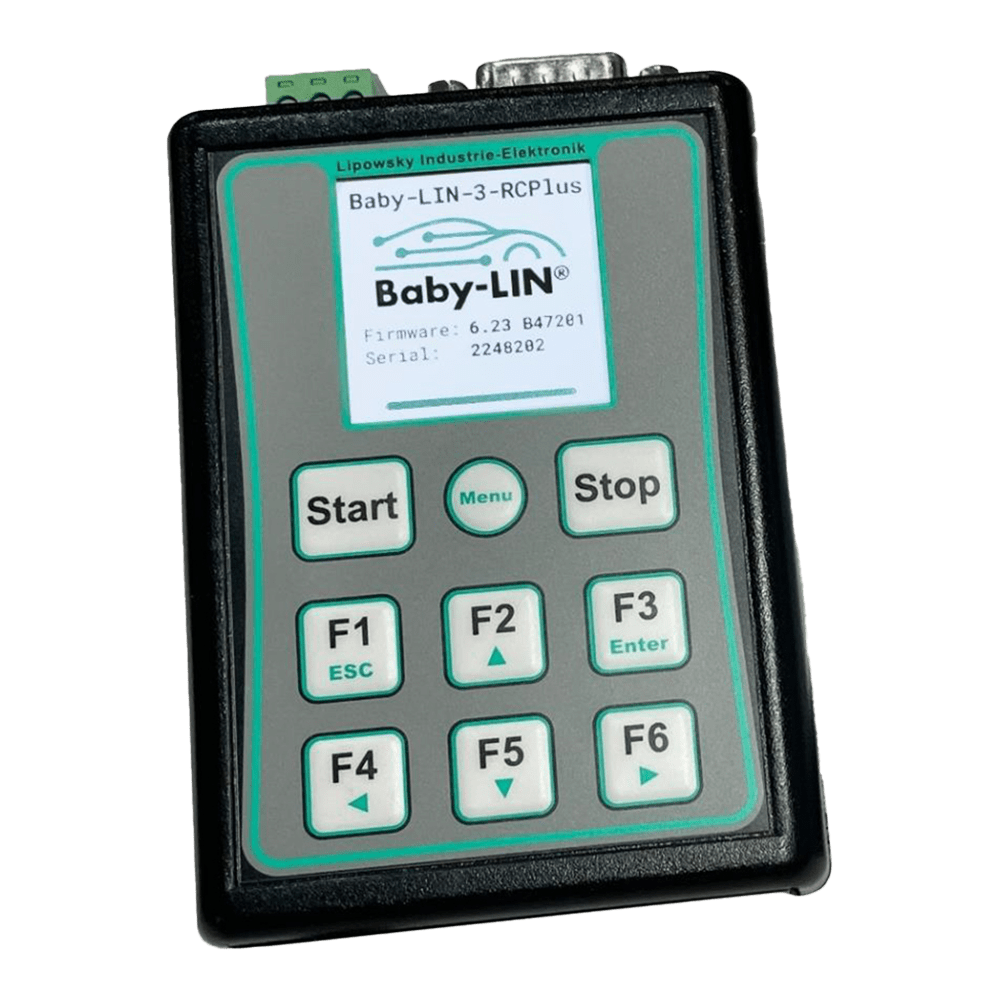
The Lipowsky Baby-LIN-3-RCplus represents the pinnacle of compact bus simulation technology, engineered specifically for professional electronic design engineers requiring advanced LIN and CAN bus testing capabilities. This third-generation simulator combines the proven reliability of Lipowsky's Baby-LIN platform with enhanced standalone functionality through its integrated 1.54" IPS colour display and nine configurable membrane keys.
Enhanced Standalone Operation
Unlike traditional bus simulators that require constant PC connectivity, the Baby-LIN-3-RCplus excels in autonomous operation. The device's intelligent interface allows engineers to configure complex test sequences and monitor bus communications directly through its responsive colour display, making it ideal for field testing, production environments, and extended durability assessments where PC access is limited or impractical.
Professional Bus Simulation Capabilities
Supporting comprehensive LIN protocol versions from 1.2 through 2.2, plus CAN High-Speed (ISO 11898-2) with optional CAN-FD expansion, this simulator handles the full spectrum of automotive and industrial bus communications. The device's ARM Cortex-M7 processor operating at 480MHz delivers 60% improved performance over previous generations, ensuring precise timing and reliable frame processing even under demanding test conditions.
Advanced I/O and Storage Features
Two PWM-capable digital I/O pins provide exceptional flexibility for testing discrete elements such as lamps, actuators, and sensors. The integrated microSD card slot supports data logging functions and SDF storage, whilst the real-time clock with backup battery maintains accurate timestamps for comprehensive test documentation. For engineers working with related products, consider the Baby-LIN-3-MB for enhanced PLC integration or the Baby-LIN-3-RC for LIN-only applications.
Downloads
Why Engineers Choose the Lipowsky Baby-LIN-3-RCplus - Advanced LIN & CAN Bus Simulator
Autonomous Testing Capabilities
Advanced Display Interface
Professional Protocol Coverage
Advanced LIN and CAN Bus Simulation with Standalone Capability
The Baby-LIN-3-RCplus represents Lipowsky's third-generation bus simulation technology, combining powerful LIN and CAN bus simulation in a compact, standalone-capable device. Built around a high-performance 480MHz ARM Cortex-M7 processor with 32MB RAM, this simulator delivers professional-grade bus testing and simulation capabilities with enhanced user interaction through its integrated colour display and 9-key membrane keypad.
Standalone Operation with Configurable Interface
Unlike basic USB interfaces that require constant PC connection, the Baby-LIN-3-RCplus operates independently once configured. The 1.54" IPS colour display (240×240 pixels) provides real-time signal monitoring and system status feedback, whilst the 9-key membrane keypad allows direct control of simulation sequences. Button functions and display content are fully configurable through SDF (Signal Definition Files) and can be modified during runtime, enabling complex user interfaces and dynamic value displays.
Comprehensive Bus Protocol Support
The simulator supports all LIN bus versions from 1.2 through 2.2, handling baud rates up to 115,200 (supporting protocols outside LIN specification). The integrated CAN-High-Speed interface (ISO 11898-2) provides standard CAN functionality with optional CAN-FD expansion available through activation voucher. Both interfaces feature galvanic isolation from the USB connection, ensuring interference-free data transmission and protecting connected equipment.
| Bus Type | Versions Supported | Baud Rate | Features |
|---|---|---|---|
| LIN | 1.2, 1.3, 2.0, 2.1, 2.2 | Up to 115,200 | Master/Slave simulation, DTL support |
| CAN-HS | ISO 11898-2 | Standard CAN speeds | Optional CAN-FD expansion |
Wiring Quick-Start
The Baby-LIN-3-RCplus provides flexible connectivity through dual connector options for both power and communication:
LIN Bus Connections
- 3-pin screw terminal (MC 1,5/3-ST-3,81): Pin 1 - LIN signal, Pin 2 - Ground, Pin 3 - Supply voltage (8-26V)
- SUB-D9 connector: Pin 7 - LIN signal, Pin 2 & 9 - Ground, Pin 9 - Supply voltage
PWM I/O Capabilities
Two PWM-capable inputs/outputs expand simulation possibilities beyond basic bus communication. These can generate output signals with configurable duty cycles (0-100%) or monitor PWM input signals, enabling comprehensive ECU testing scenarios including actuator control and sensor simulation.
// Example SDF macro for PWM output control on key F1: @@SYSPWMOUT1 = 50; // 50% duty cycle on PWM output 1 Display("Motor Speed: 50%"); end; MicroSD Storage and Data Logging
The optional microSD card slot (SDHC cards up to 32GB) enables extensive data logging capabilities and SDF file storage. This allows the device to operate completely independently from a PC for extended periods, ideal for endurance testing, production line applications, and field deployment scenarios.
Software Integration
Included LINWorks software suite provides comprehensive development and configuration tools. The software supports Windows 10/11 (32/64-bit) and offers programming interfaces for C/C++, .NET languages, Python, VB6, and LabVIEW. Linux support (x86 & x64, ARM32 & ARM64) ensures compatibility across development environments.
| General Information | |
|---|---|
Part Number (SKU) |
8001058
|
Manufacturer |
|
| Physical and Mechanical | |
Weight |
0.5 kg
|
| Other | |
EAN |
5055383600267
|
Questions and Answers
-
Can I Expand the Device to Support CAN-FD?
Yes. The integrated CAN High-Speed interface can be upgraded to CAN-FD with a paid activation option. It's software-activated, with no hardware modification.
-
What File Formats Does the Device Support for Configuration?
The device uses SDF (Session Description Files) created in LINWorks. It can import LDF (LIN Description Files) and DBC (Database CAN) files to generate SDF configurations. The microSD slot (FAT-16/32, up to 32 GB) stores SDFs; logging to the card needs the paid microSD activation option.
-
How Many Simultaneous Bus Connections Can the Device Handle?
The Baby-LIN-3-RCplus has one LIN interface and one CAN interface as standard, which can run simultaneously. A second LIN channel can be enabled with the paid Option BL-LIN-2. The Baby-LIN-3-Dual also has one LIN and one CAN interface; for more LIN channels, see the Baby-LIN-3-MB.
-
What Makes This Device Suitable for Production Testing?
The Baby-LIN-3-RCplus suits production testing because:
- Galvanic isolation protects equipment from electrical interference
- Stand-alone operation removes the need for a PC
- Operators run test sequences with simple button presses on the configurable interface
- Data logging captures results for quality assurance
-
Is the Device Compatible with Other Manufacturer's Bus Analysis Tools?
Yes, partly. It's optimised for LINWorks but can be integrated into other test environments through its DLL-based API. The standard SUB-D9 connector fits many existing test setups and can work alongside other bus analysis tools.
-
Is the USB Interface Isolated From the Bus Communications?
Yes. All communication interfaces, including USB, are galvanically isolated from the LIN and CAN bus connections.
-
What Software Is Included with the Baby-LIN-3-RCplus Purchase?
Each device includes a download licence for the LINWorks software suite, with session configuration, bus monitoring, signal editing and macro programming.
-
Can the Device Simulate Both Master and Slave Nodes Simultaneously?
Yes. The simulator can emulate any combination of LIN master and slave nodes, for rest-bus simulation without extra hardware.
-
Where Does the Baby-LIN-3-RCplus Fit in a Test Setup?
The Baby-LIN-3-RCplus is built for stand-alone LIN and CAN simulation and testing, with an integrated display and keypad. It is configured through LINWorks and can be integrated into other test environments through its API.
-
What Is the Maximum Cable Length Supported for LIN Bus Connections?
The device supports LIN bus cable lengths up to 30 metres, enough for bench testing and vehicle integration.
-
What LIN Bus Versions Does the Baby-LIN-3-RCplus Support?
The device supports LIN versions 1.2, 1.3, 2.0, 2.1 and 2.2, at baud rates up to 115,200. This covers protocols both within and outside the standard LIN specification.
-
Can the Display Content Be Customised for Specific Applications?
Yes. The 1.54" IPS colour display is programmable through SDF configuration, so you can build custom interfaces for your tests.
-
What Is the Difference Between This Model and the Baby-LIN-3-MB Available From Debug Store?
The Baby-LIN-3-RCplus is built for stand-alone use with an integrated display and keypad. The Baby-LIN-3-MB offers more PLC integration, with Ethernet and RS-232 interfaces.
-
How Does the PWM Output Functionality Benefit Testing Applications?
The two PWM-capable I/O pins let you test discrete elements directly, such as LED brightness control and actuator positioning. Output stages are configurable, with frequency ranges up to 15kHz.
-
What Power Supply Options Are Available for the Device?
The simulator runs from an 8-26V DC supply, via the 3-pin connector or SUB-D9 interface. This suits both bench testing and vehicle integration.
-
Can the Device Operate Without a PC Connection?
Yes. Once configured with SDF files in LINWorks, the Baby-LIN-3-RCplus runs on its own using the integrated display and keypad. With a microSD card and the paid logging activation option, it can also log data in stand-alone use.
-
What Programming Interfaces Are Available for Custom Applications?
The included LINWorks suite provides APIs for C/C++, .NET languages (C#, VB.NET), Python, VB6 and LabVIEW.
Supported platforms are Windows (32/64-bit) and Linux (x86, x64 and ARM-based systems).
-
How Does the PWM I/O Functionality Work?
The two PWM-capable I/O channels can generate PWM output signals mapped from bus signals, or monitor PWM input signals. This lets you simulate actuators, motors and sensors as well as bus communication.
-
What Supply Voltage Range Does the Device Require?
The Baby-LIN-3-RCplus runs from 8-26V DC, which covers 12V automotive systems. A charging 24V system can exceed 26V, so check your supply's maximum before connecting. Supply power via the 3-pin screw terminal or SUB-D9 connector. The device can be powered from USB or from the bus side, but the LIN bus supply still has to come from the bus-side connection.


No questions match your search.