

Acute Technology, Inc
Acute Technology LVDS POD for LA4000
Acute Technology LVDS POD for LA4000
SKU: LVDS POD
Verfügbarkeit für Abholungen konnte nicht geladen werden
Key Features
Overview
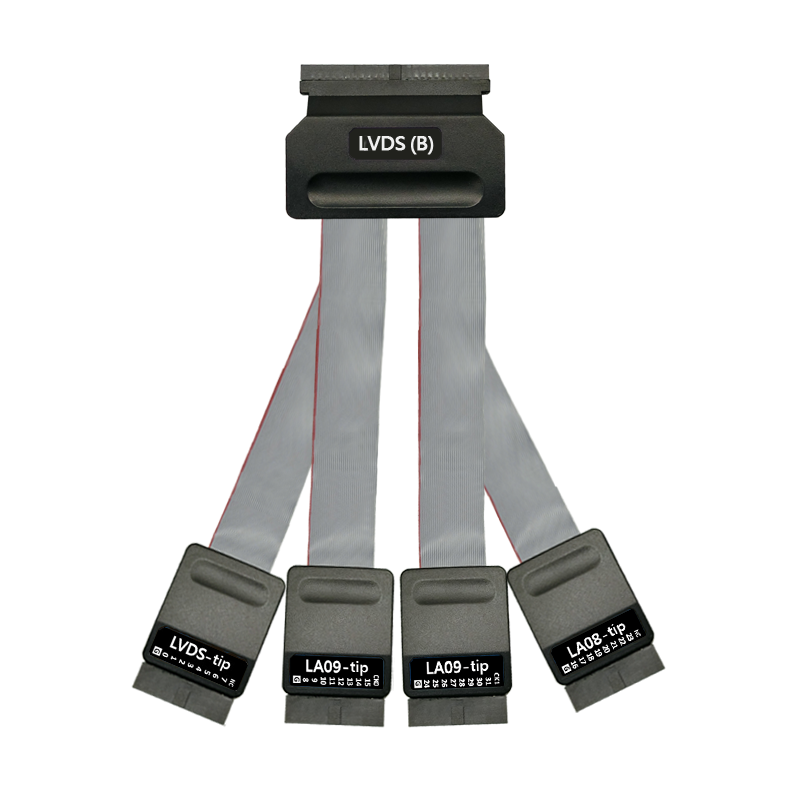
LVDS Probe is only for LA4000/3000 series & BusFinder series. LVDS Probe can be applied to logic signal and low voltage differential signal(LVDS) measurement.
• LA08/09 Tip: Digital signal input channel. It contains 2 LA09-tip & 1 LA08-tip for single-ended signal measurement.
• LVDS Tip: Low voltage differential signal input channel. It contains 8 pairs of differential signals in the LVDS-tip
LVDS, as a commonly used high-speed data transmission standard, requires dedicated probing tools for signal analysis and measurement. It finds extensive applications in high-speed data transmission systems, image processing, industrial automation, and other fields.
Signal Compatibility:
LVDS logic analyzer probes should exhibit good signal compatibility, capable of adapting to different types and standards of LVDS signals.
Measurement Range:
The probes should cover the typical LVDS signal range, including the general voltage range of 200 mV to 1200 mV, to ensure accurate measurements.
Excellent Common Mode Rejection Ratio (CMRR):
The probes should have excellent CMRR to reduce the impact of common mode interference on measurements, ensuring precise signal analysis.
Differential Acquisition Capability:
The probes should effectively capture LVDS differential signals, maintaining signal integrity and reducing signal distortion.
Low Interference and Noise:
The probes should possess outstanding interference resistance, minimizing external interference and noise"s impact on measurements.
Downloads
| General Information | |
|---|---|
Part Number (SKU) |
LVDS POD
|
Manufacturer |
|
| Physical and Mechanical | |
Weight |
2.0 kg
|
| Other | |
EAN |
5055383605866
|
Questions and Answers
-
How Does the LVDS Pod Compare to High-End Differential Probes From Premium Manufacturers?
Premium differential probes from Tektronix and Keysight reach much higher bandwidths for general high-frequency work. The LVDS Pod is built for LVDS: it takes 8 differential pairs at up to 600Mbps with about 100mV sensitivity.
It works with Acute's logic analysers, so you can decode protocols on the captured LVDS lines, which a standalone differential probe can't do.
-
What Makes the LVDS Pod Suitable for Automotive and Industrial Applications?
LVDS is common in automotive infotainment, industrial imaging and automation. The pod accepts common-mode voltages within its 0 to 3.3V input range.
With Acute's PC-based analysers you can log to the PC's SSD for long captures, which helps with extended system validation and intermittent faults.
-
Can the LVDS Pod Be Used for Educational and Research Applications?
Yes. Universities, training providers and research groups can use it to teach and study high-speed digital design: students capture real differential signals and decode protocols on Acute's PC-based analysers. Researchers can capture and analyse LVDS links in new designs.
-
What Advantages Does the LVDS Pod Offer Over Entry-Level Differential Measurement Solutions?
It acquires the differential signal in hardware, instead of relying on oscilloscope channel subtraction or software maths, which avoids the timing skew and noise of a calculated differential signal.
Acute's analyser software then decodes the captured protocols, which generic differential probes don't offer.
-
How Does the LVDS Pod Support Long-Term Signal Monitoring and Analysis?
It works with Acute's transitional storage, which stores idle periods efficiently so captures can run for long periods. The protocol monitor function works like a dash camera for long-term surveillance lasting months.
Use it to find intermittent faults and check the long-term behaviour of LVDS systems.
-
What Is an LVDS Pod and How Does It Differ From Standard Oscilloscope Probes?
An LVDS Pod is a differential probe pod made for Low Voltage Differential Signalling.
A standard single-ended probe measures relative to ground; the LVDS Pod takes the positive and negative lines of each pair together and captures the differential signal. You don't need two separate probes and maths processing to get a differential measurement.
-
Which Logic Analysers Are Compatible with the Acute Technology LVDS Pod?
It is designed for the LA4000/3000 series and BusFinder series logic analysers:
- LA4068E, LA4068B, LA4136E and LA4136B
- BusFinder BF6264B, BF7264B/B+ and BF7264 Pro protocol analysers
It can be fitted in any probe slot and provides 8 pairs of differential LVDS signal channels, plus extra digital signal measurement through LA08/09 tips.
-
What Are the Key Electrical Specifications of the LVDS Pod?
Key specifications:
- Threshold: NA (LVDS P/N reference)
- Input voltage: 0-3.3V
- Sensitivity: 100mV
- Impedance: 75kΩ || 3pF
- Data rate: up to 600Mbps
- Non-destructive voltage: -0.5V to +4.6V
- Vid-min: >150mV
- Vic (common): 0+Vid/2 to 3.3-Vid/2
-
How Does the LVDS Pod Improve Signal Integrity Compared to Alternative Debugging Methods?
Its differential input avoids the timing skew and extra noise you get from two single-ended probes, and rejects common-mode interference within its input range. Input loading is 75kΩ in parallel with 3pF.
-
What Debugging Capabilities Does the LVDS Pod Offer for Protocol Analysis?
With compatible BusFinder and LA4000 series analysers, captured LVDS lines can be decoded as eMMC, NAND Flash, SD, Serial Flash and SPI.
You can also make timing measurements and log long captures to the PC for intermittent faults.

No questions match your search.