


Mikroelektronika d.o.o.
Wheatstone Click Board™
Wheatstone Click Board™
SKU: MIKROE-4124
Couldn't load pickup availability


Key Features
Overview
The Wheatstone Click Board™ utilizes a Wheatstone Bridge circuit onboard, in order to precisely measure the resistance of an external element. Besides the Wheatstone Bridge circuit, this Click Board™ also utilizes MAX4208 – an ultra-low offset/drift, precision instrumentation amplifier, from Maxim Integrated.
Having features such as Spread-Spectrum, Auto-Zero, Low Offset Voltage Drift and more makes the mentioned IC ideal for accurate detection of very small voltage changes and conversion into a digital form. Having these features in mind, the Wheatstone Click Board™ is ideal for using in various applications which may include sensor readings and precise resistance measurements.
Downloads
How Does The Wheatstone Click Board™ Work?
A Wheatstone bridge is an electrical circuit used to measure an unknown electrical resistance by balancing two branches of a bridge circuit, one branch of which includes the unknown component. The primary benefit of the circuit is its ability to provide extremely accurate measurements, in contrast with a simple voltage divider.
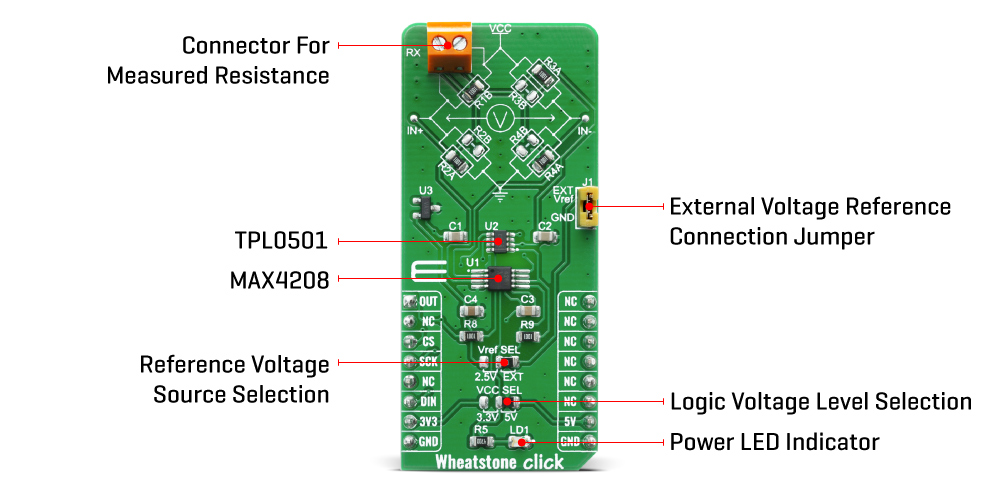
The R2, R3, and R4 are resistors of known resistance (1k ohm), while the resistance R1 is brought to the terminal block and therefore it is changeable. With no resistance connected to the terminal block, the bridge on the Wheatstone Click Board™ is in balance. At this point, the voltage between the two midpoints (IN- and IN+) will be zero. Therefore the ratio of the two resistances in the known branch (R1 and R3) is equal to the ratio of the two resistances in the unknown leg (R2 and R4). If the external resistance is connected to the terminal block, bridge is unbalanced, and the voltage on the midpoints is proportional to the external resistor value.
The Wheatstone Click Board™ is based around the MAX4208 IC, which is connected to an onboard Wheatstone bridge circuit, in order to precisely measure the resistance of an external element. The mentioned IC uses a spreadspectrum, autozeroing technique that constantly measures and corrects the input offset, eliminating drift over time and temperature and the effect of 1/f noise. This technique achieves less than 20μV offset voltage, allows ground-sensing capability, provides ultra-low CMOS input bias current and increased common-mode rejection performance. It also provides high-impedance inputs, optimized for small-signal differential voltages (±100mV), which makes it ideal for an application such as wheatstone bridge disbalance measurement.
The Wheatstone Click Board™ also has TPL0501 onboard - 256-Taps, Single-Channel, Digital Potentiometer With SPI Interface, from texas instruments. It is connected to the MAX4208 in a way that it serves an gain adjust instead of with two external resistors
The power supply voltage selection for the logic section is done by moving the SMD jumper labeled as VCC SEL to a desired position: left position to select 3.3V, right position to select 5V. This will allow both 3.3V and 5V MCUs to be interfaced with the Click board™ directly.
SPECIFICATIONS
| Type | Measurements |
| Applications | The Wheatstone Click Board™ is ideal for using in various applications which may include sensor readings and precise resistance measurements. |
| On-board modules | MAX4208 – an ultra-low offset/drift, precision instrumentation amplifier, from Maxim Integrated TPL0501 onboard - 256-Taps, Single-Channel, Digital Potentiometer With SPI Interface, from texas instruments |
| Key Features | ultra-low offset/drift, Spread-Spectrum, Auto-Zero, Low Offset Voltage Drift and more |
| Interface | Analog,SPI |
| Compatibility | mikroBUS |
| Click board size | L (57.15 x 25.4 mm) |
| Input Voltage | 3.3V or 5V |
PINOUT DIAGRAM
This table shows how the pinout on the Wheatstone Click Board™ corresponds to the pinout on the mikroBUS™ socket (the latter shown in the two middle columns).
| Notes | Pin |  |
Pin | Notes | |||
|---|---|---|---|---|---|---|---|
| Analog | OUT | 1 | AN | PWM | 16 | NC | |
| NC | 2 | RST | INT | 15 | NC | ||
| SPI Chip Select | CS | 3 | CS | RX | 14 | NC | |
| SPI Clock | SCK | 4 | SCK | TX | 13 | NC | |
| NC | 5 | MISO | SCL | 12 | NC | ||
| NC | 6 | MOSI | SDA | 11 | NC | ||
| Power Supply | 3.3V | 7 | 3.3V | 5V | 10 | NC | |
| Ground | GND | 8 | GND | GND | 9 | GND | Ground |
ONBOARD SETTINGS AND INDICATORS
| Label | Name | Default | Description |
|---|---|---|---|
| PWR | PWR | - | Power LED Indicator |
| VCC SEL | JP1 | Left | Logic voltage level selection: left position 3.3V, right position 5V |
| VREF SEL | JP2 | Left | Reference voltage selection: left position 2.5V, right position EXT |
| EXT VREF | JP1 | - | External reference voltage connection jumper |
| RX | - | - | Load cell excitation voltage connector |
| General Information | |
|---|---|
Part Number (SKU) |
MIKROE-4124
|
Manufacturer |
|
| Physical and Mechanical | |
Weight |
0.021 kg
|
| Other | |
EAN |
8606018717750
|