
Lipowsky Industrie Elektronik GmbH
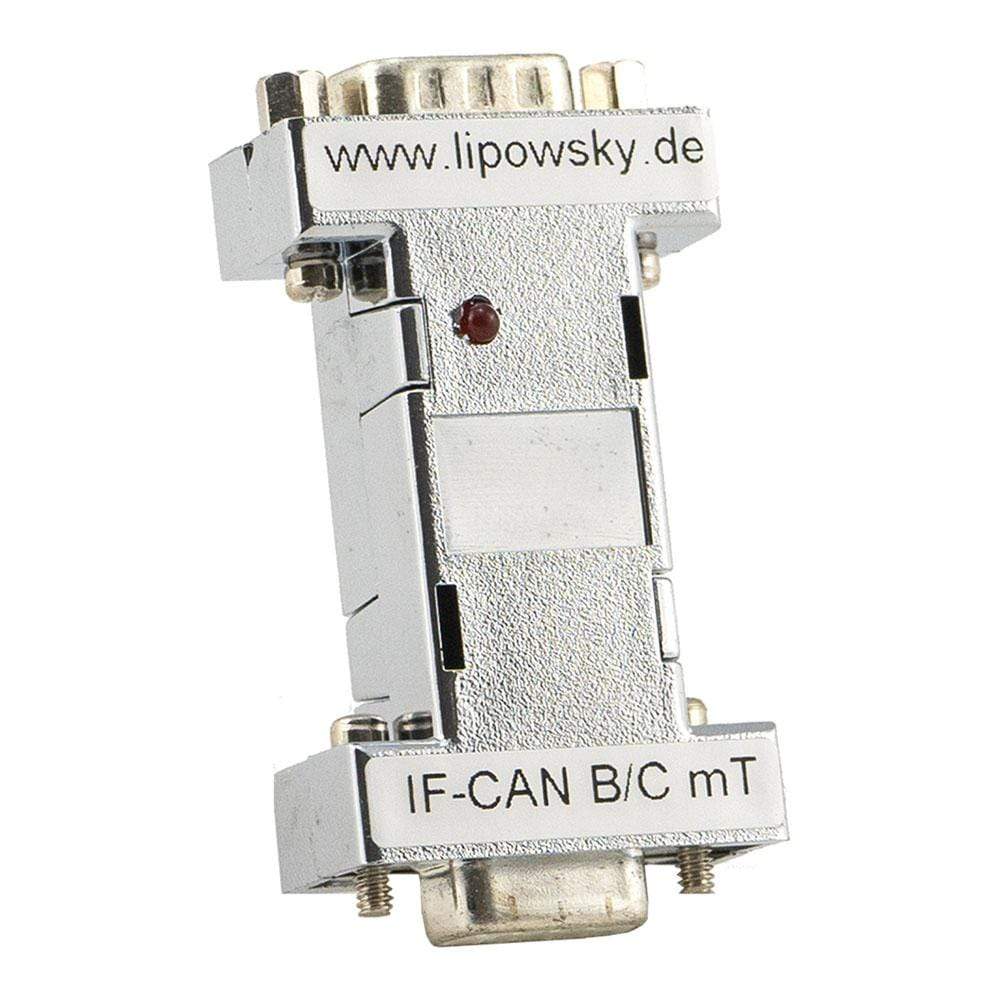
Lipowsky IF-CAN-BC-REVE02 CAN Bus High-Low Speed Converter
Lipowsky IF-CAN-BC-REVE02 CAN Bus High-Low Speed Converter
SKU: IF-CAN-BC-REVE02
Couldn't load pickup availability
Key Features
Overview
Professional CAN Bus Signal Level Conversion
The Lipowsky IF-CAN-BC-REVE02 is a professional CAN bus converter that bridges the gap between High-Speed CAN (ISO 11898-2) and Low-Speed/Fault-Tolerant CAN (ISO 11898-3) networks. This compact converter enables seamless communication between different CAN bus standards operating at different voltage levels and termination requirements.
Key Applications
Designed for automotive diagnostic applications, test equipment integration, and industrial automation systems where different CAN standards need to communicate. The converter supports bit rates up to 125 kbps and provides galvanic isolation to protect connected equipment from voltage spikes and ground loops.
Enhanced Reliability Features
The REVE02 model includes improved termination handling and enhanced signal integrity compared to earlier revisions. It automatically manages the voltage level conversion between the 2V differential High-Speed CAN signals and the larger voltage swing Low-Speed CAN signals (up to 5V differential).
This converter is essential for connecting modern CAN analysis equipment like the Lipowsky Baby-LIN-3-MB to Low-Speed CAN networks, or for integrating legacy Low-Speed CAN devices into High-Speed CAN systems. Perfect for automotive engineers working with mixed CAN environments or developing gateway applications.
Downloads
Why Engineers Choose the Lipowsky IF-CAN-BC-REVE02 CAN Bus High-Low Speed Converter
Different CAN Standards
Protect Expensive Test Equipment
Simplify Diagnostic Access
Questions and Answers
-
What Termination Is Required for Proper Operation?
The standard IF-CAN-BC has a 120Ω terminator built in on the High-Speed CAN side (a version without it is available on request). The Low-Speed CAN side has built-in 3.3 kΩ termination.
-
Is the Converter Suitable for Automotive Diagnostic Applications?
Yes. It lets High-Speed CAN diagnostic tools access older vehicles with Low-Speed CAN networks, particularly in comfort electronics and body control modules.
-
Is the IF-CAN-BC Galvanically Isolated?
Lipowsky's datasheet does not specify galvanic isolation, and both DB9 connectors carry GND on pins 3 and 6. Do not rely on the converter for isolation; if you need it, add an isolated CAN interface.
-
Can Multiple Converters Be Daisy-chained Together?
It's technically possible but best avoided, because chaining converters can add cumulative delays. Connect each converter directly between two different CAN bus segments.
-
Does the IF-CAN-BC-REVE02 Hold Any Safety Certifications?
Lipowsky's datasheet does not list EMC or safety certifications. Ask Lipowsky for a declaration of conformity if you need one.
-
What Is the Difference Between High-Speed CAN and Low-Speed CAN?
High-Speed CAN runs at up to 1 Mbps with 2V differential signalling and needs 120Ω termination at both ends. Low-Speed CAN runs at up to 125 kbps with larger voltage swings (up to 5V differential) and uses distributed termination at each node, which gives fault tolerance if one wire breaks.
-
Can the IF-CAN-BC-REVE02 Handle CAN FD (Flexible Data Rate) Signals?
No. The IF-CAN-BC is a Classical CAN (CAN 2.0A/B) physical-layer adaptor and is not suitable for CAN FD. Both buses must run at the same bit rate, and the Low-Speed (ISO 11519) side is typically limited to 125 kbps.
-
Does the Converter Require an External Power Supply?
Yes, it needs a supply. Lipowsky's datasheet specifies 8 to 36 V DC on pin 9 of either DB9 connector (High-Speed or Low-Speed side); pin 1 is not connected. Check that your CAN interface or the Low-Speed bus supplies it.
-
Will This Converter Work with My Existing CAN Interface?
It works with CAN interfaces that use the standard CiA DS102 DB9 pin-out. The converter needs 8 to 36 V DC on pin 9 of either connector, so check that your interface or the Low-Speed bus supplies it, as not all interfaces do.
-
Can I Use This Converter Bidirectionally?
Yes. The converter works in both directions, High-Speed to Low-Speed CAN and back. Conversion is automatic and transparent to the connected devices.
No questions match your search.