
OMICRON-Lab
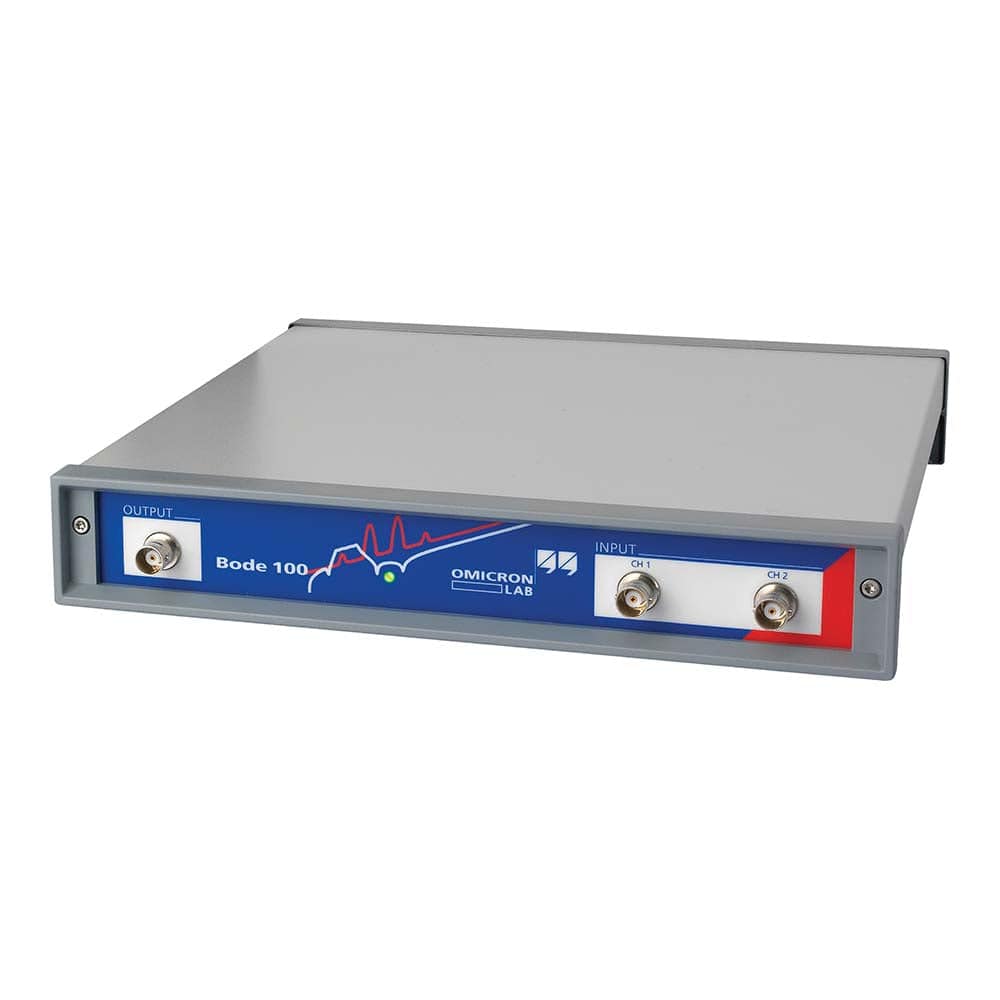
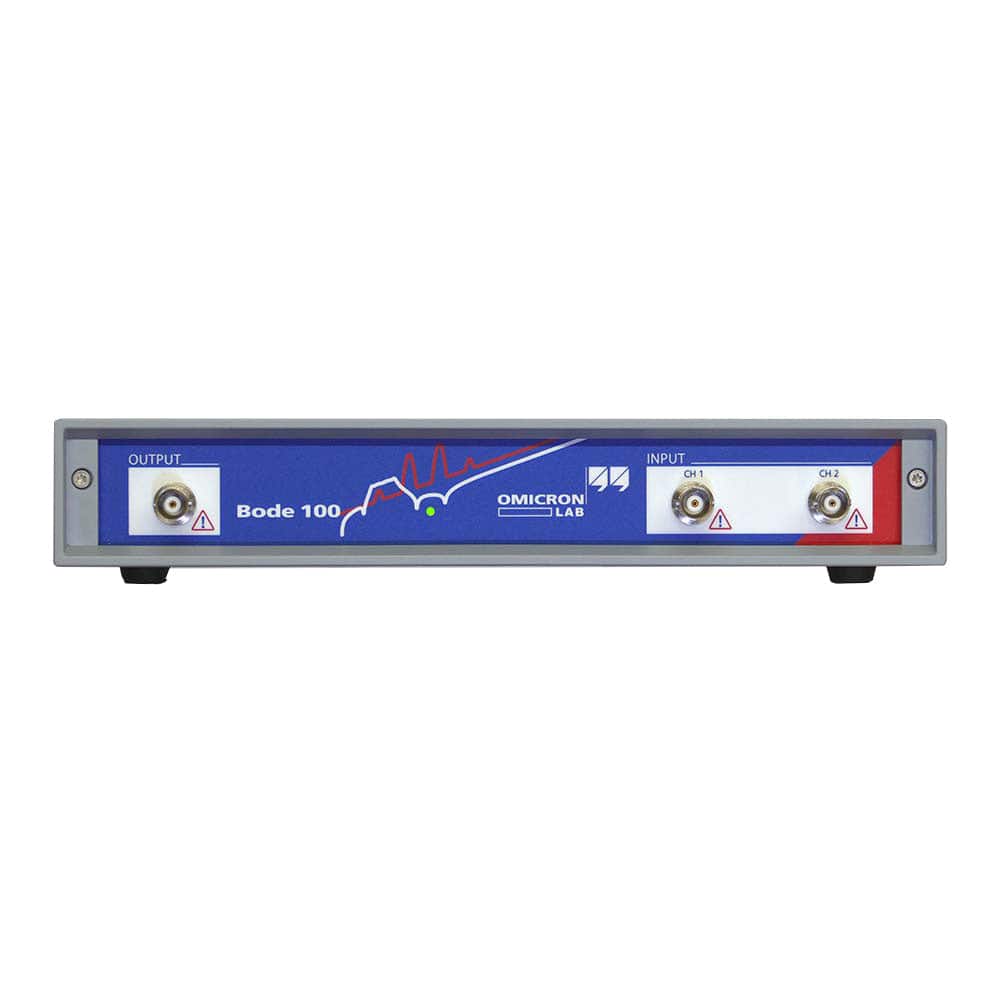
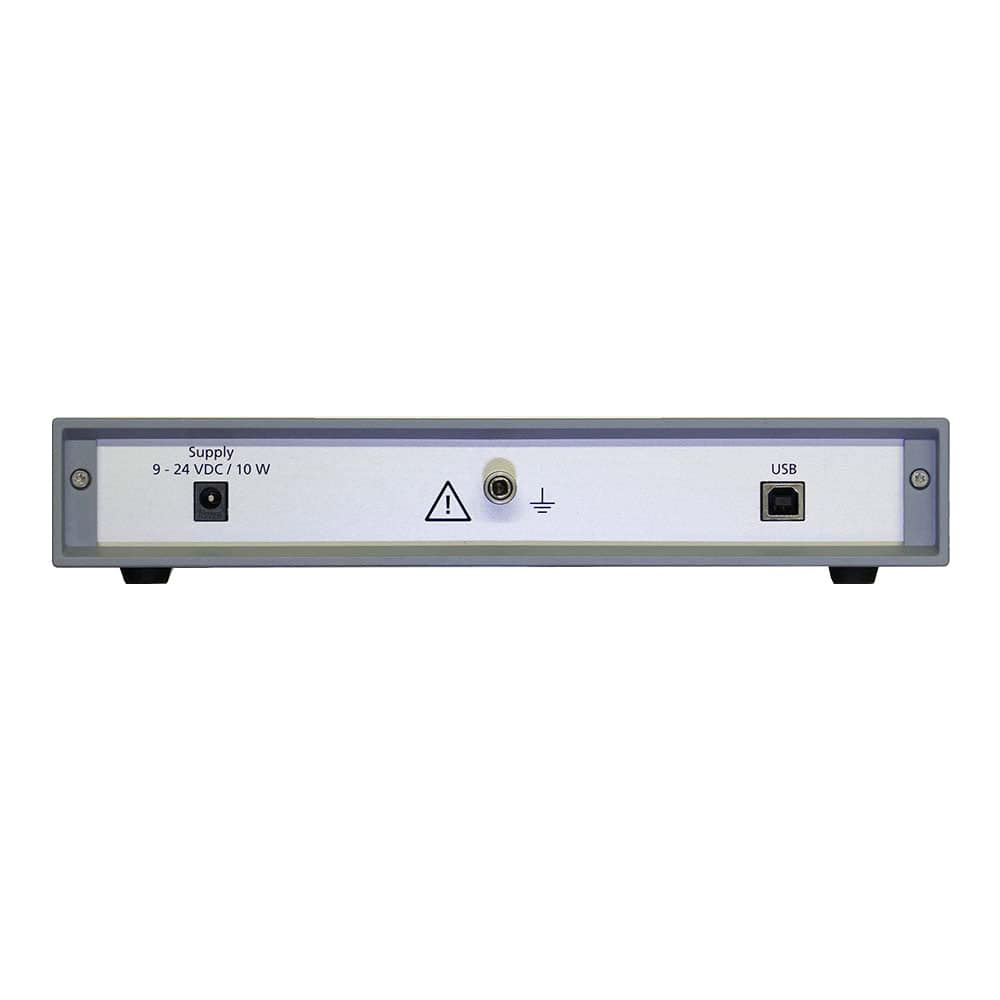
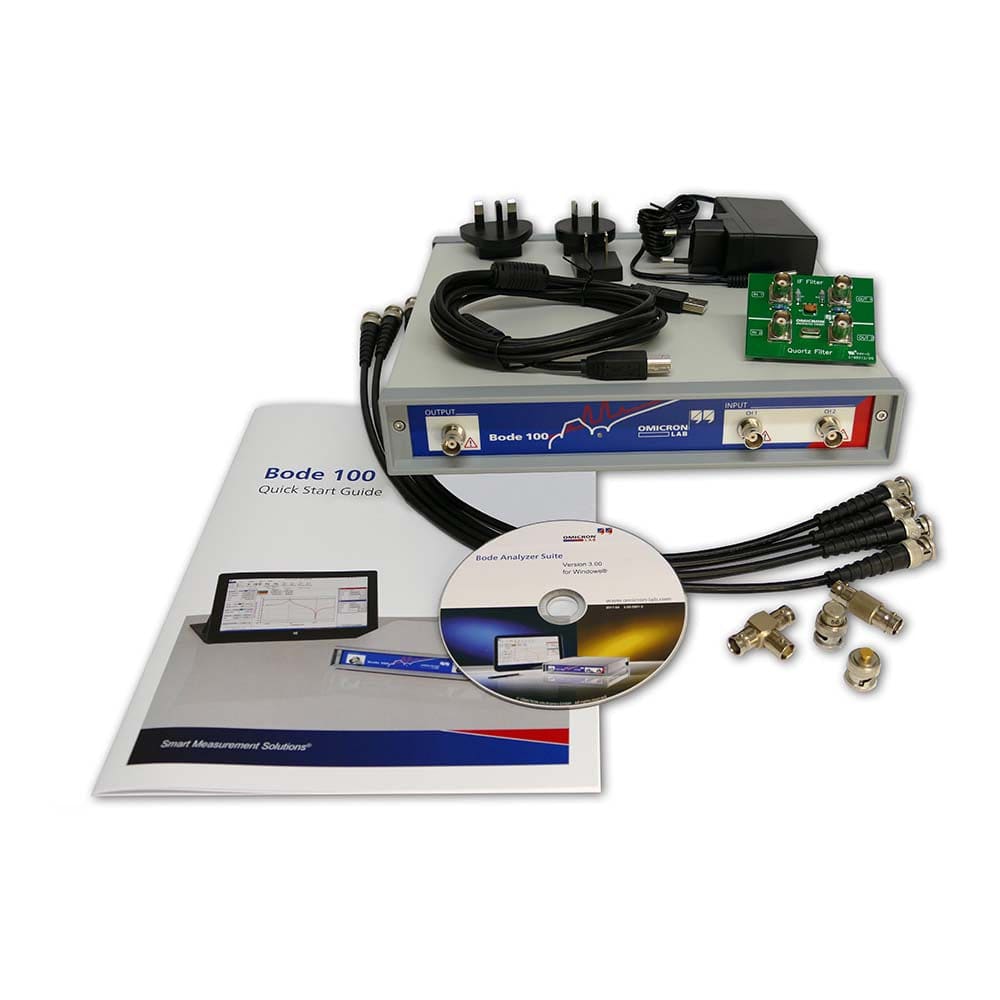
OMICRON Lab Bode 100 Vektor-Netzwerkanalysator (VNA)
OMICRON Lab Bode 100 Vektor-Netzwerkanalysator (VNA)
SKU: P0005755
Verfügbarkeit für Abholungen konnte nicht geladen werden
Key Features
Overview
Revolutionise Your Measurements
Discover an instrument that redefines versatility in the realm of test and measurement. Introducing the Bode-100, the essential tool you never knew you needed until now. Offering unparalleled performance in a compact form factor, this instrument promises to elevate the quality, precision, and efficiency of your work.
Unmatched Versatility
- Vector Network Analyser (VNA)
- Frequency Response Analyser
- Gain/Phase Meter
- Impedance Analyser
Deep Dive Into Features
The Omicron-Lab Bode-100 doesn't just stop at multifunctionality. Dive deeper into the extensive features it brings to the table:
- Sinusoidal Signal Generation: Precisely measures the response of your device under test (DUT) by generating sinusoidal signals across varied frequencies.
- Diverse Measurement Modes: From transmission/reflection, gain, and impedance measurements, choose the mode that best fits your needs.
- Complex Analysis: Measure active and passive circuits' complex gain, impedance, and admittance.
- S-Parameter Sweep: Analyse the swept S-parameters of electronic circuits and filters easily.
- Group Delay Characteristics: Understanding signal delay in your circuits is made simpler.
Ready to Elevate Your Testing Game?
Make sure to integrate the future of test and measurement instruments into your lab. Order your Bode-100 today!
Downloads
Der Omicron-Lab Bode 100: Ein multifunktionales Test- und Mess-Kraftpaket
Revolutionieren Sie Ihre Messungen
Entdecken Sie ein Instrument, das Vielseitigkeit im Bereich Test und Messung neu definiert. Wir stellen Ihnen den Bode-100 vor, das unverzichtbare Werkzeug, von dem Sie bisher nicht wussten, dass Sie es brauchen. Dieses Instrument bietet beispiellose Leistung in einem kompakten Formfaktor und verspricht, die Qualität, Präzision und Effizienz Ihrer Arbeit zu steigern.
Unübertroffene Vielseitigkeit
- Vektornetzwerkanalysator (VNA)
- Frequenzganganalysator
- Verstärkungs-/Phasenmesser
- Impedanzanalysator
Detaillierte Informationen zu den Funktionen
Das Omicron-Lab Bode-100 ist nicht nur multifunktional. Erfahren Sie mehr über die umfangreichen Funktionen, die es mit sich bringt:
- Erzeugung sinusförmiger Signale: Misst präzise die Reaktion Ihres zu testenden Geräts (DUT) durch die Erzeugung sinusförmiger Signale über verschiedene Frequenzen.
- Verschiedene Messmodi: Wählen Sie von Transmission/Reflexion über Verstärkung bis hin zu Impedanzmessungen den Modus, der Ihren Anforderungen am besten entspricht.
- Komplexe Analyse: Messen Sie komplexe Verstärkung, Impedanz, Admittanz und vieles mehr sowohl von aktiven als auch von passiven Schaltkreisen.
- S-Parameter-Sweep: Analysieren Sie mühelos die gesweepten S-Parameter von elektronischen Schaltkreisen und Filtern.
- Gruppenverzögerungseigenschaften: Das Verständnis der Signalverzögerung in Ihren Schaltkreisen wird einfacher.
Impedanzmessungen perfektioniert
Wählen Sie aus sieben verschiedenen Impedanzmessverfahren dasjenige aus, das sich am besten für Ihre spezifische Aufgabe eignet.
Visualisieren Sie wie nie zuvor
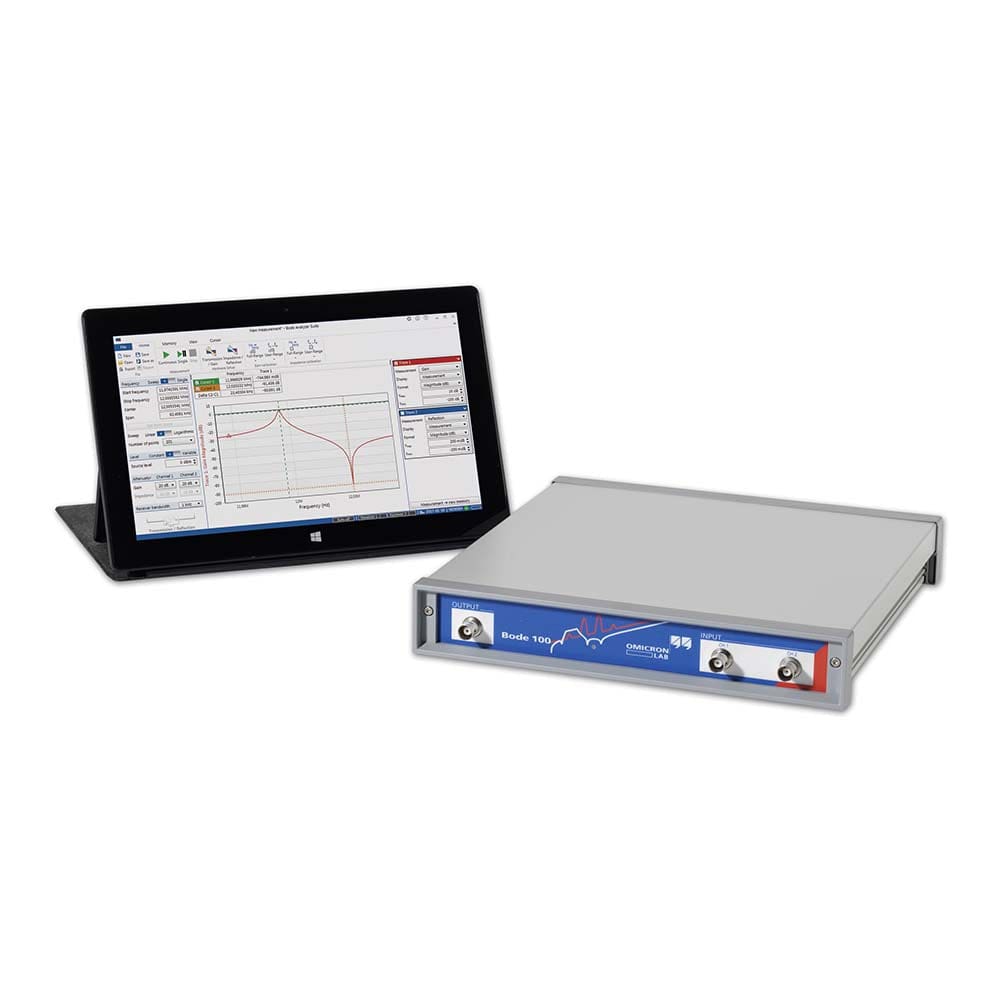
Mithilfe der Software Bode Analyser Suite können Sie Ihre Daten in verschiedenen Formaten visualisieren, darunter Smith-, Polar- und Nyquist-Diagramme. Ob Sie nach linearen oder logarithmischen Frequenzdurchläufen suchen, mit dieser Software können Sie Ihre Messungen bis ins kleinste Detail definieren und anpassen.
Warum Bode-100?
- All-in-One-Lösung: Das Jonglieren mit mehreren Instrumenten gehört der Vergangenheit an. Der Bode-100 vereint sie zu einem einzigen.
- Benutzerfreundliche Oberfläche: Mit der Software Bode Analyser Suite ist die Bedienung der umfangreichen Funktionen ein Kinderspiel.
- Präzision vom Feinsten: Jedes Mal genaue Ergebnisse.
- Kompakt und dennoch robust: Seien Sie sich seiner Größe bewusst, der Bode-100 ist ein Kraftpaket.
Sind Sie bereit, Ihre Testleistung zu verbessern?
Integrieren Sie die Zukunft der Test- und Messinstrumente in Ihr Labor. Bestellen Sie Ihren Bode-100 noch heute!
| General Information | |
|---|---|
Part Number (SKU) |
P0005755
|
Manufacturer |
|
| Physical and Mechanical | |
Weight |
2.0 kg
|
| Other | |
EAN |
5055383623648
|
Questions and Answers
-
What Is the Frequency Range of the Bode-100?
The Bode-100 has a frequency range of 1Hz to 50MHz.
-
What Is the Maximum Measurement Speed of the Bode-100?
Measurement time depends on the receiver bandwidth (RBW). OMICRON Lab gives a theoretical time per point of 1.7 ms at 5 kHz RBW, rising to 2.8 s at 1 Hz RBW.
-
Is the Bode-100 Compatible with Any Software?
The Bode 100 works with OMICRON Lab's Bode-Analyzer software for data analysis and visualisation.
-
What Is the Warranty for the Bode-100?
The Bode-100 comes with a 2-year warranty.
-
What Types of Measurements Can the Bode-100 Perform?
The Bode 100 measures complex gain, complex impedance and admittance, swept S-parameters and group delay from 1 Hz to 50 MHz. Typical uses include:
- control loop stability (gain and phase margin) of DC/DC converters
- input and output impedance
- power-plane impedance for decoupling
- parasitics of components and circuit boards
- reflection and return loss of filters, antennas and amplifiers
- resonance and Q-factor of crystals, RFID and NFC antennas
-
What Is the Omicron-Lab Bode-100?
The OMICRON Lab Bode 100 is a vector network analyser (VNA) for small-signal stability and frequency-domain analysis of electronic circuits.
-
How Does the Bode-100 Handle EMC Filter and Component Characterisation?
The Bode 100 measures both common-mode and differential-mode insertion loss of EMC filters.
With the B-WIC and B-SMC impedance adapters, it can characterise individual filter components, including common-mode chokes and X and Y capacitors, as well as complete filter assemblies. You can use the data to create SPICE models for filter simulation and optimisation. It also detects parasitics and resonances, which helps with EMC compliance and filter design validation.
-
What Calibration Procedures Does the Bode-100 Require, and How Accurate Are the Results?
The Bode 100 supports full-range calibration using open/short/load standards, and user-range calibration for specific frequency spans.
After calibration it achieves gain accuracy of <0.1 dB and phase accuracy of <0.5° in the user-calibrated range. Calibration is automated in the Bode Analyzer Suite software, and calibration standards (including a 50 Ω load and a short circuit) are included. For best accuracy, calibrate regularly, especially when you change the measurement configuration.
-
How Does the Bode-100 Compare to Low-cost VNA Alternatives Like the NanoVNA?
The NanoVNA offers basic VNA functions at very low cost. The Bode 100 gives better dynamic range, accuracy and frequency stability, with a 1 Hz starting frequency, >100 dB dynamic range and a professional software suite.
It also comes with technical support, calibration services and application expertise, and suits critical measurements that need repeatable, traceable results.
-
What Software and Connectivity Options Are Available with the Bode-100?
The Bode 100 includes the Bode Analyzer Suite software for measurement control, data analysis and documentation. Features include:
- Smith chart displays
- polar plots
- memory curves
- mathematical functions
- SPICE model generation
It connects by USB, with full remote control. Data exports to standard formats for MATLAB, Excel and other analysis tools. Regular software updates keep it compatible with current operating systems and add new measurement capabilities.
-
What Unique Competitive Advantages Does the Bode-100 Offer Over More Expensive VNA Solutions?
The Bode 100's main advantages are:
- measurement from 1 Hz, which traditional VNAs can't do
- silent, fanless operation
- compact, portable design
- strong price-performance
Expensive VNAs are better at high frequencies, but the Bode 100 leads at the low frequencies used in power electronics and EMC work. It also replaces a separate FRA and impedance analyser, saving cost. It's the best choice for engineers who don't need frequencies above 50 MHz.
-
What Makes the Omicron-Lab Bode-100 VNA Unique Compared to Traditional Vector Network Analysers?
The Bode 100 measures from 1 Hz, while most traditional VNAs start at much higher frequencies. This makes it well suited to power supply analysis, DC/DC converter stability testing and EMC filter characterisation.
Unlike conventional VNAs focused on RF, it combines a frequency response analyser and a vector network analyser in one compact instrument. You don't need separate instruments, which saves cost and lab space.
-
How Does the Bode-100's Performance Compare to High-end VNAs From Manufacturers Like Keysight and Rohde & Schwarz?
High-end VNAs from Keysight and Rohde & Schwarz cover much wider frequency ranges, up to millimetre-wave.
The Bode 100 covers 1 Hz to 50 MHz and is aimed at power supply, impedance and EMC work in that range. If you don't need frequencies above 50 MHz, it is the better fit.
-
What Specific Applications Is the Bode-100 VNA Particularly Well-suited For?
The Bode 100 is well suited to:
- power supply stability analysis (loop gain measurements)
- DC/DC converter characterisation
- EMC filter insertion loss testing
- component parasitics analysis
- PSRR measurements
- RFID and NFC antenna tuning
- transformer and inductor analysis
- power delivery network (PDN) impedance characterisation
Its low-frequency capability suits power electronics engineers, and its impedance analysis features suit component manufacturers and EMC compliance testing.
-
Can the Bode-100 VNA Perform Automated Measurements and Integrate with Existing Test Systems?
Yes. The Bode 100 can be automated through its .NET-based Bode Automation Interface and a SCPI-compatible command set, so you can integrate it into automated test equipment (ATE) and custom measurement applications. The interface gives programmatic control of all measurement functions, calibration and data acquisition, for production testing and research that needs repeated measurements.
-
What Advantages Does the Bode-100 Offer for Power Supply Engineers Specifically?
The Bode 100 measures stability by voltage injection across a small injection resistor in the loop. It can measure these on switching power supplies without disrupting normal operation:
- loop gain
- output impedance
- PSRR
- input impedance
Narrow-band receivers and high dynamic range give accurate measurements on noisy switching converters, and its speed lets you characterise across multiple operating points.


No questions match your search.