

TESTEC Elektronik GmbH
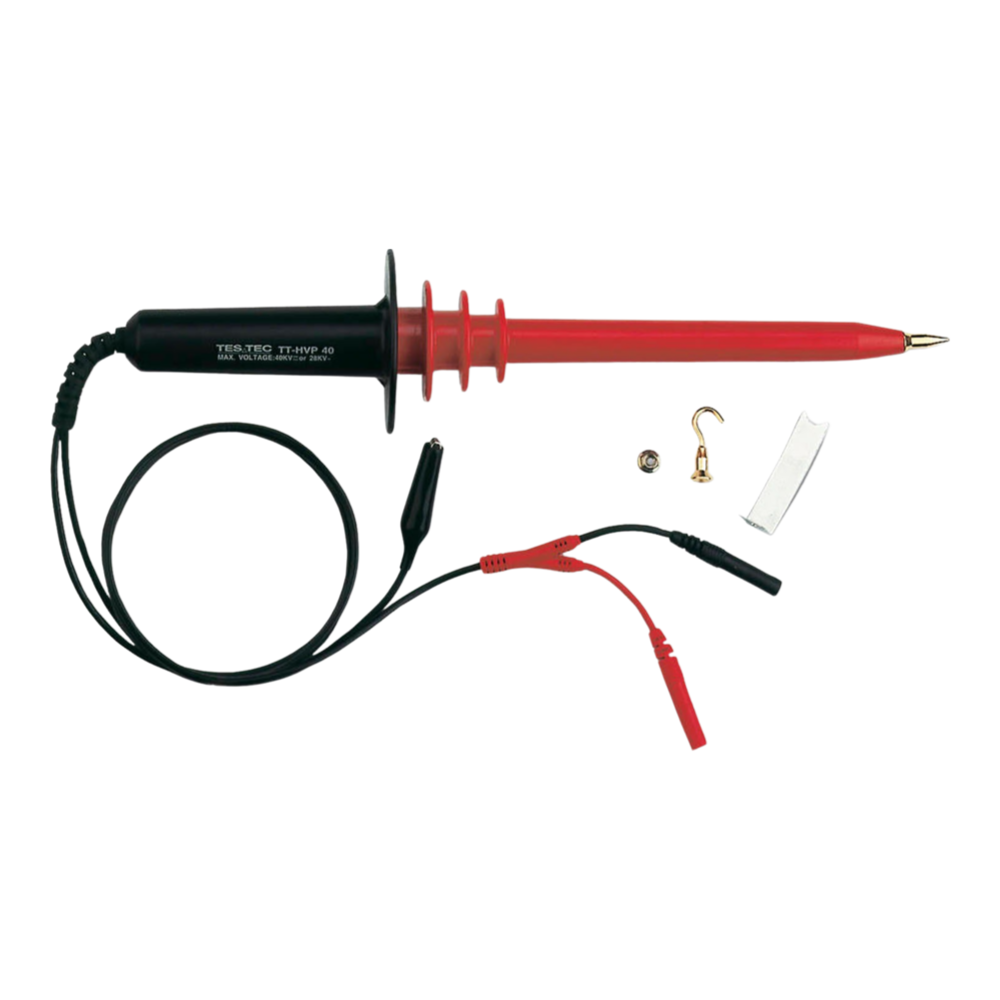
TESTEC TT-HVP40 Passive Hochspannungs-Multimetersonde
TESTEC TT-HVP40 Passive Hochspannungs-Multimetersonde
SKU: 15001
Verfügbarkeit für Abholungen konnte nicht geladen werden
Key Features
Overview
Downloads
Why Engineers Choose The TESTEC TT-HVP40 Passive Hochspannungs-Multimetersonde
Professional Grade Accuracy
Enhanced Safety Protection
Universal Multimeter Compatibility
Die Hochspannungs-Multimetersonde TESTEC TT-HVP40 wurde für den professionellen Einsatz entwickelt. Diese hochwertige passive Hochspannungssonde ist mit einem Dämpfungsverhältnis von x1000 und einer Spitzenspannung von 40 KV DC ausgestattet.
| General Information | |
|---|---|
Part Number (SKU) |
15001
|
Manufacturer |
TESTEC Elektronik GmbH
|
| Physical and Mechanical | |
Weight |
1.5 kg
|
| Other | |
EAN |
5055383622740
|
Questions and Answers
-
Can This Probe Measure AC Voltages at Different Frequencies?
Yes, from DC to 300Hz. Accuracy is ±5% at 60Hz. The response rolls off at higher frequencies, reaching -3dB at 300Hz.
-
What Applications Is the TT-HVP 40 Best Suited For?
Typical uses for a high-voltage probe of this type:
- Power supply output voltage measurement
- CRT television EHT testing
- High voltage laboratory research
- Industrial equipment diagnostics
It suits high-voltage DC or low-frequency AC (up to 300Hz) measurements made with a multimeter.
-
How Does the Probe's High Input Impedance Benefit Measurements?
The 1000MΩ input resistance keeps circuit loading low, which reduces measurement errors and avoids disturbing sensitive high-voltage circuits. This matters in power supply testing, where loading could affect the circuit under test.
-
What Environmental Conditions Can the Probe Withstand?
- Operating temperature: 0°C to +50°C
- Storage temperature: -20°C to +70°C
- Altitude: up to 4,600 metres
- Humidity: up to 80% relative humidity at 40°C
-
What Accessories Are Included with the TT-HVP 40 Probe?
The Testec manual describes these parts:
- Connecting plugs for the multimeter's Hi and COM terminals
- Ground lead with alligator clip
- Probe tip
- 1 m cable
-
What Multimeters Are Compatible with the Testec TT-HVP 40?
The probe is designed for analogue or digital multimeters with 10MΩ input resistance, which gives a 1000:1 division ratio. Most digital multimeters have a 10MΩ input. With a 1MΩ meter the ratio becomes 2000:1.
-
Can I Use This Probe for Mains Electrical Measurements?
No. The TT-HVP 40 has no rated measurement category and is not rated for CAT II, III or IV, so don't use it for mains measurements. It is a high-voltage DC and low-frequency AC probe. For mains distribution measurements, use equipment rated for the category you are working in.
-
What Safety Precautions Must I Follow When Using This Probe?
- Only trained personnel should use the probe, and never work alone.
- Always connect the ground clip to a reliable earth before touching the high-voltage point.
- Never remove the ground connection while the probe tip is on high voltage.
- Inspect the probe for damage before each use.
- Make sure conditions are dry.
- Turn off the high-voltage source during connections where possible.
- Set the multimeter range manually. Don't use autoranging.
-
How Accurate Are the Voltage Readings with This Probe?
- DC: ±5% from 1kV to 20kV, ±6% from 20kV to 40kV.
- AC: ±5% at 60Hz, with bandwidth to 300Hz at -3dB.
- Temperature coefficient: <200ppm/°C.
-
What's the Difference Between 1000:1 and 2000:1 Division Ratios?
It depends on your multimeter's input impedance. With a 10MΩ meter (most common) the ratio is 1000:1, so multiply the reading by 1000. With a 1MΩ meter it's 2000:1, so multiply by 2000.
No questions match your search.