


Lineeye Co Ltd
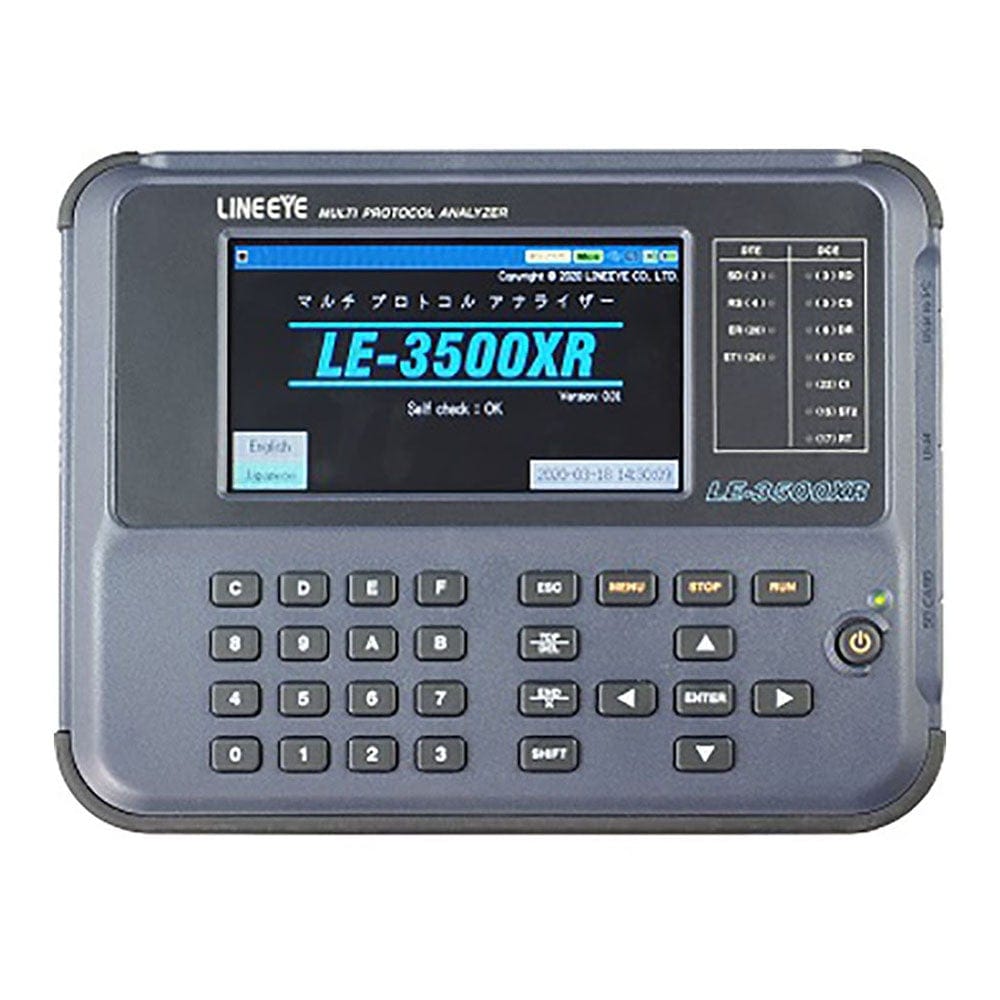
Lineeye LE-3500XR-E Multiprotokoll-Analysator
Lineeye LE-3500XR-E Multiprotokoll-Analysator
SKU: LE-3500XR(V2)-E
Verfügbarkeit für Abholungen konnte nicht geladen werden


Key Features
Overview
Overview
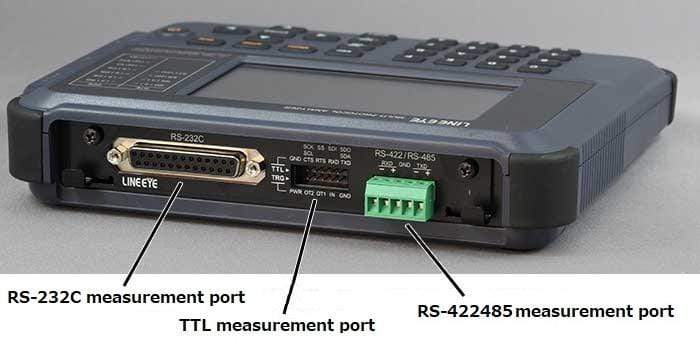
The Lineeye LE-3500XR-E is a stand-alone, battery-powered multi-protocol serial analyser for RS-232C, RS-422/RS-485 and TTL-level UART. It combines online monitoring, protocol translation, simulation modes and bit-error-rate testing in a compact handheld unit with a colour touch screen and hard keys. Data can be logged continuously to SD card or USB storage with 10 ms time-stamping, supporting long-duration troubleshooting in the field.
Expand As Requirements Grow
Optional boards extend capability to in-vehicle and legacy interfaces. Add CAN, CAN FD and CXPI with the OP-SB7XC or CAN/LIN with the OP-SB7XL. RS-530 and other datacom standards are enabled by the OP-SB10N. High-speed testing on supported links is available via the OP-FW10XR firmware. For board-level probing, the LE-5LS TTL cable provides convenient access.
Series & Compatible Models
The LE-3500XR-E sits above the LE-2500XR-E and alongside the newer LE-3500XR(V2) models. For USB protocol work, consider the LE-650H2-A USB 2.0 analyser as a complementary tool.
Why Consider This Instrument?
Unlike PC-tethered analysers, the LE-3500XR-E captures, decodes and simulates traffic without a laptop, reducing setup time on the factory floor or at customer sites. Its rugged I/O, protocol options and reliable long-term logging make it a practical choice for engineers maintaining Modbus and other serial systems.
Downloads
Why Engineers Choose The Lineeye LE-3500XR-E Multiprotokoll-Analysator
Field-Ready & Efficient
Robust Logging
Expandable Platform
Der Lineeye LE-3500XR-E ist ein perfektes Modell eines eigenständigen Kommunikationsprotokollanalysators , der über ein Farb-Touchpanel und einen Lithium-Ionen-Akku verfügt und gleichzeitig alle Funktionen des herkömmlichen Modells LE-3500/LE-3500R übernimmt, das über die für den Kommunikationsanalysetest erforderliche Überwachungsfunktion, Simulationsfunktion und Bitfehlerraten-Testfunktion verfügt.
Die Visualisierung von Signalstatus und Fehlerdaten auf dem Leitungsmonitor-Display wird durch die Farbgebung des Displays erheblich verbessert. Mit dem Touchpanel und dem physischen Tastenschalter können Sie deren Nutzung optimieren – zum Beispiel durch Wischen auf dem Touchscreen zur Anzeige einer großen Menge an Kommunikationsmonitordaten und Tastenbedienung für den MANUELLEN Simulationsmodus (in dem den Tasten Kommunikationstestdaten zugewiesen werden und ein Übertragungs-/Empfangstest ausgeführt wird). Darüber hinaus werden viele Tastenbedienungen des herkömmlichen Modells als Tastenkombinationen übernommen.
Das neu gestaltete Gehäuse mit integriertem Lithium-Ionen-Akku (der über den Micro-USB-Anschluss aufgeladen werden kann) ist deutlich kleiner und leichter als das herkömmliche Modell und reduziert den Aufwand für die Wartung von Kommunikationsgeräten und die Fehlerbehebung bei Kommunikationssystemen.
| General Information | |
|---|---|
Part Number (SKU) |
LE-3500XR(V2)-E
|
Manufacturer |
|
| Physical and Mechanical | |
Weight |
5.0 kg
|
| Other | |
EAN |
5055383628841
|
Questions and Answers
-
How Does This Compare to High-End, PC-Based Analysers?
The LE-3500XR-E is stand-alone, battery powered and field-ready, so it's quicker to deploy. Premium PC-based analysers need probes, drivers and a laptop.
-
Can It Simulate Devices as Well as Monitor?
Yes. Simulation modes include MANUAL (sends data from transmission tables), BUFFER (replays captured data) and PROGRAM (scripted sequences), plus FLOW, ECHO and POLLING. BERT (bit error rate test, ITU-T G.821) checks link quality on asynchronous and synchronous lines. This speeds up commissioning and fault isolation on site.
-
Can I Probe Board-Level UART Easily?
Yes. The supplied LE-5LS 5-line probe connects to the analyser's TTL port. The TTL interface supports 1.8V, 2.5V, 3.3V and 5V logic levels, so you can observe 3.3V and 5V UART signals.
-
Is There an Upgrade Path to Newer Models?
The LE-3500XR(V2) is the successor model rather than an upgrade for existing units. It replaces the micro-B USB port with USB Type-C and works with the same options, such as the OP-SB7XL board and OP-FW10XR firmware. Most data files can be shared between the two generations, though Lineeye notes some may not work.
-
Where Can I Add High-Speed Test Capability?
Buy the optional OP-FW10XR high-speed firmware. It adds high-speed HDLC/SDLC, X.25, CC-Link and SPI measurement, at up to 10Mbps half duplex (5Mbps full duplex) for HDLC and 10Mbps for SPI.
-
Can I Add CAN, CAN-FD or CXPI Later?
Yes. Plug-in automotive bus expansions add CAN, CAN-FD and CXPI, so you can take on future projects without replacing the handheld analyser.
-
Does It Work Without a PC?
Yes. The LE-3500XR-E runs fully stand-alone with its own 4.3-inch colour display, battery, storage (SD card or USB memory up to 32GB) and controls. Built-in Wi-Fi lets you control it, monitor and download data remotely, but Lineeye enables Wi-Fi only in Japan, the USA, Canada and the EU.
-
Is LIN Also Supported?
Yes. The OP-SB7XL expansion board adds LIN alongside CAN, with two channels that can monitor CAN and LIN at the same time, so the LE-3500XR-E can troubleshoot mixed CAN/LIN networks.
-
How Do I Capture Very Long Sessions?
Use AUTO SAVE to record traffic continuously, with 10ms timestamps, to an SD card or USB memory. Lineeye gives about 6.5 days of recording at 115.2kbps on 32GB, enough to catch intermittent faults.
-
What's the Practical Maximum Speed?
As standard, up to 2.048Mbps full duplex and 3.15Mbps half duplex. The optional OP-FW10XR firmware raises HDLC and SPI to 10Mbps half duplex.
No questions match your search.