
Dediprog Technology Co Ltd
Dediprog EM100Pro-G3 SPI NOR Flash-Emulator
Dediprog EM100Pro-G3 SPI NOR Flash-Emulator
SKU: EM100Pro-G3
Zahlungsmethoden
- Banküberweisung
Verfügbarkeit für Abholungen konnte nicht geladen werden

Key Features
Overview
The DediProg EM100Pro-G3 is a state-of-the-art SPI NOR Flash emulator to streamline firmware development and debugging processes. This high-performance tool integrates seamlessly with high-speed DRAM memory, ensuring optimal code updating for current and next-generation SPI NOR Flash devices up to 2Gb density.
Key features include:
- Rapid firmware code/data downloading, processing 1Gb in just 10 seconds
- "SPI BUS Analyzer" for capturing and logging all SPI commands and data
- Flexible connectivity with two 2.54mm pitch male connectors, including an ISP header
- Comprehensive software support, including EM100Pro-G3 Software and USB drivers
The EM100Pro-G3 significantly outperforms traditional programmers and its predecessor, especially for high-density applications. Its enhanced speed allows for quick erase, program, and verify operations, boosting productivity in firmware development cycles.
Ideal for electronic design engineers working with SPI NOR Flash devices, the EM100Pro-G3 excels in scenarios requiring frequent code updates, SPI communication debugging, and high-density application development. Its combination of high-speed performance, advanced analysis capabilities, and versatile connectivity makes it an indispensable tool for modern firmware development environments.
Downloads
Brochures
SPI-NOR-Flash-Emulator für die Firmware-Entwicklung
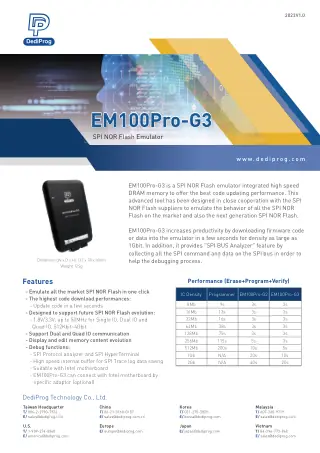
Der EM100Pro-G3 ist ein Bausteinemulator, kein Programmiergerät. Er wird anstelle des SPI-NOR-Flash angeschlossen und verhält sich gegenüber dem Zielsystem wie dieser Flash-Baustein; das Image liegt im eigenen DRAM des Emulators. Eine Codeänderung ist ein Download in den Emulator, kein Zyklus aus Löschen, Programmieren und Verifizieren an einem echten Baustein.
Hauptmerkmale
Schnelles Laden des Images. Dediprog nennt 3 s für das Laden eines 256-Mb-Images, 5 s für 512 Mb, 10 s für 1 Gb und 20 s für 2 Gb.
SPI-Bus-Analysator. Zeichnet die SPI-Befehle und -Daten auf dem Bus in einem internen Trace-Puffer auf, sodass sichtbar wird, was das Zielsystem beim Booten liest. Bei hohem Busdurchsatz kann der Puffer überlaufen; sehr dichte Traces können daher Lücken aufweisen.
SPI HyperTerminal. Ein bidirektionaler Kanal über den SPI-Bus für Debug-Meldungen zwischen Zielsystem und Host-PC.
Spannungs- und Busunterstützung. Bausteine mit 1,8 V und 3,3 V; Single-, Dual- und Quad-I/O; SPI-Takt bis 50 MHz; Speicherdichten von 512 Kbit bis 4 Gbit.
Bausteinauswahl per Software. Der zu emulierende SPI-NOR-Baustein wird aus der Liste der Dediprog-Software gewählt, sodass sich Code ohne Hardwareänderung mit verschiedenen Flash-Bausteinen testen lässt.
Anschlüsse. Eine 2x10-Stiftleiste führt die Emulationssignale, ein 2x2-Steckverbinder Reset und Trigger. Kabel und Adapter stellen die Verbindung zur Platine her; ein Adapter für Intel-Mainboards ist optional erhältlich.
Leistungsvergleich
| Dichte | Programmiergerät | EM100Pro-G2 | EM100Pro-G3 |
|---|---|---|---|
| 256 Mb | 115 s | 5 s | 3 s |
| 512 Mb | 200 s | 10 s | 5 s |
| 1 Gb | k. A. | 20 s | 10 s |
| 2 Gb | k. A. | 40 s | 20 s |
Angaben von Dediprog. Die Zeiten für das Programmiergerät gelten für Löschen, Programmieren und Verifizieren an einem echten Baustein mit einem herkömmlichen Programmiergerät; das Modell nennt Dediprog nicht.
Anwendungen
Firmware- und BIOS-Entwicklung, bei der sich das Image mehrmals täglich ändert, Boot-Debugging, bei dem sichtbar sein muss, was das Zielsystem aus dem Flash liest, und das Testen von Code mit mehreren SPI-NOR-Bausteinen ohne Hardwareänderung. Serienplatinen müssen weiterhin mit einem Programmiergerät programmiert werden.
Software
Dediprog EM100Pro-G3-Software und USB-Treiber für Windows.
Geprüft anhand des Dediprog EM100Pro-G3-Datenblatts (2023 V1.0), des Benutzerhandbuchs der EM100Pro-Serie (V2.4) und der EM100Pro-G3-Produktseite von Dediprog am 8. Okt. 2026.
| Ordering information | |
|---|---|
| Part number (SKU) | EM100Pro-G3 |
| Manufacturer | Dediprog Technology Co Ltd |
| EAN | 5055383601523 |
| Warranty | 12 Monate |
| Shipping weight | 1.0 kg |
- 1 ×EM100Pro-G3 SPI NOR flash emulator
- 1 ×USB 2.0 cable, USB-A to USB-C, 1 m
- 1 ×Power adapter with plug to match the delivery country
- 1 ×2.54 mm 2x10 to 2.54 mm 2x5 cable
- 1 ×1.27 mm 2x4 to 1.27 mm 2x4 cable
- 1 ×1.27 mm 2x4 to 1.27 mm 2x4 cable, 2.5 cm
- 1 ×1.27 mm 2x8 to 1.27 mm 2x8 cable
- 1 ×2.54 mm 2x10 to 1.27 mm 2x4 SO8 connection adaptor
- 1 ×2.54 mm 2x10 to 1.27 mm 2x8 SO8 connection adaptor
- 1 ×EM100Pro split cable with grabber clip, 12 cm
- 4 ×1.27 mm 2x8 SMT male header (10.3 mm)
- 4 ×1.27 mm 2x4 SMT male header (6.0 mm)
- 4 ×1.27 mm 2x4 SMT male header (10.3 mm)
- 5 ×Single wire with 2.54 mm Dupont head, 15 cm
- 1 ×EM100Pro reference flash adaptor (SO8W)
- 1 ×EM100Pro reference flash adaptor (SO16W)
- 2 ×Grabber clip
Questions and Answers
-
What Connectivity Options and Mechanical Considerations Apply to PCB Integration?
The EM100Pro-G3 has two connectors: a 2x10 ISP header for emulation signals and a 2x2 connector for reset and trigger.
Both are standard 2.54mm pitch male connectors, so they suit common PCB layouts and connect directly to DediProg's ISP cables. Other cables and adaptors are available for different PCB configurations, plus optional Intel motherboard support through specific ISP-ADP-Intel-C adaptors.
The unit measures 137 x 78 x 16mm and weighs 125g.
-
Can the EM100Pro-G3 Replace Physical SPI Flash Devices During Prototype Development?
Yes. During prototyping and early development the EM100Pro-G3 can stand in for the SPI flash: the target sees it as an SPI NOR flash device.
You can change firmware and test code configurations without the delay and wear of programming a physical flash, and the built-in protocol analysis shows what the target does on the bus.
-
How Does the SPI HyperTerminal Interface Help Embedded System Debugging?
The EM100Pro-G3's SPI HyperTerminal interface creates a two-way channel between your embedded application and the host PC.
You can add debug messages to your firmware that send diagnostic information over the SPI bus to the HyperTerminal window, with no extra hardware interface. Messages follow Dediprog's defined format. Host PC applications can also send commands back to control the target firmware, all through the SPI interface.
-
What Software and Operating System Support Does the EM100Pro-G3 Have?
The EM100Pro-G3 runs on Windows. Dediprog supplies USB drivers for Windows XP and for Windows 8, 8.1 and 10.
DediProg supplies the EM100Pro-G3 Software, USB drivers and documentation. It loads binary images; the command-line tool can save read-back data as bin, hex or s19. It connects over USB 2.0.
-
In What Scenarios Does the EM100Pro-G3 Give the Most Development Value?
The EM100Pro-G3 gives most value where code changes often, such as debugging boot sequences, testing firmware configurations or validating SPI NOR Flash-based applications that need frequent changes.
It suits teams developing IoT devices, automotive embedded systems and industrial control applications with rapid prototyping cycles. It's also useful in education and research, giving hands-on SPI flash experience without the constraints and cost of traditional programming.
-
How Does Automatic Voltage Selection Help Development?
The EM100Pro-G3 sets its I/O level to 1.8 V or 3.3 V automatically from the flash model you select in the software, so no re-plugging is needed (the original EM100Pro needed manual selection). It also monitors the target's VCC and keeps its outputs off until the target has powered up.
-
Why Use the EM100Pro-G3 Instead of Reprogramming SPI NOR Flash?
The EM100Pro-G3 is a device emulator, not a programmer. It connects in place of the SPI NOR flash, and the target sees it as the real part, while the image sits in the emulator's DRAM. Changing the code means loading a new image into the emulator, so there's no chip to reprogram, pull or refit.
Dediprog quotes 3 s to load a 256 Mb image, 5 s for 512 Mb and 10 s for 1 Gb. For a conventional programmer to erase, program and verify a real device, it quotes 115 s at 256 Mb and 200 s at 512 Mb.
The built-in SPI bus analyser logs the commands and data on the bus, so you can see what the target reads at boot. Emulation runs at up to 50 MHz, so the target's SPI clock should not exceed that while emulating. Production boards still need their flash programmed, so the EM100Pro-G3 speeds up development work, not production. See also the Dediprog SF600Plus-G2 SPI flash programmer.
-
What Debugging Capabilities Does the Integrated SPI Protocol Analyser Provide?
The EM100Pro-G3's built-in SPI Protocol Analyser captures SPI commands, data transfers and timing information in a dedicated 512MB high-speed internal buffer. This shows the communication between the host controller and the emulated flash device.
You can monitor SPI traffic in real time, find communication bottlenecks, validate command sequences and troubleshoot timing issues without an external protocol analyser. It supports both live monitoring during code execution and post-analysis of captured data.
-
Which Flash Memory Densities and Interface Types Does the EM100Pro-G3 Support?
The EM100Pro-G3 supports SPI NOR Flash densities from 512Kbit to 4Gbit.
- Single I/O, Dual I/O and Quad I/O modes, with clock frequencies up to 50MHz
- 1.8 V and 3.3 V operation, with the voltage set automatically from the selected flash model
- Standard SPI commands
- Next-generation flash specifications developed with leading SPI NOR Flash suppliers
No questions match your search.
