
Array Electronic Co Ltd
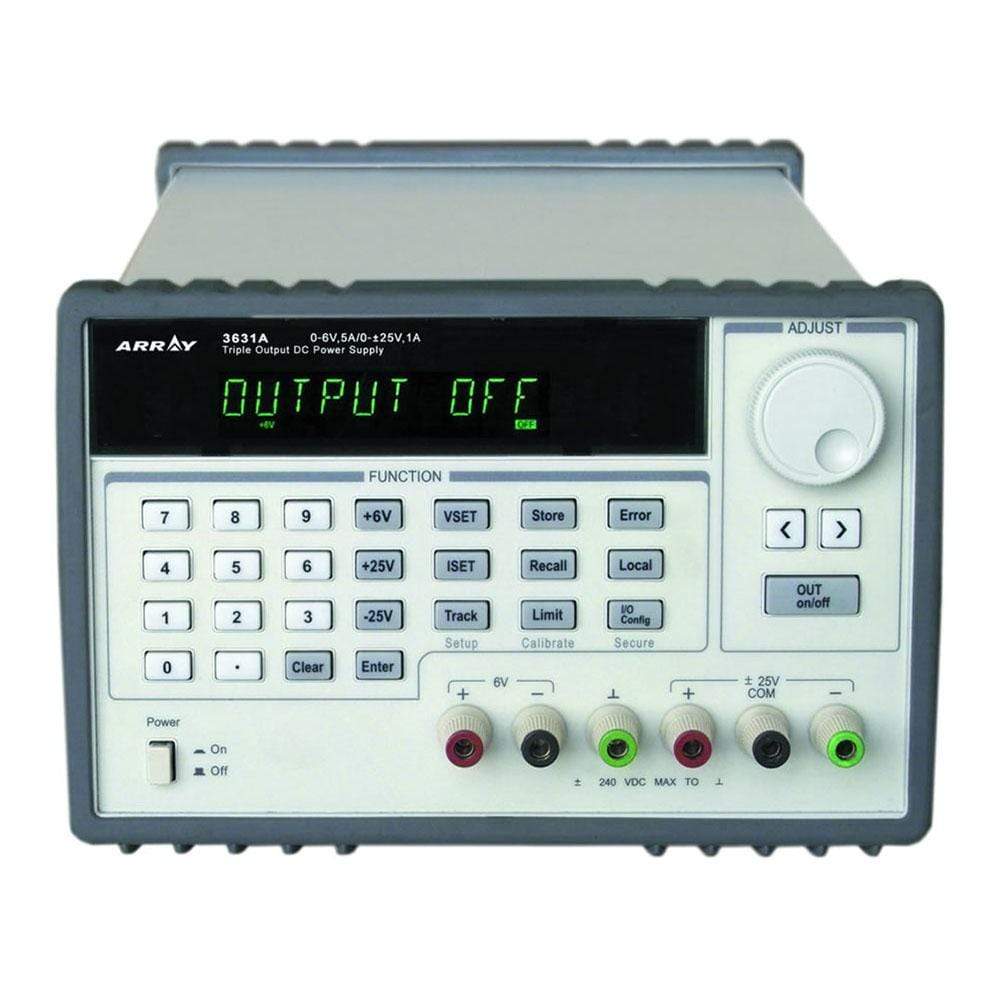
Array 3631A Gleichstromnetzteil mit Dreifachausgang
Array 3631A Gleichstromnetzteil mit Dreifachausgang
SKU: 3631A
Verfügbarkeit für Abholungen konnte nicht geladen werden
Key Features
Overview
The Array 3631A represents outstanding value in precision DC power supplies, combining linear regulation performance with advanced programmable features. This 80-watt triple output supply provides three independent channels: an isolated 6V/5A output ideal for digital circuits, and dual ±25V/1A outputs with precision tracking for analogue applications.
Built by Array Electronic Co. Ltd, a Taiwanese company established in 1998 with ISO 9000 certification, the 3631A delivers laboratory-grade performance at an accessible price point. The linear topology ensures ultra-clean power with exceptional load regulation and minimal noise, making it suitable for sensitive RF, audio, and precision measurement applications.
The 3631A shares command compatibility with industry-standard instruments, supporting SCPI programming via USB, RS-232, and optional GPIB interfaces. Front-panel operation features vacuum-fluorescent display technology and tactile controls for reliable bench use.
Compare with our complete range of bench power supplies and explore complementary electronic loads for comprehensive power testing solutions. For higher current applications, consider the Array 367XA series switching supplies.
Downloads
Why Engineers Choose The Array 3631A Gleichstromnetzteil mit Dreifachausgang
Precision Dual-Rail Power
Clean Linear Performance
Proven Value Alternative
Das Array Electronic 3631A Gleichstromnetzteil mit Dreifachausgang bietet die stabile und zuverlässige Gleichstromversorgung, die Sie benötigen.
Questions and Answers
-
What Remote Control Interfaces Are Available and Do I Need Special Software?
USB and RS-232 are standard, with GPIB as an option. The 3631A uses SCPI commands, so you can drive it from any environment that can talk to a serial or USB port, such as LabVIEW, MATLAB or Python. The USB connection needs Array's driver; no other proprietary software is needed for basic remote operation.
-
How Accurate Are the Voltage and Current Settings?
Voltage programming accuracy is 0.05% + 20mV on the ±25V outputs and 0.1% + 5mV on the 6V output. Current programming accuracy is 0.15% + 4mA on the ±25V outputs and 0.2% + 10mA on the 6V output.
-
Can I Store and Recall Different Power Supply Configurations Quickly?
Yes. The 3631A stores up to 10 complete operating states in non-volatile memory, each covering all three channel settings, tracking mode and limit values. Use the Store/Recall buttons to switch configurations during test sequences.
-
What Protection Features Does the 3631A Have?
You can set your own voltage and current limits below the maximum ratings, so an output setting cannot exceed them. When the load draws the set current, the output crosses over into constant-current mode rather than shutting down.
Array does not specify over-voltage, over-current or over-temperature protection, so add external protection if your circuit needs it.
-
How Does the Display and Front-Panel Operation Compare with Modern Instruments?
The vacuum-fluorescent display is highly visible and shows voltage and current for the selected channel at the same time. It isn't a colour LCD, but it has dedicated function keys and a control knob for precise adjustment.
-
Can I Use the ±25V Outputs Independently or Do They Always Track Together?
The ±25V outputs can operate independently or in tracking mode. Press and hold the Track key for more than two seconds to turn symmetric tracking on, and press it again to turn it off. In tracking mode, both outputs keep ±(0.2% + 20mV) accuracy. You can also connect them in series for 0-50V/1A operation.
-
What Makes the Array 3631A Different From Switching Power Supplies?
The 3631A is a linear regulated supply with three linear regulated outputs. Linear regulation gives low ripple and noise, under 0.35mVrms, which suits noise-sensitive analogue work.
-
How Does the 6V Channel Isolation Benefit My Applications?
The 6V output is isolated from the ±25V outputs and from the remote interface. This helps prevent ground loops and interference between digital and analogue circuits, so you can power different sections of a mixed-signal design without interaction.
No questions match your search.