# Title: RadioStation Click Board™
## Description: The RadioStation Click Board™ can be used to broadcast music via the FM radio band. It features the Si4713-B30 from Silicon Labs, the best in class integrated FM broadcast stereo transmitter, which operates in the frequency range of 76MHz to 108MHz. It can also broadcast RDS/RDBS data. The click board™ can be equipped with a small FM antenna, which is used to extend the broadcasting range. One of the advantages of this versatile FM broadcast stereo transmitter IC is that it needs almost no external components so it is very easy to work with it. That makes it an ideal solution for using it in cellular phones, MP3 players, portable media players, wireless speakers, personal computers and any other applications, where short-range radio broadcasting is wanted. How Does The RadioStation Click Board™ Work? The RadioStation Click Board™ broadcasts the audio signal by utilizing principles of the FM radio broadcasting. The audio signal, brought to the low noise analog input terminals of the Si4713-B30 routed to a mini 3.5 female jack on board, is attenuated and converted into an alias free, digital format. The digitalized audio is then sent to the digital signal processor (DSP) section of the Si4713-B30 IC. This input is suited for line-level signals, up to 636mVpp. The Si4713-B30 IC performs the frequency modulation in the digital domain, in order to achieve high fidelity and optimal performance. The onboard DSP provides modulation adjustment and audio dynamic range control of the signal, for the best listening experience. Audio signal is processed to have the optimal dynamic qualities. Also, Si4713 has a programmable low audio and high audio level indicators that allow enabling and disabling of the carrier signal, based on the presence of an audio content. The integrated DSP also takes care of the stereo MPX encoding and FM modulation of the signal. The low level digital intermediate frequency (IF) signal is then filtered out and sent to the output stage mixer, where it is converted to a radio frequency signal (RF). RF harmonics and noise get filtered out additionally, to get a signal which is compliant with local regulations on RF transmission (FCC, ETSI, ARIB…). The RF signal is broadcasted via the small antenna. The device supports all kinds of closed loop/pole FM antennae. The click is designed for communication over the I2C/2-wire control interface. When selecting 2-wire mode, SCLK pin should stay at a HIGH logic level during the rising edge on the RST pin, and stay HIGH until after the first start condition. Also, a start condition must not occur within 300nS before the rising edge on the RST pin. The 2-wire bus mode uses only the SCL and SDA pins for communication. The INT# pin of the Si4713-B30 is routed to the INT pin on the mikroBUS™ and it can be used to provide an interrupt. The SEN# pin of the Si4713-B30 is routed to the CS pin on the mikroBUS™ and it is used for selecting the I2C address: when SEN# is set to a HIGH logic level, the 7bit I2C address will be 1100011. when SEN# is set to a LOW logic level, the 7bit I2C address will be 0010001. The RST# pin of the of the Si4713-B30 is routed to the RST pin on the mikroBUS™. Setting it to a LOW logic state will disable analog and digital circuitry, reset the registers to their default settings, and disable the bus. Setting the RST pin to a HIGH logic level will bring the device out of reset and place it in power down mode. A power down mode is available to reduce power consumption when the part is idle. Putting the device in power down mode will disable analog and digital circuitry and keep the bus active. The Si4713-B30 IC has the capability of the received signal measurement. The antenna which is used to broadcast the signal can also be used to accept the incoming signal, sent by the receiving device. Although it can be used both to receive and transmit signal, the antenna can't operate in both modes simultaneously. This feature can be useful when calibrating the transmission power of the click board. Note: The Si4713-B30 integrates the complete transmit functions for standards-compliant unlicensed FM broadcast stereo transmission. The user application must comply with the local regulations on radio frequency (RF) transmission. SPECIFICATIONS Type FM Applications Cellular phones, MP3 players, portable media players, wireless speakers, personal computers and any other applications, where audio broadcasting on the small distance is required. On-board modules Si4713-B30 from Silicon Labs, the best in class integrated FM broadcast stereo transmitter Key Features Easy to set, high quality integrated FM radio transmitter. It uses advanced audio processing techniques to avoid over-modulation and to achieve perfect levels of audio for broadcasting. Interface I2C Compatibility mikroBUS Click board size M (42.9 x 25.4 mm) Input Voltage 3.3V PINOUT DIAGRAM This table shows how the pinout on the RadioStation Click Board™ corresponds to the pinout on the mikroBUS™ socket (the latter shown in the two middle columns). Notes Pin Pin Notes NC 1 AN PWM 16 NC Device reset RST 2 RST INT 15 INT GPO /Interrupt I2C address selection SEN 3 CS RX 14 NC NC 4 SCK TX 13 NC NC 5 MISO SCL 12 SCL I2C clock NC 6 MOSI SDA 11 SDA I2C data Power supply 3V3 7 3.3V 5V 10 NC Ground GND 8 GND GND 9 GND Ground RADIOSTATION CLICK ELECTRICAL SPECIFICATIONS Description Min Typ Max Unit Ambient temperature -20 85 °C Broadcasting frequency range 76 108 MHz Transmit emissions in-band (76–108 MHz) -30 dBc SNR 53 58 dB THD 0.5 % ADDITIONAL PINS Name I/O Description ANT O ANTENNA output pin ONBOARD SETTINGS AND INDICATORS Label Name Default Description PWR Power LED - Power LED indicator
## Product type: Click Board
## Vendor: Mikroelektronika d.o.o.
## Tags: Audio & Voice, Click Board, FM Radio, MikroE, Wireless
## Price range: 17.5 - 17.5 GBP
## Link: https://thedebugstore.com/products/radiostation-click-board-mikroe-2822-uk
## Compare-at price range: 25.0 - 25.0 GBP
## Options
- Title: Default Title
## Collections
- [New Products](https://thedebugstore.com/a/llms/collections/new-products-debug-store)
- [Mikroelektronika d.o.o. (MikroE)](https://thedebugstore.com/a/llms/collections/mikroelektronika-catalogue-uk)
- [Audio & Voice Click Boards™](https://thedebugstore.com/a/llms/collections/audio-voice-click-boards-catalogue)
- [Wireless Interface Click Boards™](https://thedebugstore.com/a/llms/collections/wireless-interface-click-boards-catalogue)
- [MikroE Click Boards™](https://thedebugstore.com/a/llms/collections/mikroe-click-boards-catalogue-uk)
- [FM Radio Click Boards™](https://thedebugstore.com/a/llms/collections/fm-radio-click-boards-catalogue)
- [Click Boards™ Summer Sale](https://thedebugstore.com/a/llms/collections/inventory-sale)
- [MikroE Sale](https://thedebugstore.com/a/llms/collections/mikroe-sale)
- [MIKROE Stock](https://thedebugstore.com/a/llms/collections/mikroe-products-in-stock-sale)
## Variants
- Default Title, SKU: MIKROE-2822, Available: yes, Inventory: 1
## Metafields
- full_description: The RadioStation Click Board™ can be used to broadcast music via the FM radio band. It features the Si4713-B30 from Silicon Labs, the best in class integrated FM broadcast stereo transmitter, which operates in the frequency range of 76MHz to 108MHz. It can also broadcast RDS/RDBS data. The click board™ can be equipped with a small FM antenna, which is used to extend the broadcasting range.
One of the advantages of this versatile FM broadcast stereo transmitter IC is that it needs almost no external components so it is very easy to work with it. That makes it an ideal solution for using it in cellular phones, MP3 players, portable media players, wireless speakers, personal computers and any other applications, where short-range radio broadcasting is wanted.
How Does The RadioStation Click Board™ Work?
The RadioStation Click Board™ broadcasts the audio signal by utilizing principles of the FM radio broadcasting. The audio signal, brought to the low noise analog input terminals of the Si4713-B30 routed to a mini 3.5 female jack on board, is attenuated and converted into an alias free, digital format. The digitalized audio is then sent to the digital signal processor (DSP) section of the Si4713-B30 IC. This input is suited for line-level signals, up to 636mVpp.
The Si4713-B30 IC performs the frequency modulation in the digital domain, in order to achieve high fidelity and optimal performance. The onboard DSP provides modulation adjustment and audio dynamic range control of the signal, for the best listening experience. Audio signal is processed to have the optimal dynamic qualities. Also, Si4713 has a programmable low audio and high audio level indicators that allow enabling and disabling of the carrier signal, based on the presence of an audio content.
The integrated DSP also takes care of the stereo MPX encoding and FM modulation of the signal. The low level digital intermediate frequency (IF) signal is then filtered out and sent to the output stage mixer, where it is converted to a radio frequency signal (RF). RF harmonics and noise get filtered out additionally, to get a signal which is compliant with local regulations on RF transmission (FCC, ETSI, ARIB…). The RF signal is broadcasted via the small antenna. The device supports all kinds of closed loop/pole FM antennae.
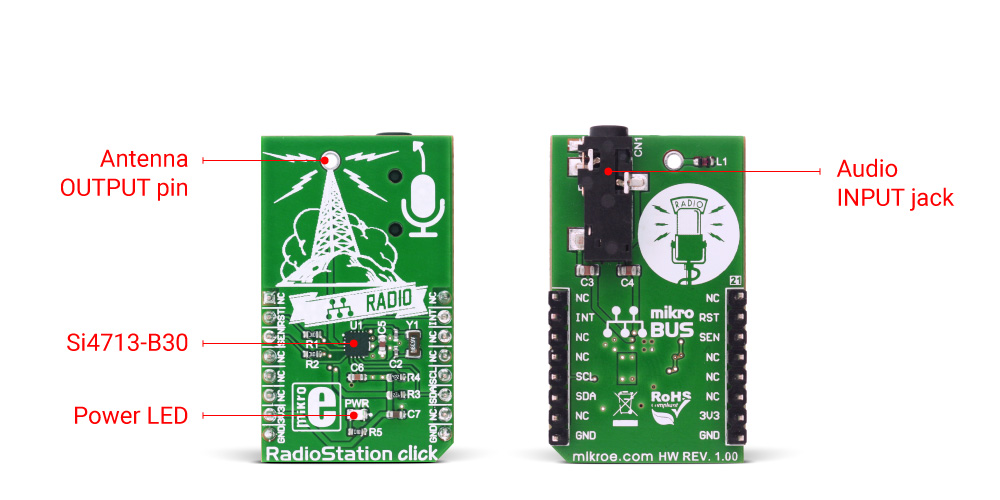
The click is designed for communication over the I2C/2-wire control interface. When selecting 2-wire mode, SCLK pin should stay at a HIGH logic level during the rising edge on the RST pin, and stay HIGH until after the first start condition. Also, a start condition must not occur within 300nS before the rising edge on the RST pin. The 2-wire bus mode uses only the SCL and SDA pins for communication.
The INT# pin of the Si4713-B30 is routed to the INT pin on the mikroBUS™ and it can be used to provide an interrupt.
The SEN# pin of the Si4713-B30 is routed to the CS pin on the mikroBUS™ and it is used for selecting the I2C address:
- when SEN# is set to a HIGH logic level, the 7bit I2C address will be 1100011.
- when SEN# is set to a LOW logic level, the 7bit I2C address will be 0010001.
The RST# pin of the of the Si4713-B30 is routed to the RST pin on the mikroBUS™. Setting it to a LOW logic state will disable analog and digital circuitry, reset the registers to their default settings, and disable the bus. Setting the RST pin to a HIGH logic level will bring the device out of reset and place it in power down mode. A power down mode is available to reduce power consumption when the part is idle. Putting the device in power down mode will disable analog and digital circuitry and keep the bus active.
The Si4713-B30 IC has the capability of the received signal measurement. The antenna which is used to broadcast the signal can also be used to accept the incoming signal, sent by the receiving device. Although it can be used both to receive and transmit signal, the antenna can't operate in both modes simultaneously. This feature can be useful when calibrating the transmission power of the click board.
Note: The Si4713-B30 integrates the complete transmit functions for standards-compliant unlicensed FM broadcast stereo transmission. The user application must comply with the local regulations on radio frequency (RF) transmission.
SPECIFICATIONS
| Type |
FM |
| Applications |
Cellular phones, MP3 players, portable media players, wireless speakers, personal computers and any other applications, where audio broadcasting on the small distance is required. |
| On-board modules |
Si4713-B30 from Silicon Labs, the best in class integrated FM broadcast stereo transmitter |
| Key Features |
Easy to set, high quality integrated FM radio transmitter. It uses advanced audio processing techniques to avoid over-modulation and to achieve perfect levels of audio for broadcasting. |
| Interface |
I2C |
| Compatibility |
mikroBUS |
| Click board size |
M (42.9 x 25.4 mm) |
| Input Voltage |
3.3V |
PINOUT DIAGRAM
This table shows how the pinout on the RadioStation Click Board™ corresponds to the pinout on the mikroBUS™ socket (the latter shown in the two middle columns).
| Notes |
Pin |
 |
Pin |
Notes |
| NC |
1 |
AN |
PWM |
16 |
NC |
| Device reset |
RST |
2 |
RST |
INT |
15 |
INT |
GPO /Interrupt |
| I2C address selection |
SEN |
3 |
CS |
RX |
14 |
NC |
| NC |
4 |
SCK |
TX |
13 |
NC |
| NC |
5 |
MISO |
SCL |
12 |
SCL |
I2C clock |
| NC |
6 |
MOSI |
SDA |
11 |
SDA |
I2C data |
| Power supply |
3V3 |
7 |
3.3V |
5V |
10 |
NC |
| Ground |
GND |
8 |
GND |
GND |
9 |
GND |
Ground |
RADIOSTATION CLICK ELECTRICAL SPECIFICATIONS
| Description |
Min |
Typ |
Max |
Unit |
| Ambient temperature |
-20 |
85 |
°C |
| Broadcasting frequency range |
76 |
108 |
MHz |
| Transmit emissions in-band (76–108 MHz) |
-30 |
dBc |
| SNR |
53 |
58 |
dB |
| THD |
0.5 |
% |
ADDITIONAL PINS
| Name |
I/O |
Description |
| ANT |
O |
ANTENNA output pin |
ONBOARD SETTINGS AND INDICATORS
| Label |
Name |
Default |
Description |
| PWR |
Power LED |
- |
Power LED indicator |
- description_tag: The RadioStation Click Board™ is a unique Click Board™ that can be used to broadcast the music via the FM radio band. It features the Si4713-B30 integrated FM broadcast stereo transmitter, which operates in the frequency range of 76MHz to 108MHz. It can also broadcast RDS/RDBS data. Available from Debug Store UK.
- title_tag: MikroE RadioStation Click Board™ (MIKROE-2822)
- manufacturer: Mikroelektronika d.o.o.
- warranty: 12 months
- amazon_enable: TRUE
- amazon_title: RadioStation Click Board
- amazon_product_type: computercomponent
- amazon_block: FALSE
- amazon_prime_enable: FALSE
- amazon_search: MikroElektronika Microelectronica MIKROE-1100
- amazon_uk_price: 22
- amazon_uk_currency: GBP
- amazon_de_currency: EUR
- amazon_de_price: 24.86
- amazon_fr_currency: EUR
- amazon_fr_price: 24.86
- amazon_es_currency: EUR
- amazon_es_price: 24.86
- amazon_nl_currency: EUR
- amazon_nl_price: 24.86
- amazon_it_currency: EUR
- amazon_it_price: 24.86
- amazon_se_curency: SEK
- amazon_se_price: 250.8
- amazon_product_id: 8606018711840
- amazon_product_id_type: EAN
- amazon_update: Update
- amazon_short_description: The RadioStation Click Board™ is a unique Click Board™ that can be used to broadcast the music via the FM radio band. It features the Si4713-B30 from Silicon Labs, the best in class integrated FM broadcast stereo transmitter, which operates in the frequency range of 76MHz to 108MHz. It can also broadcast RDS/RDBS data. The Click Board™ can be equipped with a small FM antenna, which is used to extend the broadcasting range.
- amazon_long_description: RadioStation Click is a unique Click Board™' that can be used to broadcast the music via the FM radio band. It features the Si4713-B30 from Silicon Labs, the best in class integrated FM broadcast stereo transmitter, which operates in the frequency range of 76MHz to 108MHz. It can also broadcast RDS/RDBS data. The Click Board™' can be equipped with a small FM antenna, which is used to extend the broadcasting range.
One of the advantages of this versatile FM broadcast stereo transmitter IC is that it needs almost no external components so it is very easy to work with it. That makes it an ideal solution for using it in cellular phones, MP3 players, portable media players, wireless speakers, personal computers and any other applications, where short-range radio broadcasting is wanted.
How Does it Work?
The RadioStation Click broadcasts the audio signal by utilizing principles of the FM radio broadcasting. The audio signal, brought to the low noise analog input terminals of the Si4713-B30 routed to a mini 3.5 female jack on board, is attenuated and converted into an alias free, digital format. The digitalized audio is then sent to the digital signal processor (DSP) section of the Si4713-B30 IC. This input is suited for line-level signals, up to 636mVpp.
The Si4713-B30 IC performs the frequency modulation in the digital domain, in order to achieve high fidelity and optimal performance. The on-board DSP provides modulation adjustment and audio dynamic range control of the signal, for the best listening experience. Audio signal is processed to have the optimal dynamic qualities. Also, Si4713 has a programmable low audio and high audio level indicators that allow enabling and disabling of the carrier signal, based on the presence of an audio content.
The integrated DSP also takes care of the stereo MPX encoding and FM modulation of the signal. The low level digital intermediate frequency (IF) signal is then filtered out and sent to the output stage mixer, where it is converted to a radio frequency signal (RF). RF harmonics and noise get filtered out additionally, to get a signal which is compliant with local regulations on RF transmission (FCC, ETSI, ARIB). The RF signal is broadcasted via the small antenna. The device supports all kinds of closed loop/pole FM antennas.
The Click is designed for communication over the I2C/2-wire control interface. When selecting 2-wire mode, SCLK pin should stay at a HIGH logic level during the rising edge on the RST pin, and stay HIGH until after the first start condition. Also, a start condition must not occur within 300nS before the rising edge on the RST pin. The 2-wire bus mode uses only the SCL and SDA pins for communication.
The INT# pin of the Si4713-B30 is routed to the INT pin on the mikroBUS and it can be used to provide an interrupt.
The SEN# pin of the Si4713-B30 is routed to the CS pin on the mikroBUS and it is used for selecting the I2C address:
when SEN# is set to a HIGH logic level, the 7bit I2C address will be 1100011.
when SEN# is set to a LOW logic level, the 7bit I2C address will be 0010001.
The RST# pin of the of the Si4713-B30 is routed to the RST pin on the mikroBUS. Setting it to a LOW logic state will disable analog and digital circuitry, reset the registers to their default settings, and disable the bus. Setting the RST pin to a HIGH logic level will bring the device out of reset and place it in power down mode. A power down mode is available to reduce power consumption when the part is idle. Putting the device in power down mode will disable analog and digital circuitry and keep the bus active.The Si4713-B30 IC has the capability of the received signal measurement. The antenna which is used to broadcast the signal can also be used to accept the incoming signal, sent by the receiving device. Although it can be used both to receive and transmit signal, the antenna can't operate in both modes simultaneously. This feature can be useful when calibrating the transmission power of the Click Board™.Note: The Si4713-B30 integrates the complete transmit functions for standards-compliant unlicensed FM broadcast stereo transmission. The user application must comply with the local regulations on radio frequency (RF) transmission.
.
- amazon_main_image: https://www.thedebugstore.com/images/product/lg-radiostation-click-board_1.jpg
- amazon_browse_node: 428655031
- mpn: MIKROE-2822
- backorder_label: If no stock shown above, check availability
- google_product_category: 5473
- examples:
We provide a library for the RadioStation Click Board™ on our LibStock page, as well as a demo application (example), developed using MikroElektronika compilers. The demo can run on all the main MikroElektronika development boards.
Library Description
The RadioStation Click Board™ communicates with the controller by using the I2C/2-wire interface. The library contains a wide set of functions for the complete control over the RadioStation click. Some of the functions also return the status, so it is possible to take an action in the case of error.
uint8_t RADIOSTATION_SetTuneFrequency(uint16_t freq) - Sets tune frequency
uint8_t RADIOSTATION_SetTunePower(uint8_t voltage, uint8_t capacitance) - Sets tune power
uint8_t RADIOSTATION_GetTuneMeasure(uint16_t freq, uint8_t capacitance) - Reads tuning measurements
Example Description
Demo application shows how to configure the RadioStation Click Board™ to receive the signal from the audio connector and broadcast it on 100.00 MHz frequency.
The application is composed of three sections:
- System initialization - Initializes GPIO pins, I2C peripheral used for communication between RadioStation click and MCU, and UART used for logging. This function also initializes driver.
- Application initialization - (Code snippet) Powers on RadioStation click and setups frequency for signal emission and writes a message to UART when emission is started.
- Application task - Sequentially reads measurements of the signal quality.
void applicationInit()
{
    status_ = RADIOSTATION_PowerUp();
    RADIOSTATION_GetRevision(&buff[0]);
    status_ = RADIOSTATION_SetTuneFrequency(transmitFrequency);
    RADIOSTATION_BusyWaitForSTCINT();
    RADIOSTATION_GetTuneStatus(1, &buff[0]);
    status_ = RADIOSTATION_SetTunePower(115, 0);
    RADIOSTATION_BusyWaitForSTCINT();
    RADIOSTATION_GetTuneStatus(1, &buff[0]);
    UART1_Write_Text("Radio Click now broadcastig at selected frequency");
}
The full application code and ready to use projects can be found on our LibStock page.
Other mikroE Libraries used in the example:
Additional notes and information
Depending on the development board you are using, you may need a USB UART click, USB UART 2 click or RS232 click to connect to your PC, for development systems with no UART to USB interface available on the board. The terminal available in all MikroElektronika compilers, or any other terminal application of your choice, can be used to read the message.
MIKROSDK
The RadioStation Click Board™ is supported with mikroSDK, the MikroElektronika Software Development Kit.
- attachments: [{"download_file":[{"download_file":"RadioStation Click Board™ Schematic"}],"download_filetype":[{"download_filetype":"pdf"}]},{"download_file":[{"download_file":"Silicon Labs Si4713-B30 FM Stereo Transmitter Datasheet"}],"download_filetype":[{"download_filetype":"pdf"}]}]
- condition: new
- custom_product: false
- mpn: MIKROE-2822
- google_product_category: Electronics
- custom_label_0: Click Board
- device_vendor: Silicon Labs
- device_type: SI4713-B30-GM
- warranty: 12 months
- brand: MikroE
- manufacturer: Mikroelektronika d.o.o.
- badge: No reviews
- widget:
- brands: gid://shopify/Metaobject/56256004319
- breadcrumbs: ["gid://shopify/Collection/447955239135","gid://shopify/Collection/241680580797","gid://shopify/Collection/241544298685"]
- customhs_code: 847330
- detailed_description: {"type":"root","children":[{"type":"paragraph","children":[{"type":"text","value":"The"},{"type":"text","value":" RadioStation Click Board™","bold":true,"italic":true},{"type":"text","value":" ","bold":true},{"type":"text","value":" can be used to broadcast music via the FM radio band. It features the Si4713-B30 from Silicon Labs, the best in class integrated FM broadcast stereo transmitter, which operates in the frequency range of 76MHz to 108MHz. It can also broadcast RDS/RDBS data. The click board™ can be equipped with a small FM antenna, which is used to extend the broadcasting range."}]},{"type":"paragraph","children":[{"type":"text","value":"One of the advantages of this versatile FM broadcast stereo transmitter IC is that it needs almost no external components so it is very easy to work with it. That makes it an ideal solution for using it in cellular phones, MP3 players, portable media players, wireless speakers, personal computers and any other applications, where short-range radio broadcasting is wanted."}]},{"type":"heading","level":3,"children":[{"type":"text","value":"How Does The RadioStation Click Board™ Work?"}]},{"type":"paragraph","children":[{"type":"text","value":"The "},{"type":"text","value":"RadioStation Click Board™","bold":true},{"type":"text","value":" broadcasts the audio signal by utilizing principles of the FM radio broadcasting. The audio signal, brought to the low noise analog input terminals of the Si4713-B30 routed to a mini 3.5 female jack on board, is attenuated and converted into an alias free, digital format. The digitalized audio is then sent to the digital signal processor (DSP) section of the Si4713-B30 IC. This input is suited for line-level signals, up to 636mVpp."}]},{"type":"paragraph","children":[{"type":"text","value":"The Si4713-B30 IC performs the frequency modulation in the digital domain, in order to achieve high fidelity and optimal performance. The onboard DSP provides modulation adjustment and audio dynamic range control of the signal, for the best listening experience. Audio signal is processed to have the optimal dynamic qualities. Also, Si4713 has a programmable low audio and high audio level indicators that allow enabling and disabling of the carrier signal, based on the presence of an audio content."}]},{"type":"paragraph","children":[{"type":"text","value":"The integrated DSP also takes care of the stereo MPX encoding and FM modulation of the signal. The low level digital intermediate frequency (IF) signal is then filtered out and sent to the output stage mixer, where it is converted to a radio frequency signal (RF). RF harmonics and noise get filtered out additionally, to get a signal which is compliant with local regulations on RF transmission (FCC, ETSI, ARIB…). The RF signal is broadcasted via the small antenna. The device supports all kinds of closed loop/pole FM antennae."},{"type":"text","value":""},{"type":"text","value":""},{"type":"text","value":""},{"type":"text","value":""},{"type":"text","value":""}]},{"type":"paragraph","children":[{"type":"text","value":"The click is designed for communication over the I2C/2-wire control interface. When selecting 2-wire mode, SCLK pin should stay at a HIGH logic level during the rising edge on the RST pin, and stay HIGH until after the first start condition. Also, a start condition must not occur within 300nS before the rising edge on the RST pin. The 2-wire bus mode uses only the SCL and SDA pins for communication."}]},{"type":"paragraph","children":[{"type":"text","value":"The INT# pin of the Si4713-B30 is routed to the INT pin on the mikroBUS™ and it can be used to provide an interrupt."}]},{"type":"paragraph","children":[{"type":"text","value":"The SEN# pin of the Si4713-B30 is routed to the CS pin on the mikroBUS™ and it is used for selecting the I2C address:"}]},{"type":"list","listType":"unordered","children":[{"type":"list-item","children":[{"type":"text","value":"when SEN# is set to a HIGH logic level, the 7bit I2C address will be 1100011."}]},{"type":"list-item","children":[{"type":"text","value":"when SEN# is set to a LOW logic level, the 7bit I2C address will be 0010001."}]}]},{"type":"paragraph","children":[{"type":"text","value":"The RST# pin of the of the Si4713-B30 is routed to the RST pin on the mikroBUS™. Setting it to a LOW logic state will disable analog and digital circuitry, reset the registers to their default settings, and disable the bus. Setting the RST pin to a HIGH logic level will bring the device out of reset and place it in power down mode. A power down mode is available to reduce power consumption when the part is idle. Putting the device in power down mode will disable analog and digital circuitry and keep the bus active."},{"type":"text","value":""},{"type":"text","value":""},{"type":"text","value":""},{"type":"text","value":"The Si4713-B30 IC has the capability of the received signal measurement. The antenna which is used to broadcast the signal can also be used to accept the incoming signal, sent by the receiving device. Although it can be used both to receive and transmit signal, the antenna can't operate in both modes simultaneously. This feature can be useful when calibrating the transmission power of the click board."},{"type":"text","value":""},{"type":"text","value":""},{"type":"text","value":""},{"type":"text","value":""},{"type":"text","value":"Note: ","bold":true},{"type":"text","value":" The Si4713-B30 integrates the complete transmit functions for standards-compliant unlicensed FM broadcast stereo transmission. The user application must comply with the local regulations on radio frequency (RF) transmission."}]},{"type":"heading","level":3,"children":[{"type":"text","value":"SPECIFICATIONS"}]},{"type":"paragraph","children":[{"type":"text","value":"Type\nFM\nApplications\nCellular phones, MP3 players, portable media players, wireless speakers, personal computers and any other applications, where audio broadcasting on the small distance is required.\nOn-board modules\nSi4713-B30 from Silicon Labs, the best in class integrated FM broadcast stereo transmitter\nKey Features\nEasy to set, high quality integrated FM radio transmitter. It uses advanced audio processing techniques to avoid over-modulation and to achieve perfect levels of audio for broadcasting.\nInterface\nI2C\nCompatibility\nmikroBUS\nClick board size\nM (42.9 x 25.4 mm)\nInput Voltage\n3.3V"}]},{"type":"heading","level":3,"children":[{"type":"text","value":"PINOUT DIAGRAM"}]},{"type":"paragraph","children":[{"type":"text","value":"This table shows how the pinout on the "},{"type":"text","value":"RadioStation Click Board™","bold":true},{"type":"text","value":" corresponds to the pinout on the mikroBUS™ socket (the latter shown in the two middle columns)."}]},{"type":"paragraph","children":[{"type":"text","value":"Notes\nPin\nPin\nNotes\nNC\n1\nAN\nPWM\n16\nNC\nDevice reset\nRST\n2\nRST\nINT\n15\nINT\nGPO /Interrupt\nI2C address selection\nSEN\n3\nCS\nRX\n14\nNC\nNC\n4\nSCK\nTX\n13\nNC\nNC\n5\nMISO\nSCL\n12\nSCL\nI2C clock\nNC\n6\nMOSI\nSDA\n11\nSDA\nI2C data\nPower supply\n3V3\n7\n3.3V\n5V\n10\nNC\nGround\nGND\n8\nGND\nGND\n9\nGND\nGround"}]},{"type":"heading","level":3,"children":[{"type":"text","value":"RADIOSTATION CLICK ELECTRICAL SPECIFICATIONS"}]},{"type":"paragraph","children":[{"type":"text","value":"Description\nMin\nTyp\nMax\nUnit\nAmbient temperature\n-20\n85\n°C\nBroadcasting frequency range\n76\n108\nMHz\nTransmit emissions in-band (76–108 MHz)\n-30\ndBc\nSNR\n53\n58\ndB\nTHD\n0.5\n%"}]},{"type":"heading","level":3,"children":[{"type":"text","value":"ADDITIONAL PINS"}]},{"type":"paragraph","children":[{"type":"text","value":"Name\nI/O\nDescription\nANT\nO\nANTENNA output pin"}]},{"type":"heading","level":3,"children":[{"type":"text","value":"ONBOARD SETTINGS AND INDICATORS"}]},{"type":"paragraph","children":[{"type":"text","value":"Label\nName\nDefault\nDescription\nPWR\nPower LED\n-\nPower LED indicator"}]},{"type":"heading","level":3,"children":[{"type":"text","value":" "}]}]}
- summary: The RadioStation Click Board™ is a unique Click Board™ that can be used to broadcast the music via the FM radio band. It features the Si4713-B30 from Silicon Labs, the best in class integrated FM broadcast stereo transmitter, which operates in the frequency range of 76MHz to 108MHz. It can also broadcast RDS/RDBS data.
The RadioStation Click Board™ can be equipped with a small FM antenna, which is used to extend the broadcasting range.