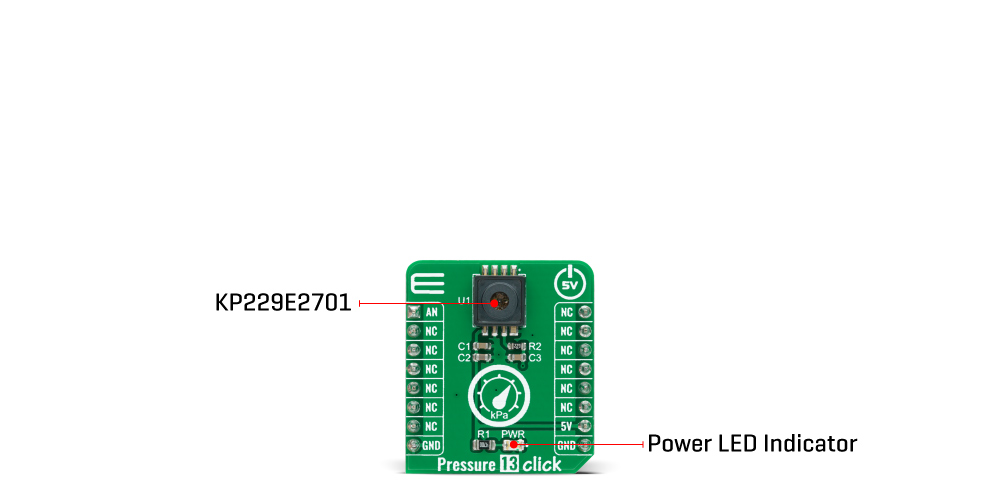
The Pressure 13 Click Board™ is based on the KP229E2701, a miniaturized analog absolute pressure sensor based on a capacitive principle from Infineon. The pressure is detected by an array of capacitive surface micromachined sensor cells (a monolithic integrated signal conditioning circuit implemented in BiCMOS technology). The sensor cell output is amplified, temperature compensated, and linearized to obtain an output voltage that is proportional to the applied pressure. The manifold air pressure (MAP) is a principal parameter to compute the air-fuel ratio provided to the engine for lower emission due to better combustion and increased efficiency. For cost-sensitive engine systems, a MAP sensor shows the potential to complement or even substitute mass airflow (MAF) sensors.
The accuracy of the KP229E2701 sensor is influenced by the supply voltage (ratiometric error) as well as by pressure, temperature, and aging effects. All parameters needed for the complete calibration algorithm - such as offset, gain, temperature coefficients of offset and gain, and linearization parameters - are determined after the assembly. These parameters are stored in an integrated E²PROM protected with forwarding error correction (a one-bit error is detected and corrected, errors of more than one bit are detected, and the output signal is switched to ground potential).
In automotive applications where high production volumes are custom, there is substantial interest in precision, low-cost, and fully integrated sensors. That's why the manifold pressure data can be used to compute diagnostics of leakages and malfunctions of the exhaust gas recirculation valve.
The Pressure 13 Click Board™ communicates with MCU using only one GPIO pin routed on the AN pin of the mikroBUS™ socket. The KP229E2701 sensor possesses several digital pins used only during calibration and test. That's why it's recommended and done to leave these pins floating. The output circuit acts as a low-pass decoupling filter between the sensor output and the A/D input of the MCU because it's recommended to protect the pressure sensor against overload and electromagnetic interferences.
The Pressure 13 Click Board™ is designed to be operated only with a 5V logic voltage level. A proper logic voltage level conversion should be performed before the Click board™ is used with MCUs with different logic levels. However, the Click board™ comes equipped with a library that contains easy to use functions and an example code that can be used as a reference for further development.
| Type | Pressure |
| Applications | Can be used for advanced automotive applications as well as in industrial and consumer applications. |
| On-board modules | The Pressure 13 Click Board™ is based on the KP229E2701, a miniaturized analog absolute pressure sensor based on a capacitive principle from Infineon. |
| Key Features | Low power consumption, high precision pressure sensing (± 2.5 kPa), ratiometric analog output, large temperature range, automotive qualified, and more. |
| Interface | Analog |
| Compatibility | mikroBUS |
| Click board size | S (28.6 x 25.4 mm) |
| Input Voltage | 5V |
This table shows how the pinout on Pressure 13 Click corresponds to the pinout on the mikroBUS™ socket (the latter shown in the two middle columns).
| Notes | Pin |  |
Pin | Notes | |||
|---|---|---|---|---|---|---|---|
| Analog Pressure Signal Output |
AN | 1 | AN | PWM | 16 | NC | |
| NC | 2 | RST | INT | 15 | NC | ||
| NC | 3 | CS | RX | 14 | NC | ||
| NC | 4 | SCK | TX | 13 | NC | ||
| NC | 5 | MISO | SCL | 12 | NC | ||
| NC | 6 | MOSI | SDA | 11 | NC | ||
| NC | 7 | 3.3V | 5V | 10 | 5V | Power Supply | |
| Ground | GND | 8 | GND | GND | 9 | GND | Ground |
| Label | Name | Default | Description |
|---|---|---|---|
| LD1 | PWR | - | Power LED Indicator |
| Description | Min | Typ | Max | Unit |
|---|---|---|---|---|
| Supply Voltage | 4.5 | - | 5.5 | V |
| Ambient Operating Pressure Range | 10 | - | 300 | kPa |
| Accuracy | - | ±3.75 | - | kPa |
| Maximum Output Current | -1 | - | 1 | mA |
| Analog Output Voltage | 0.4 | - | 4.65 | V |
| Operating Temperature Range | -40 | - | 140 | °C |
Besides a very low error margin of only 1.5% across the full scale span (including errors caused by the offset, hysteresis, non-linearity, and other factors…), the sensor also features long-term stability (±0.25% FSS), low power consumption, very low count of additional components (a single bypass capacitor for supply filtering, in most cases), making it very cheap and simple solution which can be used to measure the gauge pressure in the range from 0 to 600 mbar. Pressure 12 click is a very well suited for the development and prototyping of many different applications based on the gauge pressure measurement, including HVAC systems, pneumatic control, and regulation, air/gas pressure monitoring, but also some low-power IoT applications, such as weather IoT nodes, and similar.
The Pressure 12 Click Board is based on the ABP series gauge pressure sensor, labeled as ABPLLNN600MGAA3, made by Honeywell. The entire ABP series sensors are very similar in design, so minor differences specific for a particular sensor are actually encoded into its label. The ABP series datasheet offers a detailed explanation of each code of the label. The specific sensor used on the Pressure 12 click is a piezoresistive silicon pressure sensor, which can be used for non-corrosive and non-ionic dry gas media and should not be exposed to moisture and corrosion.

The sensor itself is based on a piezoresistive silicon membrane sensitive to pressure, which is backed up by an ASIC. The ASIC applies temperature compensation and calibration to the signal. The ratiometric voltage at the output pin is updated once per one ms (1kHz), allowing it to be used either by the A/D converter of the host MCU or directly within the control feedback loop, ensuring the least possible latency.
The thermal compensation covers the range between 0⁰C and 50 ⁰C, where the sensor has the smallest TEB value. The datasheet introduces TEB (Total Error Band) term as the most realistic representation of the sensor's accuracy, taking many factors into an account, including errors caused by the offset, hysteresis, non-linearity, and other factors… Honeywell uses the TEB to illustrate the overall sensor's accuracy, since no single parameter can exist without being influenced by some other parameters (thermal effect on the offset, hysteresis, just to name few). This helps to paint a more realistic picture of the sensor's performance.
The sensor contains a single axial barbless port, adequate for secure interfacing with various pipes, hoses or gas-filled containers of some pressurized system which needs to be controlled or monitored. No barbed port is required for this sensor, as the maximum gauge pressure, it can measure goes up to 600mbar. The voltage at the output changes proportionally with the applied pressure. The ABP series datasheet provides a simple conversion formula, which can be used to calculate the pressure value for a given output voltage. This formula is simple to be calculated by the firmware that runs on the host MCU, as the output voltage is already conditioned by the sensor's ASIC.
Since the sensor uses only an analog output voltage, which changes proportionally with the applied pressure (as described previously), there are no setup registers, or any user-configurable parameters. However, the Click board™ is supported by a mikroSDK compatible library with functions that allow using an internal ADC module of the MCU, and an example that demonstrates their use. The demo example utilizes the aforementioned conversion formula to output pressure value based on the sensor's output voltage.
Pressure 12 click is supported by a mikroSDK compliant library, which includes functions that simplify software development. This Click board™ comes as a fully tested product, ready to be used on a system equipped with the mikroBUS™ socket.
- amazon_main_image: https://www.thedebugstore.com/images/product/lg-pressure-12-click-3466-front_1.jpg - amazon_other_image_1: https://www.thedebugstore.com/images/product/lg-pressure-12-click-3466-back_1.jpg - amazon_other_image_2: https://www.thedebugstore.com/images/product/lg-pressure-12-click-3466-in-use_1.jpg - amazon_other_image_3: https://www.thedebugstore.com/images/product/lg-pressure-12-click-3466-in-use_1.jpg - amazon_browse_node: 428655031 - mpn: MIKROE-4294 - backorder_label: If no stock shown above, check availability - badge: - widget:We provide a library for the Pressure 13 Click Board™ on our LibStock page, as well as a demo application (example), developed using MikroElektronika compilers. The demo can run on all the main MikroElektronika development boards.
The library covers all the necessary functions to control Pressure 13 click board.
void pressure13_gpio_driver_init( pressure13_obj_t gpio_obj ) - Function initializes GPIO driver for the desired MIKROBUS1.The application is composed of three sections :
  void application_task ( )
  {
      adc_value = pressure13_adc_read( );

      WordToStr( adc_value, log_text );
      Ltrim( log_text );
      mikrobus_logWrite( " ADC     : ", _LOG_TEXT );
      mikrobus_logWrite( log_text, _LOG_LINE );

      calculate_pressure( );

      FloatToStr( v_out, log_text );
      mikrobus_logWrite( " Vout    : ", _LOG_TEXT );
      mikrobus_logWrite( log_text, _LOG_TEXT );
      mikrobus_logWrite( " V", _LOG_LINE );

      FloatToStr( pressure, log_text );
      mikrobus_logWrite( " Pressure: ", _LOG_TEXT );
      mikrobus_logWrite( log_text, _LOG_TEXT );
      mikrobus_logWrite( " mBar", _LOG_LINE );
      mikrobus_logWrite( "-------------------------", _LOG_LINE );
      Delay_ms( 5000 );
  }
void calculate_pressure ( void ) - Calculate Voltage Reference and Pressure.The full application code, and ready to use projects can be found on our LibStock page.
Other mikroE Libraries used in the example:
Depending on the development board you are using, you may need USB UART click, USB UART 2 click or RS232 click to connect to your PC, for development systems with no UART to USB interface available on the board. The terminal available in all MikroElektronika compilers, or any other terminal application of your choice, can be used to read the message.
The Pressure 13 Click Board™ is supported with mikroSDK - MikroElektronika Software Development Kit. To ensure proper operation of mikroSDK compliant Click board™ demo applications, mikroSDK should be downloaded from the LibStock and installed for the compiler you are using.
- attachments: [{"download_file":[{"download_file":"Pressure 13 Click Board™ Schematic"}],"download_filetype":[{"download_filetype":"pdf"}]},{"download_file":[{"download_file":"Infineon KP229E2701 Air Pressure Sensor Datasheet"}],"download_filetype":[{"download_filetype":"pdf"}]}] - condition: new - custom_product: false - mpn: MIKROE-4294 - google_product_category: Electronics - custom_label_0: Click Board - device_vendor: Infineon Technologies - device_type: KP229E2701 - warranty: 12 months - brand: MikroE - key_feature_1: For Manifold Air Pressure Measurement - manufacturer: Mikroelektronika d.o.o. - target_keyword: Pressure 13 Click Board - brands: gid://shopify/Metaobject/56256004319 - breadcrumbs: ["gid://shopify/Collection/447955239135","gid://shopify/Collection/241680580797","gid://shopify/Collection/241545969853"] - customhs_code: 847330 - detailed_description: {"type":"root","children":[{"type":"heading","level":3,"children":[{"type":"text","value":"How Does The Pressure 13 Click Board™ Work?"}]},{"type":"paragraph","children":[{"type":"text","value":"The "},{"type":"text","value":"Pressure 13 Click Board™","bold":true,"italic":true},{"type":"text","value":" is based on the KP229E2701, a miniaturized analog absolute pressure sensor based on a capacitive principle from Infineon. The pressure is detected by an array of capacitive surface micromachined sensor cells (a monolithic integrated signal conditioning circuit implemented in BiCMOS technology). The sensor cell output is amplified, temperature compensated, and linearized to obtain an output voltage that is proportional to the applied pressure. The manifold air pressure (MAP) is a principal parameter to compute the air-fuel ratio provided to the engine for lower emission due to better combustion and increased efficiency. For cost-sensitive engine systems, a MAP sensor shows the potential to complement or even substitute mass airflow (MAF) sensors."}]},{"type":"paragraph","children":[{"type":"text","value":""}]},{"type":"paragraph","children":[{"type":"text","value":"The accuracy of the KP229E2701 sensor is influenced by the supply voltage (ratiometric error) as well as by pressure, temperature, and aging effects. All parameters needed for the complete calibration algorithm - such as offset, gain, temperature coefficients of offset and gain, and linearization parameters - are determined after the assembly. These parameters are stored in an integrated E²PROM protected with forwarding error correction (a one-bit error is detected and corrected, errors of more than one bit are detected, and the output signal is switched to ground potential)."}]},{"type":"paragraph","children":[{"type":"text","value":"In automotive applications where high production volumes are custom, there is substantial interest in precision, low-cost, and fully integrated sensors. That's why the manifold pressure data can be used to compute diagnostics of leakages and malfunctions of the exhaust gas recirculation valve."}]},{"type":"paragraph","children":[{"type":"text","value":"The "},{"type":"text","value":"Pressure 13 Click Board™","bold":true},{"type":"text","value":" communicates with MCU using only one GPIO pin routed on the AN pin of the mikroBUS™ socket. The KP229E2701 sensor possesses several digital pins used only during calibration and test. That's why it's recommended and done to leave these pins floating. The output circuit acts as a low-pass decoupling filter between the sensor output and the A/D input of the MCU because it's recommended to protect the pressure sensor against overload and electromagnetic interferences."}]},{"type":"paragraph","children":[{"type":"text","value":"The "},{"type":"text","value":"Pressure 13 Click Board™","bold":true},{"type":"text","value":" is designed to be operated only with a 5V logic voltage level. A proper logic voltage level conversion should be performed before the Click board™ is used with MCUs with different logic levels. However, the Click board™ comes equipped with a library that contains easy to use functions and an example code that can be used as a reference for further development."}]},{"type":"heading","level":3,"children":[{"type":"text","value":"SPECIFICATIONS"}]},{"type":"paragraph","children":[{"type":"text","value":"Type\nPressure\nApplications\nCan be used for advanced automotive applications as well as in industrial and consumer applications.\nOn-board modules\nThe Pressure 13 Click Board™ is based on the KP229E2701, a miniaturized analog absolute pressure sensor based on a capacitive principle from Infineon.\nKey Features\nLow power consumption, high precision pressure sensing (± 2.5 kPa), ratiometric analog output, large temperature range, automotive qualified, and more.\nInterface\nAnalog\nCompatibility\nmikroBUS\nClick board size\nS (28.6 x 25.4 mm)\nInput Voltage\n5V"}]},{"type":"heading","level":3,"children":[{"type":"text","value":"PINOUT DIAGRAM"}]},{"type":"paragraph","children":[{"type":"text","value":"This table shows how the pinout on Pressure 13 Click corresponds to the pinout on the mikroBUS™ socket (the latter shown in the two middle columns)."}]},{"type":"paragraph","children":[{"type":"text","value":"Notes\nPin\nPin\nNotes\nAnalog Pressure\n Signal Output\nAN\n1\nAN\nPWM\n16\nNC\nNC\n2\nRST\nINT\n15\nNC\nNC\n3\nCS\nRX\n14\nNC\nNC\n4\nSCK\nTX\n13\nNC\nNC\n5\nMISO\nSCL\n12\nNC\nNC\n6\nMOSI\nSDA\n11\nNC\nNC\n7\n3.3V\n5V\n10\n5V\nPower Supply\nGround\nGND\n8\nGND\nGND\n9\nGND\nGround"}]},{"type":"heading","level":3,"children":[{"type":"text","value":"ONBOARD SETTINGS AND INDICATORS"}]},{"type":"paragraph","children":[{"type":"text","value":"Label\nName\nDefault\n Description\nLD1\nPWR\n-\nPower LED Indicator"}]},{"type":"heading","level":3,"children":[{"type":"text","value":"PRESSURE 13 CLICK ELECTRICAL SPECIFICATIONS"}]},{"type":"paragraph","children":[{"type":"text","value":"Description\nMin\nTyp\nMax\nUnit\nSupply Voltage\n4.5\n-\n5.5\nV\nAmbient Operating Pressure Range\n10\n-\n300\nkPa\nAccuracy\n-\n±3.75\n-\nkPa\nMaximum Output Current\n-1\n-\n1\nmA\nAnalog Output Voltage\n0.4\n-\n4.65\nV\nOperating Temperature Range\n-40\n-\n140\n°C"}]},{"type":"heading","level":3,"children":[{"type":"text","value":" "}]}]} - summary:The Pressure 13 Click Board™ is a compact add-on board that contains an integrated pressure sensor for manifold air pressure measurement applications. This board features the KP229E2701, a miniaturized analogue manifold air pressure sensor based on a capacitive principle from Infineon. This sensor converts the pressure of 10 kPa to 300 kPa into an analogue output signal, a voltage range of 0.40 V to 4.65 V. Also, the manifold pressure data can be used to compute diagnostics of leakages and malfunctions of the exhaust gas recirculation valve. The high accuracy and the high sensitivity of the KP229E2701 make this Click Board™ a perfect choice for advanced automotive applications as well as in industrial and consumer applications.
The Pressure 13 Click is supported by a mikroSDK compliant library, which includes functions that simplify software development. This Click Board™ comes as a fully tested product, ready to be used on a system equipped with the mikroBUS™ socket.