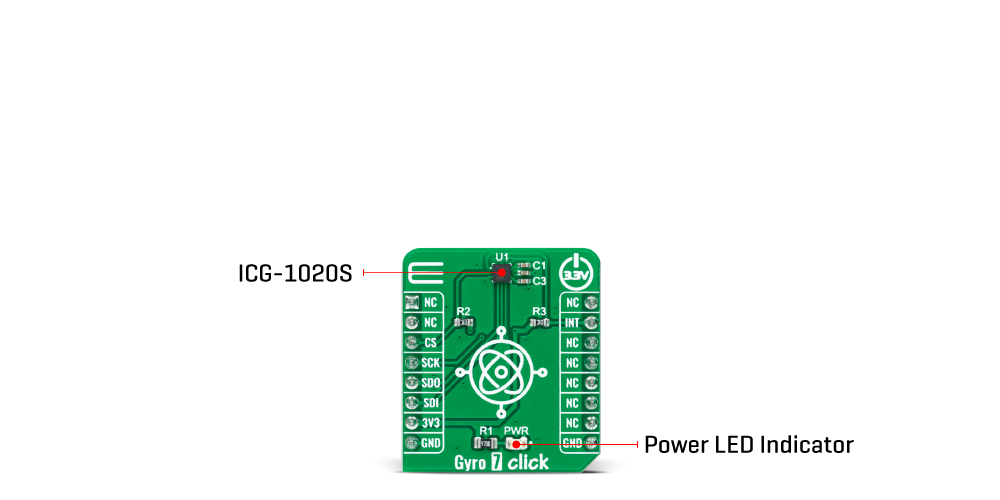
The Gyro 7 Click Board™ as its foundation uses the ICG-1020S, a high-performance 2-axis gyroscope from TDK InvenSense. The ICG-1020S is highly configurable with a full-scale programmable range from ±46.5dps to ±374dps. The single structure vibratory MEMS rate gyroscope detects the X- and Y-axis rotation. When the gyroscope is rotated about any sense axes, the Coriolis effect causes a detected vibration. The resulting signal is amplified, demodulated, and filtered to produce a proportional voltage to the angular rate. With its 2-axis integration, the Gyro 7 Click Board™ allows you to design it into an optical image stabilization (OIS) application.
Two-axis MEMS rate gyroscope sensor, the ICG-1020S, comes with integrated 16-bit ADCs and signal conditioning with two axes XY configuration. After the signal is digitized, data is processed through a digital filter and output through sensor data registers. Besides, the ICG-1020S is also characterized by high resolution and low RMS noise, noise density, a fast sample rate at up to 32kHz, and low power consumption.
The Gyro 7 Click Board™ communicates with MCU through a register-selectable standard SPI interface that enables high clock speed up to 20MHz, supporting the two most common SPI modes, SPI Mode 0 and 3. Other blocks include onboard clocking, temperature compensation, and bias circuits. The sensor data registers contain the latest gyro data, and they are read-only registers accessible via the serial interface. Data from these registers may be read anytime. It also possesses an additional interrupt signal, routed on the INT pin of the mikroBUS™ socket labelled as INT, indicating when a specific interrupt event occurs.
The Gyro 7 Click Board™ can be operated only with a 3.3V logic voltage level. The board must perform appropriate logic voltage level conversion before using MCUs with different logic levels. However, the Click board™ comes equipped with a library containing functions and an example code that can be used, as a reference, for further development.
| Type | Motion |
| Applications | The Gyro 7 Click Board™ can be used for optical image stabilization (OIS) applications |
| On-board modules | ICG-1020S - dual-axis MEMS angular rate sensor (gyroscope) from TDK InvenSense |
| Key Features | Low power consumption, full-scale programmable range up to ±374dps, integrated 16-bit ADCs, user-programmable digital filters, interrupt, high performance, reliability, and more |
| Interface | SPI |
| Compatibility | mikroBUS |
| Click board size | S (28.6 x 25.4 mm) |
| Input Voltage | 3.3V |
This table shows how the pinout of the Gyro 7 Click Board™ corresponds to the pinout on the mikroBUS™ socket (the latter shown in the two middle columns).
| Notes | Pin |  |
Pin | Notes | |||
|---|---|---|---|---|---|---|---|
| NC | 1 | AN | PWM | 16 | NC | ||
| NC | 2 | RST | INT | 15 | INT | Interrupt | |
| SPI Chip Select | CS | 3 | CS | RX | 14 | NC | |
| SPI Clock | SCK | 4 | SCK | TX | 13 | NC | |
| SPI Data OUT | SDO | 5 | MISO | SCL | 12 | NC | |
| SPI Data IN | SDI | 6 | MOSI | SDA | 11 | NC | |
| Power Supply | 3.3V | 7 | 3.3V | 5V | 10 | NC | |
| Ground | GND | 8 | GND | GND | 9 | GND | Ground |
| Label | Name | Default | Description |
|---|---|---|---|
| LD1 | PWR | - | Power LED Indicator |
| Description | Min | Typ | Max | Unit |
|---|---|---|---|---|
| Supply Voltage | - | 3.3 | - | V |
| Full-Scale Range | ±46.5 | - | ±374 | dps |
| Sensitivity | 87.5 | - | 700 | LSB/(º/s) |
| Resolution | - | 16 | - | bits |
| Operating Temperature Range | -40 | +25 | +85 | °C |
We provide a library for the Gyro 7 Click Board™ as well as a demo application (example), developed using MikroElektronika compilers. The demo can run on all the main MikroElektronika development boards.
The package can be downloaded/installed directly from NECTO Studio The package Manager (recommended), downloaded from our LibStock™ or found on MikroE Github account.
This library contains API for the Gyro 7 Click Board™ driver.
Key functions
gyro7_get_int_pin This function returns the INT pin logic state.
gyro7_read_gyroscope This function reads the gyroscope X and Y axis in degrees per second (dps).
gyro7_read_temperature This function reads the internal temperature in Celsius.
This example demonstrates the use of the Gyro 7 Click Board™ by reading and displaying the values of X and Y axis in degrees per second and the chip internal temperature in Celsius.
void application_task ( void )
 {
     if ( gyro7_get_int_pin ( &gyro7 ) )
     {
         float x_axis, y_axis, temperature;
         if ( GYRO7_OK == gyro7_read_gyroscope ( &gyro7, &x_axis, &y_axis ) )
         {
             log_printf( &logger, " X : %.2f dpsrn", x_axis );
             log_printf( &logger, " Y : %.2f dpsrn", y_axis );
         }
         if ( GYRO7_OK == gyro7_read_temperature ( &gyro7, &temperature ) )
         {
             log_printf( &logger, " Temperature : %.2f Crnn", temperature );
         }
     }
 }
The full application code, and ready to use projects can be installed directly from NECTO Studio The package Manager (recommended), downloaded from our LibStock™ or found on MikroE Github account.
Other MikroE Libraries used in the example:
Depending on the development board you are using, you may need a USB UART click, USB UART 2 Click or RS232 Click to connect to your PC, for development systems with no UART to USB interface available on the board. UART terminal is available in all MikroElektronika compilers.
The Gyro 7 Click Board™ is supported with mikroSDK - MikroElektronika Software Development Kit. To ensure proper operation of mikroSDK compliant Click board™ demo applications, mikroSDK should be downloaded from the LibStock and installed for the compiler you are using.
- attachments: [{"download_file":[{"download_file":"Gyro 7 Click Board™ Schematic"}],"download_filetype":[{"download_filetype":"pdf"}]},{"download_file":[{"download_file":"TDK InvenSense ICG-1020S 2-Axis Angular Rate Sensor Datasheet"}],"download_filetype":[{"download_filetype":"pdf"}]}] - mpn: MIKROE-5145 - mpn: MIKROE-5145 - custom_label_0: Click Board - google_product_category: Electronics - condition: new - custom_product: false - device_vendor: TDK InvenSense - device_type: ICG-1020S - warranty: 12 months - brand: MikroE - manufacturer: Mikroelektronika d.o.o. - target_keyword: Gyro 7 Click Board - brands: gid://shopify/Metaobject/56256004319 - breadcrumbs: ["gid://shopify/Collection/447955239135","gid://shopify/Collection/241680580797","gid://shopify/Collection/241545969853"] - customhs_code: 847330 - detailed_description: {"type":"root","children":[{"type":"heading","level":3,"children":[{"type":"text","value":"How Does The Gyro 7 Click Board™ Work?"}]},{"type":"paragraph","children":[{"type":"text","value":"The "},{"type":"text","value":"Gyro 7 Click Board™","bold":true,"italic":true},{"type":"text","value":" as its foundation uses the ICG-1020S, a high-performance 2-axis gyroscope from TDK InvenSense. The ICG-1020S is highly configurable with a full-scale programmable range from ±46.5dps to ±374dps. The single structure vibratory MEMS rate gyroscope detects the X- and Y-axis rotation. When the gyroscope is rotated about any sense axes, the Coriolis effect causes a detected vibration. The resulting signal is amplified, demodulated, and filtered to produce a proportional voltage to the angular rate. With its 2-axis integration, the "},{"type":"text","value":"Gyro 7 Click Board™","bold":true},{"type":"text","value":" allows you to design it into an optical image stabilization (OIS) application."}]},{"type":"paragraph","children":[{"type":"text","value":""}]},{"type":"paragraph","children":[{"type":"text","value":"Two-axis MEMS rate gyroscope sensor, the ICG-1020S, comes with integrated 16-bit ADCs and signal conditioning with two axes XY configuration. After the signal is digitized, data is processed through a digital filter and output through sensor data registers. Besides, the ICG-1020S is also characterized by high resolution and low RMS noise, noise density, a fast sample rate at up to 32kHz, and low power consumption."}]},{"type":"paragraph","children":[{"type":"text","value":"The "},{"type":"text","value":"Gyro 7 Click Board™","bold":true},{"type":"text","value":" communicates with MCU through a register-selectable standard SPI interface that enables high clock speed up to 20MHz, supporting the two most common SPI modes, SPI Mode 0 and 3. Other blocks include onboard clocking, temperature compensation, and bias circuits. The sensor data registers contain the latest gyro data, and they are read-only registers accessible via the serial interface. Data from these registers may be read anytime. It also possesses an additional interrupt signal, routed on the INT pin of the mikroBUS™ socket labelled as INT, indicating when a specific interrupt event occurs."}]},{"type":"paragraph","children":[{"type":"text","value":"The "},{"type":"text","value":"Gyro 7 Click Board™","bold":true},{"type":"text","value":" can be operated only with a 3.3V logic voltage level. The board must perform appropriate logic voltage level conversion before using MCUs with different logic levels. However, the Click board™ comes equipped with a library containing functions and an example code that can be used, as a reference, for further development."}]},{"type":"heading","level":3,"children":[{"type":"text","value":"SPECIFICATIONS"}]},{"type":"paragraph","children":[{"type":"text","value":"Type\nMotion\nApplications\nThe Gyro 7 Click Board™ can be used for optical image stabilization (OIS) applications\nOn-board modules\nICG-1020S - dual-axis MEMS angular rate sensor (gyroscope) from TDK InvenSense\nKey Features\nLow power consumption, full-scale programmable range up to ±374dps, integrated 16-bit ADCs, user-programmable digital filters, interrupt, high performance, reliability, and more\nInterface\nSPI\nCompatibility\nmikroBUS\nClick board size\nS (28.6 x 25.4 mm)\nInput Voltage\n3.3V"}]},{"type":"heading","level":3,"children":[{"type":"text","value":"PINOUT DIAGRAM"}]},{"type":"paragraph","children":[{"type":"text","value":"This table shows how the pinout of the "},{"type":"text","value":"Gyro 7 Click Board™","bold":true},{"type":"text","value":" corresponds to the pinout on the mikroBUS™ socket (the latter shown in the two middle columns)."}]},{"type":"paragraph","children":[{"type":"text","value":"Notes\nPin\nPin\nNotes\nNC\n1\nAN\nPWM\n16\nNC\nNC\n2\nRST\nINT\n15\nINT\nInterrupt\nSPI Chip Select\nCS\n3\nCS\nRX\n14\nNC\nSPI Clock\nSCK\n4\nSCK\nTX\n13\nNC\nSPI Data OUT\nSDO\n5\nMISO\nSCL\n12\nNC\nSPI Data IN\nSDI\n6\nMOSI\nSDA\n11\nNC\nPower Supply\n3.3V\n7\n3.3V\n5V\n10\nNC\nGround\nGND\n8\nGND\nGND\n9\nGND\nGround"}]},{"type":"heading","level":3,"children":[{"type":"text","value":"ONBOARD SETTINGS AND INDICATORS"}]},{"type":"paragraph","children":[{"type":"text","value":"Label\nName\nDefault\nDescription\nLD1\nPWR\n-\nPower LED Indicator"}]},{"type":"heading","level":3,"children":[{"type":"text","value":"GYRO 7 CLICK ELECTRICAL SPECIFICATIONS"}]},{"type":"paragraph","children":[{"type":"text","value":"Description\nMin\nTyp\nMax\nUnit\nSupply Voltage\n-\n3.3\n-\nV\nFull-Scale Range\n±46.5\n-\n±374\ndps\nSensitivity\n87.5\n-\n700\nLSB/(º/s)\nResolution\n-\n16\n-\nbits\nOperating Temperature Range\n-40\n+25\n+85\n°C"}]},{"type":"heading","level":3,"children":[{"type":"text","value":" "}]}]} - summary:The Gyro 7 Click Board™ is a compact add-on board that contains a high-performance gyroscope. This board features the ICG-1020S, a dual-axis MEMS angular rate sensor (gyroscope) from TDK InvenSense. The ICG-1020S provides extremely low RMS noise as well as noise density. The high-resolution gyroscope supports a full-scale programmable range of ±46.5dps to ±374dps, a fast sample rate at up to 32kHz, an SPI serial interface, and extremely low power consumption. This Click board™ is designed for optical image stabilization (OIS) applications.
The Gyro 7 Click Board™ is supported by a mikroSDK compliant library, which includes functions that simplify software development. This Click board™ comes as a fully tested product, ready to be used on a system equipped with the mikroBUS™ socket.