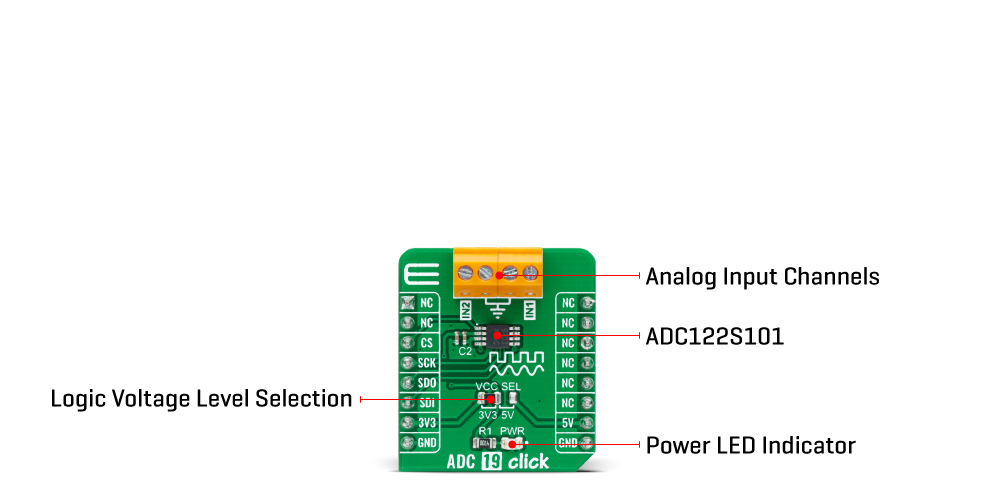
The ADC 19 Click Board™ as its foundation uses the ADC122S101, a high-performance two-channel CMOS analog-to-digital converter (ADC) from Texas Instruments. The ADC122S101 comes with an integrated 12-bit SAR-ADC, input multiplexer, and control logic block, allowing ADC to communicate with MCU through a high-speed serial interface. Unlike the conventional practice of specifying performance at a single sample rate only, this ADC is fully specified over a sample rate range of 500ksps to 1Msps. The converter is based on a successive-approximation register architecture with an internal track-and-hold circuit configurable to accept one or two input signals at its input channels.
The ADC 19 Click Board™ communicates with MCU through a standard SPI interface and operates at clock rates up to 16MHz, providing data in digital format of 12-bits. The output serial data is straight binary and is compatible with several standards, such as SPI, QSPI, MICROWIRE, and many standard DSP serial interfaces.
The ADC 19 Click Board™ can operate with both 3.3V and 5V logic voltage levels selected via the VCC SEL jumper. This way, it is allowed for both 3.3V and 5V capable MCUs to use the communication lines properly. However, the Click board™ comes equipped with a library containing easy-to-use functions and an example code that can be used, as a reference, for further development.
| Type | ADC |
| Applications | The ADC 19 Click Board™ can be used for the most demanding applications, from general-purpose remote data acquisition applications to portable consumer electronics and more |
| On-board modules | ADC122S101 - two-channel CMOS 12-bit analog-to-digital converter from Texas Instruments |
| Key Features | Low power consumption, specified over a range of sample rates, two input channels, high-speed serial interface, high performance, and more |
| Interface | SPI |
| Compatibility | mikroBUS |
| Click board size | S (28.6 x 25.4 mm) |
| Input Voltage | 3.3V or 5V |
This table shows how the pinout of the ADC 19 Click Board™ corresponds to the pinout on the mikroBUS™ socket (the latter shown in the two middle columns).
| Notes | Pin |  |
Pin | Notes | |||
|---|---|---|---|---|---|---|---|
| NC | 1 | AN | PWM | 16 | NC | ||
| NC | 2 | RST | INT | 15 | NC | ||
| SPI Chip Select | CS | 3 | CS | RX | 14 | NC | |
| SPI Clock | SCK | 4 | SCK | TX | 13 | NC | |
| SPI Data OUT | SDO | 5 | MISO | SCL | 12 | NC | |
| SPI Data IN | SDI | 6 | MOSI | SDA | 11 | NC | |
| Power Supply | 3.3V | 7 | 3.3V | 5V | 10 | 5V | Power Supply |
| Ground | GND | 8 | GND | GND | 9 | GND | Ground |
| Label | Name | Default | Description |
|---|---|---|---|
| LD1 | PWR | - | Power LED Indicator |
| JP1 | VCC SEL | Left | Logic Level Voltage Selection 3V3/5V: Left position 3V3, Right position 5V |
| Description | Min | Typ | Max | Unit |
|---|---|---|---|---|
| Supply Voltage | 3.3 | - | 5 | V |
| Analog Input Voltage | 0 | - | 5 | V |
| Resolution | - | 12 | - | bits |
| Operating Temperature Range | -40 | +25 | +85 | °C |
We provide a library for the ADC 19 Click Board™ as well as a demo application (example), developed using MikroElektronika compilers. The demo can run on all the main MikroElektronika development boards.
The package can be downloaded/installed directly from NECTO Studio The package Manager (recommended), downloaded from our LibStock™ or found on MikroE Github account.
This library contains API for the ADC 19 Click Board™ driver.
Key functions
adc19_set_vref This function sets the voltage reference value that will be used for voltage calculation.
adc19_set_input_channel This function sets the selected input channel active by modifying the control register.
adc19_get_voltage This function reads the voltage from the previously selected channel by using SPI serial interface.
This example demonstrates the use of the ADC 19 Click Board™ by reading the voltage from the two analog input channels.
void application_task ( void )
 {
     float voltage;
     if ( ADC19_OK == adc19_set_input_channel ( &adc19, ADC19_INPUT_CHANNEL_1 ) )
     {
         if ( ADC19_OK == adc19_get_voltage ( &adc19, &voltage ) )
         {
             log_printf ( &logger, " IN1 : %.3f V rn", voltage );
         }
     }
     if ( ADC19_OK == adc19_set_input_channel ( &adc19, ADC19_INPUT_CHANNEL_2 ) )
     {
         if ( ADC19_OK == adc19_get_voltage ( &adc19, &voltage ) )
         {
             log_printf ( &logger, " IN2 : %.3f V rnn", voltage );
         }
     }
     Delay_ms ( 500 );
 }
The full application code, and ready to use projects can be installed directly from NECTO Studio The package Manager (recommended), downloaded from our LibStock™ or found on MikroE Github account.
Other MikroE Libraries used in the example:
Depending on the development board you are using, you may need USB UART click, USB UART 2 Click or RS232 Click to connect to your PC, for development systems with no UART to USB interface available on the board. UART terminal is available in all MikroElektronika compilers.
The ADC 19 Click Board™ is supported with mikroSDK - MikroElektronika Software Development Kit. To ensure proper operation of mikroSDK compliant Click board™ demo applications, mikroSDK should be downloaded from the LibStock and installed for the compiler you are using.
- manufacturer: Mikroelektronika d.o.o. - warranty: 12 months - backorder_label: If no stock shown above, check availability - subtitle: 2-Channel, 12-Bit ADC, 1MSps Sample Rate - feature_1: Based on the ADC122S101 - two-channel CMOS 12-bit analog-to-digital converter from Texas Instruments - feature_2: Low power consumption, specified over a range of sample rates, two input channels, high-speed serial interface, high performance, and more - feature_3: Can be used for the most demanding applications, from general-purpose remote data acquisition applications to portable consumer electronics and more - attachments: [{"download_file":[{"download_file":"ADC 19 Click Board™ Schematic"}],"download_filetype":[{"download_filetype":"pdf"}]},{"download_file":[{"download_file":"Texas Instruments ADC122S101 12-Bit ADC Datasheet"}],"download_filetype":[{"download_filetype":"pdf"}]}] - mpn: MIKROE-4997 - mpn: MIKROE-4997 - custom_label_0: Click Board - google_product_category: Electronics - custom_product: false - condition: new - key_feature_2: Low power consumption, specified over a range of sample rates, two input channels, high-speed serial interface, high performance, and more - key_feature_3: Based on the ADC122S101 - two-channel CMOS 12-bit analog-to-digital converter from Texas Instruments - key_feature_4: Can be used for the most demanding applications, from general-purpose remote data acquisition applications to portable consumer electronics and more - key_feature_5: mikroBUS: SPI Interface - device_vendor: Texas Instruments - device_type: ADC122S101CIMM/NOPB - warranty: 12 months - brand: MikroE - manufacturer: Mikroelektronika d.o.o. - target_keyword: ADC 19 Click Board - brands: gid://shopify/Metaobject/56256004319 - breadcrumbs: ["gid://shopify/Collection/447955239135","gid://shopify/Collection/241680580797","gid://shopify/Collection/241545314493"] - customhs_code: 847330 - detailed_description: {"type":"root","children":[{"type":"heading","level":3,"children":[{"type":"text","value":"How Does The ADC 19 Click Board™ Work?"}]},{"type":"paragraph","children":[{"type":"text","value":"The "},{"type":"text","value":"ADC 19 Click Board™","bold":true,"italic":true},{"type":"text","value":" as its foundation uses the ADC122S101, a high-performance two-channel CMOS analog-to-digital converter (ADC) from Texas Instruments. The ADC122S101 comes with an integrated 12-bit SAR-ADC, input multiplexer, and control logic block, allowing ADC to communicate with MCU through a high-speed serial interface. Unlike the conventional practice of specifying performance at a single sample rate only, this ADC is fully specified over a sample rate range of 500ksps to 1Msps. The converter is based on a successive-approximation register architecture with an internal track-and-hold circuit configurable to accept one or two input signals at its input channels."}]},{"type":"paragraph","children":[{"type":"text","value":""}]},{"type":"paragraph","children":[{"type":"text","value":"The "},{"type":"text","value":"ADC 19 Click Board™","bold":true},{"type":"text","value":" communicates with MCU through a standard SPI interface and operates at clock rates up to 16MHz, providing data in digital format of 12-bits. The output serial data is straight binary and is compatible with several standards, such as SPI, QSPI, MICROWIRE, and many standard DSP serial interfaces."}]},{"type":"paragraph","children":[{"type":"text","value":"The "},{"type":"text","value":"ADC 19 Click Board™","bold":true},{"type":"text","value":" can operate with both 3.3V and 5V logic voltage levels selected via the VCC SEL jumper. This way, it is allowed for both 3.3V and 5V capable MCUs to use the communication lines properly. However, the Click board™ comes equipped with a library containing easy-to-use functions and an example code that can be used, as a reference, for further development."}]},{"type":"heading","level":3,"children":[{"type":"text","value":"SPECIFICATIONS"}]},{"type":"paragraph","children":[{"type":"text","value":"Type\nADC\nApplications\nThe ADC 19 Click Board™ can be used for the most demanding applications, from general-purpose remote data acquisition applications to portable consumer electronics and more\nOn-board modules\nADC122S101 - two-channel CMOS 12-bit analog-to-digital converter from Texas Instruments\nKey Features\nLow power consumption, specified over a range of sample rates, two input channels, high-speed serial interface, high performance, and more\nInterface\nSPI\nCompatibility\nmikroBUS\nClick board size\nS (28.6 x 25.4 mm)\nInput Voltage\n3.3V or 5V"}]},{"type":"heading","level":3,"children":[{"type":"text","value":"PINOUT DIAGRAM"}]},{"type":"paragraph","children":[{"type":"text","value":"This table shows how the pinout of the "},{"type":"text","value":"ADC 19 Click Board™","bold":true},{"type":"text","value":" corresponds to the pinout on the mikroBUS™ socket (the latter shown in the two middle columns)."}]},{"type":"paragraph","children":[{"type":"text","value":"Notes\nPin\nPin\nNotes\nNC\n1\nAN\nPWM\n16\nNC\nNC\n2\nRST\nINT\n15\nNC\nSPI Chip Select\nCS\n3\nCS\nRX\n14\nNC\nSPI Clock\nSCK\n4\nSCK\nTX\n13\nNC\nSPI Data OUT\nSDO\n5\nMISO\nSCL\n12\nNC\nSPI Data IN\nSDI\n6\nMOSI\nSDA\n11\nNC\nPower Supply\n3.3V\n7\n3.3V\n5V\n10\n5V\nPower Supply\nGround\nGND\n8\nGND\nGND\n9\nGND\nGround"}]},{"type":"heading","level":3,"children":[{"type":"text","value":"ONBOARD SETTINGS AND INDICATORS"}]},{"type":"paragraph","children":[{"type":"text","value":"Label\nName\nDefault\nDescription\nLD1\nPWR\n-\nPower LED Indicator\nJP1\nVCC SEL\nLeft\nLogic Level Voltage Selection 3V3/5V: Left position 3V3, Right position 5V"}]},{"type":"heading","level":3,"children":[{"type":"text","value":"ADC 19 CLICK ELECTRICAL SPECIFICATIONS"}]},{"type":"paragraph","children":[{"type":"text","value":"Description\nMin\nTyp\nMax\nUnit\nSupply Voltage\n3.3\n-\n5\nV\nAnalog Input Voltage\n0\n-\n5\nV\nResolution\n-\n12\n-\nbits\nOperating Temperature Range\n-40\n+25\n+85\n°C"}]},{"type":"heading","level":3,"children":[{"type":"text","value":" "}]}]} - summary:The ADC 19 Click Board™ is a compact add-on board that contains a high-performance data converter. This board features the ADC122S101, a low-power two-channel CMOS 12-bit analog-to-digital converter from Texas Instruments. This SPI configurable analog-to-digital converter (ADC) is fully specified over a sample rate range of 500ksps to 1Msps, offering high reliability and performance. The converter is based on a successive-approximation register architecture with an internal track-and-hold circuit configurable to accept one or two input signals at its input channels. This Click board™ offers high accuracy solution for the most demanding applications, from general-purpose remote data acquisition applications to portable consumer electronics and more.
The ADC 19 Click Board™ is supported by a mikroSDK compliant library, which includes functions that simplify software development. This Click board™ comes as a fully tested product, ready to be used on a system equipped with the mikroBUS™ socket.