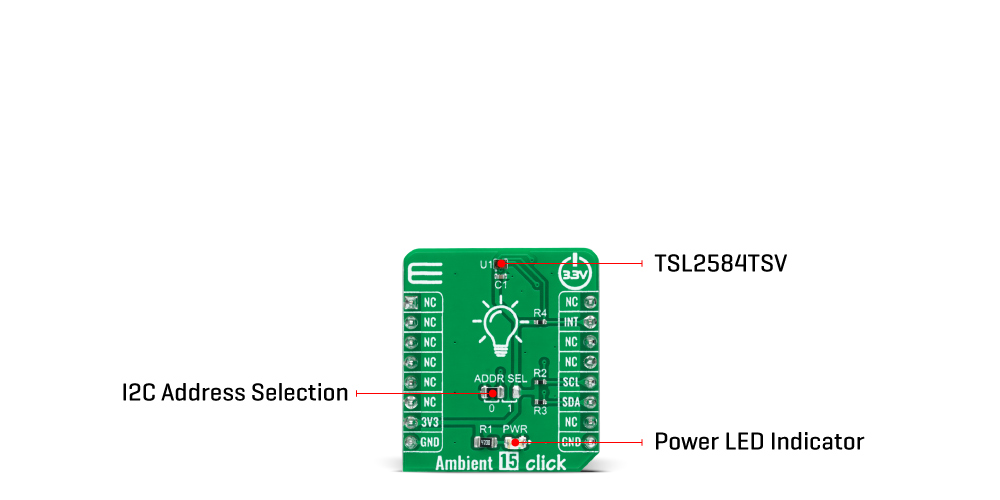
The Ambient 15 Click Board™ as its foundation uses the TSL2584TSV, a high sensitivity light-to-digital converter that transforms light intensity into a digital output signal from AMS-AG. Thanks to its near-photopic response, the TSL2584TSV can detect a wide range of highly accurate lux measurements up to 33klx, even when mounted behind dark glass. Filtering out unwanted IR light enables the sensor to accurately measure the ambient light, thus producing a near-photopic response. It also has stable performance over a wide temperature range of -40°C to 85°C, suitable for measuring the present ambient light.
The TSL2584TSV combines one broadband photodiode (visible plus infrared), one infrared-responding photodiode, and, as mentioned before, a photopic infrared-blocking filter on a single CMOS integrated circuit. Two integrating analog-to-digital converters (ADC) convert the photodiode currents into a digital output representing the irradiance measured on each channel. Integration of both channels occurs simultaneously. Upon completion of the conversion cycle, the conversion result is transferred to the Channel 0 and Channel 1 data registers. The transfers are double-buffered to ensure that the integrity of the data is maintained. After the transfer, the device automatically begins the next integration cycle.
The Ambient 15 Click Board™ communicates with MCU using the standard I2C 2-Wire interface to read data and configure settings, supporting Standard Mode operation with a clock frequency of 100kHz and Fast Mode up to 400kHz. Besides, the TSL2584TSV allows choosing the least significant bit (LSB) of its I2C slave address using the SMD jumper labelled ADDR SEL. It also possesses an additional interrupt signal, routed on the INT pin of the mikroBUS™ socket labelled as INT, indicating when a specific interrupt event occurs, such as detecting a meaningful change in light intensity.
The Ambient 15 Click Board™ can be operated only with a 3.3V logic voltage level. The board must perform appropriate logic voltage level conversion before using MCUs with different logic levels. However, the Click board™ comes equipped with a library containing functions and an example code that can be used, as a reference, for further development.
| Type | Optical |
| Applications | The Ambient 15 Click Board™ be used for obtaining ambient light data for adjusting brightness in applications that require power saving and better visibility |
| On-board modules | TSL2584TSV - high sensitivity light-to-digital converter that transforms light intensity into a digital output signal from AMS-AG |
| Key Features | Low power consumption, corresponds to a dark window because of high sensitivity, close responsivity to the human eye, I2C interface with selectable slave address, wide illumination range, stable performance over temperature, and more |
| Interface | I2C |
| Compatibility | mikroBUS |
| Click board size | S (28.6 x 25.4 mm) |
| Input Voltage | 3.3V |
This table shows how the pinout of the Ambient 15 Click Board™ corresponds to the pinout on the mikroBUS™ socket (the latter shown in the two middle columns).
| Notes | Pin |  |
Pin | Notes | |||
|---|---|---|---|---|---|---|---|
| NC | 1 | AN | PWM | 16 | NC | ||
| NC | 2 | RST | INT | 15 | INT | Interrupt | |
| NC | 3 | CS | RX | 14 | NC | ||
| NC | 4 | SCK | TX | 13 | NC | ||
| NC | 5 | MISO | SCL | 12 | SCL | I2C Clock | |
| NC | 6 | MOSI | SDA | 11 | SDA | I2C Data | |
| Power Supply | 3.3V | 7 | 3.3V | 5V | 10 | NC | |
| Ground | GND | 8 | GND | GND | 9 | GND | Ground |
| Label | Name | Default | Description |
|---|---|---|---|
| LD1 | PWR | - | Power LED Indicator |
| JP1 | ADDR SEL | Left | I2C Address Selection 0/1: Left position 0, Right position 1 |
| Description | Min | Typ | Max | Unit |
|---|---|---|---|---|
| Supply Voltage | - | 3.3 | - | V |
| Illuminance Measurement Range | 0 | - | 33.000 | lx |
| Operating Temperature Range | -40 | +25 | +85 | °C |
We provide a library for the Ambient 15 Click Board™ as well as a demo application (example), developed using MikroElektronika compilers. The demo can run on all the main MikroElektronika development boards.
The package can be downloaded/installed directly from NECTO Studio The package Manager (recommended), downloaded from our LibStock™ or found on MikroE Github account.
This library contains API for Ambient 15 Click driver.
Key functions
ambient15_set_atime This function sets the timing register for the selected integration time.
ambient15_set_gain This function sets the gain level.
ambient15_measure_light_level This function reads the raw ADC data from two channels and then measures the light level in lux based on those readings.
This example demonstrates the use of the Ambient 15 Click Board™ by measuring the ambient light level in Lux.
 void application_task ( void )
 {
     if ( !ambient15_get_int_pin ( &ambient15 ) )
     {
         uint16_t lux;
         if ( AMBIENT15_OK == ambient15_measure_light_level ( &ambient15, &lux ) )
         {
             log_printf ( &logger, " Ambient light level [Lux]: %urnn", lux );
         }
     }
 }
The full application code, and ready to use projects can be installed directly from NECTO Studio The package Manager (recommended), downloaded from our LibStock™ or found on MikroE Github account.
Other MikroE Libraries used in the example:
Depending on the development board you are using, you may need USB UART click, USB UART 2 Click or RS232 Click to connect to your PC, for development systems with no UART to USB interface available on the board. UART terminal is available in all MikroElektronika compilers.
The Ambient 15 Click Board™ is supported with mikroSDK - MikroElektronika Software Development Kit. To ensure proper operation of mikroSDK compliant Click board™ demo applications, mikroSDK should be downloaded from the LibStock and installed for the compiler you are using.
- attachments: [{"download_file":[{"download_file":"Ambient 15 Click Board Schematic"}],"download_filetype":[{"download_filetype":"pdf"}]},{"download_file":[{"download_file":"AMS TSL2584TSV Light to Digital Converter Datasheet"}],"download_filetype":[{"download_filetype":"pdf"}]}] - manufacturer: Mikroelektronika d.o.o. - warranty: 12 months - backorder_label: If no stock shown above, check availability - title_tag: MikroE Ambient 15 Click Board™ (MIKROE-4967) - condition: new - custom_product: false - mpn: MIKROE-4967 - google_product_category: Electronics - custom_label_0: Click Board - mpn: MIKROE-4967 - device_vendor: ams - device_type: TSL2584TSV - warranty: 12 months - brand: MikroE - manufacturer: Mikroelektronika d.o.o. - target_keyword: Ambient 15 Click Board - brands: gid://shopify/Metaobject/56256004319 - breadcrumbs: ["gid://shopify/Collection/447955239135","gid://shopify/Collection/241680580797","gid://shopify/Collection/241545969853"] - customhs_code: 847330 - detailed_description: {"type":"root","children":[{"type":"heading","level":3,"children":[{"type":"text","value":"How Does The Ambient 15 Click Board™ Work?"}]},{"type":"paragraph","children":[{"type":"text","value":"The "},{"type":"text","value":"Ambient 15 Click Board™","bold":true,"italic":true},{"type":"text","value":" as its foundation uses the TSL2584TSV, a high sensitivity light-to-digital converter that transforms light intensity into a digital output signal from AMS-AG. Thanks to its near-photopic response, the TSL2584TSV can detect a wide range of highly accurate lux measurements up to 33klx, even when mounted behind dark glass. Filtering out unwanted IR light enables the sensor to accurately measure the ambient light, thus producing a near-photopic response. It also has stable performance over a wide temperature range of -40°C to 85°C, suitable for measuring the present ambient light."}]},{"type":"paragraph","children":[{"type":"text","value":""}]},{"type":"paragraph","children":[{"type":"text","value":"The TSL2584TSV combines one broadband photodiode (visible plus infrared), one infrared-responding photodiode, and, as mentioned before, a photopic infrared-blocking filter on a single CMOS integrated circuit. Two integrating analog-to-digital converters (ADC) convert the photodiode currents into a digital output representing the irradiance measured on each channel. Integration of both channels occurs simultaneously. Upon completion of the conversion cycle, the conversion result is transferred to the Channel 0 and Channel 1 data registers. The transfers are double-buffered to ensure that the integrity of the data is maintained. After the transfer, the device automatically begins the next integration cycle."}]},{"type":"paragraph","children":[{"type":"text","value":"The "},{"type":"text","value":"Ambient 15 Click Board™","bold":true},{"type":"text","value":" communicates with MCU using the standard I2C 2-Wire interface to read data and configure settings, supporting Standard Mode operation with a clock frequency of 100kHz and Fast Mode up to 400kHz. Besides, the TSL2584TSV allows choosing the least significant bit (LSB) of its I2C slave address using the SMD jumper labelled ADDR SEL. It also possesses an additional interrupt signal, routed on the INT pin of the mikroBUS™ socket labelled as INT, indicating when a specific interrupt event occurs, such as detecting a meaningful change in light intensity."}]},{"type":"paragraph","children":[{"type":"text","value":"The "},{"type":"text","value":"Ambient 15 Click Board™","bold":true},{"type":"text","value":" can be operated only with a 3.3V logic voltage level. The board must perform appropriate logic voltage level conversion before using MCUs with different logic levels. However, the Click board™ comes equipped with a library containing functions and an example code that can be used, as a reference, for further development."}]},{"type":"heading","level":3,"children":[{"type":"text","value":"SPECIFICATIONS"}]},{"type":"paragraph","children":[{"type":"text","value":"Type\nOptical\nApplications\nThe Ambient 15 Click Board™ be used for obtaining ambient light data for adjusting brightness in applications that require power saving and better visibility\nOn-board modules\nTSL2584TSV - high sensitivity light-to-digital converter that transforms light intensity into a digital output signal from AMS-AG\nKey Features\nLow power consumption, corresponds to a dark window because of high sensitivity, close responsivity to the human eye, I2C interface with selectable slave address, wide illumination range, stable performance over temperature, and more\nInterface\nI2C\nCompatibility\nmikroBUS\nClick board size\nS (28.6 x 25.4 mm)\nInput Voltage\n3.3V"}]},{"type":"heading","level":3,"children":[{"type":"text","value":"PINOUT DIAGRAM"}]},{"type":"paragraph","children":[{"type":"text","value":"This table shows how the pinout of the "},{"type":"text","value":"Ambient 15 Click Board™","bold":true},{"type":"text","value":" corresponds to the pinout on the mikroBUS™ socket (the latter shown in the two middle columns)."}]},{"type":"paragraph","children":[{"type":"text","value":"Notes\nPin\nPin\nNotes\nNC\n1\nAN\nPWM\n16\nNC\nNC\n2\nRST\nINT\n15\nINT\nInterrupt\nNC\n3\nCS\nRX\n14\nNC\nNC\n4\nSCK\nTX\n13\nNC\nNC\n5\nMISO\nSCL\n12\nSCL\nI2C Clock\nNC\n6\nMOSI\nSDA\n11\nSDA\nI2C Data\nPower Supply\n3.3V\n7\n3.3V\n5V\n10\nNC\nGround\nGND\n8\nGND\nGND\n9\nGND\nGround"}]},{"type":"heading","level":3,"children":[{"type":"text","value":"ONBOARD SETTINGS AND INDICATORS"}]},{"type":"paragraph","children":[{"type":"text","value":"Label\nName\nDefault\nDescription\nLD1\nPWR\n-\nPower LED Indicator\nJP1\nADDR SEL\nLeft\nI2C Address Selection 0/1: Left position 0, Right position 1"}]},{"type":"heading","level":3,"children":[{"type":"text","value":"AMBIENT 15 CLICK ELECTRICAL SPECIFICATIONS"}]},{"type":"paragraph","children":[{"type":"text","value":"Description\nMin\nTyp\nMax\nUnit\nSupply Voltage\n-\n3.3\n-\nV\nIlluminance Measurement Range\n0\n-\n33.000\nlx\nOperating Temperature Range\n-40\n+25\n+85\n°C"}]},{"type":"heading","level":3,"children":[{"type":"text","value":" "}]}]} - summary:The Ambient 15 Click Board™ is a compact add-on board used to measure the amount of the present ambient light. This board features the TSL2584TSV, a very-high sensitivity light-to-digital converter with an I2C interface that transforms light intensity into a digital output signal from AMS-AG. The TSL2584TSV’s near-photopic response produces a highly accurate lux measurement up to 33klx even when mounted behind dark glass. Filtering out unwanted IR light enables the sensor to measure the ambient light more accurately, thus producing a near-photopic response. It is designed to control the brightness in various applications based on ambient light availability, brightness for optimum visibility, and energy efficiency. Operation in a temperature range of -40°C to 85°C ensures stable operation under extreme conditions. This Click board™ is the most suitable for obtaining ambient light data for adjusting brightness in applications that require power saving and better visibility.
The Ambient 15 Click Board is supported by a mikroSDK compliant library, which includes functions that simplify software development. This Click board™ comes as a fully tested product, ready to be used on a system equipped with the mikroBUS™ socket.