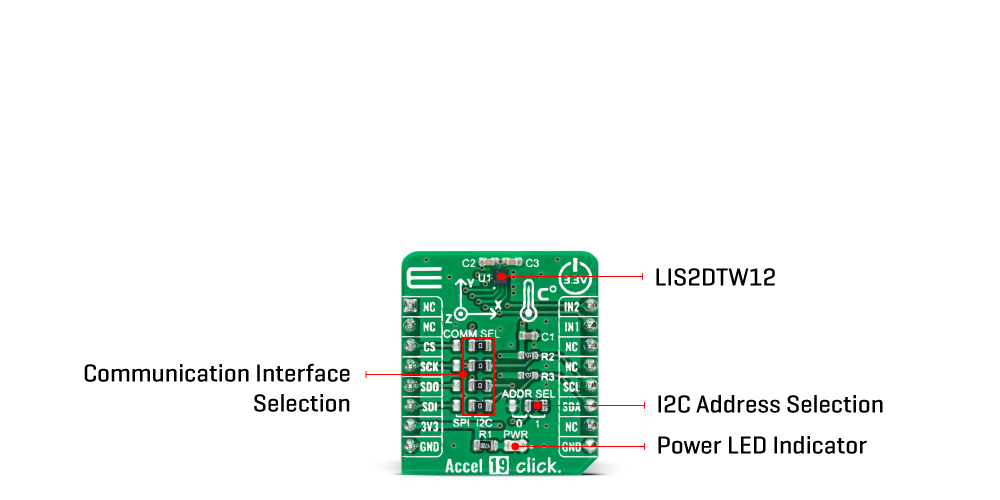
The Accel 19 Click Board™ as its foundation uses the LIS2DTW12, a highly reliable digital triaxial acceleration and temperature sensor from STMicroelectronics. The LIS2DTW12 is highly configurable with a programmable acceleration range of ±2g, ±4g, ±8g, or ±16g capable of measuring accelerations with output data rates from 1.6 to 1600Hz. Multiple operating modes with various bandwidths, low noise, very stable sensitivity, together with the capability of working over a wide temperature range, makes this device particularly suitable for vibration monitoring in industrial applications.
The LIS2DTW12 has an embedded temperature sensor with a typical accuracy of 0.8°C, ODRs ranging from 50 to 1.6Hz, and 8 to 12 bits resolution. Besides, it has an integrated 32-level first-in, first-out (FIFO) buffer allowing the user to store data to limit intervention by the host processor. Alongside these features, the LIS2DTW12 has a dedicated internal engine to process motion and acceleration detection, including free-fall, wakeup, highly configurable single/double-tap recognition, activity/inactivity, stationary/motion detection, portrait/landscape detection, and 6D/4D orientation.
The Accel 19 Click Board™ allows using both I2C and SPI interfaces with a maximum frequency of 3.4MHz for I2C and 10MHz for SPI communication. The selection can be made by positioning SMD jumpers labelled as COMM SEL to an appropriate position. Note that all the jumpers' positions must be on the same side, or the Click board™ may become unresponsive. While the I2C interface is selected, the LIS2DTW12 allows choosing the least significant bit (LSB) of its I2C slave address using the SMD jumper labelled ADDR SEL. The Accel 19 also possesses two interrupts, IN1 and IN2, routed to the INT and PWM pins on the mikroBUS™ socket used to signal MCU that an event has been sensed entirely programmed by the user through the I2C/SPI interface.
The Accel 19 Click Board™ can be operated only with a 3.3V logic voltage level. The board must perform appropriate logic voltage level conversion before using MCUs with different logic levels. However, the Click board™ comes equipped with a library containing functions and an example code that can be used, as a reference, for further development.
| Type | Motion |
| Applications | The Accel 19 Click Board™ be used for various applications such as motion-activated functions and user interfaces, tap-double-tap recognition, free-fall detection, tracking, and many more |
| On-board modules | LIS2DTW12 - highly reliable digital triaxial acceleration and temperature sensor from STMicroelectronics |
| Key Features | Low power consumption, high performance and resolution, high reliability, dedicated internal engine to process motion and acceleration detection, integrated interrupt features, selectable serial interface, and more |
| Interface | I2C,SPI |
| Compatibility | mikroBUS |
| Click board size | S (28.6 x 25.4 mm) |
| Input Voltage | 3.3V |
This table shows how the pinout of the Accel 19 Click Board™ corresponds to the pinout on the mikroBUS™ socket (the latter shown in the two middle columns).
| Notes | Pin |  |
Pin | Notes | |||
|---|---|---|---|---|---|---|---|
| NC | 1 | AN | PWM | 16 | IN2 | Interrupt 2 | |
| NC | 2 | RST | INT | 15 | IN1 | Interrupt 1 | |
| SPI Chip Select | CS | 3 | CS | RX | 14 | NC | |
| SPI Clock | SCK | 4 | SCK | TX | 13 | NC | |
| SPI Data OUT | SDO | 5 | MISO | SCL | 12 | SCL | I2C Clock |
| SPI Data IN | SDI | 6 | MOSI | SDA | 11 | SDA | I2C Data |
| Power Supply | 3.3V | 7 | 3.3V | 5V | 10 | NC | |
| Ground | GND | 8 | GND | GND | 9 | GND | Ground |
| Label | Name | Default | Description |
|---|---|---|---|
| LD1 | PWR | - | Power LED Indicator |
| JP1 | ADDR SEL | Right | I2C Address Selection 0/1: Left position 0, Right position 1 |
| JP2-JP5 | COMM SEL | Right | Communication Interface Selection SPI/I2C: Left position SPI, Right position I2C |
| Description | Min | Typ | Max | Unit |
|---|---|---|---|---|
| Supply Voltage | - | 3.3 | - | V |
| Acceleration Range | ±2 | - | ±16 | g |
| Sensitivity | 4098 | - | 512 | LSB/g |
| Bandwidth | 0.8 | - | 800 | Hz |
| Resolution | - | 16 | - | bit |
| Operating Temperature Range | -40 | +25 | +85 | °C |
We provide a library for the Accel 19 Click Board™ as well as a demo application (example), developed using MikroElektronika compilers. The demo can run on all the main MikroElektronika development boards.
The package can be downloaded/installed directly from NECTO Studio The package Manager (recommended), downloaded from our LibStock™ or found on Mikroe Github account.
This library contains API for the Accel 19 Click Board™ driver.
Key functions
accel19_get_axis_data Accel 19 get accelerometer axis function.
accel19_data_ready Accel 19 data ready function.
accel19_set_control Accel 19 set control function.
This library contains API for the Accel 19 Click Board™ driver. The library initializes and defines the I2C or SPI bus drivers to write and read data from registers. The library also includes a function for reading X-axis, Y-axis, and Z-axis data.
 void application_task ( void )
 {
     static accel19_axis_t axis;

     if ( ACCEL19_STATUS_DRDY == accel19_data_ready( &accel19 ) )
     {
         accel19_get_axis_data( &accel19, &axis );
         log_printf( &logger, "tX : %5d rntY : %5d rntZ : %5d rn", axis.x, axis.y, axis.z );
         log_printf( &logger, "-------------------------rn" );
         Delay_ms( 1000 );
     }
     Delay_ms( 1 );
 }
The full application code, and ready to use projects can be installed directly from NECTO Studio The package Manager (recommended), downloaded from our LibStock™ or found on Mikroe Github account.
Other Mikroe Libraries used in the example:
Depending on the development board you are using, you may need a USB UART Click, USB UART 2 Click or RS232 Click to connect to your PC, for development systems with no UART to USB interface available on the board. UART terminal is available in all MikroElektronika compilers.
Th Accel 19 Click Board™ is supported with mikroSDK - MikroElektronika Software Development Kit. To ensure proper operation of mikroSDK compliant Click board™ demo applications, mikroSDK should be downloaded from the LibStock and installed for the compiler you are using.
- manufacturer: Mikroelektronika d.o.o. - warranty: 12 months - backorder_label: If no stock shown above, check availability - attachments: [{"download_file":[{"download_file":"Accel 19 Click Board™ Schematic"}],"download_filetype":[{"download_filetype":"pdf"}]},{"download_file":[{"download_file":"STMicroelectronics LIS2DTW12 3-Axis Accelerometer Datasheet"}],"download_filetype":[{"download_filetype":"pdf"}]}] - condition: new - custom_product: false - mpn: MIKROE-4949 - google_product_category: Electronics - custom_label_0: Click Board - mpn: MIKROE-4949 - device_vendor: STMicroelectronics - device_type: LIS2DTW12TR - warranty: 12 months - brand: MikroE - manufacturer: Mikroelektronika d.o.o. - target_keyword: Accel 19 Click Board - brands: gid://shopify/Metaobject/56256004319 - breadcrumbs: ["gid://shopify/Collection/447955239135","gid://shopify/Collection/241680580797","gid://shopify/Collection/241545969853"] - customhs_code: 847330 - detailed_description: {"type":"root","children":[{"type":"heading","level":3,"children":[{"type":"text","value":"How Does The Accel 19 Click Board™ Work?"}]},{"type":"paragraph","children":[{"type":"text","value":"The "},{"type":"text","value":"Accel 19 Click Board™","bold":true,"italic":true},{"type":"text","value":" as its foundation uses the LIS2DTW12, a highly reliable digital triaxial acceleration and temperature sensor from STMicroelectronics. The LIS2DTW12 is highly configurable with a programmable acceleration range of ±2g, ±4g, ±8g, or ±16g capable of measuring accelerations with output data rates from 1.6 to 1600Hz. Multiple operating modes with various bandwidths, low noise, very stable sensitivity, together with the capability of working over a wide temperature range, makes this device particularly suitable for vibration monitoring in industrial applications."}]},{"type":"paragraph","children":[{"type":"text","value":""}]},{"type":"paragraph","children":[{"type":"text","value":"The LIS2DTW12 has an embedded temperature sensor with a typical accuracy of 0.8°C, ODRs ranging from 50 to 1.6Hz, and 8 to 12 bits resolution. Besides, it has an integrated 32-level first-in, first-out (FIFO) buffer allowing the user to store data to limit intervention by the host processor. Alongside these features, the LIS2DTW12 has a dedicated internal engine to process motion and acceleration detection, including free-fall, wakeup, highly configurable single/double-tap recognition, activity/inactivity, stationary/motion detection, portrait/landscape detection, and 6D/4D orientation."}]},{"type":"paragraph","children":[{"type":"text","value":"The "},{"type":"text","value":"Accel 19 Click Board™","bold":true},{"type":"text","value":" allows using both I2C and SPI interfaces with a maximum frequency of 3.4MHz for I2C and 10MHz for SPI communication. The selection can be made by positioning SMD jumpers labelled as COMM SEL to an appropriate position. Note that all the jumpers' positions must be on the same side, or the Click board™ may become unresponsive. While the I2C interface is selected, the LIS2DTW12 allows choosing the least significant bit (LSB) of its I2C slave address using the SMD jumper labelled ADDR SEL. The Accel 19 also possesses two interrupts, IN1 and IN2, routed to the INT and PWM pins on the mikroBUS™ socket used to signal MCU that an event has been sensed entirely programmed by the user through the I2C/SPI interface."}]},{"type":"paragraph","children":[{"type":"text","value":"The "},{"type":"text","value":"Accel 19 Click Board™","bold":true},{"type":"text","value":" can be operated only with a 3.3V logic voltage level. The board must perform appropriate logic voltage level conversion before using MCUs with different logic levels. However, the Click board™ comes equipped with a library containing functions and an example code that can be used, as a reference, for further development."}]},{"type":"heading","level":3,"children":[{"type":"text","value":"SPECIFICATIONS"}]},{"type":"paragraph","children":[{"type":"text","value":"Type\nMotion\nApplications\nThe Accel 19 Click Board™ be used for various applications such as motion-activated functions and user interfaces, tap-double-tap recognition, free-fall detection, tracking, and many more\nOn-board modules\nLIS2DTW12 - highly reliable digital triaxial acceleration and temperature sensor from STMicroelectronics\nKey Features\nLow power consumption, high performance and resolution, high reliability, dedicated internal engine to process motion and acceleration detection, integrated interrupt features, selectable serial interface, and more\nInterface\nI2C,SPI\nCompatibility\nmikroBUS\nClick board size\nS (28.6 x 25.4 mm)\nInput Voltage\n3.3V"}]},{"type":"heading","level":3,"children":[{"type":"text","value":"PINOUT DIAGRAM"}]},{"type":"paragraph","children":[{"type":"text","value":"This table shows how the pinout of the "},{"type":"text","value":"Accel 19 Click Board™","bold":true},{"type":"text","value":" corresponds to the pinout on the mikroBUS™ socket (the latter shown in the two middle columns)."}]},{"type":"paragraph","children":[{"type":"text","value":"Notes\nPin\nPin\nNotes\nNC\n1\nAN\nPWM\n16\nIN2\nInterrupt 2\nNC\n2\nRST\nINT\n15\nIN1\nInterrupt 1\nSPI Chip Select\nCS\n3\nCS\nRX\n14\nNC\nSPI Clock\nSCK\n4\nSCK\nTX\n13\nNC\nSPI Data OUT\nSDO\n5\nMISO\nSCL\n12\nSCL\nI2C Clock\nSPI Data IN\nSDI\n6\nMOSI\nSDA\n11\nSDA\nI2C Data\nPower Supply\n3.3V\n7\n3.3V\n5V\n10\nNC\nGround\nGND\n8\nGND\nGND\n9\nGND\nGround"}]},{"type":"heading","level":3,"children":[{"type":"text","value":"ONBOARD SETTINGS AND INDICATORS"}]},{"type":"paragraph","children":[{"type":"text","value":"Label\nName\nDefault\nDescription\nLD1\nPWR\n-\nPower LED Indicator\nJP1\nADDR SEL\nRight\nI2C Address Selection 0/1: Left position 0, Right position 1\nJP2-JP5\nCOMM SEL\nRight\nCommunication Interface Selection SPI/I2C: Left position SPI, Right position I2C"}]},{"type":"heading","level":3,"children":[{"type":"text","value":"ACCEL 19 CLICK ELECTRICAL SPECIFICATIONS"}]},{"type":"paragraph","children":[{"type":"text","value":"Description\nMin\nTyp\nMax\nUnit\nSupply Voltage\n-\n3.3\n-\nV\nAcceleration Range\n±2\n-\n±16\ng\nSensitivity\n4098\n-\n512\nLSB/g\nBandwidth\n0.8\n-\n800\nHz\nResolution\n-\n16\n-\nbit\nOperating Temperature Range\n-40\n+25\n+85\n°C"}]},{"type":"heading","level":3,"children":[{"type":"text","value":" "}]}]} - summary:The Accel 19 Click Board™ is a compact add-on board that contains an acceleration sensor. This board features the LIS2DTW12, an ultra-low-power high-performance three-axis accelerometer from STMicroelectronics. It allows selectable full-scale acceleration measurements in ranges of ±2g, ±4g, ±8g, or ±16g in three axes with a configurable host interface that supports both SPI and I2C serial communication. Alongside an embedded 0.8°C accuracy temperature sensor with ODRs ranging from 50 to 1.6Hz and resolution from 8 to 12 bits, it has a dedicated internal engine to process motion and acceleration detection.
The Accel 19 Click Board™ is suitable for various applications such as motion-activated functions and user interfaces, tap-double-tap recognition, free-fall detection, tracking, and many more.